
#On the City Between Two Wet Ledgers
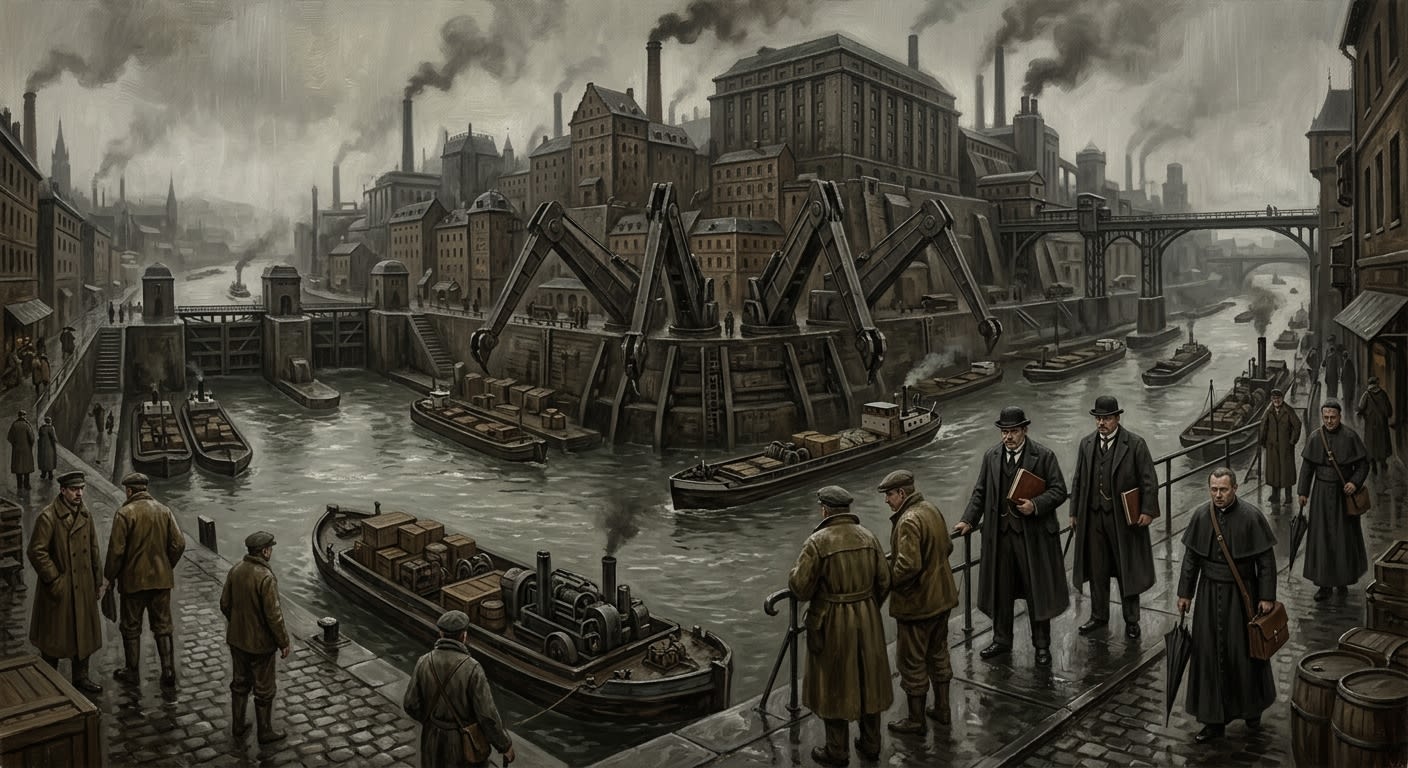
Koblenz sits where the Rhine receives the Moselle and pretends this meeting is geography rather than accounting. Two rivers arrive with their separate sins: the Rhine broad, official, tariffed, bell-marked, fond of inspection; the Moselle narrower, older in its tricks, vineyard-soured and manuscript-stained, carrying Trier's little obediences and Metz's profitable evasions downstream in the same brown water. At their confluence, the Synod built a waystation, then a customs ring, then a shrine route, then a city pretending it had always meant to be holy.
The place is filed in Zone 2, central heartlands, Rhine Corridor, strategically useful, spiritually overburdened, fiscally satisfactory. It lies north of Mainz, south of Cologne, west of the great inland corridors, and exactly where any sensible carrier moving relics from Deutz toward the broken east would pause, change hands, alter names, and let the river traffic swallow a trail. This is why Koblenz matters. It did not blaze. It did not crown a miracle. It did not repel Wrath. It held a packet for one night and failed to lose it.
Koblenz is a city of transfer: rope ferry to quay, quay to ledger, ledger to cart, cart to military column, blessing to permit, permit to fee, fee to remission if the clerk's conscience has been properly lubricated. The Bureau of Records calls such cities secondary nodes. The Bureau of Doctrine calls them providential hinges. The locals call them expensive.
#On the Confluence and Its Uses
The confluence gives Koblenz its character and its incurable self-importance. Cities built on one river become linear, obedient to current and towpath. Cities built on two become argumentative. Koblenz grew in wedges: ferry sheds against toll chapels, wine stairs under rope courts, porter benches beside shrine plaques, military storehouses occupying buildings whose owners learned that requisition is merely theft wearing boots and a seal.
The north bank counts cargo by barrel, bale, crate, coffin, and suspicious bundle. The south bank counts pilgrims by badge, route, foot condition, declared intention, and likelihood of dying before Cologne. The Moselle steps smell of vinegar, wet hemp, candle soot, and the little panic of men carrying items too holy to explain and too valuable to declare. The Rhine quays smell of tar, horse urine, boiler smoke, wet wool, and fiscal triumph.
The Synod's offices cling to the confluence because water multiplies jurisdiction. The Bureau of Tithes taxes landing, storage, transfer, inspection delay, spoilage exemption, rope usage, shrine approach, and the devotional purchase of bread on Saint Ignatius's feast. The Bureau of Passage controls ferry timings and issues route stamps with a ferocity that would be admirable if applied to something morally superior to queue discipline. Records maintains a river annex with waterproof ledgers whose covers swell every spring and whose entries, unlike certain officials, remain legible under pressure.
The city learned its craft before the Synod gave the craft a uniform. In the Atheist Wars, Koblenz's cellars held priests, pamphlets, wafers, salt, forged travel slips, and once, according to a sealed Trier note, an entire choir disguised as wine inventory. During the early Sundering years, that clandestine skill became logistics. Men who had hidden chalices learned to hide cartridges. Women who had ferried letters learned to ferry children. Brewers who had ignored Rationalist inspectors ignored proto-Bureau quartermasters with equal grace.
#On the Ignatian Night
The event by which Koblenz entered sacred consequence occurred in A.S. 45, after Ignatius Brenner recovered the three apostolic phalanges from Hartmann's cellar in Deutz and set them eastward. Public prints compress the matter until the relics seem to fly from Brenner's breadbasket to Brother Tomislav's hands in one devotional arc. Prints are for walls, children, and donors. The road was mud, fear, delay, mistake, and other people's hands.
Brenner brought the phalanges to a waystation near Koblenz: a rear room behind the Sign of the Bent Oar (Unregistered), a riverside house whose landlord appears in three ledgers under three names and whose descendants deny all of them depending on the auditor. The package arrived wrapped in oilcloth, then coarse linen, then a layer of black bread crust for scent. Brenner's hands shook. The receiving chaplain, attached to what would become the 7th Rearguard Column (Unregistered), had a fever and no official authority beyond urgency. The transfer took less than six minutes.
Pilgrimage broadsheets once advertised Koblenz as “the place where Saint Ignatius gave the relics to Brother Tomislav.”
Corrected. Brother Tomislav was not present at Koblenz. The relics passed from Brenner to a military chaplain near the confluence, then through the 7th Rearguard Column before reaching Tomislav's company and Kalnik Ridge. Devotion likes a handshake. History supplies a chain.
The landlord's account, preserved because a Tithes clerk confiscated it for unpaid river dues and thereby saved it from pious improvement, records: “one brown man, one sick priest, no wine charged, bread left.” The brown man is Brenner. The sick priest remains unnamed. The bread, according to later shrine tradition, remained soft for seventeen days. Records tested this claim by requesting the bread. The bread, being dead, did not comply.
That night gave Koblenz its unofficial patronage: the city of the middle hand. Cologne had the rescue. Deutz had the hiding. Kalnik had the fire. Koblenz had custody for a breath — sufficient to become useful, insufficient to become glamorous. The Bureau hates such intervals because they resist procession design. A pilgrimage route can market origin and climax. It has trouble selling transfer.
#On the City of Middle Hands
Koblenz made the Ignatian transfer into a civic temperament. Porters there do not boast of carrying far. They boast of carrying correctly. The distinction is local theology. A Koblenz porter will move a crate six yards from one seal table to another with more solemnity than a knight entering battle, because six yards is enough distance for loss, substitution, damp, fraud, demonic opportunity, or Bureaual reassignment. All catastrophes begin in a small interval.
The Porters' Bench (Unregistered) near the Moselle steps bears three carved hands: one receiving, one holding, one releasing. Pilgrims touch them in order. Smugglers touch only the middle hand, because smugglers understand doctrine when it affects liability. Supply-runners chalk tiny bread loaves beneath the bench before departing for the Line. The Bureau of Purity has scraped the chalk away nineteen times since A.S. 151. The twentieth layer is already there.
BENT OAR ANNEX — SEALED WALL NICHE, A.S. 188 SURVEY Behind plaster: oilcloth fragment, river silt, one reed cross, and a paper strip reading CARRY ONLY UNTIL TOLD. Ink age: inconsistent. Hand: resembles no registered Koblenz clerk. Relic response: minor warmth during Feast of Saint Ignatius; no visible flame. Disposition: retained under glass; public label reads “porter devotional scrap.”
The city also produces fraud with admirable industry. False Ignatian cloths. Breadbasket splinters. Replicas of the Bent Oar key. Little river stones sold as “touched by the Carrier's shoe,” a claim that would require Brenner to have possessed fifty thousand feet or spent the whole night dancing. Tithes fines the sellers when revenue escapes official stalls and licenses them when revenue does not. Moral clarity, in Koblenz, arrives with a price schedule.
#On War, Refuge, and River Discipline
Koblenz escaped the grand devastations by being too useful to ruin and too ordinary to mythologise properly. The Rationalists held it through offices and inspections rather than spectacle. The early Synod took it through the same methods with better hymns. During the Great Retreat, it became a rear knot: carts from Trier, boats from Mainz, runners from Cologne, exhausted men from roads whose names no longer matched the maps. Refugees slept under ferry awnings. Priests shaved beards to pass as clerks. Clerks grew beards to pass as priests. Everyone lied with increasing competence.
The city fed the retreat by interruption. Cargo halted there, split, relabelled, blessed, and sent onward. One wagon of grain became three carts of “chapel furniture.” A coffin train became medical freight. A barrel consignment listed as vinegar contained candle stubs, clean bandage, two pistols, and a child who later became a Records notary of uncommon cruelty. Koblenz did not save the west. It prevented many small losses from becoming final.
After the Concordat, the Synod regularised what the city had already been doing unlawfully with better results. The Bent Oar Annex received a plaque in A.S. 106, two years after Saint Ignatius's canonisation, because the Bureau of Pilgrimage needed time to argue with Records over whether a six-minute transfer justified shrine status. The compromise was exquisite: no full shrine, no indulgence grade, no independent feast, but approved route pause, licensed bread offerings, and a small donation box supervised jointly by Pilgrimage and Tithes. The box has been stolen seven times. Each theft occurred on a feast day. Each thief invoked Saint Ignatius at trial. Three were acquitted by technicality, two by crowd pressure, one by death, and one by escaping through the kitchen.
#On the Present Condition
As of A.S. 201, Koblenz remains a wet hinge in the central heartlands. Its quays work. Its ferries complain. Its rope courts adjudicate disputes so petty and so bitter that they confirm man's need for grace better than any sermon. Its porters carry bread on the seventeenth of Octobris, then carry ammunition the next morning with the same bent shoulders and less singing. The city has perfected the devotional shrug.
The Bent Oar Annex draws fewer pilgrims than Deutz and better ones than Cologne. The pilgrims who come to Koblenz are porters, quartermasters, mule drivers, baggage widows, supply clerks, smugglers with guilty knees, and those rare theologians who grasp that sanctity often lives in custody rather than climax. They touch the middle hand. They leave bread. They ask to carry only until told.
A.S. 174 municipal guide: “Koblenz, birthplace of the Carrier's road.”
Corrected. The road began before Koblenz and ended beyond it. Koblenz was the handoff. The phrase “mere handoff” is forbidden in current guidebooks after three porter guilds threatened to leave all municipal freight where it stood.
The city has one virtue the Bureau finds difficult to monetise: it knows when to let go. Cologne preserved. Deutz hid. Koblenz released. Kalnik burned. Four acts, one chain. Break any link and the Ledger records a darker century, permanently.