
#On the Bureau's Place
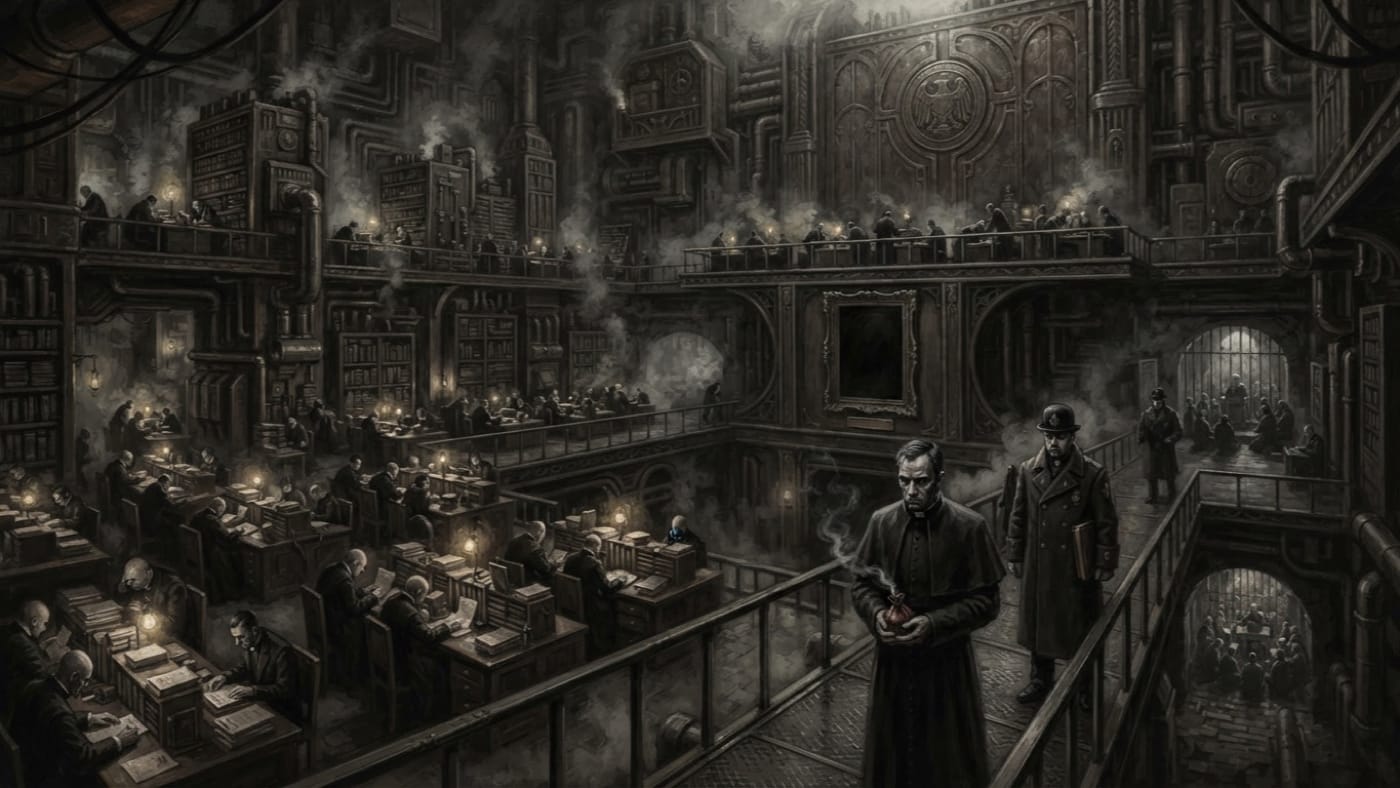
The Bureau of Discipline is the office of the Church that decides whether a pulpit exists. Six stolen pew-planks laid across a widened culvert will hold up a preacher and gather a congregation, and to the people kneeling in the wet they make a pulpit. To the Bureau they are planks. What separates the two is recognition, and Discipline is the office that grants or withholds it.
It keeps a second, rarer thing as well: the reputation of clergy who are no longer present to defend it. Both functions are attested in the Codex. Neither is spectacular. A great deal of the Synod's power lies in clerks who decline to write things down.
The work at Strasbourg is divided badly, and on purpose. The Bureau of Doctrine, which I serve with distinction and without adequate stipend, defines orthodoxy and governs what may be taught. The Bureau of Purity investigates, pursues and kindles. The Bureau of Records files the sermon, the ruling and the counter-ruling, then mislays whichever is most embarrassing. Discipline faces inward, toward the men who wear the cloth. These remits overlap at every corner. A vicar caught in heresy belongs to Purity's fire, to Doctrine's anathema and to Discipline's ledger all at once, and the three offices argue over the order of service while he waits.
The formal Synod and its Seven Seals were settled at the Concordat of Strasbourg in A.S. 90. Both founders had gone to the Creator before it was signed. The Bureau of Discipline's own founding charter has not been produced for my inspection.
#On the Conduct of Clergy
The Seven Seals entry assigns the internal conduct of clergy to the Seal of Discipline. That means scandal, concealment and the orderly disposal of inconvenient confessions. Its jurisdiction runs from the lowest parish Street-Vicar to the Archons of the provincial tribunals. The same accounting sets out the Synod's balance in a single line: Doctrine defines truth, Purity enforces it, and Discipline punishes those who enforce it incorrectly. That clause sits on the desk of every inquisitor who has ever enjoyed his work a little too visibly.
The Codex names the Seal's instrument as the Canonical Audit. It is conducted in sealed chambers by investigators whose names are kept even from Records. Its findings travel in wax-sealed pouches that are described as destroying themselves when opened. The Bureau of Engineering is credited with the mechanism and does not discuss it. I record the claim as the Codex gives it and decline to improve on it. Speculation about Engineering's devices is how junior clerks lose eyebrows.
On this point, accuracy requires a confession. The Bureau and the Seal share a name, and anyone with a pulse would assume they share a corridor. No charter within my reach says who carries the Audit's pouches, where the Bureau's desks report, or whether the men who refuse a preacher his pulpit are the same men who seal the chambers. I have seen the Seal's powers described and the Bureau's actions recorded. I have not seen the staircase between them. Doctrine does not invent staircases. It leaves that to Engineering.
Clergy are subject to Discipline. They are not shielded by it. A priest who preaches a forbidden vowel remains Purity's quarry. A bishop who mistranslates the Creator remains Doctrine's patient. Discipline adds a further question to theirs. Every other office asks whether a cleric has sinned against the faith. Discipline asks whether he has embarrassed the cloth, and its answer is filed somewhere the cleric will never be shown.
#On Recognized Pulpits
The clearest evidence of the Bureau's work is a man it refuses to see.
Brother Senn preaches to the Clock Heretics, known as the Unstruck, in the culvert-chapels beneath the Barricade Maze of Queue Road. He has been documented there since at least A.S. 194. His dossier lists his deficiencies with the relish of a tailor inspecting a pauper's coat. He has no parish and no licence. No sermon register stands under his name with Records. He has no clerical right to the title Brother. His pulpit is not recognised by the Bureau of Discipline.
He preaches anyway. Non-recognition has never silenced anyone. It classifies them. A preacher without a recognised pulpit has no standing to appeal, no superior to petition and no register for an ally to cite. When the Church wishes to speak of him, the only grammar available is the grammar of offence.
The pursuit belongs to Purity. Warrants, posters and informants all exist. Raids reach culverts thirty minutes after he has left. A Purity observation from A.S. 200 records that his hymn-patterns coincided with reduced extraction volatility at the gates. The cell's notes end with a recommendation from an unnamed reviewer: permit continued limited disruption, prevent martyrdom, maintain public denunciation. The reviewer's seal has been blacked out. Discipline is not named in that field note, and I do not name it here. Discipline is no more Senn's protector than it is his hunter. The Codex records it as the office that would not recognise his pulpit, and that is all the Codex records.
Its share of the matter was finished the moment it declined. Hunting is Purity's appetite. Sparing a man is someone else's arithmetic. Withholding recognition costs nothing and changes nothing on the Road. It also guarantees that whatever Senn becomes, a martyr, a file or a useful valve, he will never become clergy.
#On Vanished Superiors
The Bureau's second recorded act concerns me personally, which makes it the more reliable of the two.
While writing the entry on the Third Hierarch, I offered him a small compliment. The Bureau of Discipline then asked me not to praise vanished superiors until they were safely dead, identified, or both. I report the request as I received it. I have not seen it printed as a statute, and I will not invent one so that this paragraph looks better dressed. It was an admonition, and it was delivered to a Hieromnemon of Doctrine, which tells you how far the Bureau's reach extends into another office's prose.
The Third Hierarch belongs to the succession of the Seal of Discipline. His ordinal is confirmed. His name is unrecovered. In the account given in the Hierarchy of the Synod, Records holds that his personnel file was destroyed by moths in the sub-vaults during the damp winter of A.S. 112. Purity holds that no such file ever existed. Doctrine holds that he served with distinction, and that his record is complete in the sight of the Creator if not in the sight of the filing clerk. All three positions are current. His portrait in the Hall of Succession is a canvas painted over in ecclesiastical black above a blank nameplate. Three investigators looked into the matter, and all three were reassigned to contemplative duties.
That same winter, by the official note, the file of Saint Aldebrand was lost in the basement of the Basilica of the Ledgered Saints "in the reign of the Third Hierarch." The two dossiers are separate objects. Clerks who merge them should be returned to copying hymnals.
The admonition fits the vacancy precisely. A superior who is dead can be eulogised. A superior who is identified can be judged. A superior who is neither must be left exactly as unpraised as he is unnamed. Praise is evidence, and evidence draws attention to whatever lies behind the black paint. Nothing in the Codex proves that Discipline destroyed the files, overpainted the canvas or chose the investigators' new vocation. What can be said is that a Bureau which forbids early eulogy has no motive to hurry an identification.
Introductory catechisms once instructed pupils that "nothing is ever truly lost in the Bureau."
This was revised in the entry on the Third Hierarch: nothing useful is ever truly lost, and everything else is filed under Providence, vermin, or the Third Hierarch. For present purposes I add one clerical rider. What is lost may still be disciplined, and so may anyone who mourns it too warmly.
#On Present Application
This entry surveys the Bureau as it operates in A.S. 201. That is the year of the survey and should not be read as the year the Bureau was founded, which I am unable to supply.
As of that year, Discipline's attested hand reaches three matters. The first is recognition: which pulpits count, and so which preachers can expect to be answered rather than hunted. The second is praise: which clergy may be commended, and when. The third, through the Seal whose name it shares, is evidence: which findings survive being read, and which go to ash in the hand of whoever breaks the wax.
None of the three needs a scaffold. A Street-Vicar who loses his recognised pulpit still has his tongue, but he has lost his footing. A Hieromnemon who praises the wrong absence keeps his office and acquires a note. An Archon whose Audit findings are sealed for him may open the pouch whenever he wishes, once.
Senn preaches on beneath the bell-marks with his wrapped clock. The Third Hierarch's frame hangs black above its blank nameplate. Neither has been recognised, and neither has been forgotten. In the Bureau's arrangement those two conditions sit together comfortably, and the Bureau prefers it that way.