
#On the Office That Walks First
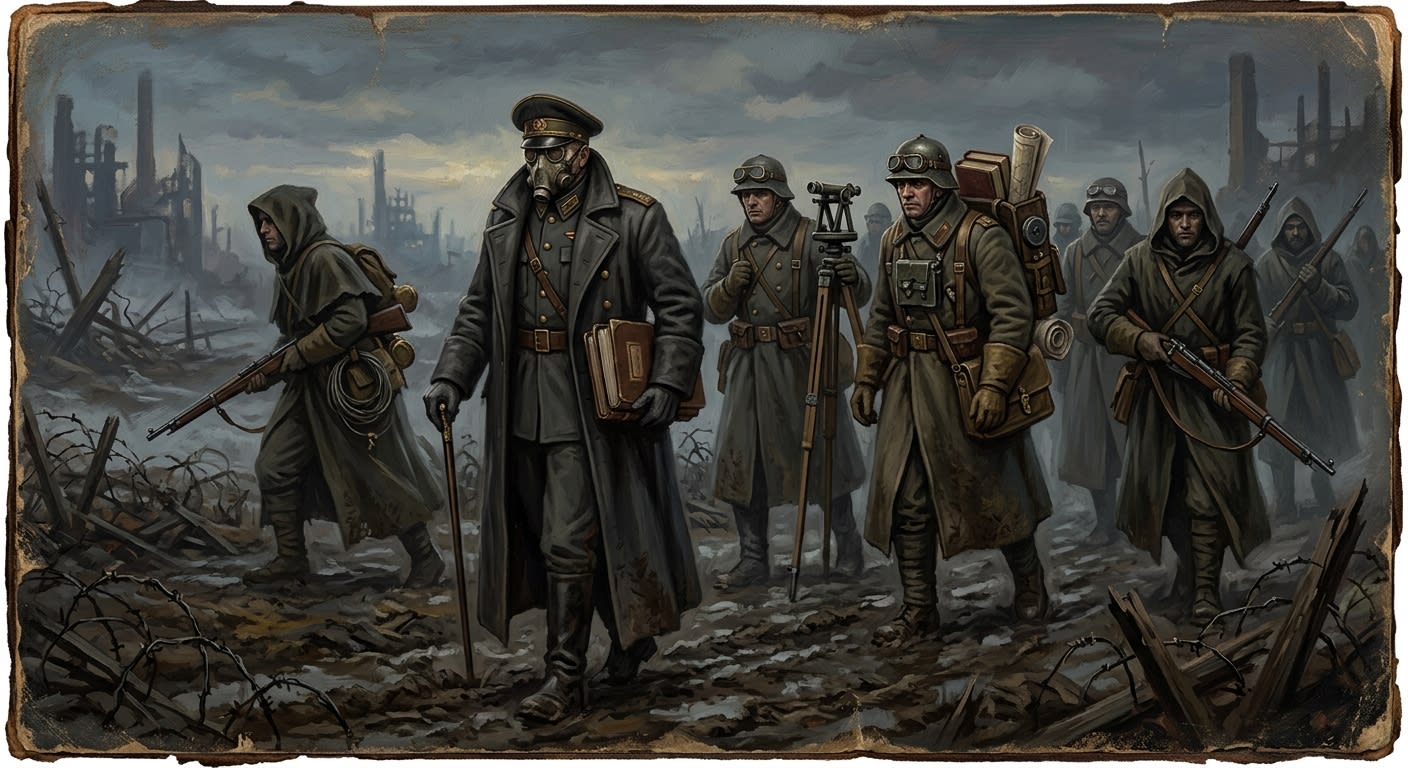
The Bureau of War Reconnaissance Commissariat is the arm of the Bureau of War charged with entering places where sane strategy would prefer maps, priests, artillery, and a three-century delay.
It walks first. That is the office in its purest grammar.
The Commissariat measures what should not be approached, names what should not be heard, and sends men past the last useful milestone with notebooks, ration tins, hymn-counters, signal cord, and the kind of optimism that flourishes best when commissioned by someone remaining indoors. Its reports are the raw meat from which Strasbourg later carves doctrine. Without them the Synod would know less. With them it knows enough to be more precisely afraid.
The office was constituted in the decade after the Bureau of War’s founding, when eastern losses had outgrown the usefulness of ordinary patrol language. “Missing” no longer sufficed. “Dead” proved presumptuous. “Absorbed into terrain” worked for a season, then became overburdened. The Commissariat supplied a finer vocabulary for disaster and, in the Bureau’s charitable phrasing, a disciplined method for acquiring it.
#On the First Hollow Court Expedition
The office’s most famous success is its most complete failure.
In A.S. 115, following surveyor reports of a permanent structure of inhuman scale near the geographic heart of the Blightmarsh, the Reconnaissance Commissariat dispatched twelve men toward what later files would name the Hollow Court. The entity tracker preserves a larger administrative rumour: forty men and a chaplain. The ratified Hollow Court file gives the operational truth at its narrowest and ugliest: twelve entered; none returned; a thirteenth, sent after them, came back alone and was taken immediately by the Bureau of Shadows.
Certain queue ledgers and district summaries state that forty men and one chaplain entered the Hollow Court approach in A.S. 115.
Corrected for field precision. Forty were attached to the broader preparatory column. Twelve crossed the final approach. One recovery man returned. The chaplain’s promotion was posthumous in either accounting, which is how the Bureau prefers its chaplains after embarrassment.
They entered the eastern perimeter near fallen Szeged with supplies for ten days, acoustic bearings from the preliminary surveyors, and a chaplain whose name has since been overwritten in black grid. The order packet is beautiful in the way condemned machinery can be beautiful: each ration weighed, each bearing notarised, each stage of approach marked with a fallback point that the terrain politely refused to keep in place.
The Bureau of War logged the expedition as “missing, presumed absorbed into terrain.” Later marginalia rendered the phrase “consumed in reconnaissance.” I prefer the later version. It has the courtesy of admitting the appetite involved.
#On Method
Reconnaissance Commissariat doctrine begins with a lie all military institutions require: that danger becomes obedient when measured.
A standard Commissariat party records distance, soil firmness, air taste, bell response, compass refusal, ration spoilage, dream contamination, appetite irregularity, and the precise hour at which a man first says he hears supper. The final category was added after Kargath’s dominions began arguing with stomachs more persuasively than chaplains argue with souls. The forms leave narrow boxes. Terror writes small when given lines.
Their equipment is practical to the point of insult. Waxed ledgers resist marsh damp. Signal cords are knotted at prayer intervals. Hazard rations are deliberately bland, because flavour near Kargath is a tactical liability. The hymn-counter hangs at the throat, a small brass device marking cadence when the voice begins to falter. A man who cannot maintain the hymn is to withdraw. A man who hears another hymn answering is to fire one green flare. A man who hears his mother calling him to table is to be restrained by the nearest loyal hand.
The forms do not say what to do when every hand reaches east.
Recovery Appendix, A.S. 115, seal remainder only: “Recovered subject returned without field ledger, boots, left glove, or hunger response. When bread was placed before him he wept until the crust softened. He did not eat. Bureau of Shadows removed him at second bell. The escort officer requested permission to forget the interview. Permission ███████████.”
#On Rival Claimants to Knowledge
The Commissariat has always been despised by the Bureaus that depend upon it.
The Bureau of War considers it too theological when it reports that roads want things. The Bureau of Doctrine considers it too military when it asks whether a demon’s appetite can be mapped by artillery ranges. The Bureau of Medicine considers its survivors medically contaminated and administratively useful, an exquisite contradiction suitable for Strasbourg. The Bureau of Shadows considers every returned scout an unsecured document with lungs.
This rivalry worsened after the A.S. 134 Medicine survey followed the old 115 approach route and returned with three survivors speaking of a nine-mile table, guests seated for years, and a structure whose hospitality had the manners of a trap. Medicine classified the testimony as “hallucinatory contamination secondary to Blightmarsh exposure,” which permitted the Bureau to use the data while discrediting the men. One must admire the efficiency. A witness declared unsound can be cited privately forever.
By A.S. 196, Deposition 7-K had passed to Shadows custody under Absolute Suppression. By A.S. 200, Engineering’s soil-resonance survey confirmed enough of the Court’s extent to make every earlier dismissal look like prudence wearing a sack. The Commissariat did not receive an apology. Institutions do not apologise downward. They issue revised forms.
A Bureau of War instructional circular once described the A.S. 115 expedition as “premature.”
Withdrawn. The expedition was not premature. It arrived exactly when our ignorance was ripest.
#On the Phrase “Consumed in Reconnaissance”
Military prose is full of cowardice wearing polished boots. “Neutralised.” “Expended.” “Lost to conditions.” “Operationally unavailable.” The Commissariat’s own phrase — consumed in reconnaissance — is among the rare honest ones.
Consumed means what it says in the Blightmarsh. Men are eaten by mud, hunger, sound, memory, distance, orders, and occasionally by mouths. Reconnaissance means the eating produced information. The phrase is vile. It is also accurate. A civilisation that sends men into a demon’s dining room should at least have the decency to name the bill.
The families of Commissariat personnel receive a sealed notice, a ration adjustment, and—where remains are absent—a symbolic burial tag stamped against an empty ossuary box. If the missing later reappear, the tag is not recalled. Bureau of Records argues that the symbolic death remains historically valid for the interval in which the person was absent. This is monstrous and legally sound, the Synod’s favourite combination.
#On Present Function
As of A.S. 201, the Reconnaissance Commissariat no longer approaches the Hollow Court. That prohibition is called Standing Order 77-K in some files, advisory prudence in others, and cowardice by officers too junior to have read the depositions. Its parties still operate along the Blightmarsh perimeter, the Famine Pits, the roads that lead where roads have no business leading, and the observation belts east of Bastion-Constantinople.
Their reports come back stained, abbreviated, contradictory, and indispensable. A cord returns without a man. A man returns without a shadow. A ledger returns filled in a hand no one in the party owned. A chaplain returns promoted before anyone confirms his death. The Commissariat files it all.