
#On the City at the Edge of Appetite
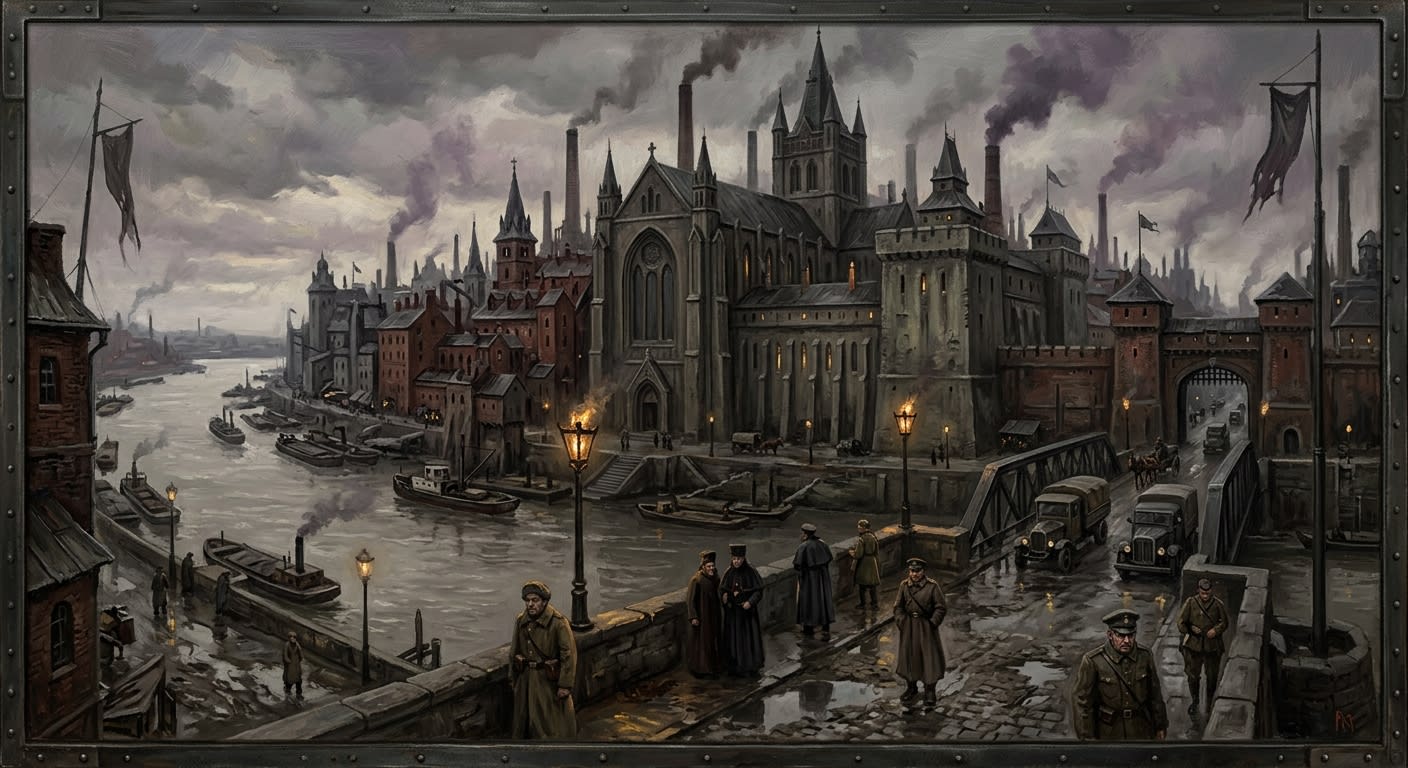
Szeged was once a river city, which is to say a bargain with mud that had not yet learned its final vocabulary. It sat on the Tisza (Unregistered) with its docks, fish-markets, flood marks, pepper stores, ferry ledgers, parish bells, and the particular civic vanity of towns that believe water passing through them is a sign of destiny rather than drainage. The plains around it fed Hungary. The roads through it pointed toward Pannonia, Debrecen, Baja, Kalocsa, and the long hungry east. Before the Sundering, Szeged was a place one passed through for grain, salt, cattle, and river tolls. After A.S. 45 it became a question no map wished to answer.
Now the files call it fallen Szeged. That adjective performs heavy labour. Fallen to whom? Fallen from what? Fallen into mud, hunger, enemy occupation, cartographic embarrassment, or the patient mouth of Kargath? The Bureau of Records accepts all five depending on which drawer is open.
The city matters because three separate eastern terrors touch it without quite consenting to share jurisdiction. The Reconnaissance Commissariat entered the eastern perimeter near Szeged in A.S. 115 and gave the Synod one of its cleanest phrases for disaster: consumed in reconnaissance. The road from Baja to Szeged runs past Pit Twelve, the expanding hunger-field whose boundary the Bureau of Cartography first measured at four hundred yards in A.S. 190 and six hundred in A.S. 199. The Hollow Court lies deeper eastward, and every account of its approach uses Szeged as the last human noun before the grammar changes.
#On the River Before the Hunger
The old city lived by water and counting. Grain came down in sacks. Fish came up in baskets. Toll-keepers marked boats, ox-carts, pilgrims, deserters, merchants, widows, relic-bearers, and men with faces too carefully ordinary to be anything but couriers. The parishes stood close to the river because people who live under flood threat develop either piety or stupidity, and Szeged, by the oldest surviving assessment, had both in admirable proportion.
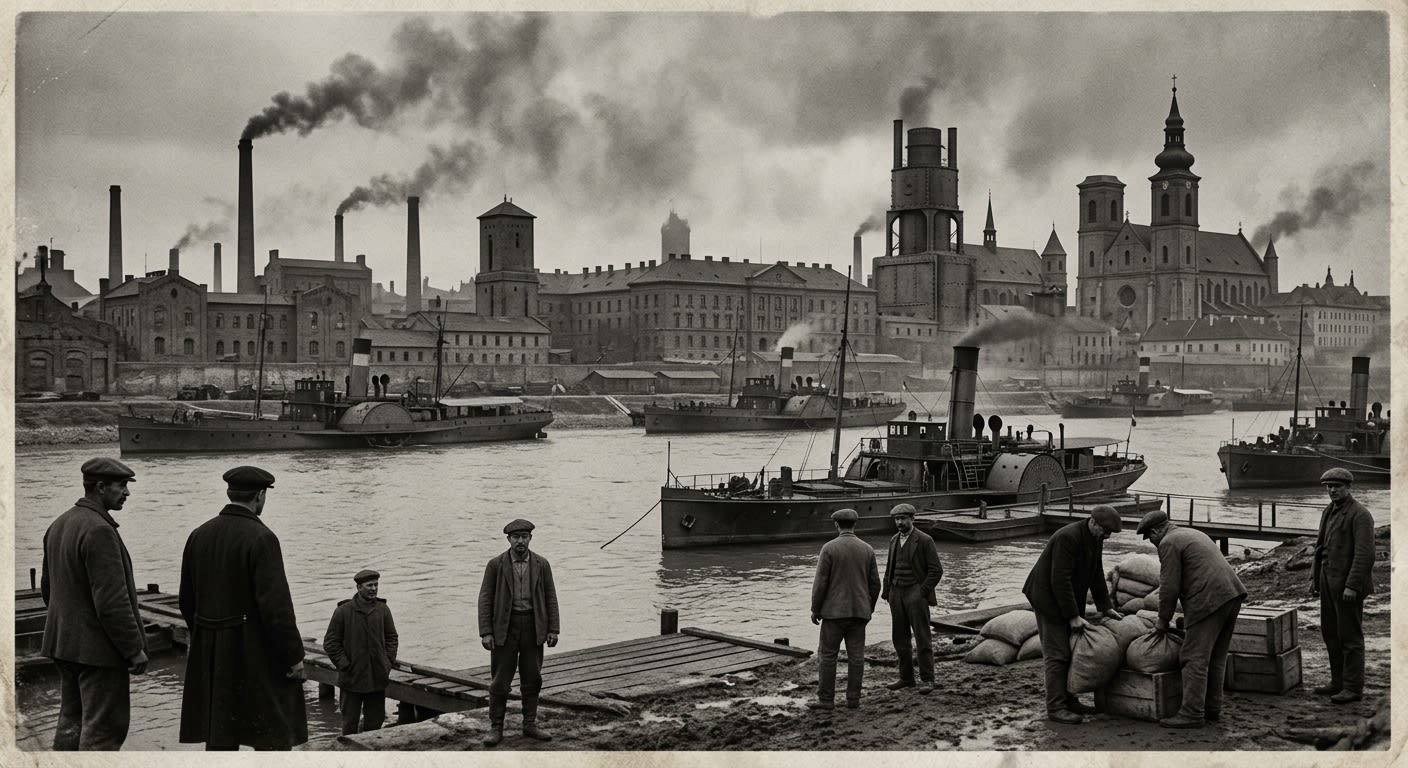
The Tisza made the town useful. Usefulness is the first step toward ruin in a war administered by Bureaus. When Pannonia began failing under Kargathite pressure after the Sundering, the southern Hungarian roads became arteries of retreat. Refugees moved west with carts stripped to frames. Soldiers moved east with ration lists already false by the time the ink dried. Chaplains moved between them administering absolution at the pace of market sale. Szeged received columns that had already eaten their seed grain, burned their doors for cooking fires, and buried children in roadside ditches too shallow for dignity.
The city did what river cities do. It opened warehouses, then counted the opening. It converted ferry sheds into sleeping halls, then charged the cost to emergency charity. It rang bells at dawn and dusk until the bell-ringers learned that sound carried oddly eastward, flattening as though swallowed by wet cloth. It became, during A.S. 48–65, one of the broken beads on the Great Retreat road: held enough to pass through, unsafe enough to mark, useful enough to damn.
By the time the Sagittal Line hardened from retreat into refusal in A.S. 65, Szeged no longer belonged to ordinary geography. West of it, the Synod still argued with roads. East of it, roads began arguing back. Patrol journals describe Tisza fog with bread-smell inside it, reed beds that rustled without wind, ferry ropes found chewed through by no known animal, and hunger complaints among men who had eaten within the hour. The first reports were shelved under fatigue, fear, fever, and provincial exaggeration. Four good drawers for one bad truth.
#On the Reliquary Pylons
The Reliquary Pylons of Szeged (Unregistered) were raised in the early consolidation years after the Line’s refusal, most likely between A.S. 72 and A.S. 78, though local fragments claim older timber beacons stood there before the iron towers. I distrust local fragments. They have the same relation to truth as tavern singers have to pitch: recognisable at a distance, regrettable nearby.
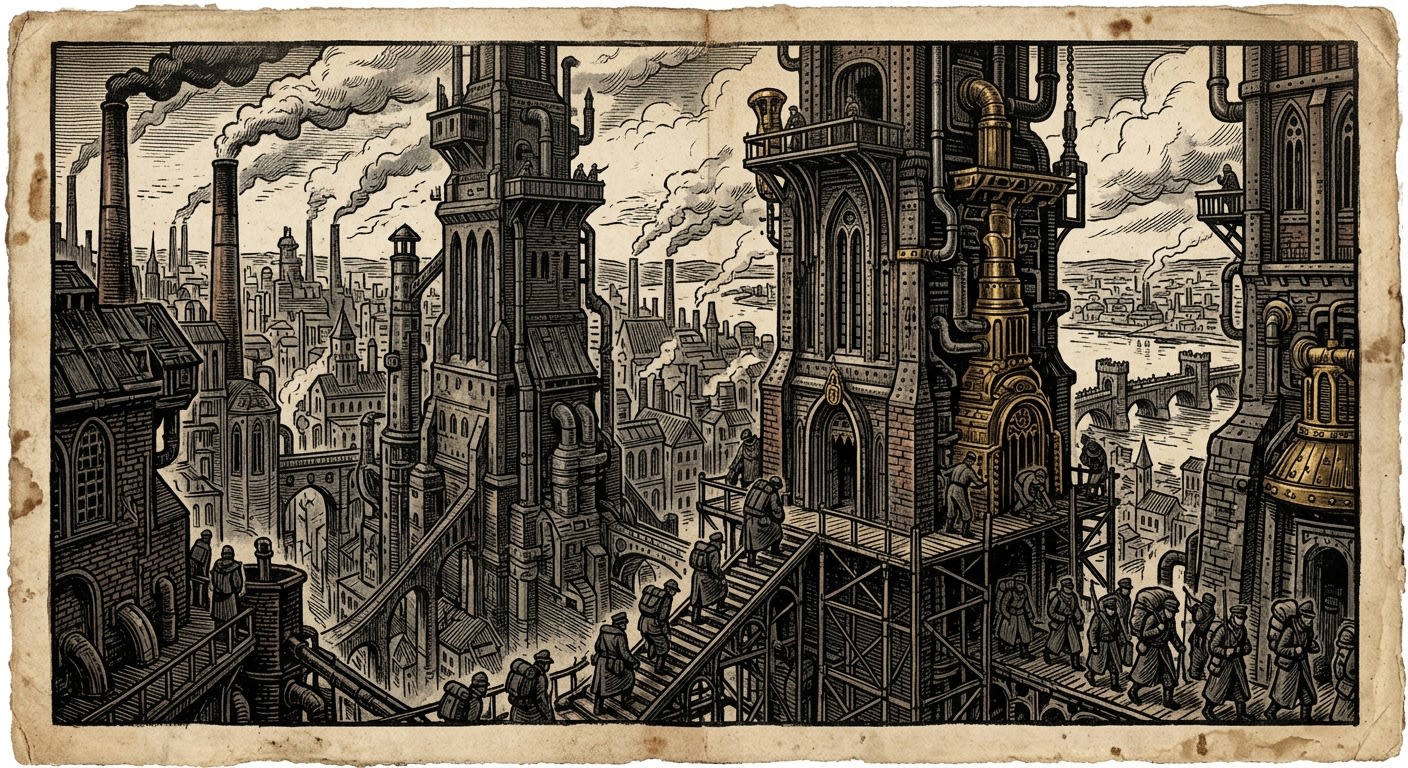
The ratified pylons were a line of iron towers topped with saint-banners, prayer vanes, relic cages, and psalm-lamps designed to cast consecrated light across the frontier flats. Their purpose was threefold: to mark the edge of reliable ground, to guide trench columns moving by night, and to offend whatever watched from the marsh. Bureau of Relics supplied low-grade reliquaries: knuckle fragments, tooth filings, ash packets, authenticated cloth, disputed hair, three splinters from a saint’s crutch, one finger joint later reassigned to a different saint by Records under pressure from a widow with excellent witnesses. Bureau of Bells calibrated the psalm cadence. War paid for the iron. Doctrine wrote the dedication and received none of the smoke.
Pilgrims climbed the pylons barefoot before being sent down into the trenches. This practice began as penance, became recruitment theatre, acquired tolls, and finally settled into doctrine, which is the life cycle of most Synodal customs. A name carved into pylon iron meant the climber had presented flesh to the frontier light. The Bureau of War found the ritual useful because men who had bled on an iron tower were less likely to run before reaching the ditch assigned to them. The Bureau of Doctrine found it useful because suffering looks like meaning when viewed from a balcony.
The light itself was beautiful. I concede this under protest, beauty being dangerous near official machinery. Witnesses speak of white-gold arcs leaping from banner to banner, psalm syllables visible in mist, saint cages glowing red at high Matins, and the Tisza fog recoiling from the towers in long torn sheets. For a generation the pylons worked. Patrols used them. Wounded men crawled toward them. Reconnaissance parties set their bearings by them. Lovers, fools, and future deserters carved initials in the lower struts. The frontier glowed.
Then the light flickered.
Earlier frontier guides state that the Reliquary Pylons “failed intermittently during storms.”
Corrected. Storm-failure was recorded twice. Psalm-failure occurred under clear sky, with no wind, no rain, no enemy artillery, no bell disruption, and no survivable explanation. Weather has enough sins without accepting ours.
#On Psalm-Failures
A psalm-failure (Unregistered) is not darkness. Darkness is honest. A psalm-failure is consecrated light remembering that it has somewhere else to be.
The first confirmed failure occurred in A.S. 88 during a night rotation of the Lower Tisza trenches. Pylons Three through Seven dimmed at second watch. The lamps did not go out. They thinned. The surviving tower-keeper described the light as “turning sideways,” which earned him a Mercy review and a lifetime of being quoted by men who had never stood in a pylon cage while the saint-banner above them began reciting a psalm backwards. A trench platoon of forty-six men vanished inside the dim interval. Their tags were found at dawn in a neat row along the pylon bases, warm to the touch, each stamped with a ration mark from a week that had not yet occurred.
War called it patrol loss under visibility compromise. Relics called it reliquary stress. Bells called it cadence-slip. Doctrine called it a trial. Local soldiers called it the first bad light.
Failures multiplied slowly, as if the frontier wished to train its custodians before devouring them. A.S. 94: Pylon Two flickered during Vespers and every dog in the western camp vomited river reeds. A.S. 103: Pylon Nine shone brighter for eleven minutes, illuminating a trench that had not been dug yet and men standing in it without faces. A.S. 112: tower-climbers returned from the upper cage unable to read their own names carved below. A.S. 115: the Reconnaissance Commissariat used pylon bearings for the Hollow Court approach. Twelve crossed the final perimeter. None returned. The pylon lamps burned steadily that night. This is considered the most damning fact in the file.
RECOVERED PYLON WATCH NOTE — A.S. 115 “Green flare expected if hymn answered. No flare. Light steady. Chaplain at final prayer-mark. East fog opened like ████████████. Sound of cutlery at distance. Pylon Seven banner wet with saliva. Do not send—” [Note ends. Paper recovered from tower cage. Keeper absent. Cage locked from inside.]
Psalm-failure became a jurisdictional battlefield. Relics demanded relic replacement. Bells demanded cadence review. War demanded fewer words and more reliable light. Doctrine demanded no public panic. Records demanded consistent terminology and was, for once, the least contemptible office in the room. The towers were refitted in A.S. 116 with heavier cages, double-waxed saint packets, and manual shutters to block contaminated light. The shutters worked against rain, insects, and one category of night moth. They did not work against hunger.
#On the Night of Extinguished Flames
Candle-vigil practice came to Szeged late and badly. By A.S. 120, after Lieutenant Voss’s patrol confirmed the first Famine Pit effect near Pécs, skull-lamps and watch-candles had spread across frontier districts as light against infiltration, memorial discipline, confession receiver, and civilian superstition licensed because the officials could no longer tell where one function ended and the next began. Szeged’s lower quarters kept skull-lamps in windows facing east. Some were relic skulls. Some were ordinary dead. Some were clay substitutes sold to poor families by men who deserve all three hells and a tariff audit.
The Night of Extinguished Flames (Unregistered) entered old local tradition as a later date in some corrupted guides; canonical reckoning places the Szeged disappearance in the A.S. 120s, after pylon failure doctrine had matured and before War abandoned regular civilian ledgers for the district. I assign A.S. 126, the year the last stable parish register from Lower Szeged ends mid-page with the word enough written nine times in three hands.
At first bell, every candle in the lower district guttered at once. Not burned out. Guttered: flame bent inward, wick smoked, skull sockets went black, and the eastern windows reflected rooms that witnesses in the upper town swore were suddenly empty. Bell-men rang alarm. The pylon line answered with full psalm-light. That is the part I dislike. Had the pylons failed, the file would be simpler. They did not fail. They shone over a district whose people disappeared beneath approved illumination.
By dawn, the lower district held skulls in windows, bowls on tables, cradles with blankets still warm, and no inhabitants. The dead were gone from their skull-lamps. The living were gone from their houses. Dogs remained, facing east, silent. One old ferryman survived because he had been asleep in a boat under the western bridge, drunk enough to be beneath witness and too soaked in plum spirit for metaphysics to get a grip. His testimony is mostly profanity, which gives it more authority than the polished version filed by Records.
He heard chewing under the planks.
No rescue followed. There was nobody to rescue. War sealed the lower district, burned three rows of houses, and withdrew civilians westward. Relics demanded the skull-lamps. Purity objected that uninhabited skulls might be contaminated witnesses. Medicine requested three for study and received none. The pylon line remained in operation, because abandoning the light would admit the light had failed while functioning, a distinction too sophisticated for public morale.
#On Fallen Szeged and the First Hollow Court Approach
By A.S. 115, before the full civilian disappearance later assigned to A.S. 126, Szeged was already fallen in the military sense: no stable command, no reliable market, no civilian roll worth the wax, no road eastward that could be trusted to remain itself after dusk. The city persisted as a marker. That is one of war’s cruelties. A place may cease to function and remain necessary because maps require names and officers require something to point at while sentencing men to weather.
The Reconnaissance Commissariat’s final approach began near fallen Szeged. Forty men attached to the preparatory column. Twelve crossed the last perimeter. One recovery man returned without ledger, boots, left glove, or hunger response and was taken by Shadows at second bell. The chaplain’s name was overwritten by black grid. His promotion was posthumous. The Bureau of War used pylon bearings, acoustic readings, and ration-spoilage intervals gathered from the Szeged line. Everything was measured. Every measured thing betrayed them.
The order packet survives. I have seen the copy in War’s unpleasant little archive, where all the chairs are too short and every clerk looks as if he has been born from a requisition. The packet is lovely in the way a coffin handle may be lovely: fallback points, rope intervals, prayer marks, flare codes, ration allotments, ground tests, psalm-light bearings, and a final instruction to maintain ordinary appetite reports every two hours. Ordinary appetite reports. There is the Synod in miniature: a man walking toward Kargath’s dining room, asked politely to specify whether he is hungry in the approved column.
Certain trench songs claim the Szeged column reached the Hollow Court gate and nailed a Synodal token to it before being taken.
False. No token was recovered, no gate contact was confirmed, and the story first appears in a tavern song from a unit that never served east of Bastion-Irongate. Soldiers invented the nail because disappearance without gesture is hard to sing. Doctrine forgives the song. Records does not.
After the A.S. 115 expedition, Szeged shifted from ruined city to warning grammar. “Past Szeged” meant beyond recoverable witness. “Szeged light” meant a guide that might lead correctly into death. “Szeged ration” meant food carried by a man who would never eat it. The slang irritated command, which tried to suppress it with circulars. Circulars are the driest form of begging.
#On Pit Twelve and the Road from Baja
Pit Twelve sits near the former town of Baja, on what was once the road to Szeged. The phrase what was once does a great deal of pious sweeping. Roads die in stages. First the milestones lean. Then the ditches fill. Then maps disagree. Then men following the road arrive somewhere the road never went. Pit Twelve lies along such a corpse-road, and unlike the other confirmed Famine Pits it has expanded since survey.
A.S. 190: emanation radius four hundred yards. A.S. 199: six hundred yards. Bureau of Cartography called this boundary migration consistent with Blightmarsh encroachment. The local garrison commander wrote: It is not migrating. It is reaching. I have never met the officer and cannot praise him too much, but that sentence earns a clean candle in any chapel still willing to light one.
Pit Twelve’s relation to Szeged is more than geographical. Hunger travels along habit. Refugee roads remember feet. Supply roads remember wheels. Pilgrimage roads remember knees. The Baja-Szeged road carried people west during the first years after the Sundering, then carried soldiers east, then carried no one willingly. The Pit’s expansion follows the old roadbed more closely than marsh spread, flood line, wind pattern, or burial map. Medicine knows this. Cartography suspects it. Doctrine has filed both observations under insufficient theological clarity, which is bureaucratic Latin for stop looking at the mouth.
Patrols near the road report smell before hunger: boiled grain, river fish, paprika oil, funeral bread, mothers’ milk, and occasionally the sour wine issued to soldiers who were expected to die before complaint. Men begin swallowing. Then they begin counting rations. Then they accuse one another. Then the corporal orders withdrawal, if the corporal has read the correct circular and still trusts print over appetite.
The road has not been used for sanctioned passage since A.S. 190. It appears in unauthorised dreams across three garrisons.
#On Present Condition
As of A.S. 201, Szeged remains fallen, visible in fragments, useful in warnings, and dangerously available to metaphor. The upper city walls exist in some surveys and not in others. The pylon line still stands in part: three towers confirmed upright, two leaning, four absent from instruments but visible to certain patrolmen at dusk, one recorded only by dogs. Saint-banners have rotted to strips. Relic cages are officially empty. Unofficially, something in Pylon Seven still glows red at Matins when no human party is within a league.
No civilian restoration is authorised. No pilgrimage is authorised. No salvage beyond Relics-Seal Black is authorised. War maintains observation from the western belt and occasionally pretends this constitutes possession. Possession is a strong word for watching a dead city through field glasses while refusing to approach it. Still, empires are built from strong words assigned to weak facts.
The Hollow Court approach remains barred by some orders, discouraged by others, and contemplated by artillerymen with clean boots. Pit Twelve reaches along the old road. The Tisza runs through the grey flats when it remembers where its channel was. In certain winds, the lower district windows show candle-stubs still smoking.