

#On the Division and Its Register
This is a documentary compilation made for the Sacred Ledger in A.S. 201 / 1911 CE from the latest cited returns of the Bureau of War's Cartographic Division. The compilation belongs to this year. The observations in it are older.
The Bureau of War keeps many drawers, and one of its offices has a duty that fits in a sentence: it records where the Gorged sit. The register covers confirmed positions in the eastern territories. It exists for officers who must route a column, site a post or judge whether a road is worth the rations needed to cross it.
Readers who confuse this office with the Bureau of Cartography should stop doing so. The Bureau of Cartography is a separate institution, with its own seals and quarrels and a mandate wide enough to take in parishes, tithe districts and the buried dead. The Cartographic Division answers to War. The two share the vocabulary of survey and the habit of being cursed by generals. The Ledger holds no evidence that they share a command, an office or a single clerk, and I will not merge two institutions because they share a noun.
The Ledger also holds no founding year for the Division, no charter, no commander and no establishment strength. I have supplied none of them. The register can be judged by what it records.
It is meant to be updated every year. In practice it is updated whenever an observation team can be spared and will accept the assignment. Read every figure below with both of those sentences in mind.
#On Positions Confirmed and Ground Unseen
The most recent survey on record is that of A.S. 200 / 1910 CE. It reports on three localities at three grades of confidence. The grades matter more than the counts.
The former Hungarian plains, now the Blightmarsh. Eleven Gorged are confirmed. At least three have been seen in substantially the same positions since A.S. 155 / 1865 CE. That was forty-five years at the time of the survey and is forty-six at this compilation. The register marks them permanent. Nobody at War expects to strike the word out.
The approaches to Bastion-Constantinople. Four Gorged are confirmed along the eastern road where it passes through the outer marshes. This is a separate locality, and the grain country does not lie at Constantinople's gates. A clerk who adds these four to the eleven and enters a regional fifteen has drawn a road the Division never surveyed.
The approaches to the Hollow Court. The figure here is an estimate of six to fourteen, credited by the source account to aerial reconnaissance, with the Gorged arranged in a rough processional line along the road to Kargath's seat. It is a range because nobody has confirmed it. The same account separately records that a Vigil Ark on long-range patrol in A.S. 198 / 1908 CE heard their cries and first classified them as geological activity. It does not name the aircraft or say whether that patrol produced the estimate. The Ledger also records that the plains have been closed to the Vigil Arks since the Sanctissima Vox was lost over the consumed plain in A.S. 147 / 1857 CE, with survey done on foot ever since. I enter both statements and reconcile neither.
Ground that no team reaches may hold more. War puts the true count at "significantly higher than confirmed" and will not write down a figure. I approve. Any quartermaster would read a figure as a confirmation.
An earlier catalogue of Kargath's demons described the Gorged as "barely mobile under the weight of their consumption."
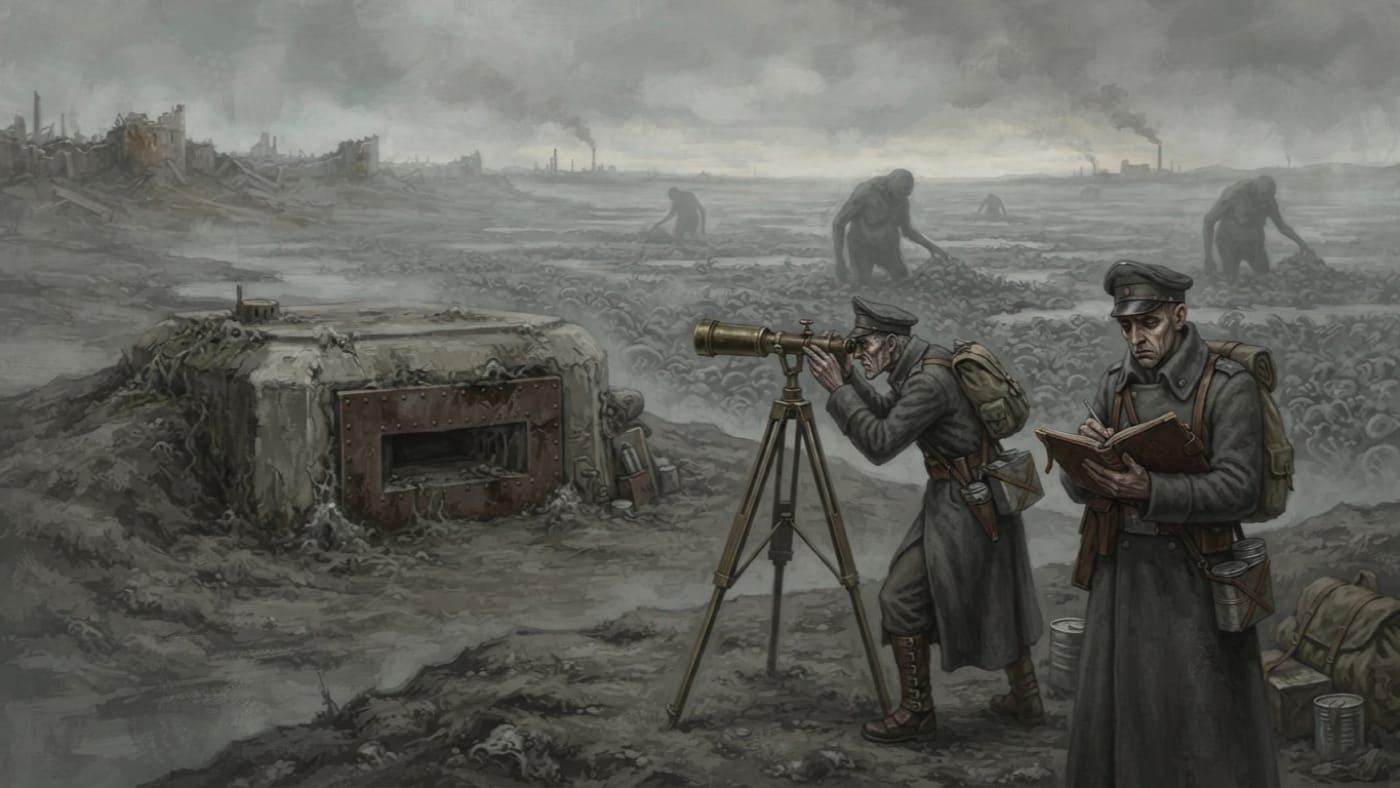
Corrected. The Gorged are stationary. The Bureau of Engineering's assessment of A.S. 192 / 1902 CE found that once the body outgrows the limbs, locomotion becomes structurally impossible. The limbs still reach, grasp and pull food toward the mouth, but they carry the body nowhere. That is the only reason a confirmed position can be entered in ink.
Attendants keep the seated Gorged supplied, and the Ledger does not know why they keep coming. The Bureau of Doctrine holds that a pull of need draws them. The Bureau of Shadows holds that Kargath's hierarchy assigns them, because a fed Gorged stays put and denies ground. Both positions are on file. The register records where the feeding happens and takes no view on who arranged it.
#On the Cost of Observation
A Gorged makes no attack on the team that surveys it. It has no need to.
The mucor fames, a grey famine-mould that smells of bread gone wrong, coats the ground for about four hundred yards out from each specimen's outermost boundary. Rations spoil within hours, leather cracks and wood loses its grain. A survey team carries food, boots, straps, a stock for the field-scope and a bound log, and every one of those things is organic. The four hundred yards are measured from each demon. They mark no edge of the Blightmarsh, and nobody has certified the four hundred and first yard as safe.
The cry travels further than the mould. The Bureau of Medicine's study at Observation Post Eleven-West, A.S. 195–197 / 1905–1907 CE, followed sentries assigned to Gorged-observation duty. In the first week their appetite rose and extra rations held it. In the second it outran the allocation, and the men ate their personal stores. By the third it was compulsive, and they were eating boot-leather, candle-wax and liturgical wafers not intended for consumption. The study records no fourth week. The post was evacuated after the senior sentry was found trying to eat the observation log.
An earlier edition gave the rotation for Gorged-observation posts as "ninety days."
Revised. Rotations have been fourteen days since A.S. 198. The change came on Medicine's recommendation and over the objection of War's logistics division, which pointed to the extra personnel required. Medicine replied in a single sentence: "The alternative is that the personnel become part of the problem." War accepted the revision. The fourteen days are a duty rotation. They are not a certified allowance of safe viewing, and serving them gives no man immunity.
Watching does a third kind of harm. The chaplaincy calls it invidia famis, envy of the fed. The sentry is hungry, because everyone on the Line is hungry and the Bureau of Tithes keeps the ration lean on purpose. Through his scope he watches a demon swallow in an afternoon more than his parish eats in a month, and after enough afternoons he starts to envy it. War's eastern advisory lists the signs: a fixed stare toward known positions, voluntary extension of observation shifts, food obtained without authority, and weight loss that does not match the ration. A man showing them is to be relieved of forward duty at once and sent to the chaplaincy for assessment.
I ask the reader to look again at the second sign. The most diligent surveyor in the eastern territories, the one who asks to stay at the scope a little longer to finish the count, has thereby qualified for removal. Under that advisory, keenness to complete the work is itself a reason to stop him doing it.
Each tightening of these rules makes the register dearer to keep: more men go east to watch the same fixed positions.
These hazards belong to the Gorged. The Self-Devoured have their own viewing advisory and the marsh its own exposure rules; no study supports combining the three into one rule for safe observation.
#On Changes That Return No Ground
A fixed position can still change in two ways the register must record.
The first happens when a Gorged's supply fails. The Bureau of War's taxonomy committee holds that the starving Gorged turns on itself and becomes a Self-Devoured. Doctrine reads a rise in Self-Devoured numbers as evidence either that Gorged are running out of food or that their attendants are starving them on purpose, and has settled neither reading.
The second is destruction. Artillery can kill a Gorged. What it leaves behind is a fovea, a depression of consumed and contaminated ground for which no recovery period has been established. Soldiers sent to survey destroyed positions report hearing the cry, muffled, as if from underground, for weeks after the shelling. Current doctrine advises against destroying a Gorged unless the tactical situation requires it.
The Division's part in this is narrow, and I keep it that way. It can record that a seat is empty. No source gives it authority to order a bombardment or to certify ground recovered, and no survey has supplied the evidence for such a certificate. A vacant entry is not a reclaimed one.
#On the Other Register
The Division keeps a second registry, this one of Self-Devoured positions in Kargath's territory. Its source describes quarterly updates drawn from observation-post reports and from survey flights by the Vigil Ark Saint Barachiel. That cadence belongs to that registry alone. It does not show that the Gorged are surveyed quarterly, and it does not show that either register reaches every locality.
The A.S. 200 return gives forty-seven Self-Devoured as confirmed and nineteen as probable. The probable ones were seen at a distance, behaving in a way consistent with the class, and still await formal confirmation. The two figures sit in separate columns and are not added together. The source reports a rise of six since the previous count of A.S. 198, which War has noted without comment. The next survey is listed as pending the allocation of observation assets, which is the same condition the Gorged register lives under.
#On the Present Compilation
These are the A.S. 200 returns, assembled in A.S. 201. No team went out to make this compilation. No new census was taken. No inspection has been recorded since the returns, and none is assumed here. Every count above is as old as the last occasion on which observers could be spared, agreed to go, and came back with the log uneaten.
The annual schedule stays on the books. Whether it was kept in any given year is not recorded, and I have not reconstructed it.