
#On the Nature of the Gorged
Being the Bureau of Doctrine's supplementary codex entry on the fourth taxonomic class of Kargath's legions, filed under Bestiary Addendum IV.1.07-004, and inscribed with a reluctance the Warden does not customarily confess to, but which the subject demands.
The Bureau of War's field-taxonomy committee classified the Self-Devoured as the final stage of Kargath's legions — the terminus, the endpoint, the logical conclusion of need that grows with feeding. The committee was wrong. The Self-Devoured are what the Gorged become when the food runs out, which means the Gorged are the penultimate horror, and the penultimate horror is, in my considered opinion, worse than the final one, because the penultimate horror still has hope. The Self-Devoured have accepted their condition. The Gorged have not. The Gorged are still waiting for enough. The Gorged still believe, with a conviction that has survived the consumption of entire villages, that the next mouthful will be the one that satisfies.
The Gorged are demons that have eaten enough.
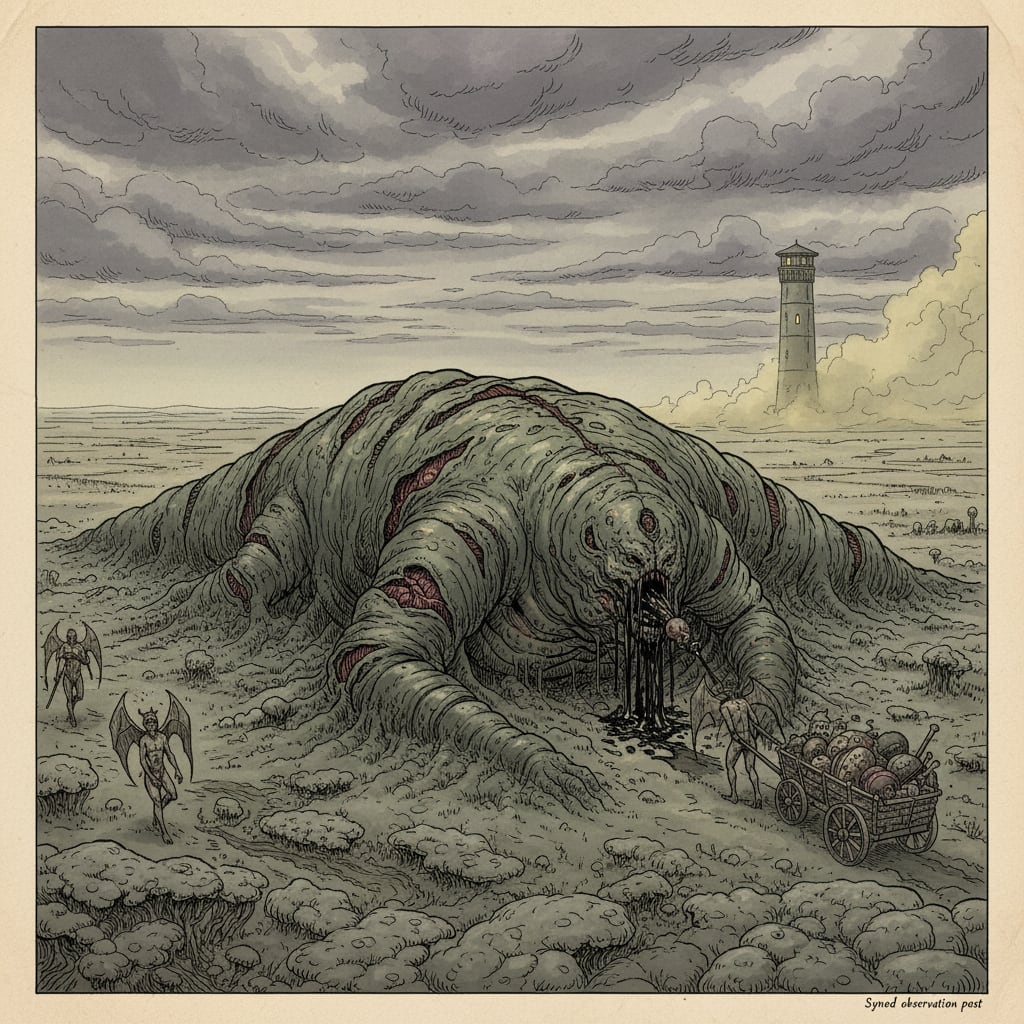
This sentence is a lie. The Gorged are demons that have eaten past capacity — their bodies are distended, swollen, split and re-healed and split again by the sheer volume of what they have consumed. They have devoured livestock, grain stores, villages, military formations, and — in three confirmed instances — other demons of lesser classification. They are vast. The smallest confirmed Gorged, catalogued by Bureau of War Observation Post Eleven-West in A.S. 188, displaced approximately the same volume as a Strasbourg canal barge. The largest — observed only by long-range telescope from the outer works of Bastion-Constantinople, never measured with precision, assigned the field designation Gut-Mountain by soldiers who lacked the vocabulary for what they were seeing — occupied the footprint of a small cathedral. It was still eating. Servants brought it offerings by the cartload, and the cartloads vanished, and the Gut-Mountain cried out, and the crying carried on the wind to the bastion walls, where sentries who heard it reported an appetite they could not explain.
The sentence is a lie because "enough" implies satisfaction, and the Gorged are defined by its absence. They have consumed past the body's capacity to hold consumption, and they are still hungry.
#On Their Formation
The Bureau of Doctrine's theological committee has produced the following developmental sequence, reconstructed from field depositions and interrogation of captured cultists, and ratified — after considerable debate — at the Fourteenth Doctrinal Congress of A.S. 147:
A Kargath demon begins as a Maw-Born or a Hollow-Walker. It consumes. Consumption is its nature, its purpose, the only imperative its existence permits. The early stages are mobile: the demon hunts, it feeds, it moves to where the feeding is richer. The hunger does not diminish with eating. The hunger grows.
A demon that survives long enough — and survival, for Kargath's creatures, means nothing more than continued access to food — begins to accumulate. The body swells. The organs, such as the Bureau of Engineering's vivisection teams have been able to identify, multiply: additional stomachs develop, digestive tracts branch and redouble, the interior becomes a network of processing capacity that converts matter into need. Nothing is digested in the human sense. Nothing nourishes. The body grows, the void inside it grows faster, and the demon transitions from hunter to fixture.
An earlier edition of this entry stated that the Gorged "choose" to stop moving.
The Gorged do not choose. The body outpaces the limbs. Locomotion becomes structurally impossible at approximately the displacement of a Strasbourg hay-cart, according to the Bureau of Engineering's A.S. 192 assessment. The assessment further notes that the limbs do not atrophy — they continue to grasp, to reach, to pull food toward the mouth — but the mass they serve has exceeded their mechanical capacity. The demon does not stop hunting. The body stops cooperating.
At this stage, attendants appear. Where they come from is a matter of theological dispute: the Bureau of Doctrine holds that lesser demons are drawn by compulsion, a gravitational pull of need that Kargath's creatures exert on their environment. The Bureau of Shadows' intelligence section, which disagrees with the Bureau of Doctrine on every matter it can identify, holds that the attendants are assigned — that Kargath himself, or the hierarchy that serves him, dispatches lesser demons to feed the Gorged as a deliberate strategic choice, because a Gorged that receives food remains stationary and functions as an area-denial weapon, and a Gorged that does not receive food becomes a Self-Devoured, which is tactically useless.
Both explanations may be correct. The Bureau of Doctrine has not resolved the dispute. The Bureau of Doctrine has, characteristically, filed both positions as provisional truth and invited the disputants to lunch, where the menu was approved by the Bureau of Purity and the conversation was supervised by the Bureau of Records, and nothing whatsoever was resolved.
#On Their Location
The Gorged are territorial in the way that geographical features are territorial: they do not move, they define the terrain. The Bureau of War's Cartographic Division maintains a register of confirmed Gorged within the eastern territories, updated — in theory — annually, and — in practice — whenever an observation team can be spared and is willing to accept the assignment. The most recent survey, A.S. 200, identified the following concentrations:
The Blightmarsh. Eleven confirmed Gorged, distributed across the former Hungarian plains at intervals the Bureau of Engineering describes as "approximately consistent with optimal feeding-territory division, if the term 'optimal' can be applied to anything involving Kargath without committing a logical error the Bureau is unwilling to endorse." The Blightmarsh Gorged are among the oldest documented: at least three have been observed in substantially the same positions since A.S. 155, which means they have been eating for forty-six years and have not finished, and will not finish, and the Bureau of War has annotated the register with the word permanent.
The approaches to Constantinople. Four confirmed Gorged, positioned along the eastern road where it passes through the outer marshes. These are the Gorged most often seen by Synod personnel — seen, smelled, and heard, because the Gorged at the approaches cry day and night in a register the Bureau of Bells has measured and confirmed falls within the range of human vocal distress but at a volume the Bureau of Bells describes as "architectural." The Constantinople Gorged are smaller than the Blightmarsh specimens. The Bureau of War attributes this to the relative scarcity of food in the marshes compared to the former breadbasket. I attribute it to the fact that anything close enough to feed them has already been consumed by the garrison or by the Gorged, and the two parties are in direct competition for resources, and the garrison is losing.
The Hollow Court approaches. An unknown number, estimated by aerial reconnaissance at between six and fourteen, arranged — the Bureau's cartographers insist this word is appropriate — in a rough processional line along the road that leads to Kargath's seat. They are fed by a supply chain the Bureau of Shadows describes as "logistically impressive, theologically appalling, and better organized than most of our own." The Hollow Court Gorged are the largest on record. Their cries, detected by the Vigil Ark during a long-range patrol in A.S. 198, were initially classified as geological activity.
#On Their Effect
The Gorged are area-denial weapons. The Bureau of War classifies them under this heading, and the classification, for once, is both precise and complete. A Gorged demon does not attack. A Gorged demon does not advance. A Gorged demon occupies space, and the space it occupies becomes uninhabitable for reasons that the Bureau of Medicine has divided into three categories, each worse than the last.
Physical contamination. The Gorged exude a discharge the field manuals describe as mucor fames — famine-mould. It is grey. It smells of bread that has gone wrong. It coats surfaces within a radius the Bureau of Engineering has measured at approximately four hundred yards from the specimen's outermost boundary, and it grows. Anything organic that the mucor contacts begins to decompose in a manner the Bureau of Medicine distinguishes from ordinary rot: the matter is consumed, converted, absorbed into a substance that feeds nothing and nourishes no one. Rations stored within the contamination zone spoil within hours. Leather cracks. Clothing disintegrates. Wood loses its grain and crumbles.
Acoustic contamination. The Gorged cry. This has been noted. What has been insufficiently noted, in my opinion, is that the cry is a weapon in the operational sense: prolonged exposure induces appetite. The Bureau of Medicine's study, conducted at Observation Post Eleven-West between A.S. 195 and A.S. 197, documented the following progression among sentries assigned to Gorged-observation duty:
Week one: increased appetite, manageable through additional rations. Week two: appetite exceeds allocation; sentries report consuming personal stores and requesting supplementary provisions. Week three: appetite becomes compulsive; sentries consume anything available including boot-leather, candle-wax, and liturgical wafers not intended for consumption. Week four: no observations were recorded in week four, because the observation post was evacuated after the senior sentry was discovered attempting to eat the observation log.

An earlier edition cited the rotation schedule for Gorged-observation posts as "ninety days."
The rotation schedule has been revised to fourteen days, effective A.S. 198, on the recommendation of the Bureau of Medicine and the strong objection of the Bureau of War's logistics division, which notes that fourteen-day rotations require three times the personnel. The Bureau of Medicine's response to this objection was a single sentence: "The alternative is that the personnel become part of the problem." The Bureau of War accepted the revision.
Psychological contamination. Sentries, scouts, and patrol units operating within visual range of a Gorged report a condition the chaplaincy has designated invidia famis — envy of the fed. The Gorged is eating. The Gorged is always eating. The Gorged has more food than the sentry, more food than the garrison, more food than the sentry's family has seen in a year. The sentry watches a demon consume in a single afternoon what would feed his parish for a month, and he watches while hungry, because everyone on the Line is hungry, because the Bureau of Tithes controls the rations and the rations are never generous. The theological problem is obvious. The operational problem is worse: soldiers who spend too long watching a Gorged feed begin, by degrees, to envy its condition. They envy the abundance. They envy the access. They envy the simple fact that the demon, at least, has something to eat.
The chaplains call this the temptation of the table. The field medics call it the early stage of Kargath-alignment. The soldiers call it going hungry-eyed, and they watch for it in each other, and they do not speak of it at meals.
#On Disposal
The Bureau of War does not use the word "disposal" in official documents relating to the Gorged. The preferred terminology is "area denial remediation," which means the same thing but contains enough syllables to insulate the reader from what it actually involves.
A Gorged can be killed. This is confirmed. The Bureau of Engineering's Ordnance Division has established that sustained artillery bombardment — a minimum of forty rounds of consecrated shell from standard field howitzers, delivered within a six-hour window to prevent regeneration — is sufficient to destroy the physical structure. The Gorged does not resist. The Gorged does not flee. The Gorged sits in its position, continues eating, and absorbs the bombardment with an indifference the ordnance teams describe as "demoralizing."
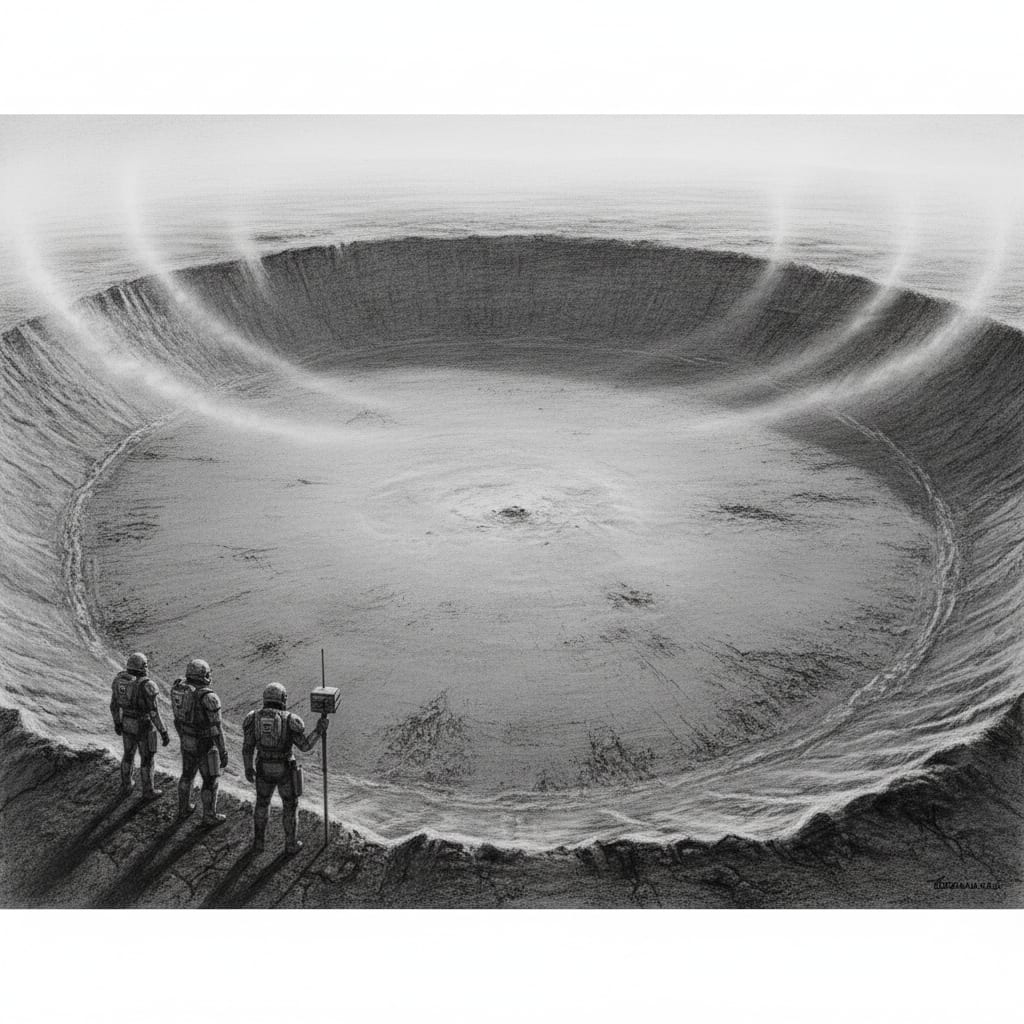
Killing them is manageable. What follows is the problem. A destroyed Gorged leaves behind a contamination zone the Bureau of Medicine calls a fovea — a depression in the terrain, roughly circular, where the soil has been so thoroughly consumed that nothing will grow for a period the Bureau declines to estimate. The mucor fames concentration in a fovea exceeds the ambient contamination zone by a factor the Bureau of Engineering has measured and then classified, on the grounds that publishing the number would constitute a threat to public morale. The fovea also retains the acoustic properties of its former occupant: soldiers assigned to survey destroyed Gorged positions report hearing the cry — diminished, muffled, as if from underground — for weeks after the shelling.
The Bureau of War's current doctrine, stated plainly, is as follows: do not destroy the Gorged unless the tactical situation requires it, because a living Gorged is a known quantity in a fixed position, and a dead Gorged is a contamination event that denies the same ground to the Synod's forces as effectively as the demon did alive. The doctrine has been criticised by the chaplaincy as "an admission of permanent demonic occupation disguised as tactical pragmatism." The Bureau of War has not responded to the criticism. The Bureau of War does not respond to criticisms it considers accurate.
The operation designated ████████ ██████, conducted A.S. ███ in the Blightmarsh sector, involved the simultaneous bombardment of ████ Gorged positions using ████████ rounds of consecrated shell over a period of ████ hours. The resulting contamination zone measured approximately ████ square miles and rendered the sector impassable for Synod forces for ████ months. The operation was classified as a tactical success. The commanding officer's after-action report, filed under seal, contains a single sentence in the summary section that has been redacted at the officer's own request.
#On Theology
The Bureau of Doctrine classifies the Gorged as a sermonem vivum — a living sermon. The same classification applies to the Self-Devoured, to the Abundance Fields, and to other manifestations of Kargath's domain that the Bureau considers more instructive than threatening. The classification is a bureaucratic convenience. It permits homiletic use without requiring tactical disclosure. It allows the Bureau to discuss the Gorged in parish sermons and catechetical instruction without acknowledging what the Gorged actually represent to the soldiers who observe them daily from the walls.
What do they represent? The Bureau has four approved answers. None of them are the real one. The real one is simple, and I am writing it here because I am the Warden and the Ledger does not refuse my ink:
The Gorged represent what the Synod fears about itself.
A body that consumes and consumes and grows and grows and is never satisfied and cannot stop and does not understand why stopping is impossible and cries out, and the crying sounds like need, and the need is genuine, and the body keeps eating.
The Bureau of Tithes collects. The Bureau of War requisitions. The Twelve Bureaus administer an apparatus that feeds itself with the labour and obedience and rations of thirty million souls, and the apparatus has never once declared itself sufficient. There is always another levy. There is always another requisition. There is always another prayer for sacrifice, another demand for compliance, another Bureau filing that reclassifies abundance as scarcity in order to justify the next collection.
I am aware of what I am saying. I am aware that the Bureau of Purity will read this passage. I am aware that the comparison is — in the Bureau's language — intemperate.
The Gorged cry. The Bureau requisitions. The difference is that the Gorged cannot help it.