
#On the Warmest District in a Cold Mountain
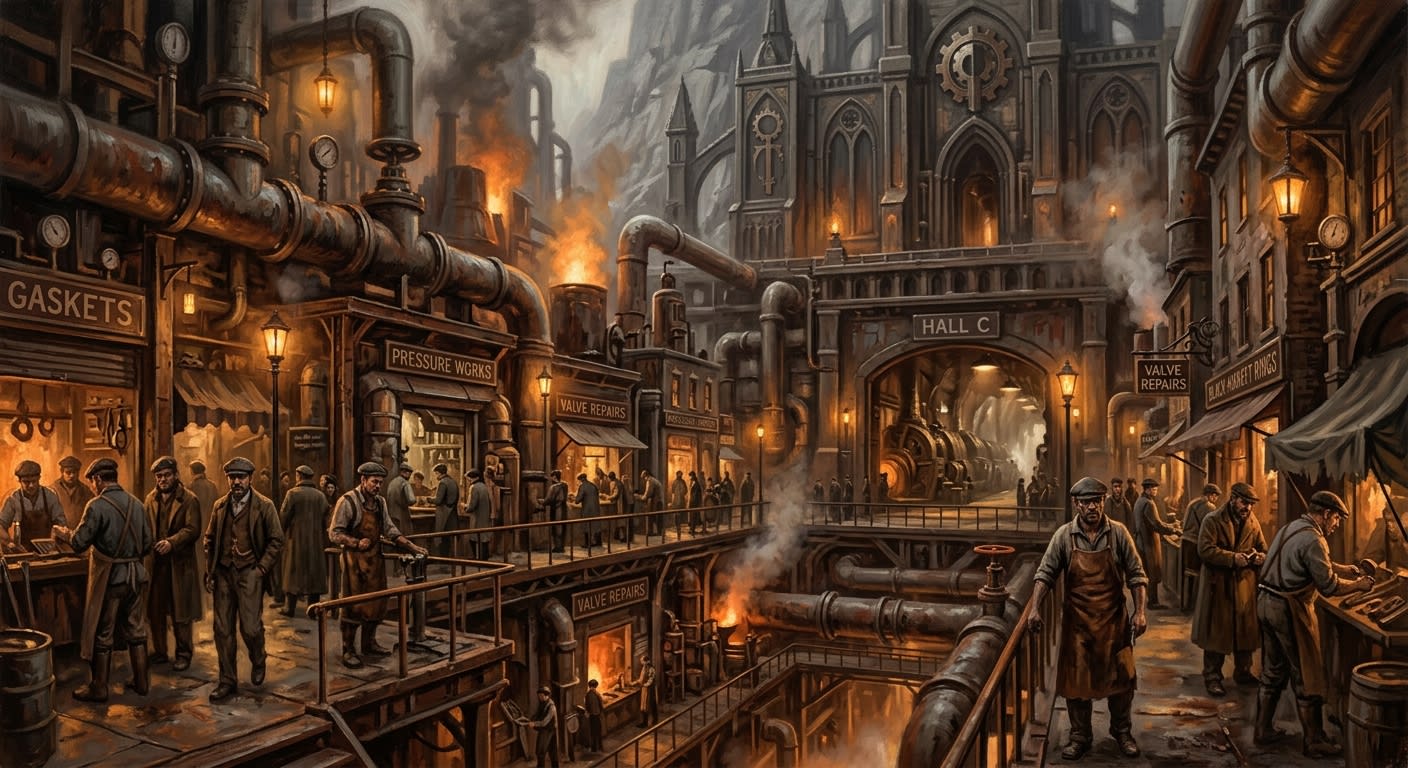
The Valve Quarter of Bastion-Irongate is the only place inside the mountain where heat may be found without a voice-license, which tells the attentive citizen everything he needs to know about mercy, labour, and the Synod's purchasing habits. Warmth is granted freely there because the work kills quickly enough to prevent laziness from taking root.
It lies along the Transit Spine after the Third Lung scar and before the freight descent, a hot side-throat of foundries, gasket shops, bolt benches, grease kettles, pressure-plate racks, throat-mark stations, and service shafts leading downward to pipes whose names change according to which Bureau is being sued. The air smells of hot oil, brass filings, ozone, tallow-wax, sung metal, wet basalt, and the sharp mineral panic of men who know a valve may decide to answer back.
Above the Quarter, the Gasket Choir sustains the fortress by calibrated breath. Below it, the Underchords buy and sell the things official systems ration too slowly to keep men alive. Beside it, the Choir Nave heaves sound through baffles into the stone. Behind it, the sealed Third Lung keeps three thousand dead pressed into masonry and lesson. Before it, the Transit Spine carries convoys, prisoners, reliquaries, ration carts, and officers with clean gloves who believe the Quarter exists to serve passage rather than to judge it.
The Quarter is not beautiful in the way commanders call Irongate beautiful: cliff batteries, chain-booms, pressure doors, commanded river, brass baffles making the Danube gorge kneel. Its beauty is lower and more insulting. A clean thread on a bolt. A gasket seated before pressure rise. A wheel turned half a notch before the gauge screams. A worker's hand withdrawing from a coupling with all fingers present, which is not common enough to become boring.
#On the Making of the Quarter
The Quarter began as a convenience and became an organ. This is how most Synod institutions are born: someone builds a bench near a problem, a clerk gives the bench a number, three men die, and by the next audit the bench has acquired jurisdiction.
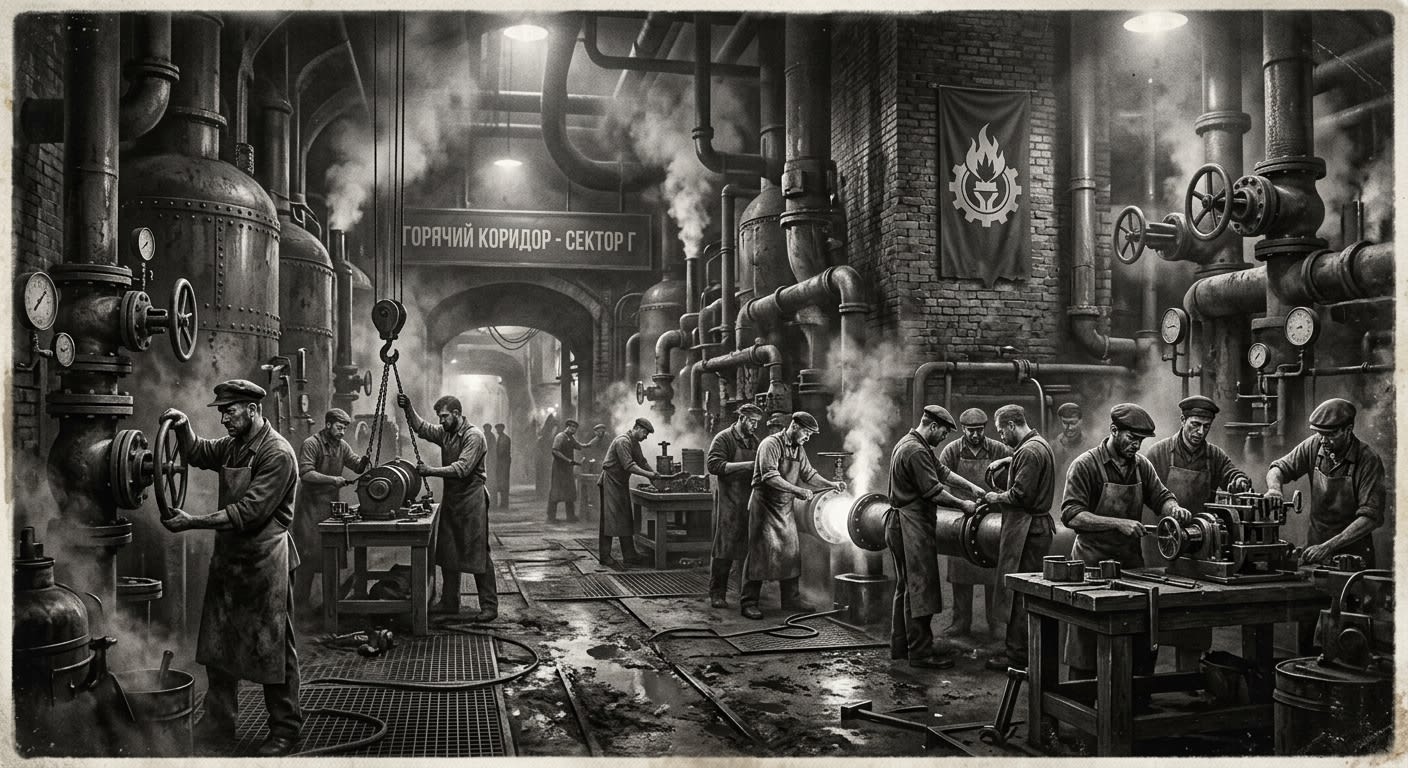
When Bastion-Irongate was first bored after the A.S. 67 garrison designation and the A.S. 72 ratification of the permanent works, Engineering placed valve shops near the pressure doors for ordinary reasons. The mountain was cold. Metal moved badly. Gaskets cracked when carried through frost. Bolts lost their obedience between forge and seat. A hot shop placed close to the load-bearing apparatus reduced failure, delay, and the number of foremen required to invent excuses.
Then came the Great Hush of A.S. 94.
Nine hours of silence loosened doors, slacked seals, unseated bolts, and compacted the Third Lung into a single administrative argument with three thousand bodies inside it. The pre-Hush shops had been treated as ancillary. Afterwards, no one with lungs and rank dared use the word ancillary again. The Quarter was expanded under the A.S. 95 recovery schedules and folded into the A.S. 97 voice-and-pressure regime, when Irongate confessed by deed, though never by grammar, that prayer and engineering were now one apparatus.
Early Engineering diagrams describe the Valve Quarter as “support works, non-primary.”
Corrected after the Third Lung collapse. A district that keeps pressure doors from becoming tombstones is primary, whatever the old ink says. The old ink has been retained for instructional humiliation.
The first permanent foundry row was cut into the basalt by crews who slept in the First Lung and coughed black by winter. Bell-sleeves were added to the ceilings so approved tones from the Choir Nave could be felt in cooling metal. Grease kettles received prayer racks. Bolt benches were numbered by saint and diameter. Pressure plates were stored upright in heated slots like ceremonial shields, because Engineering denies superstition until gravity, heat, labour, and terror make superstition efficient.
By A.S. 101, the Quarter had its own shift bells. By A.S. 112, its foremen were allowed to countersign emergency gasket requisitions without waiting for Strasbourg. By A.S. 134, after the Ossuary Breach Winter filled adjacent trades with stone dust and bone-lung, its workers had acquired the grim distinction of being indispensable enough to be mourned only after replacement.
#On Heat, Sound, and the Machinery of Obedience
A visitor entering from the Third Lung bypass feels the Quarter before he sees it. The cold leaves the face first, then the hands, then the moral certainty that warmth is benevolent. Catwalks cross overhead between pressure housings. Chains descend through haze. Wheels stand along the walls in ranks: red-handled, black-handled, brass-rimmed, bone-tagged, sealed, half-sealed, cursed in pencil, blessed in wax, and one unmarked wheel in Valve Hall C (Unregistered) that answers to a forbidden hum and should not be mentioned near apprentices.
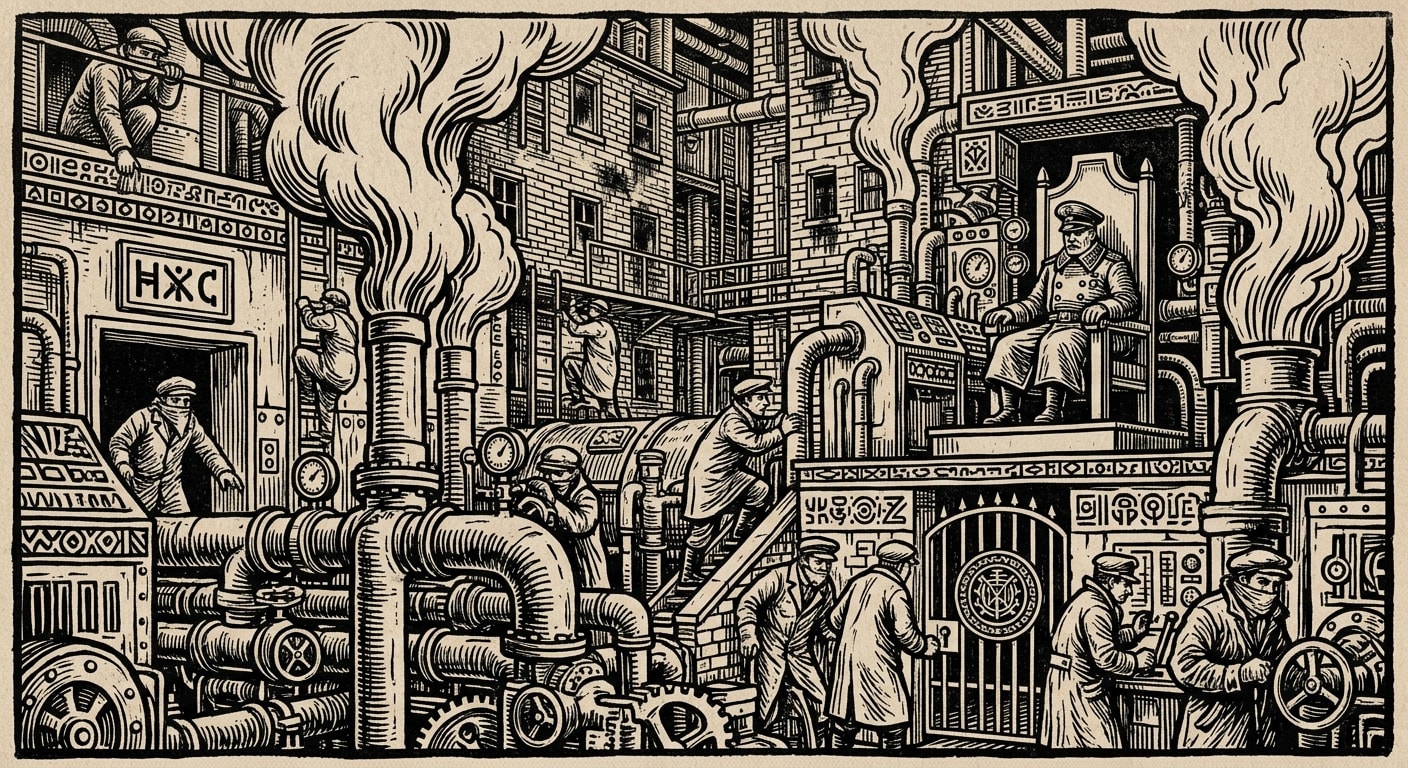
The foundries run on schedules tied to the Choir watches. Certain gaskets cool during the low mourning tone. Certain bolt seats are hammered only while the fifth harmony is present in the floor. Certain pressure plates receive their final seating mark when the gauge needle trembles under a specific stanza from the Choir Nave. The Gasket-Hymn Mechanics insist this is procedural. The Diesel Resonance Plumbers insist this is practical. Doctrine insists it was always devotional. All three are paid in different ledgers, which prevents violence in committee.
The Quarter's labour hierarchy is simple enough for a tired man and cruel enough for a Bureau. Clamp boys carry hot fittings and learn which burns are worth reporting. Wax hands mix seal compounds and lose fingerprints before they lose innocence. Gasket smiths cut and seat brass-rimmed rings. Valve riggers climb housings during live pressure and pretend the shaking is ordinary. Pressure readers watch needles as confessors watch mouths. Harmonic listeners kneel beside pipes with ears wrapped in oilcloth and report knocks, pings, whines, late echoes, and the little three-beat taps that no training manual admits.
The Quarter keeps the fortress movable. Without it, the Transit Spine becomes a throat that cannot swallow. Pressure doors jam. Freight descent locks seize. Choir resonance has nowhere to seat. The Breatheries lose regulated air. The Underchords lose stolen fittings, and criminal markets deprived of supply become creative in load-bearing walls. A single week of Quarter failure would not simply inconvenience Irongate. It would force the mountain to decide which rooms remain rooms.
#On the Workers Who Keep Their Hands Near Hell
The men and women of the Valve Quarter occupy a status the Synod reserves for useful hazards: watched, underpaid, ritually thanked, medically abandoned, and praised in sermons no official expects them to attend. They live by heat rather than comfort. Their clothes stiffen with grease. Their hair smells of burnt wax. Their teeth take on the faint green-black edge that Medicine attributes to mineral exposure and workers attribute to listening too long to pipes that dislike them.
A Quarter shift begins with the throat-grease rite: two fingers of sanctioned oil touched to the neck. The invoice calls this devotional preparation. The body knows better: oil keeps dust from cutting the skin where collars rub during heat work. Workers touch the image of Saint Vellum of the Valve before descent. Hagiography does not recognise him. The workers recognise him by not dying whenever his icon's hand is painted correctly on the wheel.
The Quarter's canteens serve brine broth thickened by flour, grain bricks warmed on safe plates, pine tea from Snowmouth (Unregistered) bundles, and fat when the foremen have stolen skilfully. A man with real butter may buy silence, affection, or a bolt team. A woman with throat lozenges may command better terms than a junior magistrate. Citrus peel arrives in sealed convoy consignments for licensed voices and vanishes into Quarter hands within hours, where it is cut into shavings so thin they resemble communion for rats.
Injuries are catalogued with the tenderness of a meat scale. Valve bite: hand caught in a reversing wheel. Brass cough: inhaled filings during hot cut. Grease fever: vapour sickness after kettle bloom. Saint's Thumb: crushed end digit preserved because the glove held. Bell jaw: locked mandible after standing too long beside a tone-fed cooling rack. Stone-dust spit needs no poetry. It arrives black, then grey, then red, then absent, because the worker has moved to the Breatheries or below.
The Quarter is one of the few warm districts open to the unlicensed, and that fact turns compassion into trap. A failed singer stripped of heat allocation may survive by taking valve work. A debt-marked labourer may clear fees by accepting live-pressure shifts. A quarantined worker whose candle test has fallen below threshold may be reassigned to grease kettles “temporarily,” which means until collapse, confession, or misplacement. The Quarter accepts those the Choir cannot use. It uses them differently.
A Breath Office circular describes Valve Quarter labour as “vocally non-dependent.”
Amended. The labour is vocally expensive in ways the candle test fails to count. Men who do not sing still breathe. Men who breathe in the Quarter pay through the lung.
#On Gasket-Rings and the Honest Coin of Illegality
The small brass gasket-ring is the Quarter's most influential export after survival. Officially it is a washer: stamped with pressure rating, date, alloy mark, batch hand, and inspection notch. In practice it is coin, token, bribe, relic, key, apology, passage fee, and occasionally wedding pledge among people whose romances have learned to respect portability.
The Underchord Cartel uses gasket-rings because coin rings falsely, paper softens, and names on chits become liabilities when the Hush Court grows hungry. A ring can sit under the tongue during inspection. It can pass through a pipe in a cloth twist. It can be justified as work stock when found in a pocket. It has worth above and below, which makes it more honest than most currencies.
No one admits the flow. Foremen lose boxes to miscount. Wax hands overcut by two percent. Clamp boys sweep slowly. Inspectors accept batch shrinkage because the alternative requires explaining why a perfect inventory coincides with dead workers in corridors that official maps declare sealed. The Quarter bleeds rings into the Underchords the way a body bleeds warmth into cold stone: constantly, deniably, and with decreasing surprise.
Gasket-rings buy counterfeit voice-licenses, oxygen bulbs, quiet passes, stolen hymn pages, dead routes, false maintenance chits, and the brisk, ugly mercies by which men avoid being converted into weather outside Snowmouth Gate. Tap-King Jaro did not invent the economy; he disciplined it. Mira Slate, if she exists in the manner Purity fears and Records cannot bill, governs the silence after payment. The Quarter supplies them both. This is public fiction, private knowledge, operational necessity, and a confession no office will sign.
The same rings feed the Counterkey Circle. Reed acquired gasket grease from the Quarter before he burned his voice out over a forge and made silence into doctrine. Alen Rill writes temperature-adjusted harmonics that account for heat rising from the Quarter and pressure falling near the Third Lung. The Hidden Alcove notation answered older scoring with the confidence of a man who has listened to pipes from the wrong side of law. None of this could happen without Quarter material: grease, rings, stolen wax, cast-off plates, scrap brass, discarded throat marks, and the old worker knowledge that official hymnals never print because workers would charge for it.
#On Valve Hall C and Other Truths Not Printed on Tours
Every district has a room that disproves its brochure. The Valve Quarter has Hall C.
Hall C is listed in public maintenance maps as a pressure control gallery serving three bypass throats, two freight-lock bleed channels, and a service return toward the lower Underchords. This is accurate in the narrow way a skull is a hat stand. Hall C contains the unmarked wheel, seven sealed gauges, a wall of blackened saint tiles, and a descending pipe column whose knocks do not match any approved pressure index. Workers spit before entering. Foremen deny instructing them to spit. Engineering issues fresh sawdust for the floor every six days because the old sawdust clumps around the central drain in patterns resembling script.
VALVE HALL C INCIDENT EXCERPT — A.S. 199 — ENGINEERING/PURITY JOINT SEAL Shift: Third heat. Worker assigned: ███████ Marn, Wax Hand, temporary live-pressure clearance. Action recorded: subject hummed while lifting kettle chain. Gauge response: seven needles turned left against stop. Unmarked wheel rotated one quarter by no visible hand. Audible phrase from drain: █████████████████████████████. Casualties: none. Subject disposition: transferred to Hush Court, then to records category ███████. Operational ruling: Hall C remains active.
The unmarked wheel is the Quarter's central superstition, which means it is an unfiled procedure. It is never turned during normal operations. It has no handle tag. Its spindle enters stone behind a brass plate whose screws have been painted over with seven coats of inspection wax. During pressure weather, senior riggers stand near it with palms open, not touching, waiting for heat from the rim. If the rim warms, the Third Lung bypass is slowed. If it cools, freight descent is cleared. If it vibrates in pairs, the Choir Nave receives a low-tone request without written order.
The Bureau of Engineering does not recognise this practice. The Choir Magistracy condemns it as folk procedure. Tunnel Command (Unregistered) knows the convoys pass when the riggers obey it. Doctrine, in its wisdom, has recorded nothing and allowed the workers to remain alive, which is the highest form of endorsement available when all available explanations are dangerous.
Hall C also marks the border between the Quarter and the Underchords in practice, though no official doorway acknowledges the relationship. Service throats behind the grease store descend into crawlspaces mapped by tap-code. Oxygen bulbs move through cracked inspection panels. Recalled hymn pages return with stains not present when issued. A worker may enter Hall C with a broken license and leave with a quiet route, a new batch mark, or no trace the Breath Office is willing to defend under oath.
#On Counterkeys, Heat, and the Argument Inside the Stone
The Counterkey Circle’s quarrel with the Choir Magistracy passes through the Valve Quarter because every argument about sound inside Irongate eventually requires metal. A frequency is piety when sung in the Nave, sabotage when scratched in grease below, and engineering when a valve seat holds because someone knew which hum to avoid while the fitting cooled.
Reed’s destroyed voice began in Quarter heat. The story is now recited in Underchord signs and Hush Court charges: license revoked A.S. 196 for ice-lung Grade Three; gasket grease acquired from Quarter workers; grease heated until it smoked; throat seared; official compulsion ended; heresy began speaking in silence. The Bureau finds this melodramatic. Workers find it legible. A system that uses voices until they fail should not be astonished when failure develops theory.
Alen Rill's progressions sharpen the danger. Reed writes protest. Rill writes adjustment. His sequences change as corridors change: heat rising from the Quarter, damp thickening under baffles, pressure falling by the Third Lung, cart thunder passing overhead, and the little thermal swell that comes when Hall C opens a bypass no diagram admits. He does more than oppose the Magistracy's key. He measures the conditions the official key ignores.
That is why the Circle frightens serious men. Treason with bad mathematics is police work. Treason with good mathematics is a rival office.
The Quarter workers hate the Circle, shelter it, mock it, feed it, and fear it in proportions impossible to print. A Circle cell can unseat seals and kill everyone. A Circle cell can also teach a mechanic which official stanza has been wrong since the A.S. 164 standardisations and which repair will hold if the hymn is shortened under emergency heat. Field knowledge does not respect doctrine's little fences. It climbs through them with dirty boots.
The Choir Magistracy answers with audits. Purity answers with arrests. Engineering answers by quietly copying confiscated counterkey fragments into sealed technical appendices and then denying the appendices exist. The Quarter answers by keeping the wheels turning and the grease warm.
#On the Present Condition
As of A.S. 201, the Valve Quarter runs beyond tolerance, below staffing, above heat schedule, under suspicion, and inside a fortress that cannot afford to learn how close the tolerances have become. Its foundries feed the Transit Spine. Its gasket shops patch the Choir's dependencies. Its rings enrich the Underchords. Its grease writes heresy. Its workers keep breathing because the alternative has not been assigned a shift bell.
The Breath Office has expanded candle testing after the A.S. 199 lung-rot outbreaks, which means more failed singers arrive at the Quarter seeking hot work and a way to remain indoors. Cantor Ys Varr has tightened license audits, which means more throat cases fall out of the Choir and into labour queues. Commandant Hadrik Sorn has increased denial drills, which means live-pressure cycling at hours when ordinary districts sleep. Morwen presses the Irongate with imitation, replacement, and envy; the Quarter replies by dulling reflective brass, covering gauge glass when not read, and assigning pairs to any wheel polished enough to hold a face.
Shortages have worsened since A.S. 200. Purity wax is late. Brass stock arrives underweight. Throat lozenges vanish between Bratislava and Snowmouth, reappear below, and are purchased back at four times tariff by offices that denounce smuggling in the morning and survive by it at dusk. Ward Eight of the Breatheries requires fittings the Quarter cannot spare. The Dead Gallery surveys require salt-rubbed chains issued from Quarter stores. Hall C requires sawdust, silence, and lies.
The official status reads: operational.
Operational is a lovely word. It means the dead have not yet outnumbered the forms. It means the doors have closed when ordered, opened when bribed by pressure, and held when sung to. It means no convoy has been crushed this week in a manner requiring cathedral bells. It means the under-market has supplied what requisition failed to move. It means a worker with black spit reported for third heat because his daughter still has a bunk in First Lung. It means the mountain remains hollow, resentful, useful, and warm in the place where men put their hands into its anger.
The winter stock audit has already begun badly. Batch 17-K arrived with forty-three rings short, three over-stamped inspection notches, and one washer bearing a date from A.S. 94 in a crate packed last month at Bratislava. The quartermaster blamed copy error. The foreman blamed theft. The oldest wax hand spat into the cooling trough and said the Great Hush was asking for its fittings back. That answer has no legal value and great practical value, which is why no one repeated it near a clerk.
There is a ledger in the foreman's office listing every wheel by tag, hall, service line, pressure relation, last turn, and last human injury. It is the most honest book in Irongate because it was never intended for Doctrine. The injuries are written without euphemism: thumb gone, eye boiled, jaw locked, cough black, hand fused to rim, heard name in pipe, refused return, returned anyway. Records would improve these entries until no blood remained. Engineering would convert them into causal categories. The foreman leaves them blunt because blunt entries keep apprentices frightened in the correct direction.
A boy newly assigned from the First Lung once asked why the Quarter keeps so many broken wheels hanging above the canteen. The answer given was tradition. The better answer is education. Each broken wheel has a tag: pressure surge, false calm, bad hymn, wet wax, proud rigger, cheap brass, no witness. Men eat beneath them with bowls cupped in scarred hands. The wheels do not comfort. They supervise.
The women of the bolt benches keep a second calendar by burns. Ordinary dates belong to Bells and Records. Burn dates belong to skin. Mina of Hall B remembers A.S. 198 as the year the western bypass spat blue flame across her left forearm and wrote a line there no chaplain could read. Old Carst remembers A.S. 178 by the counterfeit wax that failed during a Shipka shipment and took two nephews, one eye, and his patience with Purity lectures. Sera Knuckle remembers no years at all after her jaw locked under the seventh harmony; she counts by apprentices trained and apprentices buried, which is more accurate than most official chronology.
The Quarter's children learn pressure language before catechism. They know a good hiss, a bad hiss, a wet knock, a dry knock, a saint-knock, a Jaro-knock, and the thin repeating tick that means everyone should leave the corridor without waiting to discover whether the tick has doctrinal permission. School primers call this superstition and then send inspectors to ask children what they heard before adults admit the gauge moved. Childhood in the Quarter is a catechism of useful fear: do not touch brass that hums; do not whistle in a stairwell; do not look into oil deep enough to return a face; do not accept a warm ring from a stranger unless the stranger has fewer fingers than you.
There are marriages in the Quarter. There are songs, though most are tapped against cups or hummed with lips closed to avoid fines. There are jokes about Hall C, which stop when the floor warms. There are funeral meals where the dead man's bowl is filled with brine and set under a broken wheel until the shift bell, after which someone drinks it because waste is impious and grief does not improve soup. There are love tokens made from rejected brass, worn under shirts where Purity cannot decide whether they are contraband, jewellery, or informal pressure stock. The wisest lovers choose rings stamped with low ratings. High-pressure rings invite comments from the married.
The Valve Quarter does not save Irongate. It prevents Irongate from admitting how often it needs saving.
A recent Engineering bulletin praised the Quarter as “a model of disciplined industrial devotion.”
Revised for private circulation. The Quarter is a model of coerced competence, sanctioned improvisation, black-market dependency, occupational sainthood, and heat applied to terror until terror takes a thread. Industrial devotion may be restored to the sentence when the Bureau pays for new lungs.