
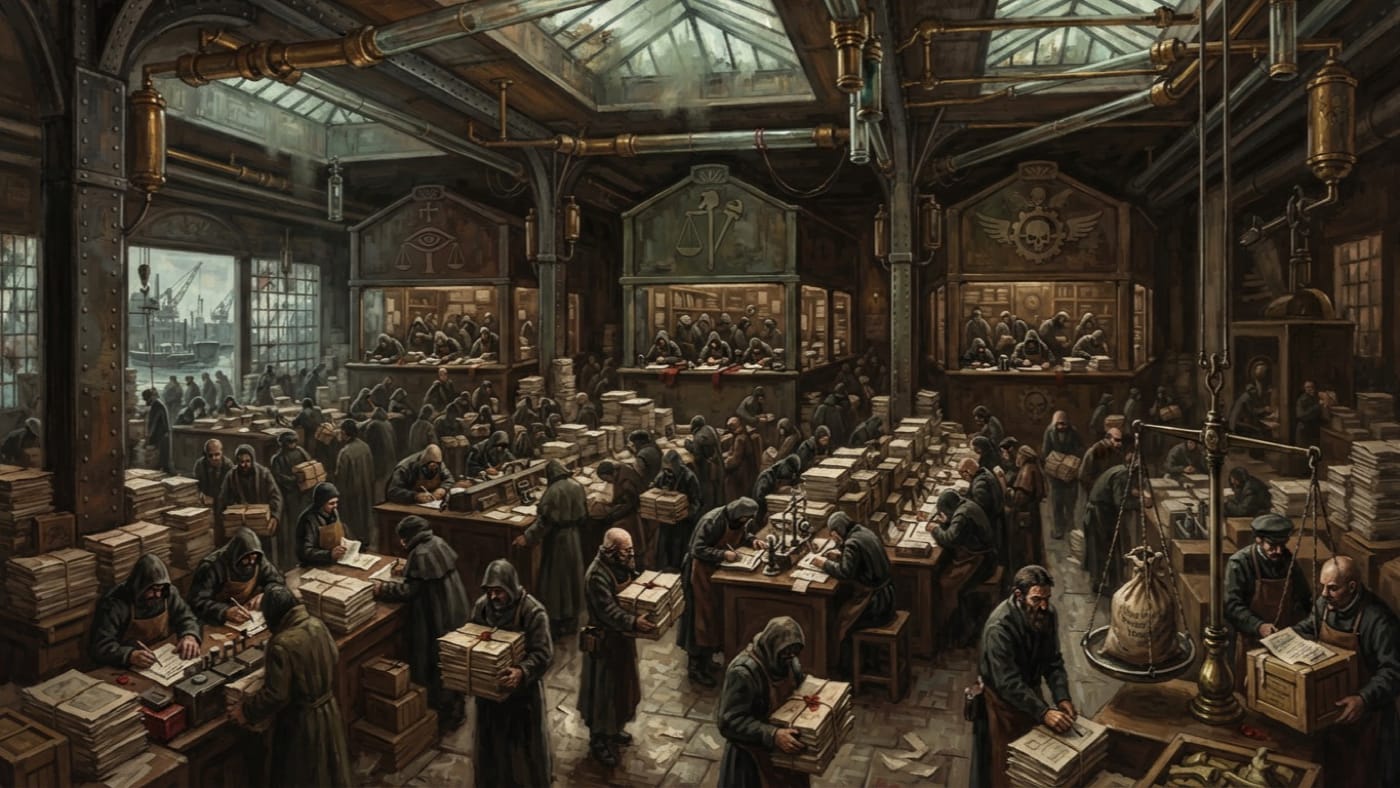
#On the Quarter's Station
Marseille keeps four quarters, and the Canebière pays for the other three. The Vieux-Port has its antiquity and its streets too narrow for enforcement wagons. The Cathedral Quarter has Saint-Victor's bells. The Eastern Basin has the pilgrim fleet, the relic dealers, and an office of the Bureau of Shadows that local children use for giving directions. The Canebière has desks. Behind the desks sit the merchant houses and shipping offices through which the city conducts its legitimate trade. Above them, in an arrangement no surveyor has been asked to draw, sit three competing Bureau offices. I have described their supervision elsewhere as watchful disinterest, and I see no cause to amend the phrase.
No file shown to me records the quarter's boundaries. Its function is on record. Iberian grain, North African phosphite, Sardinian iron and Sicilian sulphur cross the harbour as cargo, and at some hour each sack, crate and hold must also become paper. The Canebière is where the paper is made. The harbour moves the goods. The Canebière moves the description of the goods, which is the more delicate operation and the better paid.
The merchant asks one thing of the Church's administration: that the cargo leave. The offices ask one thing of the merchant: that the cargo first be known. It must be named, weighed, assessed, owned and permitted, in that order or in whatever order the presiding clerk prefers that morning. The quarter conducts its business between those two demands, at about the speed of cooling wax.
#On the Merchant Houses
A merchant house in the Canebière is a counting-room with a reputation attached. It trades in correspondence: letters of consignment from Iberian factors, drafts drawn against Genoese banking houses, harbour receipts, and copies of copies, each sealed by someone who will deny it if the cargo goes astray. The partners rarely see a ship. They see manifests, and they read them the way a confessor reads a penitent. They look for what the document omits.
Take a representative consignment. I give it as an illustration and cite no recorded case. Grain arrives described in a factor's hand as wheat, forty-two sacks, dry. The Tariff-Chapel weigher puts the load on scales calibrated against reliquary fragments and finds forty-one sacks that agree with the description and a forty-second that is wet. The weigh ticket now contradicts the manifest. In the Synod's port practice a contradiction between documents is a question of identity, and identity belongs to a Manifest Litigant. The litigant will argue at length, with precedents, whether dry was a description, a warranty or a prayer. While the argument proceeds, the wheat waits and storage is charged. The wet sack has become a wet docket.
Outbound cargo travels the same road in reverse. A dispatch requires a declaration of ownership, a stated destination, a weigh ticket and an assessment of dues. If passengers travel with the goods, it also requires the attention of whichever authority counts souls. The house gathers these papers into a bundle tied with cord. A courier carries the bundle from office to office and collects seals the way a pilgrim collects blessings, at about the same cost and with less spiritual return.
A house is judged by its bundles. A slack cord, a smudged destination or a seal impressed at a slant will cost a tide. A house that loses enough tides loses its correspondents. Then it loses its name, because in the Canebière a name exists only as a signature that other men's clerks recognise.
#On the Three Offices
Three. The number is fixed, and it is my own number, set down in my own hand. I have recorded no identities and will record none here. A codex entry that names an office assigns it a jurisdiction, and in Marseille any jurisdiction assigned in the morning has been contested by vespers.
Anyone holding a plan of the harbour's administration will make guesses. The harbour divides its work plainly. The Bureau of Pilgrimage holds passenger manifests, the Bureau of Tithes holds cargo assessment, and the Bureau of War holds military shipments. That division governs the water. Whether the Canebière's desks follow the same proportions is a question for whoever is paid to ask it, and I am paid for other questions.
The effect can be stated. A cargo that needs three seals needs three queues, three sets of hours and three opinions on what makes a signature legible. When the offices agree, the cargo moves. When they disagree, the cargo is described in greater detail.
The rivalry between Pilgrimage and Tithes makes agreement expensive. The Salt Dues were imposed in A.S. 92 as a temporary surcharge on coastal trade for the Iberian campaigns, and they remain temporary. The Bureau of Pilgrimage has filed its opposition every year since A.S. 94, on the ground that the Dues raise the cost of embarkation. The Bureau of Tithes has noted each filing. Every merchant house in the quarter pays the Due. Any house freighting goods toward a pilgrim departure also pays for the quarrel, because its cargo concerns both Bureaus, and each Bureau's clerks treat the other's seal with the professional courtesy of rival undertakers.
The memorandum of A.S. 167 forbids personnel of either Bureau to borrow, lend or accept as a gift any writing implement or fluid from the other. The prohibition extends to chalk, to wax, and to the margins of shared documents. A bundle that crosses both counters therefore needs two pens, two sticks of wax, and margins broad enough that neither annotation can be charged with trespass on the other. Prudent houses keep their own wax. Imprudent houses learn which wax is whose.
#On Legitimate Trade
In the Canebière, legitimate is a term of art. It means a cargo with a declared owner, a recorded weight, an assessed due, and a receipt for each of them. It says nothing about the merchant's soul. The soul is assessed elsewhere, at another rate, and the Great Ledger does not accept bills of lading.
The receipt is what makes the difference. A merchant who holds a receipt owns a cargo. A merchant who has lost it owns a rumour. The Tithe Assessor treats an unreceipted cargo as unpaid, the litigants treat it as unidentified, and the dock quarter treats it as available. The Canebière's whole art is to keep the cargo in the first category for as long as the voyage lasts.
Marseille has other trades, and they keep their own addresses. Relics are authenticated at the Quai Saint-Lazare, and the dealers trade between the harbour and Saint-Victor. The Demon-Glass Polishers keep their shuttered workshops in the eastern harbour district. The Black Ledger has its two confirmed cells in the dock quarter. None of these addresses is in the Canebière. The Canebière takes care that this is written down, signed and witnessed, and it renews the record whenever a magistrate shows interest.
I make no accusation against the merchant houses as a class. I observe only that a smuggler and a Canebière merchant both want the same thing, a cargo that moves without delay. The merchant pays to be asked questions. The smuggler pays to avoid them. Both are paying, and the Bureau of Tithes has never shown much curiosity about which payment it receives.
#On the Present Condition
This account draws on the Marseille survey sealed in A.S. 201. It certifies no new inspection of the quarter and reports none. The quarter's present condition is commerce, and the war keeps that commerce busy. Every escalation along the Sagittal Line raises demand for what passes through the southern mouth, and that demand reaches the Canebière as more paper. Pilgrim departures for Thessaloniki add more: provisions to be declared, freight to be assessed, and passage contracts that cross the line between the Bureau that counts goods and the Bureau that counts souls.
Genoa competes for the shipping contracts and the naval commissions, and the competition sharpens every pen in the quarter. A house that loses a tide to a quarrel over sealing wax may lose a consignment to the Ligurian coast. The houses know it. The offices know it too, and they find the knowledge less pressing.
The fleet-count arbitration convened in A.S. 199 has issued no ruling. Its question is whether return voyages are separate departures for the purpose of harbour dues, and the Canebière follows it closely, as anyone would who has paid harbour dues on a return voyage. The Salt Dues remain temporary. The three offices remain three. Cargo leaves Marseille every day, and it leaves fully described.