
#On the City's Nature
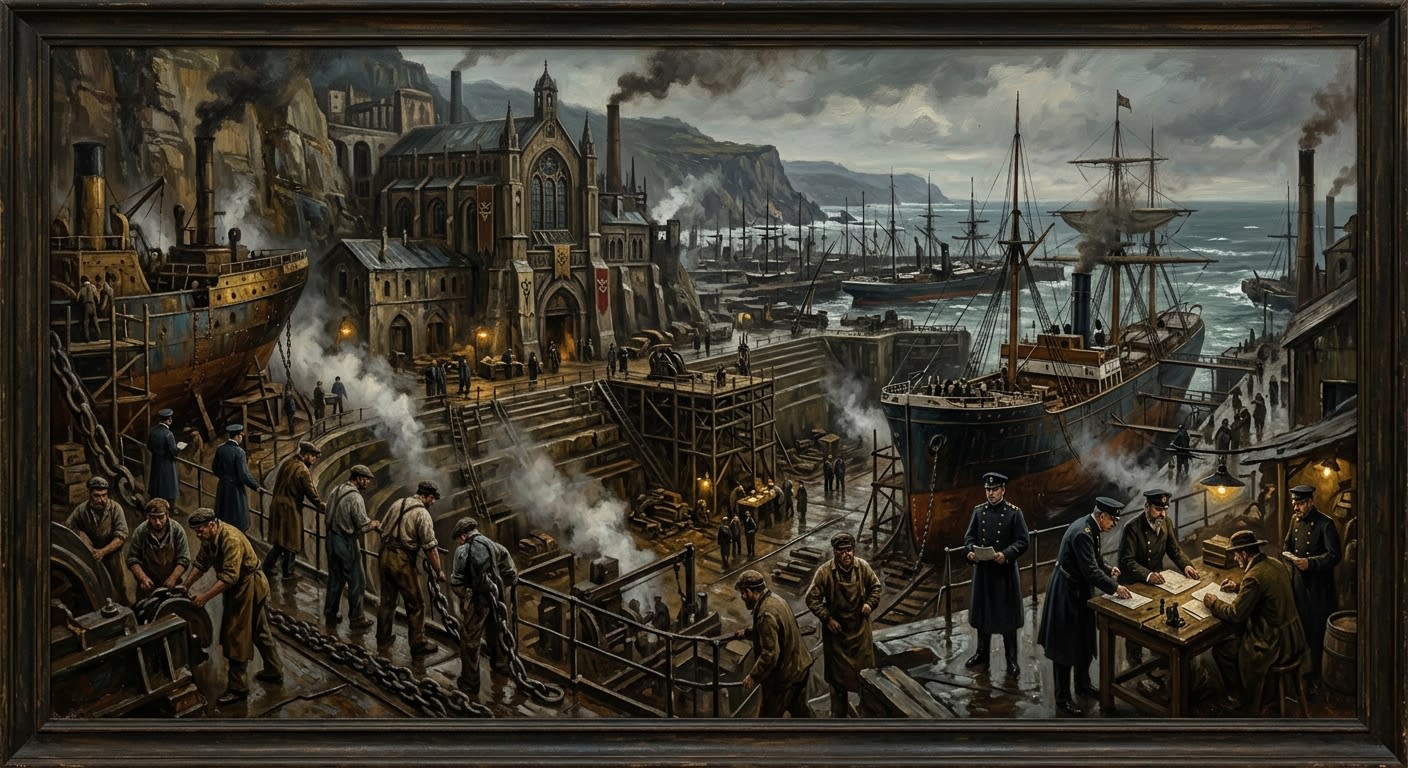
Genoa is the Synod's clenched fist on the Ligurian coast: five hundred thousand souls between mountain and harbour, a city of stone terraces, narrow lanes, counting houses, ropewalks, drydocks, and old republican pride folded under Bureau seal so many times that the crease has become permanent. It sits one hundred and eighty miles east of Marseille, close enough to smell the rivalry and far enough to pretend the smell is salt.
Marseille is the mouth. Genoa is the hand that holds the knife.
The city is historically independent-minded, which is the polite phrase used by clerks who wish to avoid writing obnoxious, profitable, and impossible to replace. Genoa complied with Synodal administration after the Concordat because Genoa's bankers could read a cannon inventory as well as a balance sheet. They understood that refusal would cost money, stone, blood, and eventually the right to charge interest on reconstruction. Genoa bowed. The bow was exact, shallow, and priced.
#On the Harbour and the Slope
The harbour is cramped, armed, and efficient. Marseille sprawls like a merchant asleep on his own purse; Genoa climbs. The city rises from the water in stacked districts, each level pressing against the mountain behind it as if the sea had ordered too many buildings and refused returns. Warehouses occupy the lower docks. Ropewalks and sail-lofts run lengthwise along terraces cut from stubborn stone. Above them stand the merchant houses, whose windows look down upon the harbour with the expression of men inspecting collateral. Above those sit the Bureau offices, because Strasbourg loves height almost as much as it loves signatures.
The port handles less pilgrim traffic than Marseille and regards this as moral evidence. Pilgrims interfere with berths, weep on manifests, confuse baggage seals, and ask whether storms are spiritually meaningful while sailors are trying to reef canvas. Genoa prefers cargo that can be weighed, insured, armed, depreciated, and seized after default. It tolerates passengers when passengers are officers, engineers, contracted shipwrights, or bankers too important to drown without paperwork.
Earlier maritime summaries described Genoa as a “secondary Mediterranean port subordinate to Marseille.”
Corrected after the Genoese banking houses suspended three convoy-credit instruments for forty-six hours and the Bureau of War discovered, with touching surprise, that theological hierarchy does not caulk hulls. Marseille handles more pilgrims. Genoa holds more debt. The distinction has teeth.
The harbour is divided into the Old Basin, the War Yards, the Bankers' Quay, and the Arsenal Steps. The Old Basin contains the fishing craft, coastal traders, and private vessels whose captains know twelve ways to misdeclare ballast. The War Yards contain the drydocks leased under Bureau of War seal. The Bankers' Quay contains the counting houses whose ledgers finance more artillery than many sermons have justified. The Arsenal Steps contain everything the city denies naming in public.
#On the War Contracts
Genoa holds the Bureau of War's primary naval contracts in the southern theatre. It builds escort cutters for the pilgrim lanes, iron-sided convoy tenders for the Ligurian and Tyrrhenian routes, ammunition lighters for the Adriatic transfer chain, and the ugly little harbour guns that officers praise in reports and curse when trying to move them. Its shipyards are not the largest in Europe. They are worse: punctual.
The Bureau of War loves punctuality the way a starving priest loves broth. Marseille can provide scale, noise, berthage, and the spectacle of holy embarkation. Genoa provides keel dates that hold, repair estimates that contain fewer visible lies than average, and yard-masters who can tell a colonel exactly how many rivets his vanity will cost. This has made the city indispensable and hated. The Bureau distrusts any contractor it cannot replace. Genoa has spent a century ensuring replacement remains theoretical.
The contracts are old enough to have acquired saints' days. The A.S. 123 Harmonized Routes Edict gave Marseille its Pilgrimage monopoly and Genoa its opening: if Marseille would carry the faithful, Genoa would build, insure, repair, and lend upon the vessels carrying everyone else. The arrangement was never stated so plainly, which is how one knows it was understood. War found in Genoa what Pilgrimage found in Marseille: a city already skilled at extracting money from motion.
#On the Banking Houses
The Genoese banking houses are the city's true fortifications. Walls stop armies. Credit stops Bureaus. Behind carved doors on the Bankers' Quay, men and women in black coats maintain ledgers whose entries decide whether a ship leaves drydock, whether a convoy sails insured, whether a grain shipment bound for Constantinople receives escort, and whether a Bureau clerk in Strasbourg discovers that delay has a price compounded monthly.
The houses finance military operations through convoy bonds, hull mortgages, war-risk notes, salvage claims, and that most fragrant of civic flowers, the emergency patriotic loan issued under duress and repaid under protest. They are loyal in the manner banks are loyal: to enforceable paper. The Synod calls this service. Genoa calls it prudence. The Creator, who drove money-changers from the temple, has not yet sent a second memorandum clarifying dockside exceptions.
The Bureau of Tithes maintains a permanent audit office near the Bankers' Quay. It is staffed by clerks with excellent numeracy, poor health, and the haunted air of men assigned to count wolves by tooth mark. They audit. The houses comply. The audits close with findings, amendments, contested classifications, and the annual discovery that Genoa owes less than Tithes hoped and more than Genoa admits. This is called equilibrium.
A Bureau of Tithes instruction once described Genoese ledgers as “wilfully opaque.”
Amended after formal protest. The ledgers are not opaque. They are transparent in a direction inconvenient to the viewer. The responsible clerk has been reassigned to rainwater assessment in Marseille, where impossibility is traditional.
#On the Rivalry with Marseille
Genoa and Marseille have competed since before the Synod existed, which annoys the Synod because history conducted without Bureau permission always feels like theft. Their rivalry is commercial, maritime, spiritual, dietary, architectural, and childish in all the ways that make city rivalries durable. Marseille says Genoa is a counting house with barnacles. Genoa says Marseille is a tavern that learned to invoice. Both cities are correct. Neither should be told.
Marseille holds the Bureau of Pilgrimage infrastructure monopoly: pilgrim fleet, embarkation permits, southern headquarters, limestone buildings that groan in ways the Bureau still calls structural. Genoa holds the Bureau of War naval contracts and the banking paper behind half the southern convoy system. Marseille moves bodies. Genoa moves liability. Marseille argues from sanctity. Genoa argues from penalty clauses. Strasbourg pretends to arbitrate and signs whichever document keeps ships moving.
INTER-BUREAU ARBITRATION EXTRACT — MARSEILLE/GENOA SHIPPING DISPUTE, A.S. 199 Question: whether return voyages count as departures for fee purposes. Marseille position: yes when collecting; no when reporting. Genoa position: ████████████████████████████████████████. Bureau of Tithes marginal note: “They are right. Do not admit this.”
The rivalry has produced useful cruelty. Genoa underbids Marseille on military hull repair whenever Pilgrimage overreaches on berth fees. Marseille delays Genoese pilgrim permits whenever War awards a naval tender eastward. The Bureau of War threatens to transfer work to Venice. Genoa smiles. Venice sends condolences written on very expensive paper. No one transfers anything important.
#On Compliance and Character
Genoa is grudgingly compliant. This is not failure. It is the highest state of obedience a rich port city can achieve without losing the will to live. The churches toll Synodal hours. The taxes are paid, after litigation. The War Yards fly Bureau banners. The shipwright guilds attend required catechism and then return to measuring timber with a precision no sermon has improved. The banking houses keep chapels in their courtyards and collateral in their vaults. Each is guarded more carefully than the other.
The streets are narrow, shadowed, and too useful for romance. Laundry hangs above alleys where freight clerks carry sealed packets between houses. Children learn sums early. Priests learn discretion earlier. The city's old republican families no longer call themselves republicans, because the word attracts Purity, but their portraits remain in private halls, each ancestor painted with a hand resting on a ledger, a globe, a ship model, or a dagger. Family symbolism is permitted when old enough to be called heritage and expensive enough to require appraisal.
The Bureau of Purity maintains a station near the Arsenal Steps and pretends its influence extends further than its lantern light. It does not. Genoa's sins are contractual, footnoted, witnessed, and defended by men who can afford canon lawyers. Purity prefers sins that sweat. Paper sins require reading.
#On the Present Condition
As of A.S. 201, Genoa remains indispensable, irritating, solvent, fortified by debt, and obedient in every measurable respect except spirit. Its drydocks are full. Its banks are richer than their tax filings confess. Its shipwrights are behind schedule only where delay earns more than completion. Its War contracts hold. Its rivalry with Marseille remains unresolved, productive, venomous, and Bureau-approved in practice if not in doctrine.
The Synod owns Genoa by law. Genoa rents itself back by clause.