
#On the Instrument
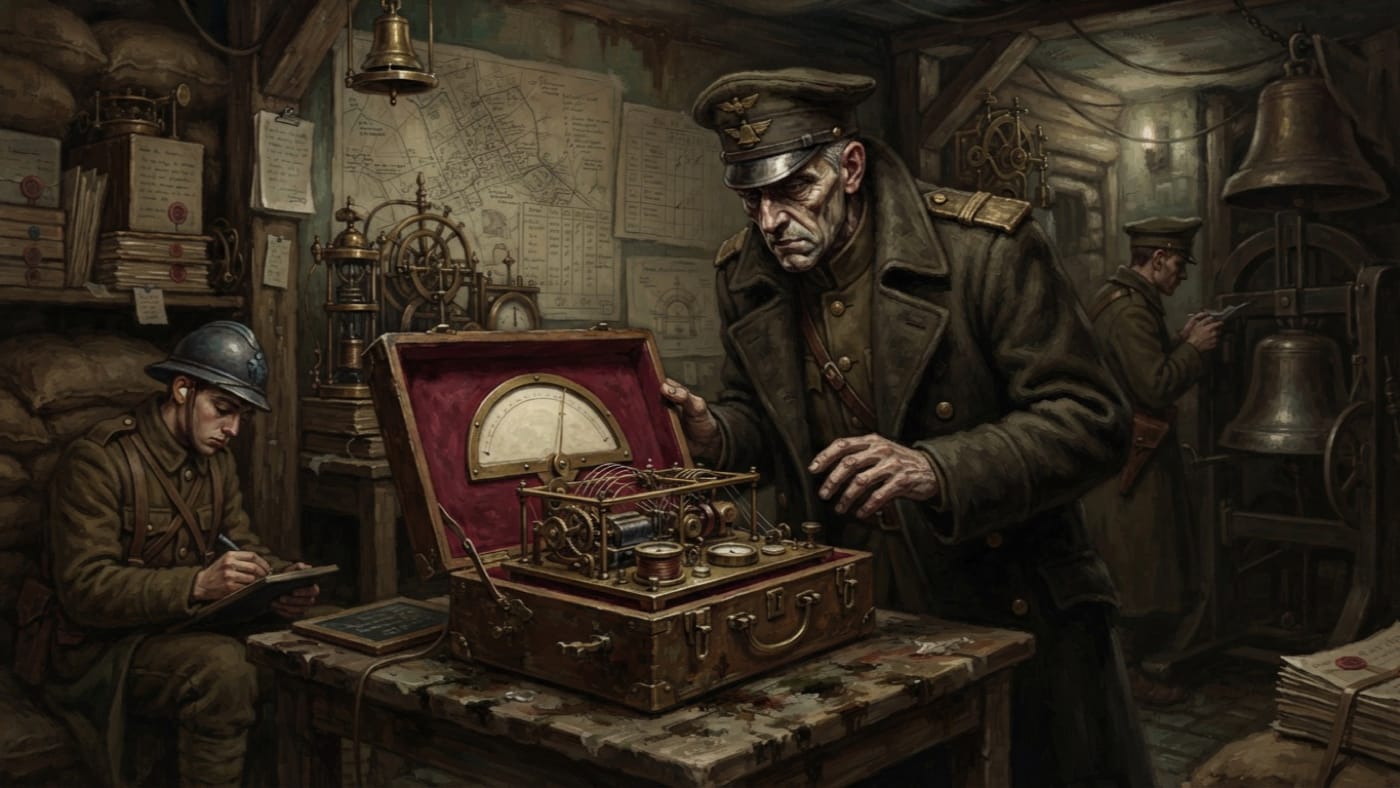
The Cantor's Gauge is made of brass and hair-thin wire. The Bureau of Bells keeps it, and it trembles toward discord. That is the whole of its public description. I give it in full at the outset so that no clerk can say I embellished before I had even begun.
It exists to tell a bell-master when the sound has gone wrong. The one plain sentence on record says that it measures resonance degradation. A civilian reads that phrase and turns the page. A trench regiment reads it and checks its wax. Along the Sagittal Line a bell is an order. Men rise, fire, eat, confess and are buried by peal. When the peal degrades, the order degrades with it, and the soldier who obeys it does so with immaculate discipline, straight into the wrong trench.
The Gauge's subject is that second kind of failure. A Pale Chanter takes away a man's will to obey. Prayer-Jam corrupts the thing he obeys. The first is a matter for Doctrine, the chaplains and the firing squad. The second goes into the ledger of brass and wire, because the Line found that sound can betray an army even when every soldier in it is still willing.
#On Brass and Wire
The Gauges travel in felt-lined cases. I mention the felt because the Bureau of Bells treats it as an article of faith. A soldier at the front sleeps on duckboards in water up to his ankles. His rifle is wrapped in sacking, and his rations are wrapped in whatever the rats refused. The Gauge rides in felt. Any man who wants to understand the Synod's priorities need only compare the two packing lists.
Inside the case are the brass and the wire. The wire is described as hair-thin. When discord is present it trembles toward it. No credentialled witness has recorded anything further. The record gives no scale, no sensitivity, no calibration sequence, no maker, no workshop, no year of first issue, and no rule for reading one tremble against another. Some field officers have taken "toward discord" to mean the wire points at the enemy. They are wrong. It points toward a judgment, and that is a different thing from a bearing. Men who fire on a judgment's bearing tend to hit their own support trench.
Only an officer of the Bureau of Bells may touch a Gauge. A colonel may not. Engineering may not, though Engineering would very much like to. I may not either, and I do not need to touch it to write about it. That arrangement keeps the instrument safe from clumsy hands, and it keeps the Bureau's methods away from anyone who might ask questions. The Bureau does not say which of the two benefits it values more.
#On the Bell-Master's Work
The Gauge does not work alone. It sits among the bell-masters' tonal maps and frequency schedules, in the procedures that grew out of the Office of Bells' constitution of A.S. 52 and were fixed by the Bell Codex at its ratification in A.S. 115. Neither date has anything to do with the Gauge. I give them so that no reader imagines the Codex was written around it.
Bells are the prescribed answer to Chanter resonance: the Ninefold Matins at triple volume, the Iron Vespers held beyond their liturgical window, the Silentium reversed into a roar. The bell-master works the ropes. The Gauge tells him whether the result is still holy. It doesn't silence a counter-hymn, sound a protective tone, mend a cracked bell or ring anything at all. It measures. The bell-master is the one who has to act.
A measurement is also not a confirmation. In jam conditions no order on the Line is valid until two separate media and a living witness agree on it: bell, ink, lamp, flag, slate or runner. A steady wire does not make a peal trustworthy. It only removes one reason for doubting it. Officers who confuse the two have been buried with full honours and a short service.
#On Vienna's False Peals
Every bell-master learns from the Vienna file, and every bell-master claims never to have opened it. I mean the A.S. 190 acoustic action at Vienna. It must not be confused with the Siege of Vienna of A.S. 95, which belongs to an earlier century of grief and has its own folio.
In A.S. 190, during a confirmed counter-hymn action, the Bureau of Bells did everything the catechism told it to. It ordered the Matins at triple volume, the Vespers past their window and the Silentium reversed. The Chanters sang through all of it. The sound bent, and the bells began to ring off-key. Men who had obeyed bells since boyhood heard "left" become "kneel" and "kneel" become "fire". Two companies fired into their own support trench. The remedy was orthodox, and Vienna proved that orthodox remedies can fail.
The bells were melted down and recast a quarter-tone sharp. Nobody credible knows why that works, and it does. The bell-master who gave the order says the instruction reached him in a dream. The Bureau of Bells has classified the dream, which is the Bureau's usual answer to anything that might need explaining.
The Vienna file names no Cantor's Gauge. No record says a Gauge detected the failure, and no record credits one with the recasting. I raise the point because a certain kind of clerk loves a tidy history, and a tidy history is always a forgery.
War Circular 191-B instructed officers to "trust the bells unless contradicted by written command."
Corrected after the Brest fog action, and carried forward here as the inherited correction. Officers are to trust the bells only when bells, ink, lamps, flags and surviving witnesses agree. Where they disagree, seniority passes to the least musical officer present.
#On What a Reading Proves
When the wire trembles, there is discord. That is all a trembling wire proves.
It does not say where the discord came from. Doctrine holds that sorcery bruises Creation and that the bruise rings wrong when a bell strikes it. Engines & Furnaces once put on paper that the Synod's own bell density correlates with the decay. That leaked memorandum of A.S. 195 has since been sealed, resealed, misfiled and quoted by every competent officer at the front. Its estimate of probability belongs to its authors, and causation remains unproved. Either way the wire shakes the same. Brass does not care whether the Great Deceiver or the Bureau of Tithes is to blame.
A still wire proves even less. The record does not establish that any reading is a safe one. A bell-master looking at quiet brass knows only that the brass is quiet. Every useful instrument has this weakness. Men trust it most at exactly the moment it has least to say.
In A.S. 193 the Bureau of Engineering deployed resonance instruments along the Irongate sector, and its findings were classified at once. Nobody has said whether those instruments were Cantor's Gauges. I won't say so either. If Engineering's equipment and the Bell Bureau's turned out to be the same, two departments would have to share a budget, and that is a fate neither would survive.
The other measures keep their own accounts. Reliquary wax protects the ear and does nothing for the order coming in. The Orison crews' saint-dust is meant to weigh down corruption in the broadcast air, and it is rationed by a Tithes office that regards salvation as a line item. Wax, dust and wire each have their own limits, and none of them makes up for the others.
#On Present Application
As of A.S. 201, Prayer-Jam is endemic along the Line. It is worst in No Man's Land, but it is found well beyond it. Field bell-batteries operate in the Irongate sector with bell-masters at the Gauge and soldiers with wax in their ears. At Irongate the chant-braced works of the Danube gorge have begun producing harmonics the Bureau of Bells cannot identify. At Shipka, Syrion's fog delays peals until dawn arrives at the wrong hour, and men who trust the bell shave by a morning that has not yet come. No Gauge reading from either place has been published to me. If one exists, it is in the felt with the instrument.
The custody stands. The Bureau of Bells holds the Gauges and the right to read them. Engineering keeps its classified findings, and the Orison crews keep their rationed dust. The infantry keeps its wax and its written orders, and it keeps the duty of dying correctly whenever all of these disagree. The Bureau of Doctrine has entered the instrument as sanctioned equipment with method withheld. I have countersigned it and filed it beside the Vienna folio.