
#On the Bell That Arms the Evening
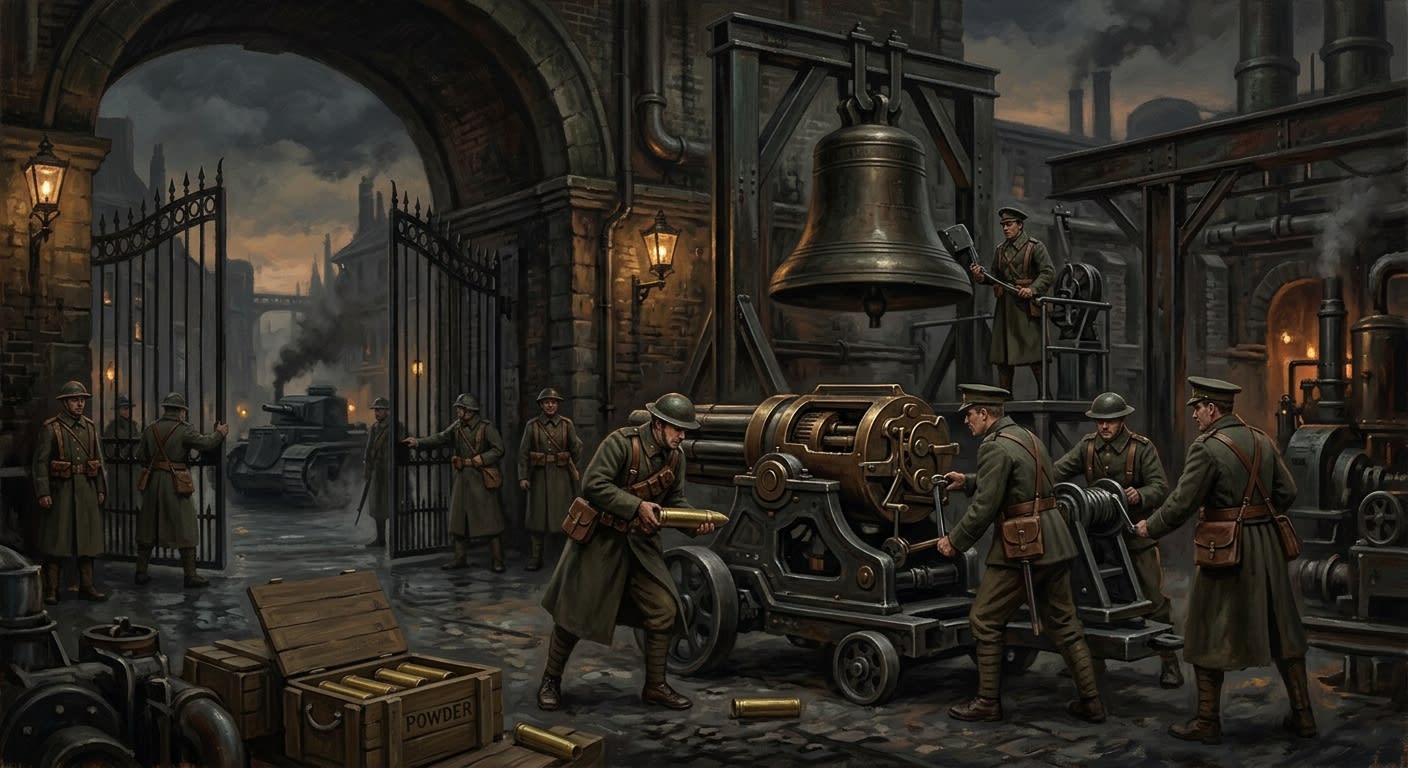
Iron Vespers is the martial peal by which the Synod closes the day without ending the war.
It begins as a sound and becomes a custody transfer. Day hands the wall to night. Civil appetite hands the street to curfew. The quartermaster hands keys to the watch officer with the expression of a man surrendering a child to a wolf that has produced references. Somewhere a boy stops being a recruit and becomes a silhouette against the parapet. Bronze performs the paperwork faster than ink.
At its simplest, because even the Bureau of Bells occasionally permits simplicity to stand in public unattended, Iron Vespers locks garrison gates and opens powder magazines. At the appointed hour, bronze speaks in the sequence prescribed by the Bell Codex: gate-bolt, watch-change, powder-key, cartridge-count, reliquary check, wall acknowledgment, final peal. Soldiers love the sequence because it replaces uncertainty with tasks. Officers love it because tasks can be inspected. Clerks love it because inspection produces forms. The Creator, whose patience with clerks remains the greatest miracle in history, has not yet objected.
The name misleads civilians. They hear Vespers and imagine candles, psalmody, a parish nave settling into gold light, old women touching rosary beads with fingers polished by grief. The Line hears something else. Iron Vespers is not evening prayer in armour. It is armour praying. It tells the garrison that the light has surrendered its supervisory function and that bronze must take command until dawn. Every hinge, shutter, lock, breech, fuse, cartridge crate, saint-dust coffer, ration hatch, and corpse gate receives its portion of the command.
The peal belongs formally to the Bureau of Bells. It belongs operationally to War. It belongs ritually to Orison. It belongs evidentially to Records. It belongs financially to Tithes whenever Tithes can insinuate itself into bell-metal procurement, which is always. Doctrine owns its meaning, of course. Doctrine owns meanings the way rats own granaries: by occupying them before anyone sensible arrives.
The civilian day dies quietly if properly managed. The garrison day dies with locks.
#On Its Place in the Codex
The Bureau of Bells insists that Iron Vespers descends from the earliest Cologne rhythms, heard in the cracked square after the Miracle and transmitted through smoke, terror, and committee procedure into the ratified A.S. 115 recension. Doctrine prefers the committee. Bells prefers the miracle. Records keeps both because contradiction, when indexed well, becomes institutional furniture.
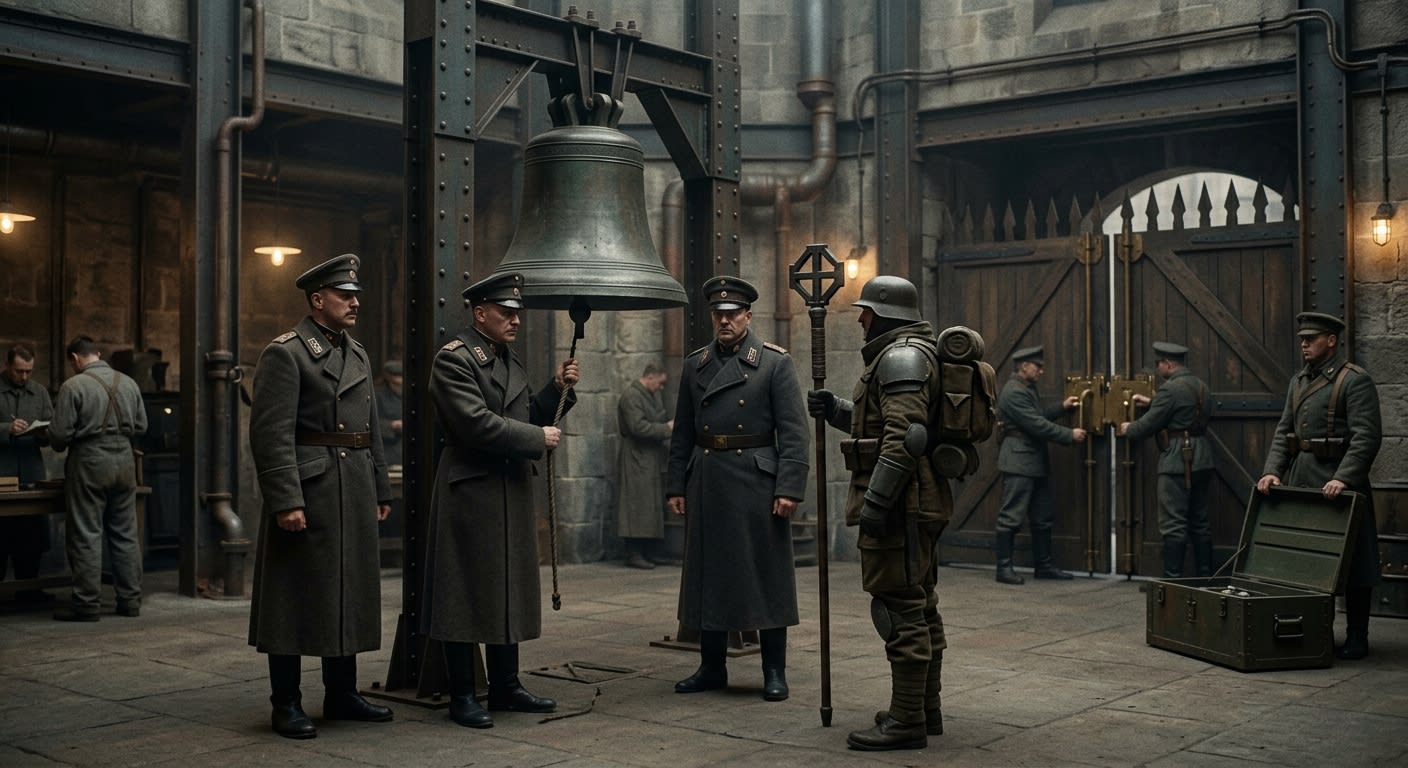
The Bell Codex groups the great peals in a sequence schoolchildren recite before they are old enough to resent rhythm: Ninefold Matins, Widow's Toll, High Angelus, Iron Vespers, Silentium. Dawn collapses into duty. Grief receives its permitted note. Noon commands recitation. Evening arms the walls. Silence swallows catastrophe. A life ordered by these peals is less lived than struck.
Iron Vespers occupies the hinge between civic obedience and military necessity. Ninefold Matins wakes the body. High Angelus disciplines the mouth. Iron Vespers commands the hand: lock, count, load, seal, watch. It does not ask whether the soldier is afraid. Fear has no place in the sequence except as the material being shaped. A bell cannot remove fear. It can put fear in formation.
The standard peal varies by bastion, because the Bureau of Bells has learned, after great pain and greater correspondence, that identical bronze does not behave identically in marsh, mountain, river gorge, fog pass, or Bosphorus wind. Brest favours a low triple opening that travels across the Bug mud without becoming laughter in the reeds. Przemyśl clips the middle interval so ridge echoes do not counterfeit magazine release. Irongate answers Iron Vespers through tunnel-mouths and the Gasket Choir until the mountain itself seems to close its teeth. Shipka rings it early during fog weeks because time near Syrion grows lazy unless beaten. Constantinople rings it through twenty-three bells suspended over the Bosphorus, and half the southern front feels the locks move in its bones.
The Codex permits local addenda, a mercy disguised as arrogance. Each addendum is written as though the tower in question were unique among all towers, which is true in the same way every condemned man is unique before Records assigns him a number. Brest claims mud absorption. Przemyśl claims ridge-return. Irongate claims pressure throat distortion. Shipka claims fog interval slippage. Constantinople claims salt-air decay, imperial inheritance, Bosphorus echo, and a dozen other grand diseases suitable to a city that has never met a problem it could not dress as destiny. Bells tolerates these claims because towers, unlike theologians, collapse when ignored.
Several frontier manuals describe Iron Vespers as a “curfew peal.”
Corrected. Curfew concerns civilians, lamps, taverns, and the appetites of the insufficiently supervised. Iron Vespers concerns powder, gates, magazines, walls, and the lawful preparation of violence. A citizen goes indoors at curfew. A soldier becomes useful at Iron Vespers.
The distinction matters because the Enemy listens. A curfew peal invites counterfeit convenience. A martial peal carries layered command. It tells men where to stand, which keys may turn, which prayers accompany powder access, which shutters close against Pale Chanter sound, which bell crews remain awake after the first watch, and which officer will be blamed if the sequence is late enough for courage to acquire opinions.
#On Gates, Powder, and the Seven Motions
Every fortified post adapts Iron Vespers to its own architecture, yet the core ritual preserves seven motions. The Bureau of Bells calls them strokes. War calls them actions. Records calls them fields. The men call them the things one does before night has teeth.
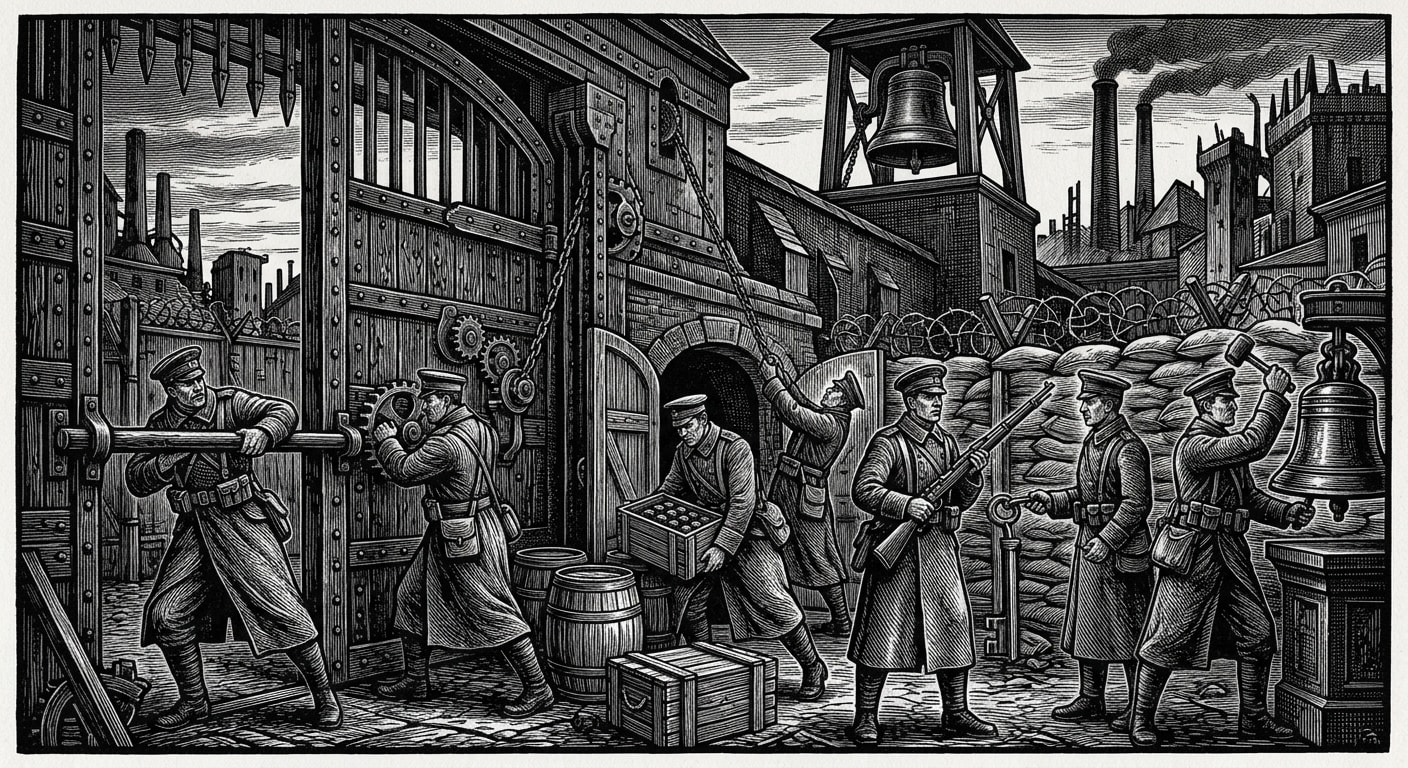
First, the Lock-Stroke. Outer gates close. Portcullises descend. Chain-bars slide into brackets polished by a century of anxious hands. Any person outside the gate at the Lock-Stroke becomes a petition, a casualty, or a lesson according to rank, weather, and paperwork.
Second, the Count-Stroke. Watch captains count men, cartridges, lanterns, stretchers, field telephones, reliquary seals, and those small private charms soldiers are not allowed to possess and officers are not paid enough to confiscate. A missing man before Count-Stroke is absence. A missing man after Count-Stroke is dereliction. The difference has killed more clerks than demons, though I speak here with admiration.
Third, the Powder-Stroke. Magazine keys may turn. Powder ledgers open. The air changes at this stroke; every veteran knows it. Oil, metal, saltpeter, wax, sweat, and the dry papery smell of authorised death. Boys become quiet. Old soldiers become sarcastic, which is their version of prayer.
Fourth, the Relic-Stroke. Reliquary covers are lifted. Saint-dust packets are checked. Bell-metal earplugs are issued in sectors threatened by Pale Chanters. Chaplains bless ammunition in batches too large for sincerity and too small for logistics. The blessing counts. Sincerity rarely does.
Fifth, the Wall-Stroke. Parapet crews answer by horn, flag, lamp, or secondary bell. At Brest the answer runs along brass-ribbed trusses. At Przemyśl it climbs ridge stations. At Shipka, where fog pockets swallow sound, the answer may be tugged through rope-lines by men who work deaf with reliquary wax in their ears. The wall acknowledges the evening and receives custody of the night.
Sixth, the Witness-Stroke. Records confirms that Iron Vespers has occurred. A bell not recorded is a rumour. A powder chest opened under rumour is mutiny. A gate locked under mutiny is, under certain conditions, initiative. Records exists to prevent commanders from discovering too many conditions.
Seventh, the Final Peal. No one moves without permission after it. The garrison has become an object: locked, armed, counted, blessed, witnessed, dangerous. This is the desired condition of every Synodal institution and most Synodal marriages.
Training for the seven motions begins before recruits are trusted with powder. They practice on dead keys, wooden cartridges, empty reliquaries, and bells too cracked to command anything larger than a washroom. The instructor rings, the recruit touches, turns, counts, seals, or freezes. Wrong motion earns a baton across the knuckles. Late motion earns the same baton with commentary. A recruit who anticipates the Powder-Stroke is treated with special tenderness, by which I mean he is made to sleep beside a locked chest for three nights while veterans whisper fire-prayers through the boards.
#On Debrecen and the Smoke-Hand
Iron Vespers would remain a garrison convenience, beloved by bell-masters and quartermasters, had Captain Elias Brekke not ordered it rung at Debrecen.
Between A.S. 78 and A.S. 83, during the Blightmarsh pushes (Unregistered) east of Constantinople, Brekke's Radiant Fusiliers found the Pit of Debrecen (Unregistered): seventy Ash-Mothers chained inward around a central pyre into which infants had been thrown. The ground breathed. The bell-choir heard the breathing before the scouts saw the stone lip. Smoke rose from the pyre in the shape of a hand and clawed the sky for eleven minutes.
Brekke ordered Iron Vespers.
Consider the decision. It was not evening by the strict schedule. It was not a garrison wall. No gate stood to be locked. No magazine required formal opening; the Fusiliers were already under arms. A lesser captain would have ordered a volley and later claimed necessity. Brekke reached for the Codex. He took a peal built for closure and turned it against a ritual aperture. He made evening fall on the pit.
The regimental bell-choir struck Iron Vespers while the Fusiliers formed three ranks along the rim. They did not fire into the women. They fired into the pyre, into the chains, into overseer sigils cut into stone, and into three things that emerged from smoke wearing the faces of children who had never lived long enough to receive names. The hand withdrew when the third sustained peal held. Its shadow remained on the ground for six days.
Bureau of Rites classified the event as Category Four Manifest Sorcery, Ritual Origin. Bureau of Medicine classified the mothers beyond clinical assessment. Bureau of War classified intelligence value moderate, proving again that War can stare into Hell's pantry and ask whether the shelves are strategically relevant.
DEBRECEN ANNEX — IRON VESPERS FIELD VARIANT Bell-choir strength: ███ Peal duration: eleven minutes / thirteen by survivor count / seven by War summary. Smoke-hand response at third sustain: recoil; digit loss; ground shadow retained. Phrase heard beneath final stroke: ███████████████████████ Captain Brekke ordered repetition. Two bell-men bled from both ears and complied.
After Debrecen, Iron Vespers acquired emergency extensions. The Codex never admits improvisation when amendment will do. The Debrecen Variant (Unregistered) permits Iron Vespers outside vesperal hour when a field commander encounters hostile ritual infrastructure involving gates, pits, pyres, wombs, smoke columns, or sorcerous apertures requiring martial closure. The list began short. It grew, because Hell is imaginative and the Bureau, when frightened, becomes encyclopedic.
The first training broadsheet for the Variant was atrocious. It showed a smiling Fusilier captain ringing a handbell beside a pit rendered as a neat black circle, while little arrows indicated “hostile aperture,” “sorcery smoke,” and “maternal assets.” I ordered the sheet burned on aesthetic grounds before Mercy could object on moral ones. The replacement sheet contains only the peal sequence, the authorising clauses, and a warning that any officer using Iron Vespers to end an ordinary argument will be cashiered, flogged, and assigned to hear bells from inside the tower.
Brekke vanished into Candlewick inventory after A.S. 84. Iron Vespers did not. A man may be filed away. A useful peal is harder to bury.
#On Pale Chanters and the Bell Against the Unhymn
The Pale Chanters taught the Synod that sound can be murdered without becoming silence.
Their counter-hymns do not break bone. They evacuate purpose. Soldiers remember the rifle, the order, the finger, the drill, and forget what firing is for. At Prague in A.S. 167, on the Night of Silent Steel, Radiant Fusiliers stood loaded beneath banner-light while seven Chanters inverted the Kyrie from seminary ruins. The command came. No volley followed. Forty-three men died with rifles unfired. War filed command miscommunication. Soldiers filed the truer version in their mouths and stopped saying it near officers.
Iron Vespers became a countermeasure because it is the peal most nearly shaped like command. Ninefold Matins wakes. High Angelus interrupts. Silentium devours. Iron Vespers orders action under threat. When the Chanters begin their unhymn, Bell-masters may sustain the martial sequence beyond the vesperal window, hammering Lock, Count, Powder, Relic, Wall, Witness, Final into the garrison mind until action remembers itself.
An A.S. 169 cadence-table supplement claimed Iron Vespers “drowns Pale Chanter song in all field conditions.”
Corrected after Vienna. Iron Vespers disrupts, anchors, or delays counter-hymn effects under favourable conditions. It does not guarantee immunity. Guarantees belong to theologians, merchants, and other dangerous entertainers.
The most effective applications use physical acts paired to strokes. At Lock, men grip the rifle. At Count, they touch cartridges. At Powder, they open the pouch. At Relic, they touch saint-thread. At Wall, they sight forward. At Witness, they repeat the officer's name. At Final, they fire if ordered. The bell drags the will through stations of obedience. Even a hollowed mind may follow a groove if the groove is bronze and loud enough.
Bells have failed. At Vienna A.S. 190, Chanters sang through peals and bent sanctified bronze off-key. The bells were melted and recast a quarter-tone sharp. No one explains why this helps. The Bell-master claimed a dream. Doctrine classified the dream. Engineering measured the new tone. Bells classified the measurement. Progress marched onward in blindfold and boots.
Iron Vespers now travels with saint-dust lacing in Orison broadcasts, with reliquary wax issuance, with gesture commands for deaf crews, with counter-toll drills, with warning cards pasted inside garrison chapels: IF THE EVENING RINGS AT NOON, OBEY EVENING. Soldiers understand. Civilians ask questions. This is why soldiers survive more often than civilians in properly managed disasters.
The Orison engineers have proposed a sung accompaniment to reinforce the sequence in men whose ears are packed with wax. Bells hates the proposal because it smells of jurisdictional theft. Orison insists the human voice can carry command through bone and breath where bronze fails. Bells replies that bronze fails only when misused by singers. War, with rare wisdom, has ordered both Bureaus to continue quarrelling while soldiers test the method in trenches. The early reports show improved motion compliance and increased nightmares involving bell-ropes made of tongues. Medicine requests more data. Medicine always requests more data; one day it will request a soul sample and call the jar preliminary.
#On Unauthorized Vespers
No powerful command remains uncounterfeited. The Enemy studies bells. Rebels borrow bells. Local idiots ring bells because local idiocy is the one resource the Synod has never needed to requisition.
Unauthorized Iron Vespers is among the Bureau of Bells' most feared civic crimes. A false ration bell creates annoyance. A false curfew creates arrests. A false Iron Vespers arms men and locks gates under hostile grammar. It can empty streets, open magazines, trigger watch transfers, expose powder keys, strand patrols outside walls, and persuade nervous officers that night has legally begun. One proper peal in the wrong custody can do the work of a saboteur battalion.
The Night of Borrowed Curfew at Cologne taught the Bureau that lawful grammar in hostile hands remains grammatically lawful to trained citizens. Iron Vespers poses the same danger with ammunition attached. Bell-masters keep counter-signals sealed under triple chain. Garrison bells require dual custody. Clappers are inspected for filings, wax plugs, curse-scratches, sympathetic cuts, and those tiny doctrinal modifications beloved of men who think treason improves when miniaturised.
Punishments for unauthorized Iron Vespers vary by intent. Error earns scourging, reassignment, or corrective deafness if the offender is useful. Malice earns Purity. Successful counterfeit earns a special tribunal, because ordinary courts cannot be trusted near a crime that made them obey. The bell itself may be melted, exorcised, recast, renamed, or promoted. Bells, unlike men, often emerge from scandal with better appointments.
BUREAU OF BELLS INCIDENT LEDGER — FALSE VESPERS, SITE █████ First stroke accepted by west gate. Second stroke opened powder hatch. Third stroke answered by tower not present on city plan. Counter-peal attempted; clapper split lengthwise. Casualties: ███ Disposition of bell: retained for study; study personnel rotated monthly; one returned speaking only in gate commands.
The Bureau insists that no enemy force has fully mastered Iron Vespers. This is comforting. It is also phrased with the slippery elegance of a clerk who has placed three knives under the cushion. Fully mastered. Enemy force. Iron Vespers. Remove any one of those terms and the denial limps.
Counterfeit prevention has become its own priesthood. Bell-Custodians sleep in rooms built around clappers. Counter-Toll Operators learn to murder a false tone before it finishes crossing a courtyard. Tower boys polish ropes under witness, then sign that no knot has changed its theological intention. In Strasbourg, three bells used for martial sequences have had their names sealed, because the Bureau believes a bell whose name is known can be bribed by sorcery. I mocked this until a nameless bell refused to ring for an Archon of Tithes (Unregistered). Now I mock it more cautiously.
#On the Men Who Hear It
A bell peal exists in doctrine, but doctrine has no ears. Men do.
Ask a veteran what Iron Vespers means and he will not say “martial-vesperal garrison closure.” He will say: the gate shutting behind the last patrol. The smell of powder unlocked. The priest walking too fast. The lieutenant counting twice because his hand shook the first time. The sound of a friend outside the wall calling after the Lock-Stroke and no one moving to answer. The relief when the Final Peal sounds and one more day has become somebody else's accounting problem.
Iron Vespers divides the garrison into before-night and after-night. Before-night, men gamble, complain, write letters, mend socks, curse soup, oil rifle bolts, remember women, invent blasphemies against quartermasters, and pretend the eastern dark is only weather. After-night, every object has rank. Rifle above cup. Cartridge above letter. Bell above voice. Order above thought.
Chaplains teach that Iron Vespers sanctifies vigilance. Sergeants teach that it prevents fools from wandering into wire after dusk. Both teachings save lives. The chaplain's version writes better. The sergeant's version works faster.
In rear cities, the peal has become theatre. Children mimic it on kettle lids. Factories strike tin plates at shift-end and call it little vespers until Bells fines them. Tavern singers work the rhythm into marching songs with the Powder-Stroke replaced by a bawdy pause; Purity objects to the bawdy pause, Bells objects to the rhythm, and War objects to nobody because soldiers need taverns more than moralists admit. The tune survives in alleys, naturally. Suppressed tunes breed in alleys the way rats breed under grain offices.
Families near the Line arrange supper around Iron Vespers. Mothers pause when it rings. Fathers count sons by reflex. Widows hear the Lock-Stroke and remember who failed to come inside. Children learn that evening is not when light fades. Evening is when bronze says the walls have taken custody.
#On Present Use and Future Misuse
As of A.S. 201, Iron Vespers remains active across all seven bastion sectors, all major garrison towns, most forward magazines, selected inland arsenals, and several institutions that have no military function but enjoy sounding important. The Bureau of Bells tolerates the last category when fees are current.
The peal has grown heavier in recent decades. Pale Chanter numbers rise. Shipka fog interferes with timing. The Fractured North refuses harmonisation. Counterkey cells study bell grammar. Orison broadcasts carry saint-dust through air that increasingly dislikes obedience. War wants more emergency authority. Bells wants stricter custody. Records wants duplicate logs. Tithes wants surcharge authority on all martial peal maintenance. Doctrine wants the matter to sound inevitable.
The chief danger is not failure. Failure can be corrected, buried, blamed on wet rope, bad bronze, local sin, or a clerk's regrettable enthusiasm. The danger is that it will work for the wrong hand. A garrison trained to obey bronze may obey bronze when bronze lies. A magazine opened by lawful sequence does not inspect the soul of the ringer. A gate closed at the proper stroke does not ask who benefits from closure.
The Bureau knows this. It has known since Cologne. It has known since Prague. It knew at Debrecen when Brekke used the peal outside its hour and saved what could be saved by violating the schedule with such disciplined reverence that the violation became precedent. Every command strong enough to rescue a line is strong enough to betray it.
Tonight, at the appointed hour, Iron Vespers will ring from Strasbourg to Brest, from Przemyśl ridge to Irongate tunnel, from Shipka fog to Constantinople's west tower. Gates will lock. Powder will open. Men will touch cartridges in the dark and remember, because bronze tells them, what their hands are for.
I will hear it from my office if the wind is right and the Cathedral is in one of its obedient moods. The first stroke will pass through glass, paper, wax, and bone. Somewhere below me a clerk will pause mid-sentence and hate himself for pausing. Somewhere above me a Bell-master will count decay with lips moving silently. The city will become, for seven strokes, a garrison pretending to be a capital.
Somewhere east of the Line, a Pale Chanter will hear the peal and shape its mouth around the answer.