

#On the Calling
"The schedule is a god with no face." — Rope-Ferry Chain proverb
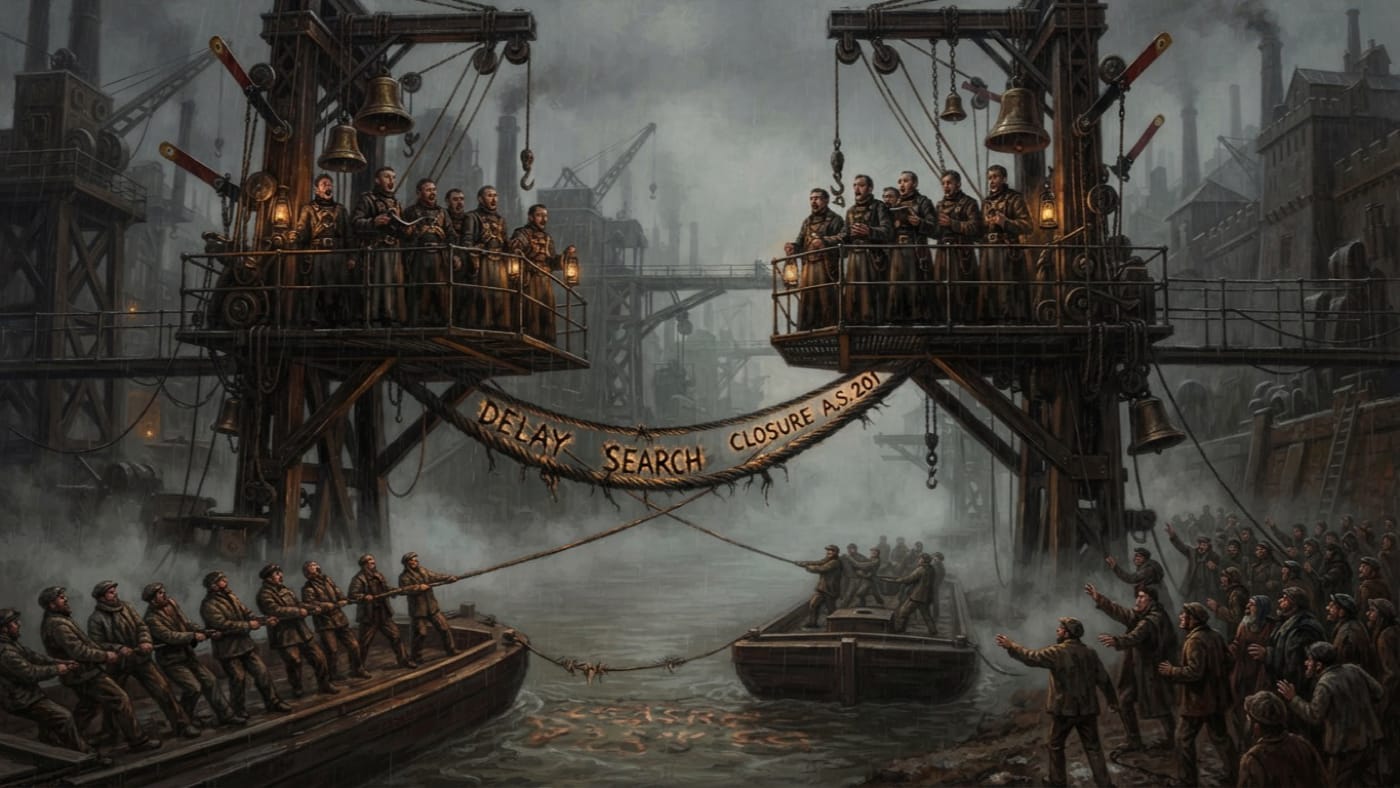
Somebody has to give the schedule a mouth. On the Rope-Ferry Chain that office belongs to the Schedule Choir. It is a sanctioned guild of callers who stand on the timber gantries at the major nodes and sing the timing calls that let twelve barges move without killing one another. It is the least decorative choir in the Church. Its hymnal is a timetable, and its vestry smells of tar.
The work is physical first. A flat-bottomed barge hauled across on a hemp mainline needs the haulers on both banks to take the strain together and the hands at the iron pulleys to let off together. The next ferry down the reach has to hold until the first has cleared. Fog takes away sight. Wind takes away flags. Pulley noise swallows a shouted order whole. A sung call carries over all three because it is pitched, measured and repeated, and a crew that has heard it ten thousand times leans into the rope on the beat before the mind has finished hearing it.
I have stood beneath the gantries and heard it: the breath drawn, the held note, the groan of the block, the cable lifting out of the river and dripping. Grain moves on that note. Conscripts move on it. Coffins come back on it.
#On the Schedule
"Flow is mercy." — Inscription above the Ink Dock
The schedule itself lives at Ink Dock. There the clerks issue time permits, stamp the queue and post the day's crossings. There, too, Superintendent Halvick Sorn keeps the master closure slate, a single oak board written in charcoal and locked in a floorbox beneath the Ink Dock Hall. Whatever the slate says opens and closes the river. Sorn holds it. By his own account and everyone else's, he has not lost a single unscheduled minute in twenty-three years.
Between that board and the water stands Gantry Tower Row, where the Chain does its signalling with bell-lines, lamps, smoke and voices. The day's crossings are read out to the gantries, the gantries turn them into calls, and the calls turn them into hauling. Lamp oil, damp paper and hoarse throats are the Row's whole economy. The Chain's own file records that the choir keeps the lantern codebook there. A sung call and a lamp flashed into fog do the same job, and someone must keep the book for both. The file names the keeper. It says nothing about what the keeper reads in that book after curfew, and I decline to fill the gap.
This gives the Choir an odd place in the Chain's anatomy. Slate, rope and cage belong to others. The Choir holds the moment of execution. Every closure Sorn writes reaches the river through a throat on a gantry, and a throat can be slow, loud, grieving or devout in ways no charcoal mark specifies.
#On the Rope's Corrections
Then the rope began to write, and a guild of timekeepers found it had been training for theology all along.
The River Ledger needs only a short account here. In fog dense enough to wet hemp, the mainline cables darken from within. The darkening resolves into names, numbers and dates, and the river later makes them true: drownings, arrests, cargo short by the very weight the rope had printed. Manifestations have increased since A.S. 199. In the winter of A.S. 200 a single event at the Bend Ferry, Node Seven, called the Throat, wrote fourteen names. The Throat has the fastest current on the Chain, the drowning cages and the thickest writing. Its gantry is the worst place on the river to stand and sing.
The Choir calls these manifestations divine scheduling corrections. That is their doctrine, offered without any ruling from my Bureau, and I record it as theirs. In this reading the Creator keeps a timetable of His own and now and then annotates ours. The Choir has accordingly put out a grammar. A name written high on the cable means delay. A name written low means search. A number beside a knot means closure. These are the Choir's readings. No Bureau has certified them, and nobody has asked the river.
Their liturgy over the writing comes from one observation. The letters lengthen while watched and shorten when spoken over. So the Choir chants over manifestations, loudly, at the cable, in fog, with lanterns guttering and the pulley blocks muttering in voices the crews refuse to name. The letters shorten. The writing continues. Nobody has shown that a shortened name drowns any less thoroughly than a long one.
An earlier draft of this assessment listed choral chanting among the effective countermeasures against River Ledger manifestation, on the ground that letters chanted over were observed to shorten.
Struck by the author. Shortening is a change of length. The writing continues, the named still meet their entries, and I have no record of a foretold drowning prevented by a tenor. Chanting is retained as a crowd measure only.
An omen is a reading. A closure is a mark on Sorn's slate. The Choir has plenty of the first and none of the second, and its whole present ambition lives in the gap between them.
#On Permission to Close
The Choir cannot close a ferry. It can make keeping one open very expensive.
Look at its instruments: chants, crowd control and rumour. A guild that can hold a frightened queue steady with a sung line can also tell that queue, in the same breath and at the same pitch, that a number has appeared beside a knot at the Throat. Ferry crews already fear names on the rope. Teach them that a number means closure, and any crew that hauls through it hauls against its own Choir, its own superstition and the faces of the men beside it. Sorn may keep the crossing open. If he does, every drowning that follows is his, and the Choir will have been heard warning him.
That is influence at its cheapest. It needs no veto and no countersignature. It needs only the gantry to speak first, in public and in fog, before the slate has spoken.
The other powers of the Chain feel the pressure in their own ways. Rope-Master Lysa "Splicehand" Kett controls the mainlines and their upkeep. Once the Choir reads the cable as scripture, every frayed strand becomes a sermon and every rope inspection a contested text. Provost-Captain Merrow Venn controls arrests and cages, and she has posted skiff patrols to read manifestations before the crews do. A name low on the cable means search, says the Choir, and Venn searches. Did the rope foretell the arrest, or did the reading arrange it? The Chain's records cannot answer that, and her provosts have no reason to ask.
Every closure costs something downstream. Grain waits at Ink Dock while the queue swells from the Queue Road. Conscripts stand on the wrong bank. Provisions bound for the Sagittal Line spoil in damp sacks. The Mouth reports shortages that the upper nodes deny ever shipping. An omen that closes a crossing hands someone a delay, and on the Chain a delay is always somebody's merchandise. I have found no record that the Choir sells its readings. I have found a great many people who would profit from hearing them an hour early.
#On the Unscheduled
The Choir is not the only party reading the river.
The Ferry Chokepoint Brokers trade in timing windows, witnesses, passwords and copied Ledger fragments. To a broker, a gantry call heard and understood is a free price sheet. The Black Ferrymen run the night crossings through the reed channels by hand-line and lantern code, outside the schedule the Choir sings. The Reed Mothers read the same writing for a smaller purpose. When a child's name appears, they move the child.
The brokers give every client one rule first: do not sing, not even to pray. Brokers have learned that water-demons mimic ferry calls. The Synod answered with sanctified call-and-response, which the brokers now counterfeit. On a dark crossing in a reed channel, an unlicensed voice is an invitation. On a licensed gantry the call is known and counted. It is answered from the far bank in its proper form and sung where the crews expect to hear it. Both practices answer the same river. The broker's silence protects one skiff, and the Choir's pitch moves a laden barge with its crew and a provost's cargo. Neither cancels the other, and I have no intention of drafting the decree that would try.
#On the Present Application
A.S. 201. The ferries still cross. Throughput has fallen nine percent across three seasons. Crews refuse heavy-fog crossings whatever the schedule says. The Choir's calls now carry a second voice under the timing: the reading of the rope, sung to men who already fear their own names. Sorn writes closures. Kett rations rope. Venn reads first and arrests second. The brokers buy fragments. The Bureau of Purity burns the luck-knots cut from written mainlines. Strasbourg asks for clearer copies.
My assessment of the Choir: indispensable at the crossing, unratified in doctrine, and more audible at the closure slate every season. Its timing calls keep twelve barges from drowning one another, and that service buys it a hearing for everything else it sings. No office I serve has ratified its readings of the Ledger. I recommend no suppression. Without its callers the Chain would break by noon, and the Choir knows it.