
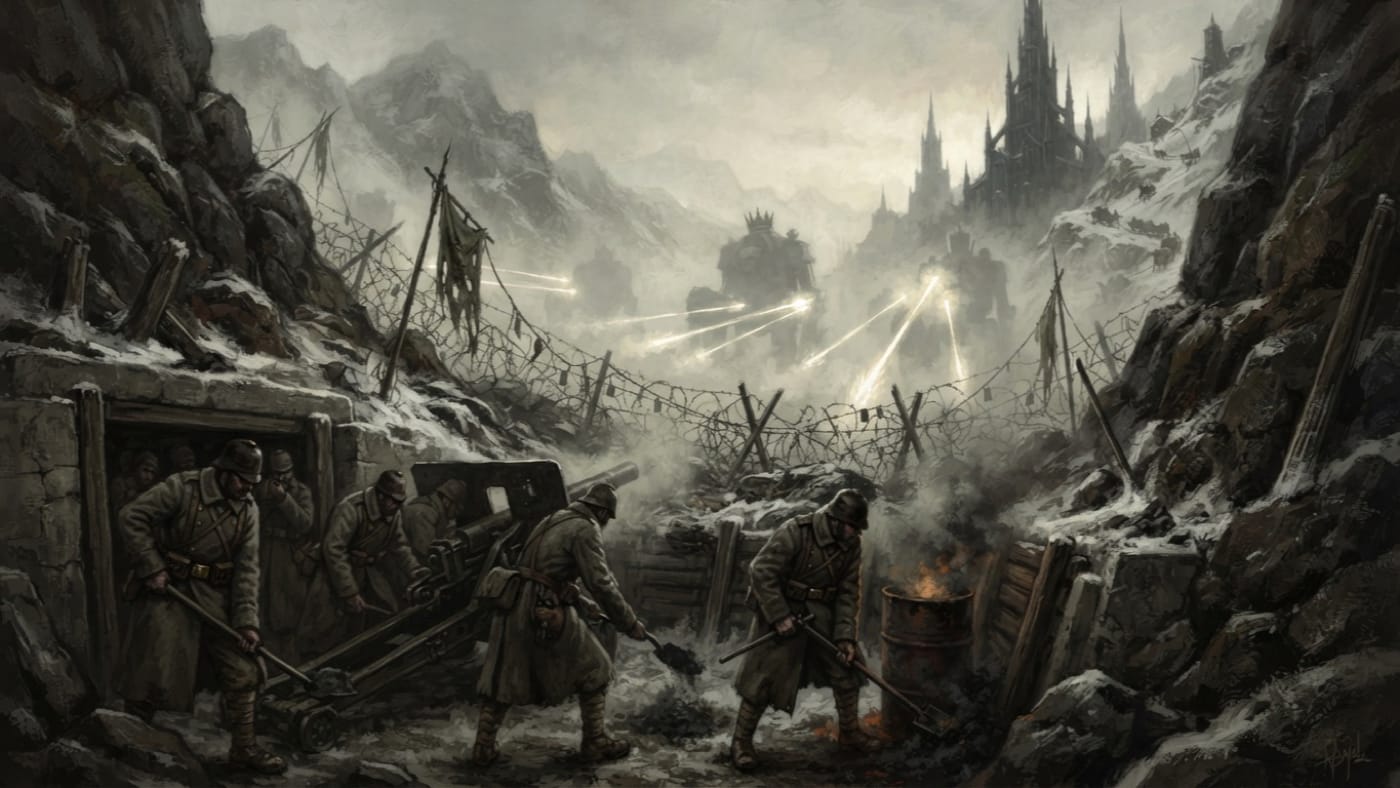
I've read the continuity file, the voice guides, and the location and lore sources. Here is the article.
#On the Ground Called the Front
The Carpathian Front has no charter. I have looked, which is more than can be said for the officers who use the phrase in dispatches. It is the name the soldiers, the clerks and the Bureau of War give to the stretch of mountain where the Sagittal Line stops being a ditch and becomes a staircase. Its centre is Bastion-Przemyśl.
The Line runs north to south, from Bastion-Königsberg on the Baltic to Bastion-Constantinople at the Bosphorus. Przemyśl holds its middle-northern anchor. Above it lie Brest's lowlands and the Bug River, where the enemy at least has the decency to arrive on flat ground. Below it the Carpathians bend south toward Bastion-Sibiu and the Transylvanian wall. The fortress sits in the western Carpathian arc and guards the passes through it. Its eastern salient points at Atheron's highlands as though it means to argue with them.
Some terms need sorting, since junior staff confuse them weekly. The Carpathians are rock. The Carpathian Gates are the fortified hinge of passes, saddles, pass-forts and road-locks that the Synod built into that rock. The Carpathian Corridor is the road, rail and mule system that feeds the hinge. The Front is wherever, among all that, a man can be shot at from above.
The mountains carry other pressure further south. Velmora works the gold veins opposite Sibiu. Morwen presses Irongate at the Danube gorge. Syrionic fog sometimes drifts up out of the southern theatre. None of these commands the Przemyśl sector, and the garrison has trouble enough without borrowing them.
#On the Passes and Their Maintenance
Rail feeds the Front only as far as the gradient allows. After that, supply climbs the Corridor on mule-back, porter-back, and rope lifts strung across gullies. In winter the snow closes the high saddles for weeks. Battalions then live on whatever the autumn manifests got right. The ridge works are dug into the mountain: gun galleries cut through stone, snow galleries roofed against drift, and tunnels joining one battery to the next so that men can change post without showing the sky their outline. Signal huts pass word along the crests by lamp and bell when the weather allows it. When it doesn't, they rely on boys with good lungs and short life expectancy.
Beyond the eastern works lies the Wire Orchard. It is three miles of barbed, electrified, signal and tag wire hung so thickly that from a distance it looks like a dead plantation. It kills the enemy, and it sorts everyone else. Freight comes up the Rail Lane and the Wagon Lane and stops at each gate for a manifest check. People come up the tag lanes and stop for a ration-tag check. Provosts compare the paper with the face, then the face with the ledger. The local saying is "No tag, no dawn." The Bureau has never found a way to improve on it.
The labour that keeps the grid singing is drawn from the people it confines. Draft overflow, debtors and men under confession penalty restring the current lines, clear frozen tags and dig out the Underwire culverts after every thaw. They get bread for the work and a cut hand for their trouble. The cut will fester.
#On the Host Across the Heights
Atheron does not hold the eastern passes because they are useful. He holds them because they are high. Every ridge he takes gets a spire, and each spire is taller than the last, so that the garrison at Przemyśl wakes every morning to a skyline that has risen in the night. The Ebon Heights and the Crownspire stand somewhere behind those ridges. They appear on our maps because a map without them looks incomplete. Nobody who has seen Atheron personally has filed a report fit for the Bureau's shelves. It is best that this continues.
Pride fights by comparison. Its host is arranged so that each arm makes the defender smaller in a different way. The Crownguard Titans come first. They are huge, crowned and slow, and the body wants to kneel in front of them. The Sun Spear Legion forms behind their banners and throws white-gold lances that blind and burn. They hunt instruments, glass, brass and any man foolish enough to watch them come in. The Mirror-Lords follow, for whatever the light has left of a soldier's opinion of himself.
A Sun Spear wound whitens flesh and causes the condition our surgeons call light-burn. Many survivors pass through the Radiant After-Period, during which they describe themselves in Atheron's vocabulary: small, dim, low thing. Some recover. Some never look at a horizon again. Doctrine holds that the light presents a ranking and the man must still sign for it. The cases that sign are handed to Purity, which keeps them behind locks and calls it pastoral isolation.
The practical consequence for the Front is simple. On this sector, looking at the enemy is a tactical error.
#On Recorded Contact
The Legion's first well-filed appearance came in A.S. 184 at Orchard Ring North. Older reports describe Atheron's ranged formations in broken language, so the filing date marks the start of good paperwork and nothing more. A fog bank turned gold at dawn. Twelve lances crossed the wire without disturbing it and struck observation slits, periscope mirrors and the brass numerals of a battery's elevation wheel. Nobody standing in the open was hit. Forty-one men inside protected works lost part of their sight. Engineering ordered the brass blackened. It was the most intelligent thing anyone did that year, and I resent recording it.
Early Przemyśl guidance required observers to watch incoming fire and report projectile curvature.
Withdrawn. The observers went blind and filed reports of unbearable beauty. Four of them tried to thank the enemy. Curvature is now worked out after the fact from where the survivors were facing.
At White Noon in A.S. 190, a Crownguard file halted short of artillery range and the Sun Spear phalanx stepped out between its banners. The sky over the salient whitened without warming. Every polished surface in the forward works threw light upward. The first smoke volley went up clean and did nothing. The second, mixed with chapel-brazier ash and kitchen soot, dulled the lances in flight, and three of them fell and shattered on the wire. That is the source of the dirty-smoke doctrine. It is not proof of immunity, and every quartermaster who has asked for that promise in writing has been refused.
The Nine-Hour Rubric of A.S. 195 is remembered for the destruction of the Spire-Crusher. In the fifth hour, while the batteries were concentrating on the tower, a Sun Spear detachment sent lances through the ventilation slits beneath Platform Casimir. They burst against the bronze bell plates. The bell crews were found blind beneath their instruments, still striking the Humility Sequence from memory. The platform held. The crews never saw their medals.
In A.S. 197 a visiting inspection team brought a polished ceremonial hammer into the forward works. It reflected a spear into the inspection trench, where it struck five officers who were admiring the shine on their own kit. The garrison wrote a song about it.
#On the Present Discipline
This survey reports the sector as it stands in A.S. 201. The Front survives on habits that a parade inspector would call disgraceful, and every one of them was paid for by somebody's eyes.
Gun crews work with their heads down, wearing smoked lenses, and serve the guns from range tables they know by heart. Brass fittings are blackened. Buckles are muddied before every stand-to. Ash pots stand open along the parapet, ready to thicken the smoke with whatever will burn black: soot, lampblack, coal dust, chapel ash, and spoiled ration flour once the quartermaster has finished complaining. Screens are hung crooked from rags. Forward banners are stained on purpose during alerts. The Bureau of Heraldry protested, and its protest was overruled. Heraldry is welcome to stand on the parapet holding a clean one.
Then there is the singing. Squads that chant titles and slogans lift their attention toward grandeur. Squads that sing filth about Atheron's crown, his posture and his probable loneliness keep their minds low and shared. The clergy objected, and the casualty returns answered them.
None of this makes a man safe. Smoked glass cuts down the direct burn and makes the dread at the edge of sight worse. Dirty smoke dulls the lances without stopping them. A battery that drove back one spear phalanx on Tuesday will be under a taller spire on Wednesday, and the Corridor behind it will still be closed by snow. Every local victory on this Front leaves the Front exactly where it was: in the mountains, below Atheron, and short of mules.
Visitors from the rear sometimes ask to see the Front. They are shown the parapet mud, an ash pot and the back of a gunner's neck. Anyone who asks to see more is put on the next mule down.