
#On the Chapel at Wawel
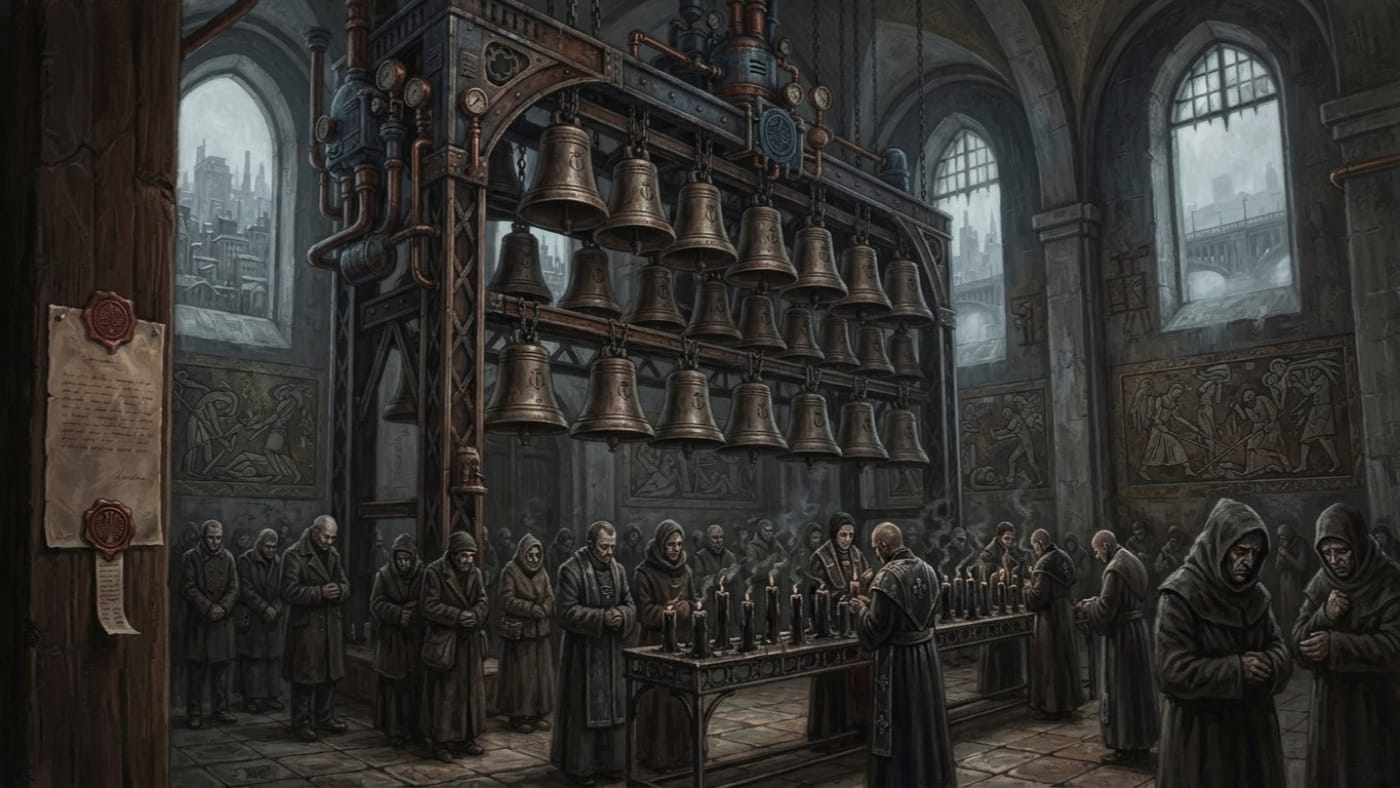
The bells of the Chapel of the Drowned Priests reach the jaw before the ear. A visitor standing beneath them when they sound feels a pressure along the teeth, a dull complaint in the molars, a short moment of private alarm, and only then hears a note at all. Forty-seven low throat-bells hang there, one for each of the clergy drowned in the Night of Knives in Kraków. The chapel's whole argument is that number. The rest is masonry.
The chapel stands in the Cathedral on Wawel Hill, the ecclesiastical crown of Kraków, and it has a narrow office. It is a station on a route. Each 17 Martius the Vigil of the Drowned Priests climbs up to it from below the hill, pauses among the bells, and goes back down toward the river. Nobody died here. The bodies went downstream, and the chapel was given a number. That is the proper arrangement: grief upstairs, evidence in the water, and the Bureau with a view of both.
#On the Forty-Seven
On 17 Martius A.S. 18 / 1728 CE, under the authority of Colonel-Prefect Ignaz Brechtold, forty-seven clergy of Kraków were taken to the Vistula. Their mouths were secured with iron wire, and they were drowned from the Dębnicki Bridge. The Rationalist tribunal that examined the matter recorded the deaths as ritual suicide. With the dry contentment of men who own the pen, it noted that the faithful had silenced themselves in solidarity. The tribunal did not explain the barbs of wire in the palms. Tribunals of that sort rarely account for their hardware.
The truth survived because a nun could count. Sister Agata Wiśniewska witnessed the night and set down what she saw. Her account was hidden in a psalter binding and carried to Avignon, where it passed through exile cupboards and the honest negligence of people who forget to burn things. In A.S. 148 the Fifteenth Doctrinal Congress ratified it and fixed the number. One hundred and thirty years. The bells were cast after that ratification, so the chapel's voices are younger than the grief by more than a century and owe their existence to a vote. I find this neither shameful nor surprising. The Church buries quickly and certifies slowly. Both habits have saved souls.
Two of the forty-seven are named first, and parishes quarrel over which comes first. Brother Paweł Nowak was the youngest. Father Janusz Sobecki was the eldest. In this chapel the other forty-five belong to the count, and I will not make up names to decorate a bell-frame. These were real men. A fabricated name would be a second wire.
#On the Low Bells
They are called throat-bells, and the name is apt to the point of rudeness. Their voices sit so low that the ear is the last organ to be told. Teeth first, understanding afterward. On every other day of the year they sound like old iron remembering water. That phrase is not mine. I would have claimed it if it were.
No register before me names the founder, the casting year, the metal or the hand that tuned them. The Ledger will swear only that they were cast after the ratification of A.S. 148. Antiquarians find this intolerable. They want an inscription, a foundry mark, a guild dispute over the price of tin. Let them want. The forty-seven drowned received no foundry mark either.
The sensation invites miracle-talk, and the Church refuses it firmly. Pilgrims report that the bells weep, that a second voice runs under the low note, that a dead brother's name can be heard in the hum. The Bureau of Doctrine files every such report as commemorative sensation. The tuning was chosen and the ache was meant. A bell that reaches the body before the mind is a sermon for people who stopped listening to sermons years ago. The Creator permits that kind of craft. Doctrine keeps a ration book for prodigies and does not issue them to bells.
Their silence still matters more than their sound. Any tower can ring. What sets this chapel apart is that once a year it keeps forty-seven voices ready and uses none of them.
#On the Hour of Silence
On 17 Martius the Bureau of Bells silences Kraków for one hour under Form 17-K. The Bureau of Festivals keeps the date on the calendar, and Doctrine keeps the account that gives the hour its meaning. The chapel obeys first and most completely. A market tower may cough out a stray chime through negligence, and a handbell may slip from a careless sacristan's grip. The throat-bells hang still from the first minute to the last, and the Bureau has never had to cite them once. In my experience that cannot be said of any choir.
The procession reaches them halfway through its course. It begins below Wawel Hill and climbs to the Cathedral and the chapel, where it pauses among the silent bells with forty-seven candles still lit. Then it goes down by the Grodzka Gate, the witness-gate bound to Sister Agata's testimony, and on toward the Dębnicki Bridge. At the midpoint of the span the candles are put out one by one, and the smoking wicks are dropped into the river. The current carries them downstream to Sandomierz, where fishermen collect them, as fishermen once spent nine days pulling the bodies from the water.
That end of the route belongs to Sandomierz, along with its Recovery Chapel, its wick-keeping and its register. The Wawel chapel keeps the count. Whatever survives from the recovery is a downstream matter. Visitors who climb the hill expecting relics go away disappointed, and I consider the disappointment instructive.
A pilgrim's guide sold at the foot of Wawel states that the forty-seven bells were hung in the spring after the murders and first fell silent for the Vigil in A.S. 19.
Corrected. Local mourning in Kraków began at once, because grief needs no quorum. The formal Vigil, with its mandated hour, dates from the ratification of A.S. 148. The bells were cast after that ratification. The guide confused a city's weeping with a Congress's decree and dated the bells by sentiment. Its printer has been notified. Its readers, regrettably, cannot be recalled.
#On the Keeping of Memory
The chapel is kept as an instrument of accuracy, and accuracy here has three duties, each harder than the one before. The number must be forty-seven, in whatever order a parish prefers to speak it. The account must be Sister Agata's, as the Congress ratified it, with neither the tribunal's lie nor the broadsheet's miracle added. And the remembering must be compulsory, because memory left to volunteers lasted a century and a third before anyone wrote down its date.
So Kraków remembers by ordinance. The Doctrine observation post on Wawel watches the city's compliance from the rooftop and records every chime that breaks the hour. Pilgrims in the chapel below feel forty-seven bells hanging silent above them, and some weep. Clerks above count the bells that are not silent and fill in forms. Both are acts of remembrance. Only one of them is admissible.
The Bureau of Heraldry designed the Vigil's seal: a river cut through by iron wire, with forty-seven drops hanging above the waterline. It appears on Rationalist-sympathizer arrest warrants. Brechtold used wire to stop forty-seven mouths. The Church has taken his wire, drawn it on a seal and pressed it into the wax of warrants against his heirs. I call that a just use of stolen property.
Sentiment says the bells grieve. Doctrine says they were tuned. The Ledger says there are forty-seven of them, that the account behind them is ratified, and that they keep silent for one hour on 17 Martius without being asked twice. That is enough for me. Anyone who wants more from a bell should go and become a bell-founder, and leave the archive to me.