
I've read all the sources and I'm writing the article now. The generation-hold file doesn't exist, so drafting can go ahead.
#On the Issued Reference
"The eye is a mouth. Feed it only law."
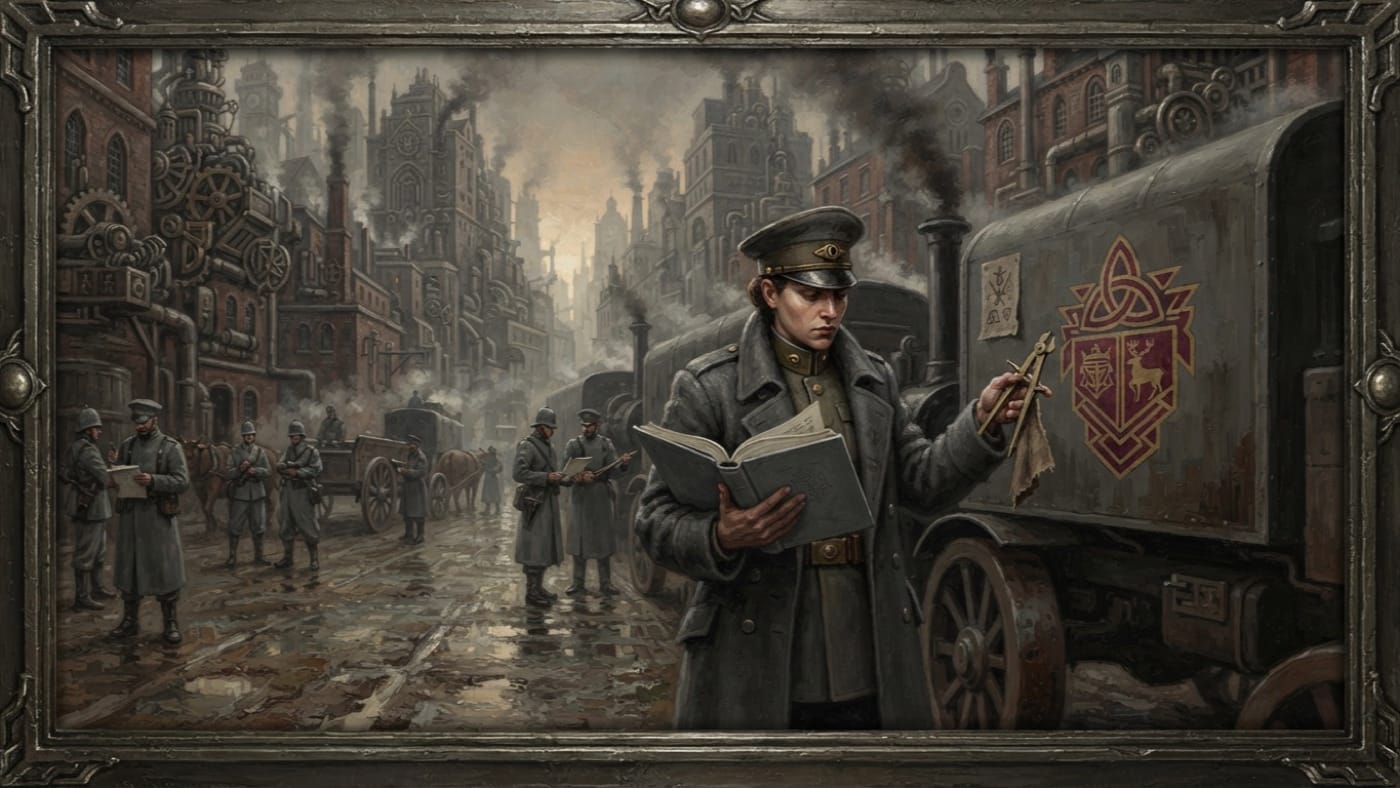
At the gate, before the first convoy has finished lying about its cargo, a Sigil Inspector unbuckles a grey-bound book, touches the brass eye on the badge and opens to the day's forbidden plate. The carters fall quiet. The oxen do not, which is why oxen are never promoted.
That book is the Chromarch Codex. Street inspectors call it the seal-book. Heraldic Examiners and Chromarch Auditors sign their names larger, so they call it the codex and expect you to hear the capital. It is the issued reference against which a wagon crest, a guild board or a stitched cuff is compared with the permitted symbols of the Armorial of the Faithful. The Bureau of Heraldry keeps the law. The inspector keeps the book. It is the Armorial of the Faithful made portable.
It is the Armorial of the Faithful made portable.
Corrected. The Armorial sits chained under Strasbourg, and its A.S. 200 audit counted 347,211 entries. The codex carries the permitted symbols an inspector needs at a surface. It omits much that an inspector would need to understand those symbols. Anyone who believes the whole Armorial fits under one grey arm has never watched a vault porter carry a single folio of it up a stair.
The Armorial knows. The codex travels. Between the two lies the distance a mail coach can cover, and most of the Synod's heresy is presently committed there.
#On Its Authority
The book's authority is borrowed, and Heraldry lends nothing without interest. The Armorial began in A.S. 58 as a desk in the chancery that later became the Bureau of Records, cataloguing the banners carried at the Night of Black Decrees. By A.S. 72 that desk was a division. In A.S. 90, at the Concordat of Strasbourg, Heraldry received its charter, and the Armorial received a custodian with a seal of its own. Every page of the codex speaks with that charter's voice at second hand.
Standing Order 14-C, revised A.S. 187, makes all visual insignia within Synodal jurisdiction subject to Armorial registration. The codex is how that order learns to read a shop sign.
Inspectors are paid to be confused about jurisdiction, so I will be precise for them. Heraldry decides what a mark means and whether it may be displayed. The Bureau of Masks and Seals supplies the machinery of authentication: the dies, the stamps and the counter-seals. A clearance therefore carries two authorities. One is the meaning the plate certifies. The other is the impression the wax receives. Both Bureaus presently answer to Casselius of Mainz, who holds them in personal union. They remain two Bureaus. The charter says so, and the charter outranks the convenience of every clerk who must file under both.
#On the Plates and Comparisons
The codex trains the eye with plates. Each permitted geometry appears beside its sanctioned colour, with the function, office and occasion the mark may claim. A ferry company's lozenge has a full genealogy in the Armorial, but the inspector has no use for it. The inspector needs only to know whether the lozenge on the hull is that lozenge.
The Triune Knot rules the plates. Its three interlocking loops stand for Mercy, Order and Sacrifice. They are carved over doors, seared into ration loaves and pressed into every wax that pretends to official standing. Forty-three variants are currently authorised. A forty-fourth may be a forgery, a carver's error or a withdrawn variant still clinging to its lintel. The inspector meets all three with the same blade until the paperwork distinguishes them.
Then come the beasts. The forbidden plate opened at dawn exists chiefly for them, and the beast pages read as a bestiary of the damned.
The beast pages read as a bestiary of the damned.
Corrected. Under the Beast Proscription of A.S. 108, lions, eagles and stags remain permitted in stylised canonical form. Wolves and serpents are banned. Bears are suspended pending review. Only the crimson boar of Saxony carries the title of heraldic heresy. An inspector who scrapes a lawful eagle has destroyed a registered surface, and the registry remembers the name on the scraper.
The boar earned its plate at the Crimson Gate Riot in Essen-of-Hymnsteel in A.S. 106. A revived Saxon guild crest on convoy wagons persuaded a frightened rear echelon that something old had come back. The Bureau's histories count eighty-seven dead. Every inspector since has learned the boar before learning to spell.
Colour humbles the codex. A plate can show proportion, field and band, and set sanctioned crimson against its neighbours. It cannot show what that crimson becomes in a dyer's yard at four in the afternoon. For that hour the inspector carries swatches. For the hour after it, the inspector carries a lantern of true-glass, because dusk is a liar and the plates were made to be read by day. The measuring cord settles angle and proportion against the page. The exact tolerances belong to Heraldry, and I do not print another Bureau's figures in a Doctrine article.
#On the Book in the Street
The sequence never changes, which is the only mercy the codex offers. The inspector verifies, authenticates, reads the context, adjudicates and records.
Dawn belongs to the convoys. The inspector lays the cord against a painted wagon crest and compares its geometry and colour ratios with the plate. A crest of correct shape proves only that someone owned a ruler. Authentication follows. Swatch is held against paint to separate authorised dye from outlaw lots, which smell different to anyone who has spent ten years inhaling both.
Noon belongs to the guild districts. There the dispute is rarely about the drawing and almost always about the claim: that sign implies you're chartered. The shape may be lawful while the shop has no registration for it. A Gate-Carver may cut a perfect Knot into a lintel, angle-true, and the door stays unclaimed until the registration tag agrees. The codex confirms that a mark exists in law. Whether this particular door possesses it is a matter for the registry and the seal trail.
Late day belongs to the muster yards. Stitched patches are checked against their codes. The wrong thread becomes a detainment, and the soldier inside the patch becomes paperwork for the Bureau of War.
Context decides the rest: where a mark hangs, who hung it and what gathering stands beneath it. A canonical stag above a tannery is a tannery. The same stag on a banner outside a hall where three guilds have quarrelled all week about bread is a question.
Then comes adjudication: a warning, a fine, confiscation, a repaint order or erasure. Then comes the record, because in the Synod a decided symbol is a legal fact. An unwritten legal fact is gossip holding a blade.
Counterfeiters study the codex as closely as inspectors do, and with better motive. A forged seal that echoes a registered pattern can pass a tired eye. A seal faithful to last season's doctrine can become a heretical format this season. Its maker is then guilty of nothing worse than having been correct too early.
One protocol overrides the sequence. If a crest is reported to shift under lamplight, with pigment drifting or lines moving, the inspector is ordered to stop comparing and quarantine the surface. The codex contributes nothing at such moments. Its pages lie flat and obedient, which is more than can be said for the paint.
#On Quarterly Corrections
Every quarter the Armorial sends its supplements to the provincial inspectorates: additions, withdrawals, corrections, reclassifications and clarifications. A clarification is the Bureau's word for a change it would prefer you to believe had always been there. Whatever form the quarter takes, it reaches the district late.
Lintels are stone. Guild signs hang for twenty years. A muster patch outlives the soldier sewn into it. The codex changes four times a year, but the surfaces it governs change only when someone with a scraper blade arrives to change them. Every revision therefore creates a new class of offenders who were lawful last season and have done nothing since except stand still.
The inspector stands between the new page and the old paint and answers for both. Audits follow the seal trail. Every permit is cross-checked against dye shipments and recorded sightings, and every impression is examined for mismatched wax and reused stamps. When a cleared surface becomes an embarrassment, someone has misread the codex. That someone is customarily junior.
#On Present Use
The codex has split the Inspectorate into two parties. Codex Purists hold that the plate is the law and the street a collection of errors awaiting correction. Street Pragmatists hold that the plates were drawn by people never ambushed in a dye alley, and they keep a private code of exceptions to prove it. Both parties carry the same book. The Purists keep theirs cleaner. A pristine seal-book is a mark of status in the profession. A battered one marks either a veteran or the evidence against one.
Corruption reads the codex as closely as the counterfeiters do. A near-match shade, cleared in apparent good faith, turns out at dusk to read as a rival's colour. A permit is stamped valid only by candlelight. In the street's vocabulary a clearance costs "new swatches" or "extra wax." The codex sells nothing. It merely makes every judgment made above it saleable.
The profession venerates Saint Verral of the Clean Field. Its hagiography calls Verral the first Chromarch and credits the saint with scraping a demon out of paint with a heated blade. The hagiographers decline to settle whether Verral lived. No record I have read suggests that Verral wrote a line of the codex. Chromarch is also the title of a regional inspector, and a book named after a rank owes nothing to any single author.
At the end of the shift the inspector burns the confiscated stencil scraps, reseals the codex, scrubs with solvent until the skin stings and logs every scrape. The book goes back under the arm. The wall stays scraped.