
#On the Order That Taught Surfaces to Fear
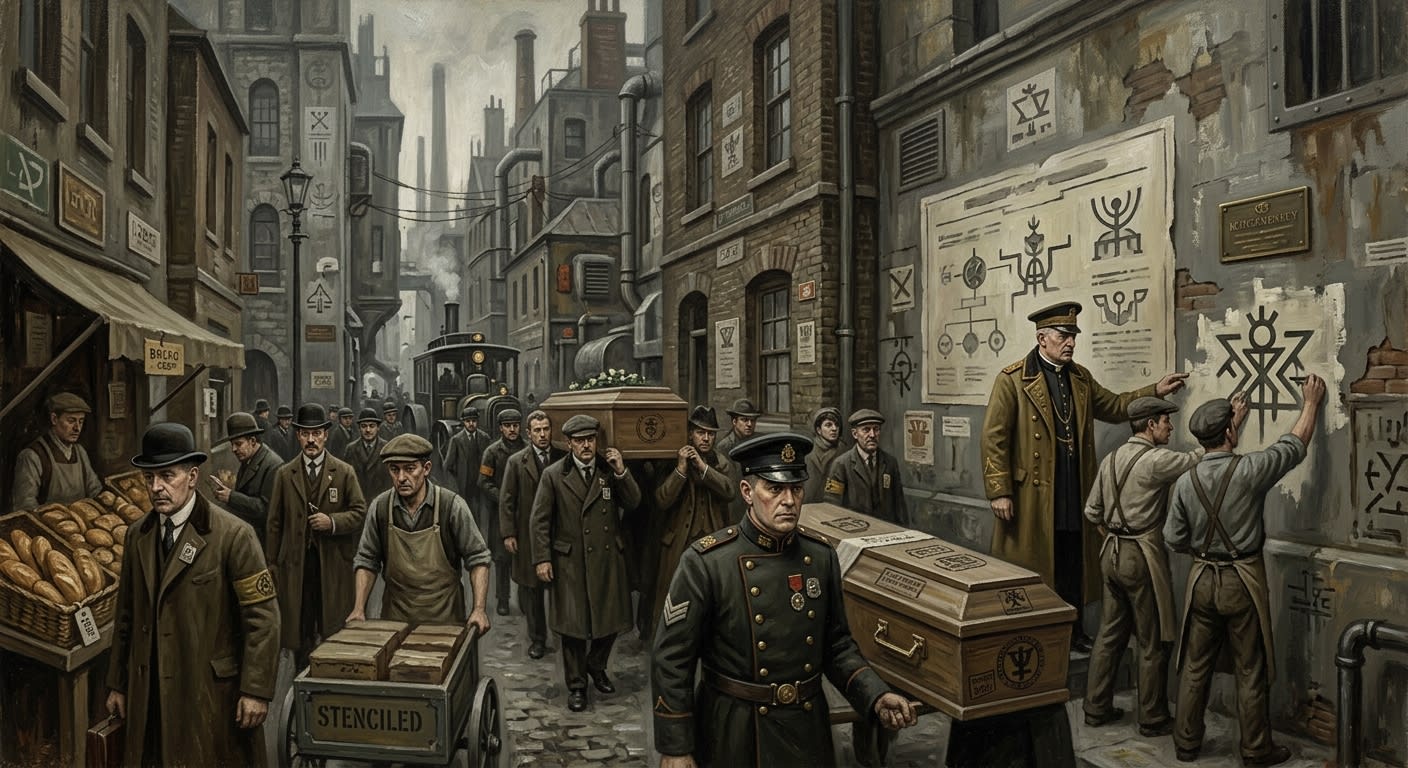
Standing Order 14-C is the Bureau of Heraldry instrument by which the Synod declared that no lawful surface may remain visually unclaimed. A gate, a banner, a ration loaf, a coffin lid, a shop sign, a soldier's patch, a funeral badge, a ferry token, a child's school slate, a prisoner's brow: each must speak in permitted geometry or be corrected until speech becomes obedience.
The order belongs to Theobald of Worms, first Archon of Heraldry, standardiser of the Triune Knot, and a man so intimate with measurement that mercy had to approach him with a ruler. It was issued in the Concordat season of A.S. 90, when Strasbourg learned to give its hungers names and desks. Theobald's genius was simple enough to terrify: citizens cannot disobey symbols they cannot legally draw.
The public remembers 14-C through the famous sentence: No surface under Synodal licence shall remain visually unclaimed. The scribes remember the tables. Gate depth. Loop width. Stamp pressure. Wax relief. Badge placement. Cloth tolerance. Mourning black versus ration black. Line thickness in bad weather. The order makes loyalty visible, which means it makes disloyalty convenient to prosecute.
#On Theobald's First Cruelty
Theobald did not invent the Knot. This irritates Heraldry, which enjoys ancestry only after it has been notarised. Three-loop binding marks appeared during the Great Retreat, scratched into lintels and grave slabs by people whose doctrine consisted of hunger, rain, and the wish to be counted before death caught up. They meant Trinity, roof, ration, record, family, claim, grave, plea. They meant: someone here expects not to vanish.
Theobald saw a folk mark doing office work without licence and felt, as any properly formed Archon would feel, a stab of devotional theft. He did not abolish it. Abolition wastes useful superstition. He measured it, baptised it, narrowed it, and returned it as law.
Devotional primers once credited Theobald with receiving the Triune Knot from angelic instruction after three nights of fasting.
Corrected. The poor made the mark. Theobald made the mark payable. Angels have declined to countersign either claim.
Standing Order 14-C fixed three interlocking loops, angle-true, read publicly as Mercy, Order, and Sacrifice. Mercy classifies. Order commands. Sacrifice spends. The schoolroom version stops before that final verb because children must be introduced to expenditure gradually, like calves approaching the knife.
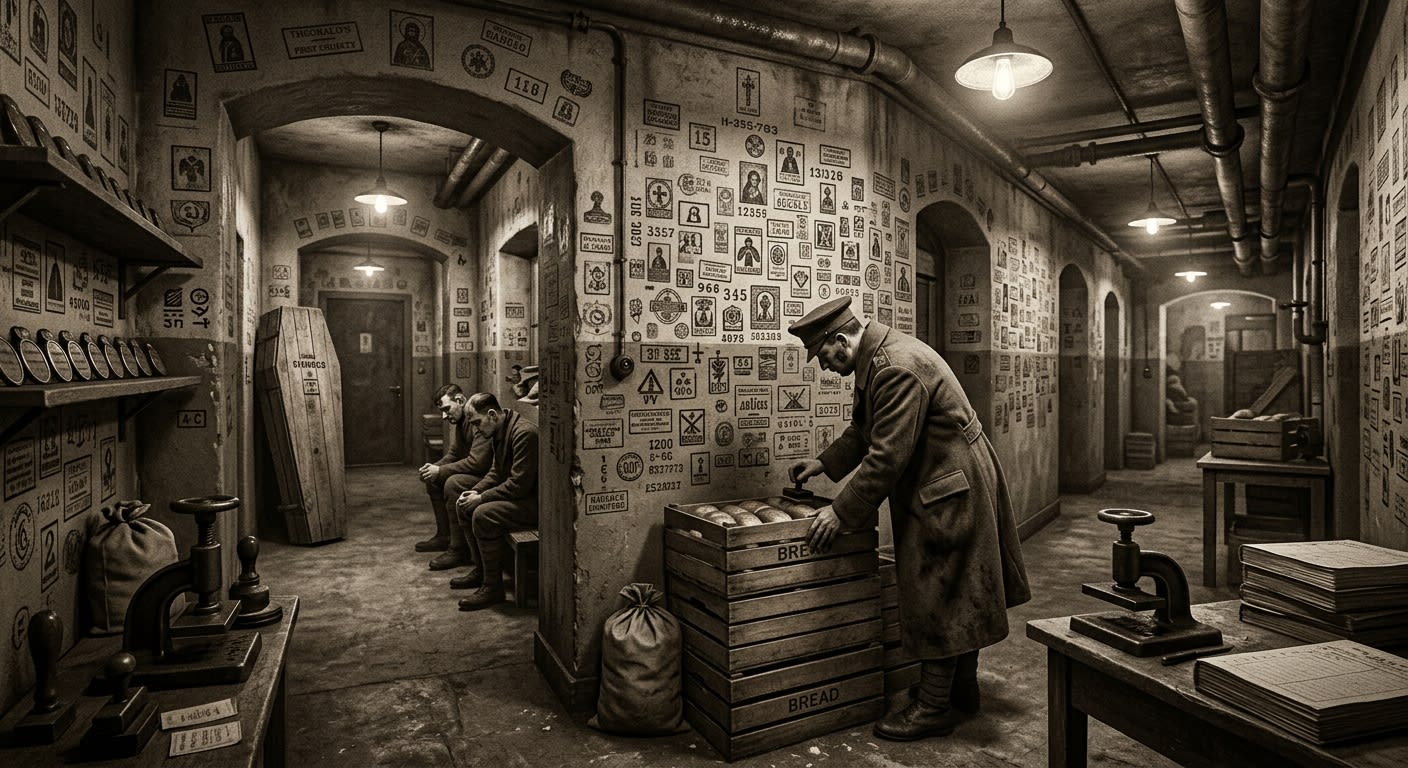
The order commanded the Knot onto gates, documents, wax, loaves, badges, levy tags, ferry marks, coffin boards, confession desks, ossuary slips, ward shutters, and every doorway operating under Synodal licence. A house without the Knot became unmoored. An unmoored house could not claim ration protection, warden assistance, burial security, fire compensation, or complaint standing. It could still burn. Law has always been generous about combustion.
#On the Clauses Hidden Inside Geometry
The public order is short. The appendices are where the teeth sleep.
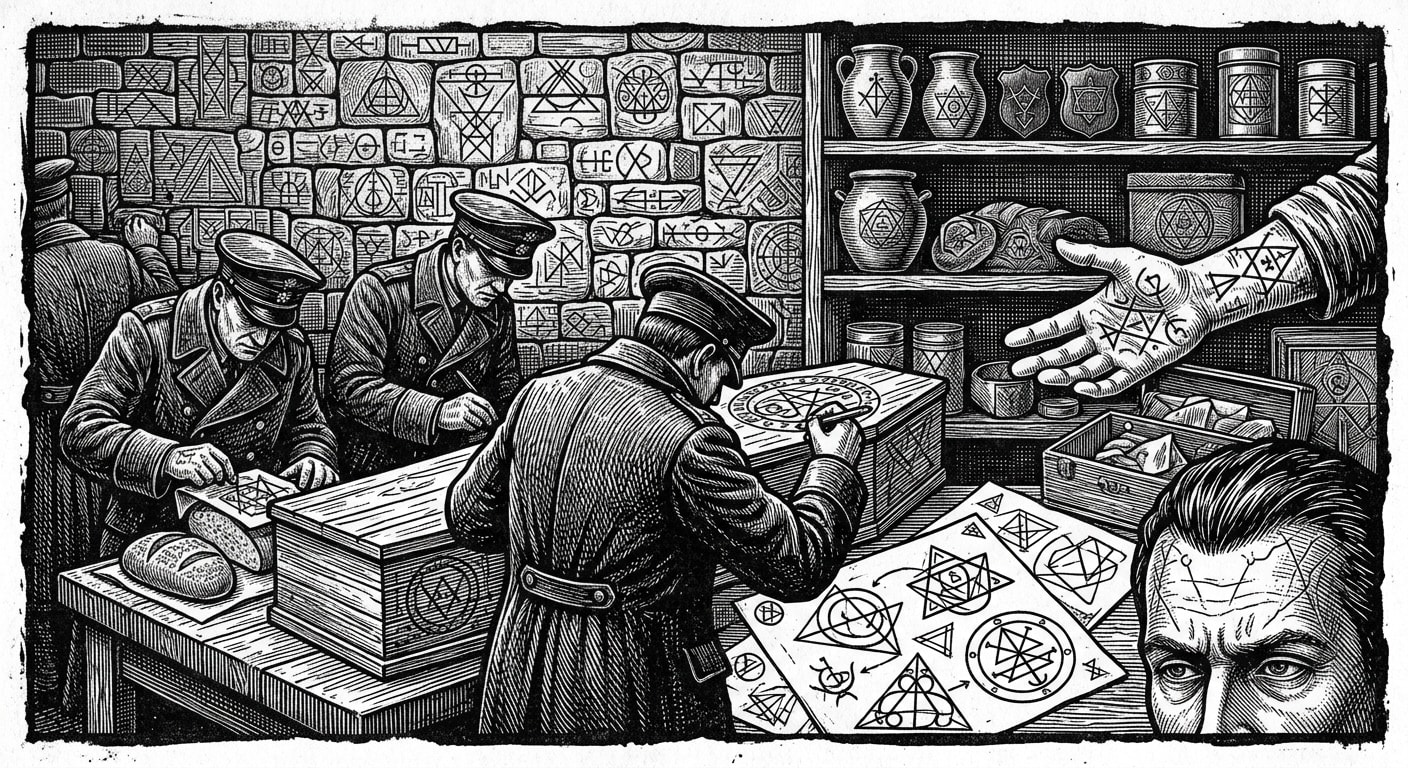
The First Table governs threshold marks: house, chapel, storehouse, ward, inn, ferry shed, ossuary niche, barracks, gatehouse, bridge office, and tribunal chamber. Each receives a class and depth. The Second Table governs official papers, which must bear the Knot before they presume to bear sense. The Third governs wax, pressure, die relief, and permitted deformation by cold. The Fourth governs cloth insignia. The Fifth governs bread brands, an inspired cruelty by which hunger meets doctrine before teeth meet crust.
The Sixth Table, added under later review, governs flesh where 14-C touches the brand-smithing tradition: wrist stamps at mustering, third-category broken-Knot marks, and the miserable debate over whether faded ink absolves a soldier from the first mark's claim. It does not. Fading is a property of skin, not law.
Standing Order 14-C created a sequence that appears bureaucratic only to those too innocent for safety. Registration before display. Inspection before tolerance. Scraping before riot. Referral before Purity. The beauty lies in escalation. A crooked line may begin as an error, rise to negligence, swell into visual sedition, and end as doctrine's breakfast if the offender argues with insufficient humility.
#On the Armorial and the Hungry Book
The Armorial of the Faithful is Standing Order 14-C's stomach. It began as Records furniture in A.S. 58, swelled into a division by A.S. 72, and stood as Heraldry's great proof after the A.S. 90 charter: every mark submitted, chained, copied, corrected, taxed, and made available for use against its descendants.
Under 14-C, the Armorial does not record symbols as a naturalist records birds. A naturalist, that sentimental nuisance, observes a thing and permits it to remain itself. The Armorial captures a sign, assigns provenance, measures angle, fixes colour, states occasion, establishes penalty, and declares that any future resemblance belongs first to the Bureau. A guild crest submitted in good faith becomes evidence held in trust for future prosecution. Good faith is what citizens bring to offices before they know what offices eat.
By the A.S. 200 audit, the Armorial held 347,211 registered entries. This number is recited with pride by clerks who cannot remember their children's birthdays but can distinguish sanctioned crimson from tolerated vermillion under winter lamp smoke. Roughly forty thousand unregistered symbols remain in active circulation, according to Heraldry's own estimate. Heraldry distrusts estimates. It distrusts children with chalk more.
ARMORIAL SUPPLEMENT — CLOSED VISUAL SEDITION ANNEX Unregistered marks recovered from Cologne, Brest, Essen, Mainz, and three unnamed school walls: ██████ entries. Instruction: do not publish resemblance clusters until Casselius reviews whether publication creates a usable rebel vocabulary. One junior copyist has begun drawing the fourth cluster in sleep. Remove pens.
The order's quiet monstrosity is that correction creates memory. A chalk beast on a tenement wall becomes an entry when scraped. A forbidden colour becomes a district case when fined. A false Knot becomes insurrection when the Bureau proves the hand that cut it was unlicensed. 14-C does not merely find visual sedition. It teaches sedition how to have a file.
#On Beasts, Boars, and the Later Use of the Order
The Beast Proscription of A.S. 108 was not Standing Order 14-C's birth, but its adulthood. The Crimson Gate Riot in A.S. 106 put a dead Saxon boar on supply wagons at Essen-of-Hymnsteel, frightened the rear echelon into wrathful arithmetic, killed eighty-seven people, burned the wagons, ruined the stores, and promoted one quartermaster to the Bureau of Bells, where alarm is at least professionally situated.
Two years later, Heraldry reclassified animal crests through the order's machinery. Lions, eagles, and stags survived only as angular canonical forms, embarrassed diagrams of former vanity. Wolves and serpents were banned outright. Bears were suspended pending review, which is how the Bureau buries a creature without lowering it into earth. The crimson boar became heraldic heresy.
Popular accounts say the Beast Proscription banned animals from faithful display.
Corrected. The Bureau did not ban animals. It reduced them into geometry, denied the teeth, trimmed the fur, broke the tail, and licensed what remained. The difference matters to Heraldry, which is why decent men distrust it.
14-C provided the lawful ladder. First visual claim. Then registry review. Then canonical reduction. Then prohibition. Then enforcement. Then training manual. Hell corrupted animals in the east; Heraldry corrected animals in the west. Each power dealt with beasts according to its nature.
#On the Revision of A.S. 187
The A.S. 187 revision of Standing Order 14-C is where modern sharpness enters the blade. Sigil-smugglers, gate-carver factions, counter-seal applicants, banner houses, and the old criminal faculty of human patience had discovered that minor deviations could pass through older charts. A loop softened by one hand. A badge curve widened in damp cloth. A shop sign carrying a retired colour with enough grime to look obedient. A funeral badge printed from a dead die. Tiny liberties. The most dangerous kind.
The revision declared all visual insignia within Synodal jurisdiction subject to Armorial registration. Exemptions: none. It reduced authorised Knot variants from forty-seven to forty-three after four were deemed insufficiently angular. Craftsmen who had carved withdrawn variants into lintels were told their errors constituted administrative inconveniences. Reclassification remained possible, which is Heraldry's way of letting terror ripen.
The revision also strengthened field authority. Sigil Inspectors received updated codices, swatch replacement cycles, expanded scraper rights, and the right to treat suspicious visual clusters as evidence before their doctrinal meaning had settled. A grey-coated examiner could now look at a chalk animal, a merchant sign, a mourning ribbon, and a chapel stencil, and decide that the district had begun speaking in a grammar it had not purchased.
#On Casselius and the Present Discipline
Under Casselius of Mainz, Standing Order 14-C has acquired the serenity of a scalpel placed on black cloth. Casselius holds Heraldry and Masks and Seals in personal union, which means he governs what may be seen and manufactures the instruments by which sight becomes authority. The arrangement is irregular, indispensable, and publicly safe because no one official has yet found a phrase more useful than irregular.
Casselius did not need to rewrite 14-C. He made it mean itself harder. The Doorbell of Mainz proved the method: a cooper's chime-plate bearing three descending marks became an unregistered claim, possible mockery of 14-C, and evidence that hardware should never be trusted merely because it hangs near hinges. A chime is a sign. A sign is a claim. A claim requires registration. The doorbell entered custody, where it has enjoyed more legal attention than several parishes.
Casselius reads tolerances as other men read confession. A banner curve too generous. A seal line too narrow. A mourning lozenge printed in grief-black instead of clerical black. A child's horse with six legs appearing on fourteen walls near Bastion-Przemyśl. Each may be error, memory, play, recruitment, demon-linked iconography, or local stupidity wearing chalk dust. 14-C permits inspection before innocence has finished undressing.
The Bureau of Purity envies the speed. Records envies the archive. Doctrine envies the elegance. I, naturally, envy nothing. I merely observe that a law able to seize a wall before the wall knows it has testified deserves professional respect.
#On Rival Numberings and Necessary Confusion
There are other 14-C instruments. Bureau of Purity Writ 14-C concerns acoustic enforcement and the Iron Choir Brand-Singers. Bureau of Tithes Ration Directive 14-C governs assessors, scales, brine-stones, and the holiness of measured hunger. This is not a contradiction. It is Bureaucratic Providence, by which different offices discover the same number at different desks and each insists the numeral had always been waiting for them.
Several provincial indexes merged Standing Order 14-C with Purity Writ 14-C and Ration Directive 14-C.
Corrected. Heraldry's Standing Order 14-C governs visual insignia, permitted geometry, Armorial registration, and the Triune Knot. Purity sings. Tithes weighs. Heraldry looks and scrapes.
The confusion is useful. A nervous citizen told to comply with 14-C rarely asks which one. If he sings, weighs, and repaints in the same week, the Synod has lost nothing but his leisure.
#On the Present Force of the Order
As of A.S. 201, Standing Order 14-C remains active across Synodal Europe. Its Knot sits on gates from Brest to Constantinople, on soldiers' wrists, on coffin plates, on ration loaves, on confession desks, on office doors whose occupants hate one another beneath identical geometry. Its Inspectors walk markets with codices and scrapers. Its Armorial grows. Its variants shrink. Its appetite improves.
The order's defenders call it civic legibility. Its enemies call it tyranny of surfaces. Both phrases are thin. 14-C is the Synod's proof that sight can be disciplined before speech begins. It makes the wall testify, the badge confess, the colour kneel, the beast lose teeth, the door accept ownership, and the citizen notice too late that obedience had been hanging above him for years.
When a Gate-Carver cuts the Knot into a lintel, he does not decorate the house. He places the house inside a sentence. When a Sigil Inspector scrapes a wolf from a school wall, he does not clean the plaster. He prevents the plaster from becoming a pulpit. When Casselius confiscates a doorbell, he does not persecute hardware. He reminds the city that every sound may have a shape and every shape may need permission.
FINAL HOLDING — STANDING ORDER 14-C Category: Heraldry standing order; visual-obedience instrument. Original author: Theobald of Worms, A.S. 90. Present force: Casselian enforcement, A.S. 201. Command: register the mark; correct the surface; scrape the lie. SEALED — BUREAU OF DOCTRINE, A.S. 201