
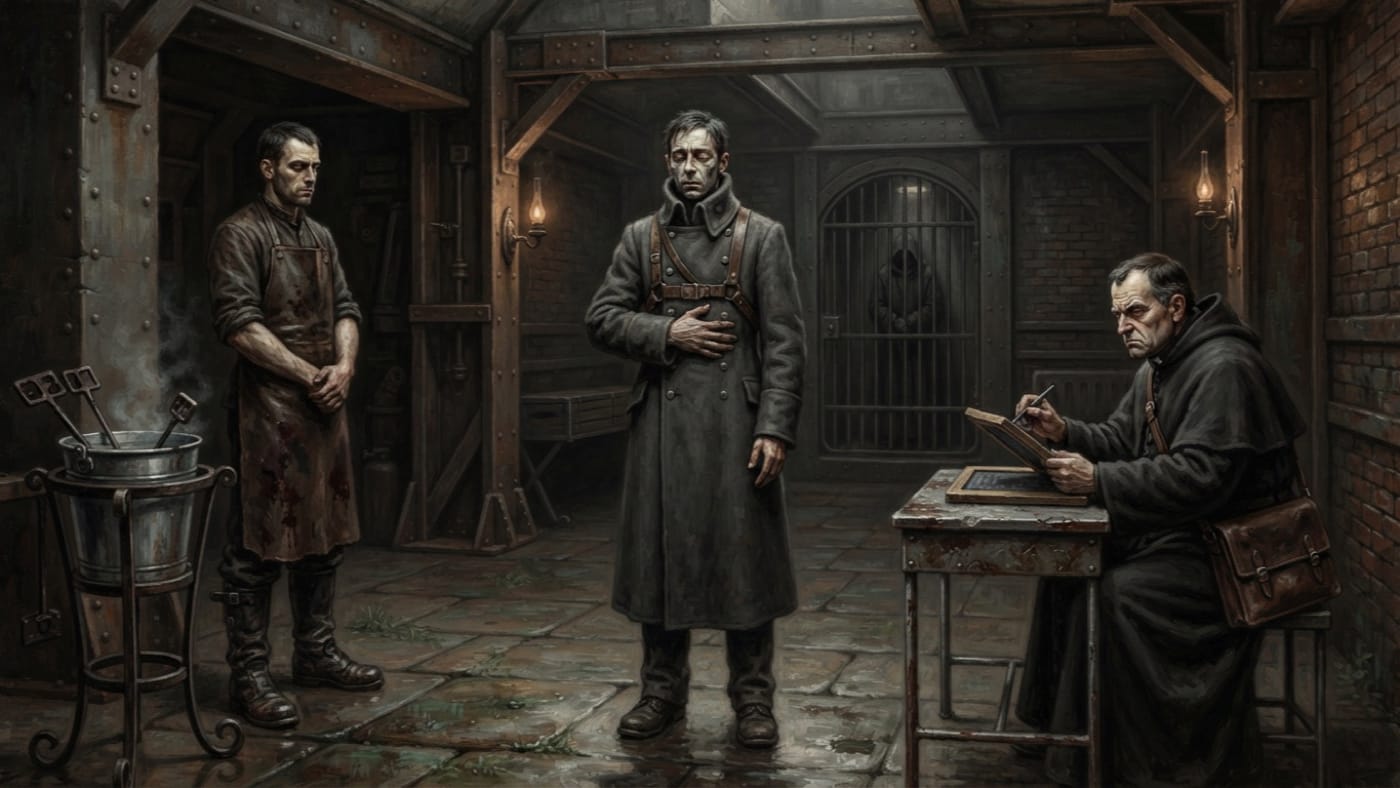
#On the Ending of the Rite
The Closing Tone is the prescribed end of an Iron Choir branding rite. The attending Brand-Singer sings three descending notes. Fourteen heartbeats of silence follow. After that, nobody in the chamber speaks until the scribe certifies the room clean. Standing Order 22-S prescribes the sequence, the Bureau of Purity enforces it, and everyone present obeys it with the special devotion of people who would like to go home.
It is the fifth of six stages. By then the singer has set the room tone with rod and metronome token, and the Opening Hymn has steadied the condemned. The stage cues have carried each segment of the confession through the cadence. The irons have landed on the beat, so that each scar answers to its line of text. Then the singer descends and the chamber is held quiet. Only after that can the sixth stage begin, in which the singer reports anomalies and the scribe certifies completion.
The sequence exists because a confession is a document before it is a wound. A room that keeps sounding after the iron goes into the water spoils the record. It may leave a syllable in the bucket, a stray interval in the stone, or a phrase the scribe half-hears and half-writes. Purity calls the result an echo lie. The Closing Tone is meant to starve it.
#On Orla's Prescribed Silence
Between A.S. 94 and A.S. 104, Purity borrowed trenchline psalmists from the Bureau of Orison and Song to keep condemned bodies still under the iron. The arrangement had no profession, no licence and no proper ending. The approved Life of Saint Orla of the Steady Note records that the rites of those years simply stopped. Scribes reported false echoes. Brand-Smiths heard syllables rising from the cooling bucket. One Ash Chorister confessed to a sin belonging to the man he had just sung over. Records now held a confession that had changed owners, and it asked Purity for an ending.
The Life credits Orla with supplying one: three descending notes, then fourteen heartbeats of silence. I report the attribution as the Life gives it. A hagiography is an institution's account of why its rules are holy. This one agrees with its rule so well that I am inclined to admire the editor.
The pattern takes its authority from her last rite, in a Strasbourg iron chapel in the winter the Bureau of Doctrine files as A.S. 104. Orison's calendar and Purity's roster disagree by a year, and A.S. 103 keeps its partisans. The file says 104, and in this building the file outranks partisans. At the third brand the room answered her. The Life says she lowered her drone and held it until the Closing Tone was complete, then died after the fourteen heartbeats had been counted. Her preserved instruction runs to four words: "Do not answer it."
Purity's Writ 14-C constituted the licensed corps in the same settlement. Keep three instruments apart, because the clerks will not do it for you. The Closing Tone is what the singer performs. Standing Order 22-S is the order that prescribes it. Writ 14-C made the singer a licensed person to begin with. Mix them up in a filing and you will learn how many forms one correction requires.
Early Orison commentaries described the response in Orla's chamber as "devotional sympathy from sanctified stone."
Struck by Purity Circular 14-C/9. Sympathy assumes the wall meant well. Purity does not certify the intentions of masonry. The fourteen heartbeats are counted against the room, and no one counts them in fellowship with it.
#On the Three Notes and the Witnessed Interval
The three notes descend. The Standing Order says nothing more about them, and in a Purity instrument that silence is partly trust and partly a trap. It fixes no absolute pitch, no interval, no duration and no universal key. The singer's training supplies what the paper leaves out, and the singer's licence pays for any mistake.
Then comes the hush. Fourteen heartbeats. The Order does not say whose. I have read it four times hoping to catch it in the act of saying, and I conclude that its drafters either trusted every professional to know or dreaded the argument too much to settle it.
Everyone in the room knows the posture of that interval. The singer stands with one hand spread against the ribs, ash-grit still on the tongue. The Brand-Smith has put the iron in the water, steam still rising, and does not shift a boot on the wet flags. The scribe holds the slate with the stylus lifted and writes nothing. A pair of issued wax plugs waits in the singer's ash-stained cuff for afterward. If the condemned is alive, the condemned breathes. Nobody has found a way to make that silent, and the Order sensibly does not ask.
When the count ends, the silence is complete. Completion and certification are separate acts, and careers end in the gap between them. At the sixth stage the singer reports pitch breaks, drift, and any sound the room made without being asked. The scribe hears that report, judges the chamber and certifies it clean. Until then, nobody speaks. A Brand-Smith who thanks the Creator under his breath at the fifteenth heartbeat has spoken in an uncertified room, and the log will record it in a hand steadier than his.
Consider what this gives the scribe. The most solemn violence the state performs is not over until a clerk with a slate says it is. Inquisitors wait on that clerk, and so do prefects. In theory the Great Deceiver waits too, though he files no complaints.
#On the Answer That Must Be Refused
Echo weather is the field name for a chamber that replies on its own timing. It does not repeat the sound it was given. It answers early, late, or in a cadence of its own. The Bureau of Doctrine calls this residual liturgical resonance. Orison calls it architecturally induced acoustic reflection. Purity takes the reports and waits, without much hope, for the two Bureaus to agree.
The Closing Tone is especially exposed to it, because a descending figure invites completion. A singer trained for years to repair wrong pitch hears a false interval come back off the wall, and the throat moves to correct it before thought arrives. Correction is harmony, and harmony is an answer. The order is short and has no appendix: do not harmonise.
Orla's final rite is cited against that order with tiresome regularity, always by the wrong people. Yes, she held her drone against a responding room. The Life files that performance as a miracle, and a miracle grants no licence. A modern singer who answers the wall in imitation of the saint will have the throat inspected and the pitch audited. Someone patient will read the relevant chapter of the Life aloud to the singer in the quarantine corridor, slowly.
What happens if the room answers during the descent itself belongs to the acoustic emergency protocols. Whether the tone continues, breaks off, or gives way to other handling is a question for those papers, which I am not cleared to quote and will not guess at. Routine closure is described above. Emergencies have their own paper and their own Resonance Wardens.
Everyone should understand the limits of the Closing Tone. It prevents echo lies. It proves nothing about the room: whether the room was cleansed, whether anything was present, or where an answer came from if one came.
#On the Schools and Their Compliance
Mercy Tone reaches the fifth stage after long sustained drones, with the condemned usually still breathing. That is the point of Mercy. Survival to certification is an official metric, because a subject who dies before the scribe certifies leaves Purity with an incomplete document and an argument. Mercy singers call their survival rates compassion. The auditors call them good paperwork. On this occasion both sides are reading the same column.
Judgment Tone arrives faster, at the end of a sharp, accelerated cadence of note, iron, mark. Judgment singers have the most trouble with stage five, because three descending notes and an idle interval feel to them like a sermon stopping halfway through a sentence. The Order does not care how they feel. They descend, and they wait.
The Silentists lean on timing and keep sound to a minimum. They like the fourteen heartbeats better than any other part of the rite and would cut the three notes if anyone let them. Nobody does. The Silentist sings the descent like everyone else, sparely and with visible resentment.
No school has an exemption, a variant or a private ending. The common ending is all they share, and it outlasts what wears them down. Night quotas for urgent truth cases tempt a singer to rush the descent. A tired cord drifts on the third note. A tribunal prefect with a quota sheet stands in the doorway because the next prisoner is waiting. Cantor-Marshals then check the scar patterns against the hymn-timing logs and find all of it.
#On Present Certification
As of A.S. 201, the Closing Tone is performed in every licensed iron chapel. That means Strasbourg's halls, the cellar rooms of Mainz, and frontier chambers at Bastion-Przemyśl and Bastion-Brest, where the architecture is impolite on principle. Approved Hymn Protocols Revision 14, issued in A.S. 199, makes pitch-anomaly reporting compulsory. The report is required. A report that causes disorder is punished. Singers have learned to write very calmly.
Repaired rooms are distrusted on the evidence of experience. Orla's chapel had a fresh repair in its north wall on the morning of her last rite, and every Scar-Voice knows that detail even if they know nothing else in the Life. New mortar gets a longer listen at stage six. Some scribes take longer to certify such a room, and nobody rebukes them for it.
The singer still descends, the room is still held, and the scribe still decides. The chain of trust ends with a tired clerk, a slate of damp vellum, and fourteen heartbeats nobody has ever specified.