
#On the Classified Relation
In A.S. 155, 1865 by the foreign count, the Synod sealed a relation. Doctrine's wording names it as the relationship between crowd acoustics and demonic audition. I quote the phrase because I must, and because any better phrase would need knowledge that the Concordat of Silence exists to keep from me.
Readers want a hall. They want a long table, candle-smoke and a row of signatories, one of whom weeps. The Codex can give them none of this. I have found no signing ceremony, no roster of negotiators, no venue and no complete text in any archive I am permitted to open. What survives is application. There is a Bureau of Doctrine redaction under Standing Order 44-C in the register of the Procession Marshal. There is a cadence appendix in Corps instruction, a sealed variant of the Malven drill, and Section 7 of the Cadence Corps Manual. The record leaves four fingerprints and no hand.
From these the shape is plain enough. Orders go out to the street. Explanations stay in the vault. A Marshal may know what to do with a crowd that answers the wrong beat. He may not know what it is answering.
#On the Laws Before Silence
The Corps was legislated into being one dead body at a time, and the order of those laws matters.
In A.S. 112 the Ashbread Stampede folded a ration crowd against the depot tables at Bastion-Brest. The hemp lane ropes snapped one after another, and the first Corps was organized from what was left. In A.S. 113 the Concordat of Civic Cadence licensed that improvisation and set down its catechism: One beat. One body. One road. The Bureau of Rites and the Bureau of War ratified it. In A.S. 115 the Bell Codex was ratified in its present standard, so every gate and bridge in the Theocracy now had a lawful tolling to march against.
The Night of Two Bells came in A.S. 129. In Strasbourg, two lawful bells struck together over a funeral procession. The procession split. Nineteen mourners died at a canal embankment because each stream had followed a bell that had every right to ring. The Route-Timing Concordat answered this. It bound routes to the published bell schedule, cleared rival tolling from funeral routes, and created the Cadence Architects to work out the arithmetic of choke points.
Each of these laws answered a count of the dead. The Concordat of Silence has no count attached to it in any register I can read. Perhaps it answered a catastrophe, or a slow pile of field reports, or one theologian's sleepless arithmetic. The record will not say which, and I will not make up corpses to give it a better origin. Other compilers have been less careful. Their massacres all happen at dusk and are all very well lit.
What the earlier laws taught, the later one complicated. For forty-two years the Corps had held that a crowd moving as one could not be turned by the enemy. After A.S. 155, instructors had to teach a footnote to that.
#On Off-Tempo Disorder
The cadence appendix gives the matter two names. The public term is off-tempo disorder. The training term is echo-beat.
The pair shows how the classification works. Off-tempo disorder describes a fault in the crowd: drift, poor discipline, a column that has lost its whistle. A ration clerk can write it down without alarm, and a bridge warden can hear it without crossing himself. Echo-beat describes something answering. The first name is for the parish and the second is for the barracks. Doctrine sorts its readers by which name it hands them.
The signs are concrete, and cadets learn them from the slates. A rhythm enters the crowd from no source the Marshal can find. It overrides his cadence. Heels that struck to his baton begin striking to something else, and the column bends toward an alley, an embankment or open ground at a tempo that serves no human purpose. The barracks phrase for a man caught this way is that he walks sideways. The same phrase covers a man trying to slip his lane. The Corps does not explain how the two meanings are related.
The register records echo-beats at three posts on the Sagittal Line, with no dates attached. At Bastion-Shipka, Syrion's time-fog makes it worse. At Bastion-Przemyśl, trench-line levy columns march within reach of the Wire Orchard's interference. At Bastion-Constantinople, the sheer density of processions gives cover to whatever wishes to join one. None of the three is recorded as the founding incident. Syrion is not blamed for all of them, and a Shipka garrison chaplain who preached otherwise was corrected in writing.
Choirwind is a separate matter. It has its own term, its own section of the Manual and its own embarrassment.
An earlier edition of the Cadence Corps Manual, Section 7, explained choirwind as a natural effect of bell harmonics meeting river-valley acoustics.
That explanation has been withdrawn. No replacement classification appears in the edition available to this Codex. Marshals encountering choirwind are to cut the crowd, signal the nearest Bureau of Rites station, and refrain from listening.
#On the Order to Scatter
Everything a Marshal learns before the appendix teaches cohesion. Ropes are tensioned. Chalk lanes are walked twice. The whistle-flute is tuned at dawn to the day's dominant bell, and a cadet who files it sharp is flogged. Micro-stops are held to the heartbeat. All of it serves one end: a mass of frightened people that moves as a single animal and does not crush its own feet.
SCATTER undoes all of that in a breath.
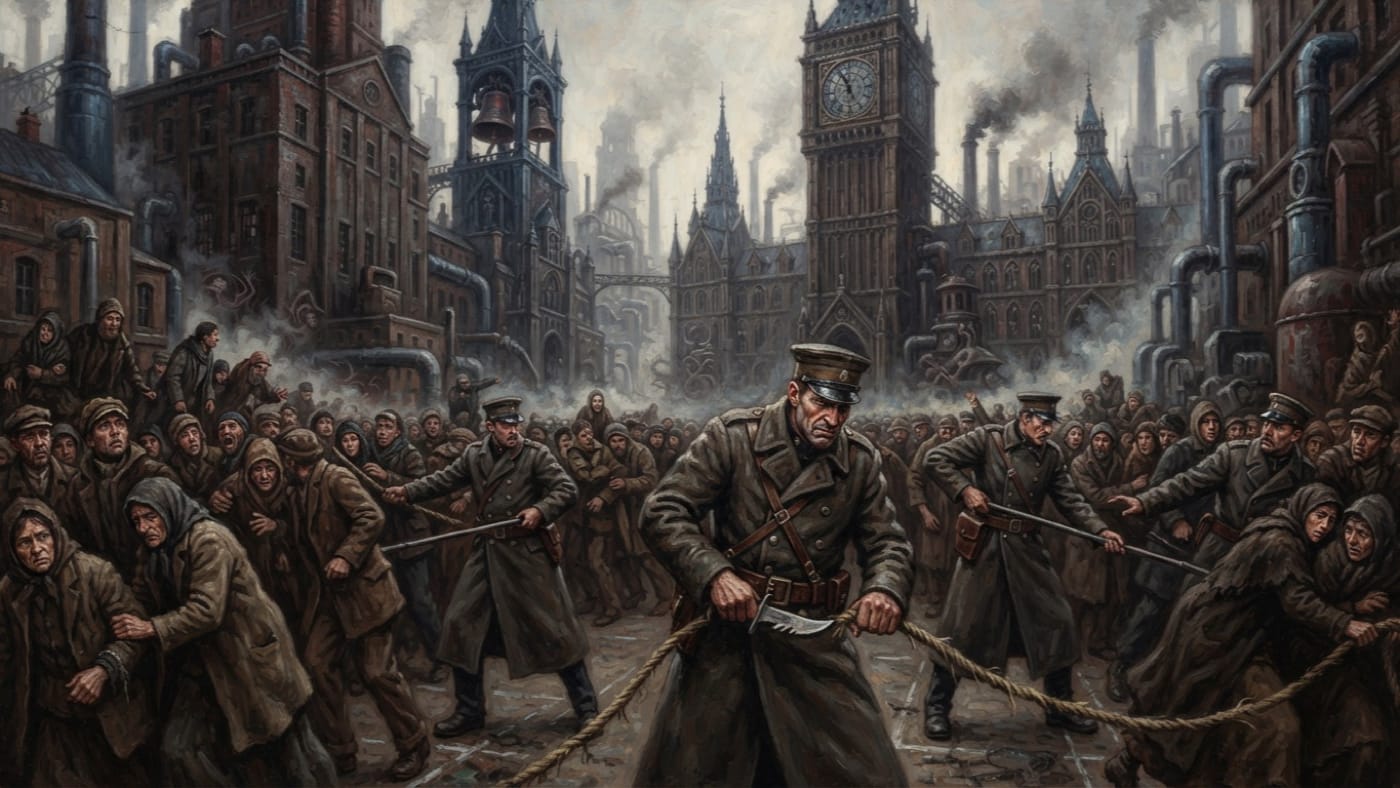
When a cadence has been captured, the Marshal breaks the mass into fragments too small to carry the foreign rhythm. The rope-knife goes through the lane rope at both anchors. Rope-Runners pull their iron stakes and drive groups of a dozen down side lanes that the chalk had marked black an hour before. Families are cut apart at the wrist. The column that took all morning to build stops being a column, and the street is left with confusion where a moment ago it had a procession.
A Marshal who calls SCATTER against ordinary drift gets a stampede, and he owns it. A Marshal who fails to call it when the drift has a source gets an answer from that source, and nobody will tell him who owns that.
None of the published references proves that the Concordat invented SCATTER, and none promises that SCATTER works. The appendix lists it, and that is all. What comes after it is blacked out on the page.
CADENCE APPENDIX — CONCORDAT OF SILENCE, A.S. 155 Public term: off-tempo disorder. Training term: echo-beat. Emergency command: SCATTER. If the crowd continues in harmony after dispersal, ████████████████████.
#On the Malven Appendix
Prefect Malven "Iron Step" is a composite patron of historicity that Doctrine rates sufficient. His plague quarter is set in three cities and most tellings place it before the Corps existed. He did not sign the Concordat of Silence. Nobody signed it in any record I can produce, and a saint stitched together from bootmakers and requisition lists signs nothing.
His beat goes on all the same: HEEL / REST / HEEL-HEEL. Every cadet learns it on a chalk square before receiving a whistle. In the ordinary exercise, twelve cadets play the crowd, one plays fever, one plays a mother and one plays municipal obstruction. The student taking Malven must move them into a sealed lane without dropping the beat, and without spending more than four commands.
The advanced variant appears only in a sealed appendix. After the third circuit, the instructor introduces an off-tempo echo. The page records what the examiners are to see: the student splits the crowd, reseals the infected lane, and resumes HEEL / REST / HEEL-HEEL only after a signal that the page will not name. A student who follows the beat without correcting it has failed in a way the appendix blacks out. A student who breaks too early has failed in another way, also blacked out. The marginal reference reads Concordat of Silence, A.S. 155.
The three schools of the Corps read the drill according to what each already cares about. Doctrine Marchers see the resumed beat as purity restored, the rite put back together. Flow Marshals watch the interval and count the seconds between split and reseal, because seconds decide who is crushed. Iron Wedges see the split as a wedge formation with a better pedigree. The appendix supports all three readings. Doctrine has always preferred instruction that settles arguments by making everyone wrong at once.
#On the Record Still in Use
The present-use survey of the Manual, taken in A.S. 201, confirms that Section 7 still sits under the A.S. 155 classification. Its instructions have outlived whatever explanation once came with them: cut the crowd, signal Rites, refrain from listening. The Bureau of Bells keeps up the tollings that the Corps marches to, and is not cited in any surviving Concordat reference that I have seen.
So the Marshal works with half the paper. At a gate at midday, with forty thousand pilgrims behind him and the bells turning over, he has to decide whether the beat under his boots is his whistle's or something else's. He decides with the procedure in his hand and without the paragraph that would tell him what he is fighting. If he guesses right, the report credits the Manual. If he guesses wrong, the report credits the Marshal. The explanation was never issued to him, so the explanation cannot be blamed.
I have asked Doctrine for the sealed pages twice, under my own seal as Hieromnemon. The first request came back stamped noted. The second came back stamped noted in a different hand, which I count as progress.