

#On the Notices and Their Reach
Corridor Watch is a heading before it is anything else. It sits at the top of notices, abstracts and flags. It recommends and annotates, and it is quoted in this Codex and in the Purity traffic that passes across my desk. Nowhere in the papers placed before me does it introduce itself. I have no charter, no founder's signature, no roll of officers, no seal register, and no headquarters with a stair and a porter who drinks. In A.S. 201 / 1911 CE I was asked to compile what the notices say. They say a great deal about paper and almost nothing about themselves.
Three attestations survive. The first is this year's ash-yard flag at Mannheim. The second is this year's Rhine Corridor abstract, which names five nodes. The third is a convoy notice from the southern yards dated A.S. 138 / 1848 CE, sixty-three years older and concerned with a different offence entirely. A reader who wants to make one institution of the three, with a clean line of command from chain-yard to copyhouse, may do so in his own Codex. Mine records where the heading has been seen. It does not record where the heading has jurisdiction, because nobody has shown me any.
#On the Mannheim Paper Flag
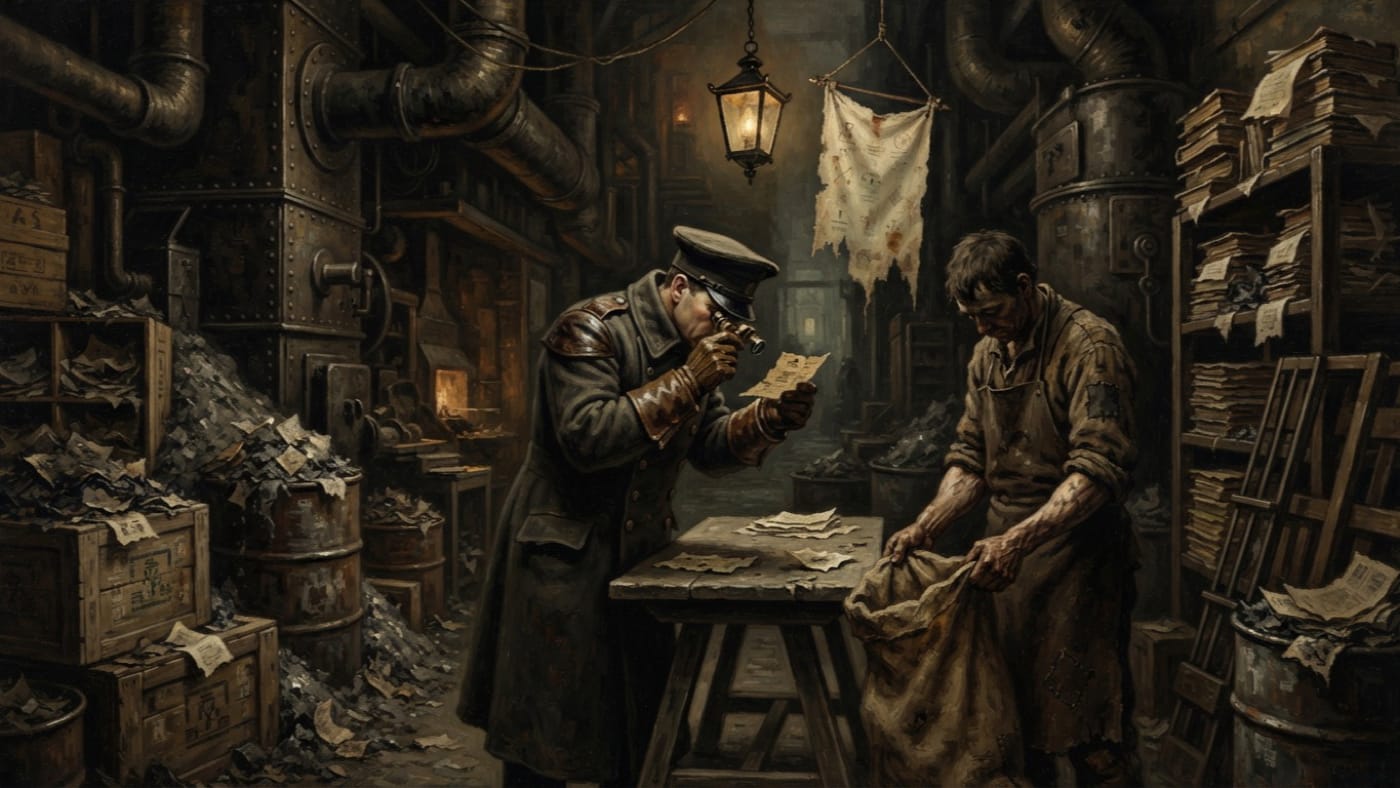
The Mannheim ash-yards lie behind the copyhouse quarter. Spoiled forms, failed drafts, ledgers bitten by mould and rejected prayer sheets are burned there under licence, sorted by office, moisture, ink class and rag content. Every city burns paper. Mannheim burns it with a filing system.
In A.S. 201 a Corridor Watch flag fell on the yard for "repeated rag-fleck anomalies matching a seized A.S. 189 Mainz training manual." Rag flecks are the coloured specks of fibre that survive pulping, so each batch of paper carries its own pattern of them. Two sheets with the same flecks most likely came out of the same vat. That is the whole of the comparison, and it is not a small thing.
The manual needs care. Purity recovered it from a cellar in Mainz in A.S. 189 / 1899 CE. It was written in ash-ink on the backs of approved prayer sheets. The year 189 dates the recovery and nothing else. Who composed the manual, when, and from whose stock the sheets were drawn are all unrecorded. My own Mannheim survey let the word printed slip out. The manual was written, not printed, and the record tells us where it was found and is silent on where it was made.
By Mannheim's account, the ash-yard workers are now inspected at the end of each shift. Their cuffs are beaten over white cloth, their teeth are checked for stored ash, and the burn barrels are cooled under guard. Children are kept away. The account describes what is done. It does not say that everyone holding the white cloth answers to Corridor Watch, and I will not enlist them on its behalf. I once wrote that Purity must have invented the teeth inspection after lunch. That was a sneer and should not be filed as an attribution.
The Mannheim survey also sets out a suspected route: approved school sheets copied in the city, the spoiled ones sold as scrap, the scrap repulped into unofficial slips, the slips waterproofed with tallow and river glue, and questions coming back on ferry tokens downstream of Mainz. Suspected is the word, and it stays the word. No mill has been named. No courier has been stopped with a satchel. No shipment has been followed from vat to ferry.
#On the Rhine Nodes
The Corridor abstract of this year is short. I reproduce it as it was published, black bar included, because I hold no fuller copy and will not pretend otherwise.
CORRIDOR WATCH ABSTRACT — A.S. 201 Nodes flagged: Mainz west porch; Cologne lower copy row; Mannheim ash-yard; two unnamed ferry chapels. Indicators: waterproof question slips; silent-mouth hymn compliance; thread-spool knot variance; false rosary weight mismatch; maternal-name avoidance. Projected cell relation: █████████████████████████ Recommended action: delay mass arrests until names ripen. Drax annotation: "Obscene phrase. Operationally correct."
Five places are named. One is a porch, one a row of copy desks in Cologne, one the yard already described, and two are chapels on the ferry routes whose names the abstract withholds. I will not supply names for them. A clerk who fills a blank in a Purity abstract with a likely guess has done the Great Deceiver's filing for him.
The indicators are listed against the set of nodes, not node by node. Nothing in the abstract says the knot variance was found at the west porch, or that the ferry chapels hid false rosaries, or that every site showed every sign. The relation the abstract projects between the nodes is under the bar. It may describe one cell, several, or a hypothesis abandoned the following week. The bar does not say.
Its recommendation was to delay mass arrests. What came after that recommendation is not in the file, and the file is all I have.
#On the Southern Notice of A.S. 138
The earlier attestation comes from another geography and another quarrel. In A.S. 138 Josek of Düren, a condemned debtor, carried a sealed ossuary crate to Bastion-Irongate. He came through ninety-three miles and the Graben crossing ambush, set the crate at the gatewarden's feet and died before anyone inspected the seal. The seal was intact. Within a week the epithet Cart-Saint had reached the convoy stations, and the Cart-Saint Riots followed.
The notice records the epithet "observed in Irongate, Graben route stations, and two southern convoy yards," and gives three recommendations: remove the markings, interrogate the men who repeat the word, and watch debtor consignments for hesitation in their cadence. Its subject is an unauthorised word on walls and in mouths among condemned carriers under Ossuary-Draft Handler discipline. Paper does not come into it, and neither do Rhine copy rows, ferry tokens or any Mainz manual.
So the notice shows that the heading Corridor Watch was used in southern convoy reporting in A.S. 138. It does not show that the same desk, under the same authority, wrote this year's Rhine abstracts. Sixty-three years of unbroken operation cannot be assumed from one recurring heading. Nor does the southern notice confine the Watch to Mannheim, or extend it across the whole of the Church's reach. The mandatory hooding of A.S. 140 / 1850 CE was War's directive. I mention it only so that nobody credits it to a Watch that never signed it.
#On Paper, Names and Proof
The Rhine has given suspicion plenty of material. Arno Kett organised the first verifiable Silent Godless cells in the Corridor cities between A.S. 125 and 135 / 1835 and 1845 CE. In A.S. 173 / 1883 CE the Great Inquest of Names sealed Mannheim copyhouses where rag flecks matched confiscated slips, and by A.S. 175 / 1885 CE the cells had come back with stricter rules. That history explains why paper, names and dutiful singing now draw attention. It does not place Corridor Watch inside any of those years. Kett belongs to the Godless, not to the Watch's founding, which has no recorded date or author at all.
The methods themselves belong to known offices. Purity's White-Mantled Inquisitors trace paper sources. The Bureau of Records keeps alias protocols. The Bureau of Orison and Song listens for silence where singing is compulsory, and admits in its own reports that people stop singing for many reasons, only some of them atheism. The notices draw on this machinery. They do not show me a Watch commanding it, and I will not draw a command chart over the top of three documents.
The limits of the paper can be stated plainly. A fleck match shows that two sheets probably shared a vat. It does not show who wrote on either sheet, who carried it, who read it, or whether the reader believed it. An ash-yard labourer handles approved stock all day, and ash in his cuff is part of what he is paid to handle. A spoiled school sheet sold for scrap can pass through a dozen innocent hands before a guilty one. Purity's A.S. 197 memorandum keeps the Mainz manual classified as possible disinformation while noting that its advice proved accurate in seven later investigations. Neither half of that sentence confirms the present suspect network, and neither produces a conviction.
District summaries entered Mannheim as "effectively compliant."
Correction carried forward from this Codex's Mannheim survey: effective compliance may hide ineffective belief. A mouth may sing while the inward clerk refuses to stamp. The correction applies to the district summaries it names, not to any circular of Corridor Watch, which has published no such claim that I can find.
#On the Present Disposition
The two recommendations on record still stand. Trace the paper before the fire. Delay the arrests. Both are advice, not orders I have seen carried out, and I record no raid, no sealed mill and no confession arising from either.
The Watch's reach stays where the evidence leaves it: one southern notice, two Rhine documents, five named nodes and a black bar. Its founder, chain of command, strength and legal authority are unknown, and I have entered them as unknown rather than flatter the heading with an invented history. A notice that tells a city to compare pulp before it hangs people has shown more restraint than most of what is filed in its neighbourhood, and I have catalogued it accordingly.