
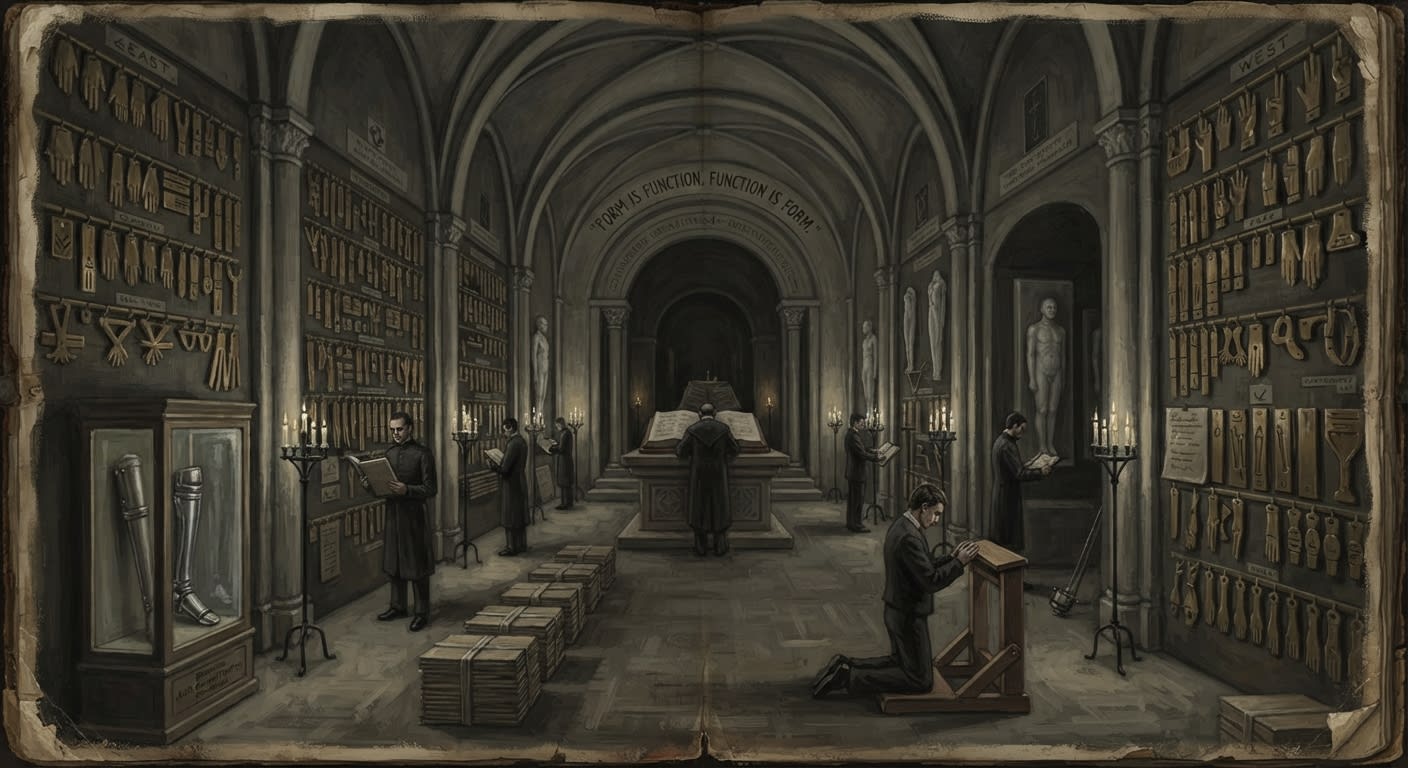
#On the Hall Where the Body Is Filed
"Form is Function, Function is Form." — Inscription above the Archive of Prescribed Gesture, Strasbourg Cloister
The Bureau of Rites keeps its grammar in books. It keeps its punctuation in the Archive of Prescribed Gesture. The Archive is a vaulted hall inside the Strasbourg Cloister, forty regulated paces from the windowless chamber of Liturgist-Primus Corvin Marche. It holds everything the Synod has decided about what the faithful may do with their hands, knees, necks and breath before the Creator. Its candles stand on iron stands at intervals fixed by annex. A clerk who enters by the left door leaves by the right, and any clerk who forgets is logged.
The doctrine of the place is simple enough for a child and severe enough for a tribunal: the posture of a prayer is part of the prayer. A petition spoken on the correct syllable with the wrist bent eleven degrees too far is a correctly addressed letter under a forged seal. The Creator receives it. The Great Deceiver reads it first.
This office has seen no founding instrument for the hall. Its authority descends from the gesture articles of the Charter of Prescribed Observance, ratified in A.S. 58 under the seal of Augustinus and countersigned by Kratz. These are the articles on incense angle, the bend of the wrist before relics and the lawful duration of a genuflection. Over the following generations the articles gathered commentary, then instruments, then clerks to keep the instruments, then a roof to keep the clerks. The Bureau's survey plate of A.S. 195 attests the hall: brass laid against a censer, a Sub-Prior bent over a ledger large enough to bury him in, and the Codex Liturgiae open on a central lectern the size of an altar.
Earlier notices in this Codex, and a pilgrims' guide printed in Speyer, describe the Archive of Prescribed Gesture as "the Bureau of Rites' library."
Corrected. A library lends. The Archive is a repository, a tribunal, a measuring room and an engine of precedent, and the only thing that leaves it is a ruling. The Speyer guide has been withdrawn. Its printer has been instructed in the correct posture for receiving a withdrawal notice.
#On the Contents
The Archive houses the Codex of Gesture, the Second Pillar of Prescribed Form: every physical movement of worship from the sign of the cross to the placement of the hands during absolution. The written volumes are the least of it. A text can say incline the head. Only brass can say how far.
The cathedral variants hang on the east wall and the field variants on the west, facing each other across the nave like two choirs that were never reconciled. Each variant is a hand-position plate, a brass silhouette cut to the approved attitude and stamped with its rite, season and annex. They hang in racks by the hundred. Below them sit the angle-frames that certify the arc of a swung censer, the knee-depth gauges and the thumb-rules. The largest thing on the floor is a jointed wooden kneeler. Apprentices must learn a correct genuflection from it by sight before they are permitted to perform one.
The side bays hold plaster casts of the corpse-still postures prescribed for vigils over the dead, dusted weekly with a brush whose bristles are counted. Beside them lie the timing tables, which express reverence in seconds, the exception folios, and the correction slips, which arrive from the parishes by the sackful and never stop.
The Archive also keeps the losers. The schism of two fingers against three consumed the Bureau for three years and divided the clergy for a generation. The Dyarchists held that two fingers expressed the Creator's mercy, given and withheld. The Tridentines held that three honoured the three Seals. A Liturgist-Primus four occupants before Marche settled it: three fingers for cathedral rites, two for field worship. Nobody was satisfied, and the compromise produced a three-hundred-page exception manual, which now has its own lectern. Behind it, under wax, sit the brass plates of every rejected configuration. One plate shows the thumb folded beneath the palm. It has been classified as a sealed anomaly and turned to face the wall.
#On Measurement and Correction
The Archive's outposts are the Sub-Priors of Form and their auditors. They go into the parishes with pocket watches, ledgers and the portable brass, and they bring home what they find.
The law they carry is exact. A genuflection lasts four seconds at minimum and nine at most. The infirm may hold eleven by dispensation, annotated in triplicate. The first copy goes to the parish, the second to the Archive, and the third to the Archive's audit of the second. A rural compliance audit in A.S. 199 logged two congregants at nine seconds. This is lawful, though only just. The Bureau's own plate records that the dispensation forms were unavailable. The two were left to discover at the tenth second, in public, whether their knees would obey their faith.
Every correction slip comes back to Strasbourg and becomes one of three things. A deviation repeated often enough, by persons of sufficient rank, becomes precedent: it is measured, cast in brass and added as a variant under a new annex number. A deviation that must not spread becomes a warning, copied to every parish in the diocese with the offending angle drawn in red. A deviation that fits no category becomes a sealed anomaly and goes to the north bays, where the Archive keeps motions it has recorded and cannot name. One is a congregation in the Vosges that crossed itself right to left on three consecutive Sundays and denied it. Another is a shepherd whose genuflection measured exactly four seconds every time for thirty years. The Bureau found him more alarming than any error.
Aldric the Unbending, thirty-one years in the Chair, is said to have called the Archive the only honest room in the Cloister because it records what bodies do rather than what men claim. The remark reaches this office unattributed and unindexed. That is how the Bureau of Rites preserves the few things it cannot bring itself to stamp.
#On Disputed Motions
The Archive settles nothing between Bureaus. It keeps each quarrel, measures it and gives it a shelf.
The Bureau of War brought the worst of them. Before the Crownguard Titans of Atheron, men at Bastion-Przemyśl kneel without meaning to. The command enters the tendon before it reaches the mind. War answered with knee splints, averted gaze and counter-tolls. Rites then asked whether a knee locked against kneeling was a refusal of reverence. In a memorandum of commendable bluntness, War replied that it was a refusal of Pride and that Rites was welcome to stand in the wire and check. The Archive filed both papers. Between them hangs a specimen splint labelled Apparatus, Anti-Genuflective, Provisional. The Titan kneel is catalogued as an extracted genuflection so that nobody can confuse it with a prescribed one. Whether an extracted genuflection counts against the soldier's devotional account remains under review.
The Bureau of Bells makes a quieter kind of trouble. Half the timing tables in the Archive are keyed to the peal: the bow falls on the third stroke, and the rise follows the silence after the fifth. Bells may not alter a peal without Rites' countersignature, and it resents the restriction. Rites may not alter a timing table without the peal it depends on, and it resents the dependence. Since the Bell Codex was ratified in A.S. 115, every revision to its cadences has forced a revision of brass in Strasbourg. The clerks call those years "recastings," with the weariness of men who remember the smell of the furnace.
The Bureau of Medicine asks whether a palsied hand making the sign of the cross has committed a deviation or suffered a symptom. Rites holds that the tremor is liturgically material and its physiology secondary. The file is marked, as such files habitually are, pending liturgical review. With the tact of the recently correct, the Bureau of the Hourglass has pointed out that a four-second genuflection timed by a clock in the drifting marshes of Shipka is not reliably four of anything. The Archive answers that the second in its tables is a liturgical second, defined by the Codex, and that the clock is at fault. The Hourglass has written this down, and I suspect it intends to use it.
The Bureau of Purity asks nothing. It requests copies. A pattern of late genuflections, a thumb habitually out of tolerance, a head that bows a fraction short at the Creed: none of these is a crime, and all of them can be written up in a file.
#On the Present Use
In A.S. 201 the Archive is active and overfull. New racks have been cut into the older plaster of the north wall. The correction slips from the last audit cycle lie in tied bundles along the nave, and the apprentices step over them in cadence. No other Bureau finds the place interesting. War visits when a splint needs certifying and Bells when a peal must move. Purity sends a clerk with a satchel, and the clerk does not stay.
All the same, its reach is complete. Every field prayer on the Sagittal Line follows a two-finger plate hanging in this hall. Every cathedral rite in Strasbourg follows the three-finger plate across the nave from it. When Rites certifies the oaths of Purity's judges, it certifies the hand on the relic as well as the words, and the approved hand is kept here. The Grey wears faces at Bastion-Königsberg, and the garrison there reaches for the prescribed prayer before its weapons. When it does, arms, shoulders and knees move in the order this room has laid down. Soldiers who have never heard of the Archive hold the wall in its postures.
Marche's chamber adjoins the hall. He consults the Archive by written query like everyone else, though his query travels only forty paces. Nobody has ever seen him genuflect in it. The archivists say he has never needed correcting. I say a man who has never been measured cannot be found wanting.