

#On the Teaching Carried by Hands
This survey is entered in A.S. 201, 1911 CE by the old reckoning. That date belongs to the compilation alone. Any clerk who copies it into a column headed "founded," "composed" or "adopted" will be reassigned to the wind-gap census, where the paperwork is honest because nobody survives long enough to falsify it.
The Creed of Silence is a teaching. It is passed hand to hand among the Null Tongue Brotherhood at the Steppe Gate. It is not a second name for the Brotherhood, and the two are filed separately: a fellowship can be watched, and a doctrine has to be understood first. The Bureau prefers the first exercise, and so do I.
The surviving record is thin. We hold no authenticated complete text of the Creed. We hold no numbered articles, no catechism under seal, no founder and no charter. What we do hold is the standing watch file, one lesson card seized in A.S. 188, court notices, the results of the Bureau of Purity's fourteen investigations, and the gestures themselves as informants copy them, badly, into ledgers ruled for words.
The watch file records that a widow may carry the whole Creed in her left hand and still hire a translator when the clause is too sharp. That sentence proves the teaching travels by gesture. It does not prove a left-handed rite, a fixed sequence or a transcript waiting to be recovered. Three junior readers have taken it for all three. The Bureau thanks them for their enthusiasm and has withdrawn their access.
#On the Mouth Withheld
The Brotherhood traces its wound to the Red Pronunciation of A.S. 94 / 1804 CE. On that night Arbiter J. Sarn mispronounced one binding term on the Third Treaty-Stone, and roughly a thousand throats closed before dawn. The next year Doctrine corrected the casualty notice upward, which is the only direction such notices ever move. No document ties the Creed's first form to any single year after that night. The Brotherhood counts from the wound, and the wound is all it can show.
The older teaching rests on a distinction that adherents state flatly. The stones govern breath and utterance. They have no hold on soul or intention. They bind contracts and leave conscience alone. From this the Brotherhood concludes that withheld speech leaves the listening stone unfed. A man who never pronounces the clause gives the clause nothing to bite. The true vow is made inwardly and kept outwardly, in deeds, where no stone is said to read.
The Bureau of Doctrine rejects this division. The Church has always taken its oaths aloud before the Creator and witnesses, and a vow sworn only inside the skull leaves the Ledger nothing to count. Doctrine's objection is theological. Its irritation is clerical. Both are sincere.
#On Instruction Without Recitation
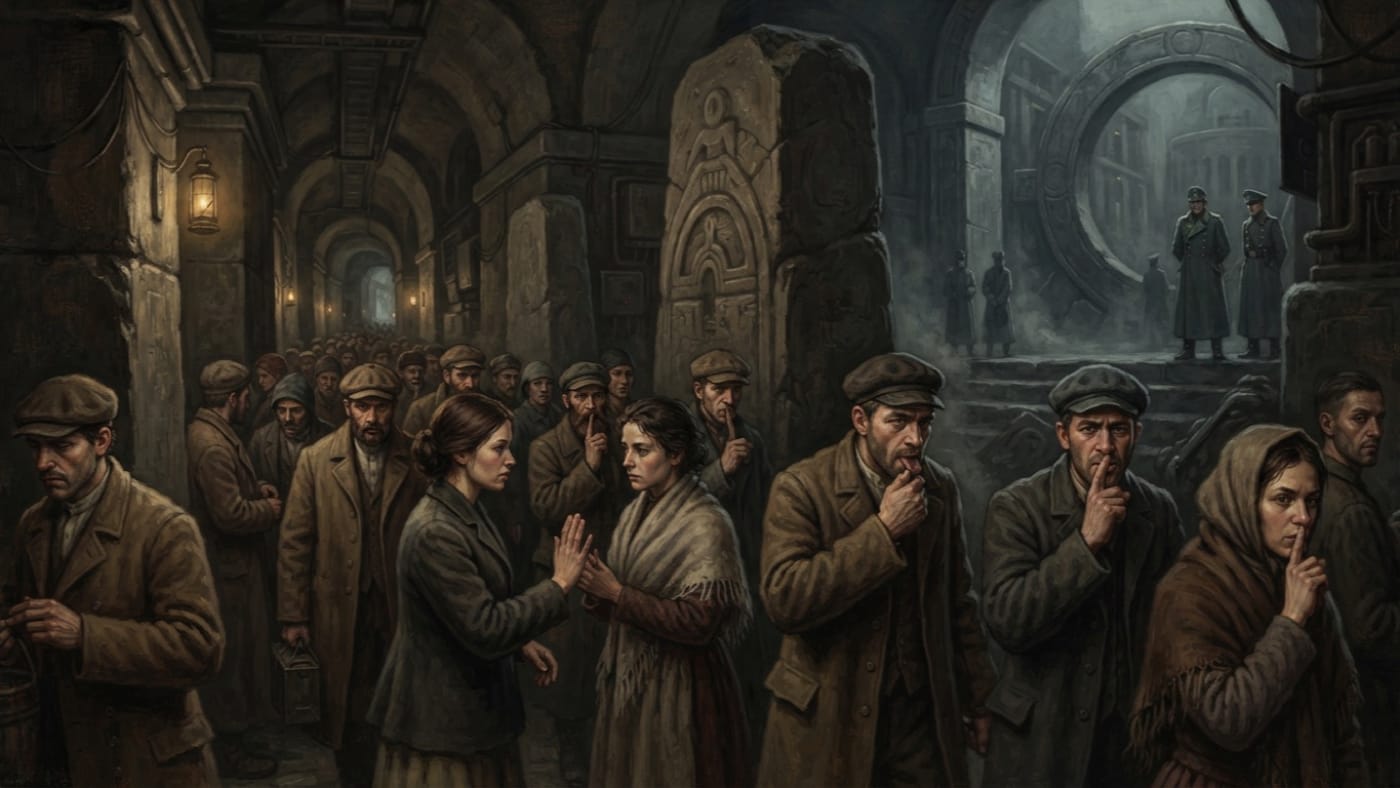
A Creed with no recitation still has to be taught, and the teaching starts in the throat. Instructors show the novice how to hold the throat still, keep the tongue flat and the jaw loose, breathe through panic, and catch the reflexive answer before it leaves the teeth when a patrolman barks. These are skills of the body, taught in the cellar of the Split Tongue, in the Oath Inns of the northern gullies, in refugee queues and in the low ground where wind shadow gives a lesson a few minutes' cover.
Instruction travels in primers, phoneme cards, hymn books and marginal notation that passes for devotional posture. The learners are refugees, debtors, translator-apprentices and court survivors. Many of them believe nothing at all. A child who knows three signs knows three signs. A mute petitioner may simply be mute. A scribe of the translator-scribe trade may sell phoneme guides by day and teach hand-cant by night without accepting a word of the theology. Knowing the signs does not make a Nullist, and a census that counts hands will count the whole Gully Market.
The card seized in A.S. 188 shows what the practical vocabulary is made of. Palm flat: wait. Thumb under tongue: do not answer. That is cant: survival instructions for a queue. Nothing on the card claims to encode any article of the Creed, and Purity's copy lists no such claim. The watch file treats the cant as limited vocabulary built for market corners and patrol searches. It has no complete grammar, and certainly no standard dictionary of doctrine.
The branches apply the teaching differently, and all three deny that they are branches. The Quiet Hands teach silence for survival only: no spoken answers near the Treaty Ring, written petitions where possible, paid translators when a petition will not serve. The Stone-Mutes refuse court speech outright and make much larger claims about what the treaty eats. The Open Palms move refugees, debtors and failed witnesses through rooms where one word would cost more than a winter's bread. None of the three has dispensed with papers, witnesses, route marks or the occasional bought tongue. Silence buys time at the Ring. It has never bought legal standing.
#On the Silence That Failed
In A.S. 187 / 1897 CE an adherent attempted a null-walk past the Fourth Stone in daylight. The public notices do not name him. He carried clean papers. He spoke no clause, paid for no certificate and made no sound. Witnesses saw his palms open and outward. At the Fourth Stone he fell. Blood ran from both ears, and the examining physician found ink in his trachea.
The Brotherhood's verdict was that his mind had spoken: fear formed words inside the skull, and the stone heard that inward mouth. The explanation is attributed and unproved, and it is convenient. It saves the method by blaming the man. Purity recorded its own finding as inconclusive. That leaves three readings, each worse than the last. Silence may fall within the treaty's jurisdiction. The treaty may read thought. Or some unrecorded clause spoke through a man who refused to speak for himself. No office has chosen among them.
High Arbiter Senn Vark has never ruled on the case in public. The record gives no year for his order that a mute petitioner appoint a speaking proxy before the Bench would hear her, or for the twenty-seven silent witnesses who came to the next session and were charged standing fees. The Brotherhood buys Vark's precedent on silence the way every faction at the Gate buys his precedent on anything. That arrangement says nothing about whether silence protects anyone.
In A.S. 196 / 1906 CE a junior Lictor ordered nine suspected Nullists to answer together near the Third Stone. Seven answered and developed throat bruising in the shape of witness marks. Two stayed silent, and the Caravan Court released them for lack of an admissible statement. Stone-Mutes cite the episode as proof. It is evidence about compelled speech, and it is admissible in that capacity. The release was an evidentiary ruling. The stones issued no grant of immunity, and a single afternoon with two silent men cannot settle a question of jurisdiction.
#On the Lost Rubbing
The order of events matters here, and careless readers get it wrong. The first classified Living Addendum appeared in the Fourth Vault of the Burnless Archive in A.S. 194 / 1904 CE. The Creed was already old by then. The Stone-Mutes worked the addenda into their sermons on appetite, and the teaching absorbed the event without beginning there.
At the quarterly audit of A.S. 199 / 1909 CE, the Archive's count of stone-rubbings came to sixteen where there should have been seventeen. The missing sheet was the Third Stone's southern face, which carries the archaic variant of the clause Sarn mispronounced. Its shelf now holds a blank folio, and the ink on it is wet. The rubbing has not been found. Its fate is unknown. The Archive's keepers have offered a theory that it was consumed, and that theory is interpretation recorded in the Archive's own file. Nobody has established it as fact.
Informants report a change in emphasis after the loss. The older teaching said silence could starve the stones. The teaching now carried through the cellars says silence may hide from a treaty that adherents understand to be learning how to amend itself. Starving an enemy is a campaign. Hiding from a growing instrument is a vigil. The Stone-Mutes go further, as they always do: they teach that the Archive feeds on enforced speech, on closed throats, and on every ruling that becomes a death and every death that becomes an addendum.
No council recorded this change and no decree dated it. No revised Creed has surfaced, and there is no evidence that every adherent accepted it. The shift shows only in what the hands now teach and in how much less the Stone-Mutes write down.
Early Purity memoranda described the Brotherhood as "self-limiting due to inaudible doctrine."
Corrected, as the standing watch file records. Inaudibility limits sermons. Discipline still travels. A queue that learns one hand sign together has become a congregation without anyone preaching to it.
#On Present Application
As of A.S. 201 the Brotherhood is tolerated, monitored and operational, and its Creed is taught wherever passage waits long enough for fear to learn grammar. Its practical use to refugees and caravan courts sits alongside doctrinal suspicion, and nobody at the Gate pretends otherwise. The Seal-Houses denounce it, the translator-scribes undercut it, and everyone hires its runners.
This year Vark ruled that valid addenda bind on procedural grounds. The Stone-Mutes call the ruling confirmation. What it confirms is form, and their theology of appetite still has no proof.
The Stone-Mutes want the Gate silent for one full day: no court, market, oath, toll or spoken name. No such day has taken place. Nobody has demonstrated what would follow from one.