

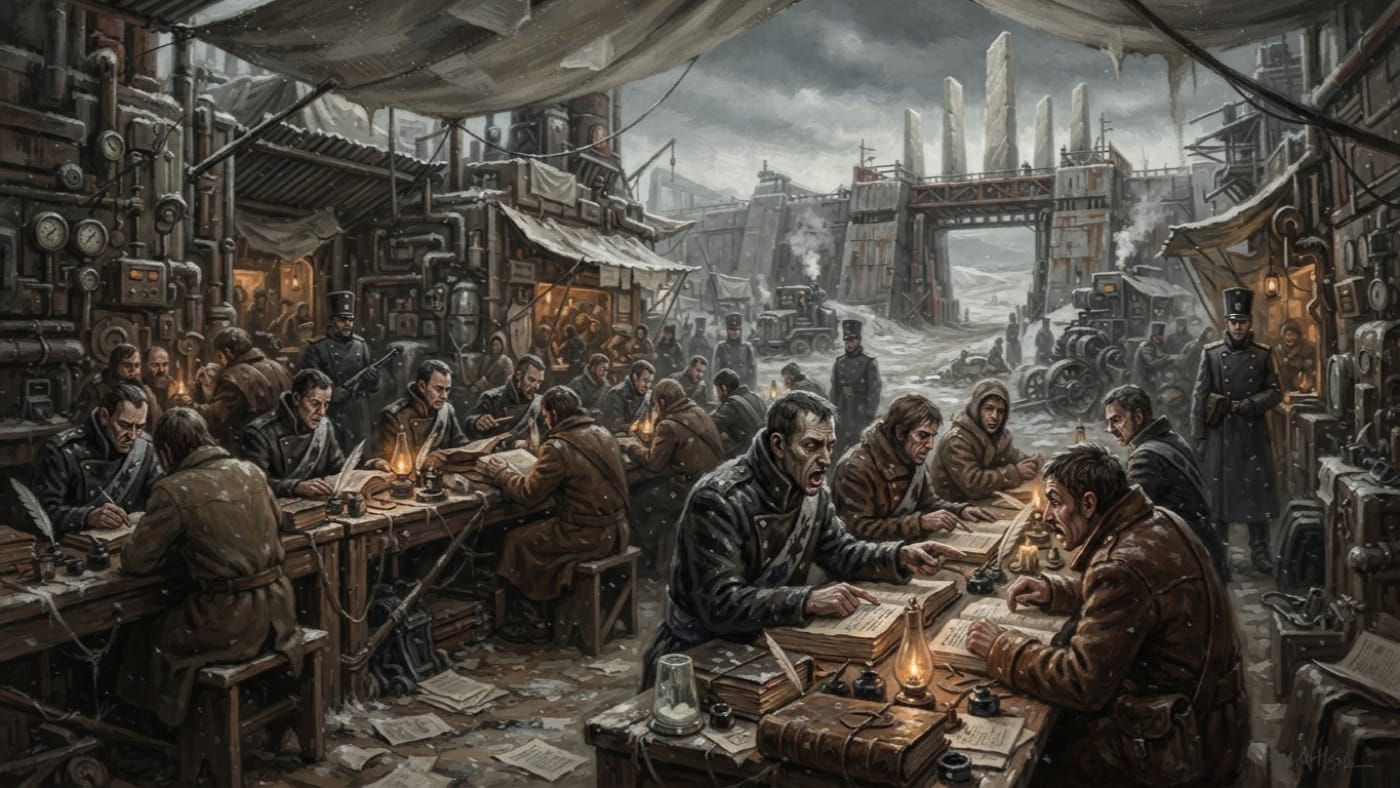
#On the Trade at the Throat
At the Steppe Gate of Windscript Treaty-Stones, a traveller who cannot say the treaty correctly hires someone who can. That person wears an ink-stained sash, keeps a counter in the Scribe Bazaar, and is called a translator-scribe. Any honest list of the town's occupations begins with this one, and the Steppe Gate keeps very few honest lists.
The Gate holds the Moldavian border chokepoint where food, salt, and war matériel cross the steppe. Refugees wait at the Ditch Gate holding papers that consist mostly of hope. Seven wind-polished limestone monoliths stand in the Treaty Ring, and the wind reads their clauses aloud all day. A merchant arrives speaking one steppe dialect. His escort contract is drafted in another. The court's paper must satisfy the Triune Alphabet, which the Synod imposed by edict in A.S. 178 on a continent whose stones are older than the edict. Somebody must stand between these three tongues and make them agree. The translator-scribe sells justice to those who cannot pronounce it.
The Bazaar smells of leather glue and bitter tea. The counters are hide-lashed timber. Lumps of salvaged glass hold the paper down against the crosswind. White dust settles on every page and is blown off with a practised puff, and near the stones even a puff counts as a risk. On the town's ladder, senior scribes rank above patrol captains. Common scribes rank with the wranglers of the Caravan Corrals. The refugees and the indentured stand on the bottom rung, and they are very often the customers.
#On Dialect, Document, and Mouth
The work runs in stages, and the client pays at each one.
Dialect comes first. The scribe hears what the client means, whether a cargo, a debt, or a plea for shelter, and works out which words the Treaty will recognize for it. Steppe dialects hold terms that no Synod dictionary admits. The High Arbiter's oldest surviving ruling shows what happens to such a word once the court notices it. Today it costs five coppers to use.
The document comes next. The Gate runs on passage writs, escort contracts, dialect attestations, caravan manifests, clause slips, and pronunciation certificates. The scribe prepares or renders a good share of these, and certified translations leave the town alongside the stamped passes they accompany. A certified translation does not grant passage, and the scribe cannot make it do so. The Seal-Houses stamp. The witness seals. The Caravan Court rules. The scribe's craft is to bring the client to each of those desks with nothing on the page that will embarrass anyone sitting behind them.
The mouth comes last. A written clause can be corrected. A clause spoken within hearing of the stones cannot be unspoken. A mispronounced binding term draws the clause-spirits, and the record of what they do is specific: throats tighten, ink bleeds from ears, paper edges open the skin, and corrections appear on documents nobody has touched. Before court, the scribe drills each client in the syllables they must say and warns them off the ones they must not. Then the client goes to the Ring with whatever the purse can buy: a licensed phoneme guide, a mouth-guard stamped with the correct syllables, an oath-witness charm. These are precautions. None of them certifies survival, and no honest scribe sells them as if they did. Dishonest scribes deserve their own entry.
The scribe's own danger makes less noise. A scribe spends the whole day speaking for other people near stones that listen, and the profession holds no recorded exemption from the rule it serves.
#On Precedent Bought by the Volume
No translator-scribe practises without Senn Vark.
The High Arbiter's precedent books are sold openly in the Bazaar. They are bound in goat-hide and sealed with the Caravan Court's nine-weight stamp. Their indexes run by clause, dialect, disputed vowel, cargo class, and fatality. For a salt manifest, the scribe consults the cargo index. For a grandfather whose name has three spellings, the scribe consults the dialect index. For a nervous client facing a red syllable, the scribe consults the fatality index first and the client's purse second.
The price of an edition depends on how much blood it discloses. Cheap copies leave out the marginal risk tables. Expensive copies carry Vark's approved pronunciation marks, his witness formulas, and a red caution glyph beside every clause whose past enforcement produced bodies. A scribe working from the cheap edition knows what the court ruled. A scribe working from the dear one also knows what the ruling cost. The client cannot see which edition sits under the counter and finds out at the Ring.
The Seal-House Consortium resells certified editions at three times the price. The Bazaar notice for A.S. 201 advertises Certified Vark Precedent, Ninth Compilation, at Western Arc Stall 14, and ends with the words Buyer assumes pronunciation risk. The translator-scribe is that buyer, and resells the risk in smaller portions to everyone who sits down across the counter.
That is how the trap springs. To cite Vark is to accept both Vark's reading and the court's authority to issue it. A scribe who wants to argue a clause against the High Arbiter must first produce the volume in which the High Arbiter decided it, and so must confess to having bought it. The scribes know this. This Codex's dossier on Vark records that they loathe him with commercial devotion. I can find no better phrase, so I have stolen it from myself.
#On the Price of Passage
Customers sort themselves by how much mispronunciation they can afford.
Caravan lords hoard precedent and keep scribes on retainer. When they hire at the Oath Inns, they bid against one another, and the witnesses there take money from both sides. Escort contractors need their papers rendered before the patrol riders read them. Refugees from the Ditch Gate need a dialect attestation and one correct sentence, and can pay for neither. The street says the treaty protects the literate. The street is a vulgar auditor, but an accurate one.
Every rendering ends at someone else's desk. Seal-Mistress Ylena Korr holds the stamping bottleneck. Captain Rho Balesh holds the patrol chokepoints. The High Arbiter holds precedent. The translator-scribe holds nothing except the question of whether the client reaches those desks able to speak. It is a small power, and the town would starve without it.
Debt pushes the trade further down the ladder. Owed clauses compound at the Gate, and a default can end in labour conscription or in tongue service, which is forced scribing. A debtor copying under compulsion is no translator-scribe, whatever ink is on the sleeve. The court has repossessed that debtor as an instrument. The Bazaar resents being confused with such people. So does the Bureau, which likes its coercion correctly labelled.
The Gully Ledger Cartel forges Vark's judgments badly, and does so on purpose. A caravan that has watched a counterfeit fail will pay anything for a certified copy, and certified copies are sold in the Bazaar. Whether this helps the scribes or only the Seal-Houses depends on whose ledger you read. The Null Tongue Brotherhood offers literacy aid in the gullies, prefers silence to translation, and is treated by the Bazaar as a competitor.
Behind every price lies A.S. 94. That year Arbiter J. Sarn misread a binding term on the Third Treaty-Stone, and roughly one thousand throats closed in a single night. This was the Red Pronunciation. The error was an arbiter's, but the translator-scribes inherited its lesson without inheriting his salary.
For now the scribes are threatening to strike, and the caravan lords are demanding the power to rewrite the treaty. Neither has happened yet. Both are good for business.
The translator-scribe sells justice to those who cannot pronounce it.
Corrected against this Codex's dossier on the High Arbiter. At the Steppe Gate, justice belongs to the stones. The translator-scribe sells access to the machinery by which justice may be survived, and buys that access first, by the volume, from the court.
#On Clauses That Arrive After the Book
A precedent book promises that the law will hold still long enough to be indexed. Since A.S. 194, the law has refused.
From that year onward, Living Addenda have appeared in the Burnless Archive. They are wet-ink clauses with no living author, complete with witness seals and archive marks, and they amend writs and rulings with perfect procedure. The Caravan Court asked whether a clause binds when it satisfies the form, and answered that it does. Vark's ruling 201-Blue/17 confirmed that review cannot suspend an instrument the court does not outrank. The Addenda bind.
So any volume sold before an Addendum arrived may now be wrong somewhere, and nobody has marked where. A red glyph means a clause has killed. A missing glyph means only that the clause had not yet killed when the compilation was sealed. A scribe who coaches a client from the Ninth Compilation is coaching from a past that the Archive is allowed to revise. Clients paid for certainty, so they will blame the counter. The stones will blame the mouth. Nobody blames the Archive, because nobody has yet found a mouth on it.
In A.S. 199, a rubbing of the Third Stone's southern face vanished from the Archive. In its place was a blank folio whose ink is still wet. The town read this as proof that the treaty can be rewritten and began hiring scribes as if they were mercenaries. The Bureau records the demand. It records no method. No translator-scribe has shown one, and none is licensed to look. Altering the original stone text remains a red line at the Gate, and I see no profit in letting a profession of linguists find out how literal that phrase is.