

#On the House in the Gullies
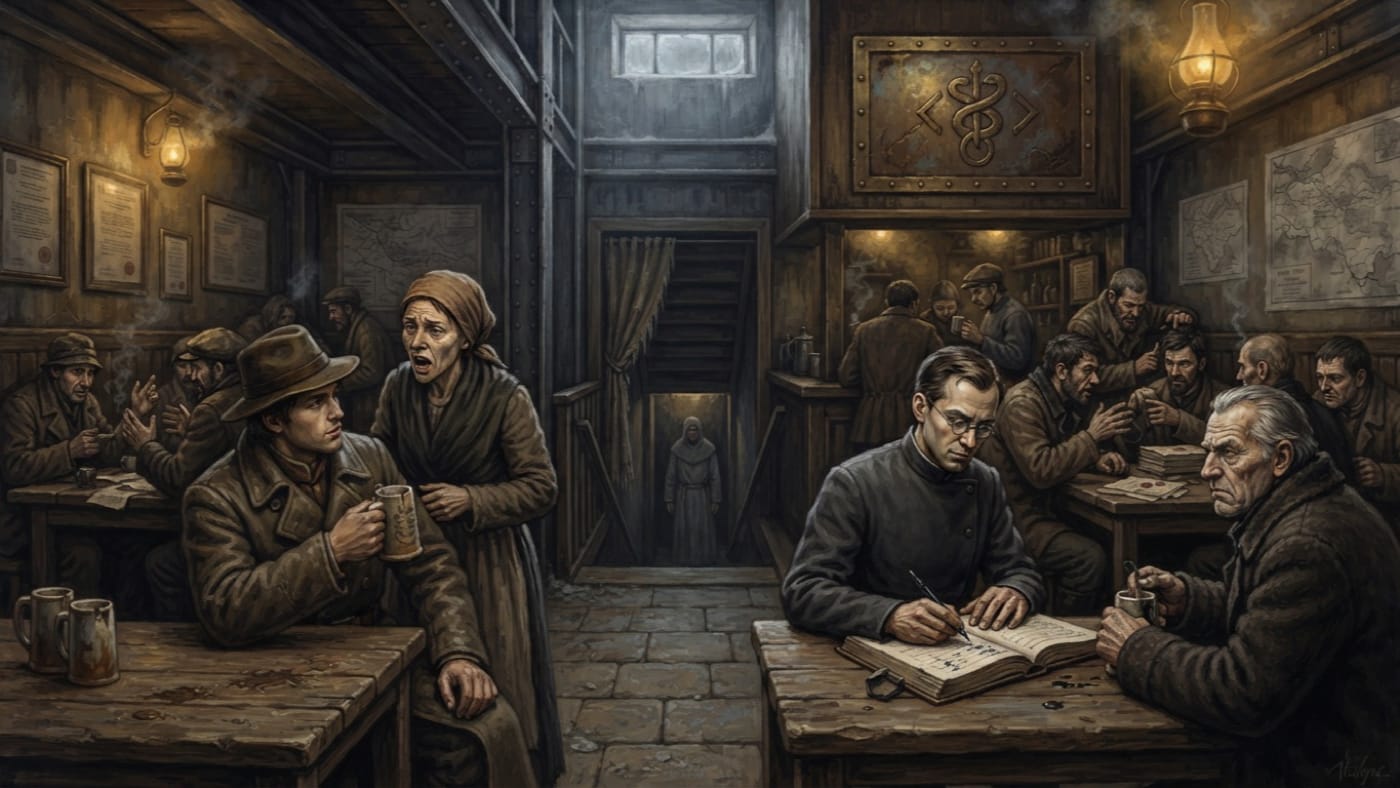
The Split Tongue stands among the Oath Inns in the northern gullies of the Steppe Gate. It sits below the cutbanks, where the wind comes down from the Treaty Ring already tired and still has enough breath to carry a careless word back uphill. It offers lodging and contracts. It also sells a sour ale, and the district has taken that ale as its smell, along with the sweat of people who have just signed something.
Nobody in the town will tell me why the house is called the Split Tongue. I asked three times, before witnesses, and received three answers, each with a price. I have entered none of them. A name with no attested origin is only a sign over a door, and the Bureau does not canonise signage.
The record does establish what the house is for. A caravan master arriving at the Gate needs a bed, a translator, a witness and an hour marked in ink, in rising order of expense. The Split Tongue supplies the bed and the beer itself. The rest it hosts, the way a cathedral hosts the money-changers on feast days and calls the rent a tithe. There are knife fights. The town survey lists them among the house's hazards in the same line as its ale, which is either candour or a menu.
#On the Witnessed Cup
The Split Tongue's only claim on history is a complaint, filed by its own keeper in A.S. 171.
The deposition concerns a junior clause-reader of the Caravan Court of Nine Weights named Senn Vark. He was nobody in particular then. He is High Arbiter now, and the deposition did not foresee it. The keeper's grievance was simple. Vark would not order sour beer unless the server repeated his request, the room scribe marked the hour and a second patron nodded. The keeper called this an obstruction of trade.
The Bureau has no portrait of the scene, so the reader must supply one. A young man at a gully table says he would like a beer. The server, who wanted only to bring the beer, must say the order back to him. The room scribe was hired to witness contracts for salt and passage. Now he must lift his pen and enter the hour at which a clause-reader wanted ale. A stranger at the next bench, who came in to be left alone, must look up and nod, and so becomes a party to a beverage. Then the beer arrives. It is sour. It was always going to be sour. The procedure did nothing for the beer except give it standing at law.
The complaint was dismissed. The deposition does not record the grounds, and I decline to supply them. A dismissal at the Steppe Gate needs no reasons, only a seal.
Later, at a date the record does not give, the same innkeeper lost a toll dispute. His own petition contained the phrase informal understanding, which the Fourth of the Treaty-Stones (Unregistered) hates with admirable venom. Nothing in the file links the two matters except the man who lost both. I record them in order because they happened in order. The reader may draw the moral. The Bureau has already drawn the fee.
#On Contracts and Hospitality
At the Steppe Gate, hospitality is a branch of evidence law. Correct speech has a price here, and the Split Tongue is one of the rooms where travellers learn what it is. Translator-scribes, witnesses-for-hire, passage writs, escort contracts and oath-notes all pass through the inns. Travellers have to sleep somewhere while their papers wait in the queue at the Seal-Houses.
A traveller who cannot pronounce a binding term will have heard what happened in A.S. 94, when an arbiter misread one and a thousand throats closed in a night. That traveller hires a translator-scribe (Unregistered). The hiring takes place in rooms like this one, at tables like Vark's, over ale like that ale. The town survey is frank about the conditions: rival bidders, witness scams, and a market where the collateral asked of a desperate client may be a real confession. I give this as the general shape of the trade, not as the minutes of any particular evening.
Oath-drinking at the inns is listed among the Gate's rituals. Confessions at the Gate are recorded as addenda, stored in the Burnless Archive and used as legal leverage. Set those two facts side by side and you see what the house really sells. A guest who drinks to a promise and confesses to secure a scribe has paid twice. He pays the keeper in coin and the Archive in paper. Paper there does not burn, and it does not forgive.
The clause-spirits punish mispronounced binding terms. No record shows them punishing a man for asking clumsily for ale. The cup ritual was Vark's own discipline. The house rule, then as now, was to pay. That the house complained of his discipline tells you what it wanted from its patrons. It wanted them to talk freely, because words spoken freely are cheaper to collect.
#On the Cellar Meetings
The Null Tongue Brotherhood meets beneath the Split Tongue.
In public the Brotherhood calls itself a literacy aid. The town's own survey gives its working purpose as breaking treaty magic through silence. Its members talk in gesture-cant and refuse to speak wherever speech binds. They practise the null-walk, in which a person crosses the town without uttering a syllable the stones can weigh. The null-walk is illegal. Street opinion holds that it works. Street opinion also holds that the stones have learned to hear silence and punish it. I file the Brotherhood's confidence under doctrine. A finding would need results.
The cellar meetings are attested. Who owns the cellar is not. Nothing in the record makes the keeper a member, a landlord to the sect, or an informer, and I note with professional regret that an informer would be the most useful of the three. Upstairs the house profits from witnessed speech. Below, it lets its cellar to people who refuse to speak. Either it has placed a magnificent hedge, or nobody has looked down the stairs.
An inn makes an odd chapel for a sect that will not speak. The beer must still be ordered, and somebody upstairs says the words.
#On Paper That Survives the Guest
Guests leave the Split Tongue. Their contracts stay.
Every oath-note signed at its tables, every confession handed over as collateral, every hour a room scribe marks goes into a system where paper outlives the person who wrote it. Since A.S. 194 that system has also produced Living Addenda: wet-ink clauses that no living hand wrote, correctly sealed, which amend whatever they touch. In A.S. 199 a rubbing of the Third Stone's southern face vanished from the Archive. A blank folio now holds its place on the shelf, and its ink is still wet.
No record shows an Addendum rewriting a Split Tongue contract. I say so plainly because the gullies will soon say otherwise, for a fee. The danger lies in the structure. Any instrument witnessed in that house is witnessed well enough to bind, and anything that binds can be amended by a hand that satisfies the form. The room scribe who marked the hour of Vark's beer was doing exactly the work the Archive now does without him.
Caravan Court notices, repeated as reassurance in the gully inns, stated that Living Addenda were "under review and suspended pending decision."
Corrected by Ruling 201-Blue/17 of the High Arbiter. Review suspends enforcement only where the reviewing authority outranks the instrument under review. The Caravan Court does not outrank the Treaty. Anyone who signed at the Split Tongue trusting the suspension was trusting nothing.
Vark has now spoken before witnesses for thirty years. The house that complained of him goes on pouring sour ale for men who wish they had copied him. The keeper's grievance was dismissed in A.S. 171, and the town has upheld that dismissal ever since, at some cost to everyone who drinks there.