
#On the Cities and Their Office
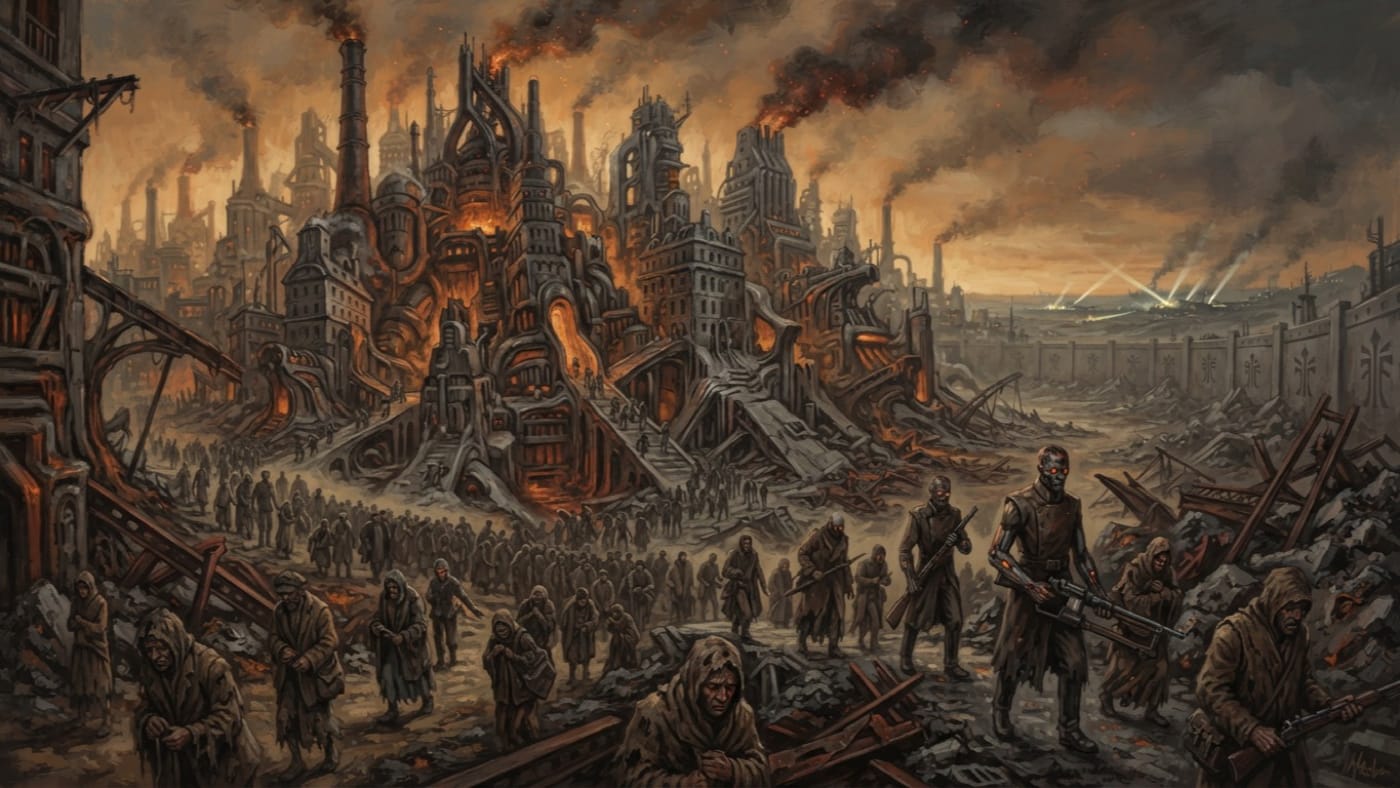
The Crucible Cities are where Maldrake works on people. They stand in Thrace, among the slag and glass of the Iron Wastes, somewhere north of the guns of Bastion-Constantinople. The Church still calls them cities because every replacement term put forward by the Bureau of Doctrine was worse than the original. A city has streets, walls, crowds, and one purpose that all of them serve. These places have all four. Their purpose is refinement.
Wrath divides its labour across the furnace-country with a clerk's tidiness that I find personally offensive. The Eternal Forges make weapons, along with the Hammered who carry them. The Burning Trenches keep the war moving forward. The Char Fields keep the dead at their posts. The Crucible Cities take living men and women and turn them into servants. Each works by its own method, and every one of those methods is fire.
People are still inside these places, and they are not empty ruins kept for show. People live in them in the same sense that ore lives in a furnace: present, changing, and on the ledger only for what they will become. Maldrake's domain dates from his emergence in Thrace at the Sundering of A.S. 45. The Ledger gives no founding year for any single Crucible City and names none of them. I will not supply one to fill the column.
#On the Geography of Conflict
Every city is shaped by its quarrels. In ours this happens slowly, through litigation, fire insurance and the occasional riot over bread. In the Crucible Cities the quarrels shape the stone directly, and fast.
Their buildings melt and set again in new forms as the fighting inside them changes. Wherever enough violence collects, walls run like tallow, and they harden wherever it stops. A street that has been fought over long enough stops being the same street. A courtyard where men have bled for a season can tilt into a ramp, and a tower that has been held and lost too often can slump into a buttress for whatever the next fight needs. The rock remembers the battle better than the men in it do, and it builds to suit what it remembers. Smoke lies in the low places. Slag weeps from the window-frames. Somewhere a hammer keeps ringing, though nobody I know of has located the anvil.
The published Wrath dossier reports that no survey of a Crucible City has ever matched the survey that came after it. I accept the claim. I would add that no survey of a Crucible City has ever matched the city either, but the Bureau dislikes a joke that has an actual finding in it.
Think of a map that tells the truth for one afternoon and is a slander by the next morning. Our cartographers produce these without trying. The Crucible Cities produce them by design.
#On the Refinement of Humans
The process takes years, and that fact alone should finish off the comfortable idea that Wrath is only a sudden fit of temper.
The dossier records that humans are brought into the Crucible Cities as raw material. It also records that those who come out the far end chose what they became. Both entries stand in the Ledger, and I have no intention of reconciling them for the reader's comfort. Material can choose. The Great Deceiver has known this longer than the Church has.
Refinement starts with something true. Maldrake's influence does not seek out the cruel. It seeks out the wronged: the soldier whose rations were stolen by his officer, the mother whose son was taken under a quota that should never have applied to him, the parish that sent for protection and got a printed regret. The grievance is real and the anger is earned. Most of the time the Church caused the injury, and I record this because it is so.
The cities take that anger and keep it alive. Over years of ritual and repetition the rage is fed, and the violence is given a direction, a place to go, and a reward when it gets there. The gifts are real. Strength comes, and so does the stamina to keep fighting. Hesitation burns off like a fog. Victories follow, and some of them are just: real enemies punished, real wrongs answered.
The cities need the step that comes after the victories. The grievance gets settled and the rage carries on without it. The violence that started as a means turns into the person's identity, and once that happens it needs new targets to stay what it is. A slight becomes a crime and a delay becomes a betrayal. The person who walked in carrying a wound learns to love the knife more than the wound.
The body follows the conviction. Scars stay warm long after they close. Heat comes off the skin as if from a stove that is never banked. Muscles stiffen beyond what flexing can loosen. In advanced corruption the eyes take on an ember-light, weapons fuse to the hands, and metal grows where nothing metal was ever fitted. The Bureau of Purity lists these signs in a column. They do not appear in the same order or to the same extent in every subject, and the Bureau's column works hard to hide that.
How long it takes and how it is administered are both blank in the Ledger. The Church does not know who runs the refinement, or whether anyone runs it at all beyond the Sin-General's will pressing down on the place. I have read the speculation. Speculation is cheap, and I have no budget for it.
#On Those Who Emerge
The survivors of the Crucible Cities are called Crucible-Born. The Bureau of War counts them as Maldrake's most dangerous servants, and its reason is their minds, since their strength is matched by plenty of other things that also emerge from Thrace.
The Crucible-Born keep their intelligence and their personality. They keep pieces of their memories. They can plan a campaign, set an ambush, and wait. That last ability decides everything. The army of Wrath needs direction, because rage with nothing to aim at turns on whatever is closest, including itself, and without Maldrake's pressure his hosts would wear themselves down on the landscape. A servant who can think gives the furnace a governor. A furnace with a governor can run for a whole campaign without burning itself out in one charge.
Set them beside their kin. Ember-Soldiers were human once too, but whatever is left of them has shrunk down to targets and marching. The Hammered were never human; they are demons made in the Eternal Forges and they carry no memories at all. The Crucible-Born belong to neither group. They remember enough to recognise a road, a bell, a uniform or the accent of a parish. They believe violence is salvation and destruction is devotion. They believe Maldrake's war is the last righteous cause left in the world. They are wrong, and on campaign they are still extremely effective.
The Wrath dossier states that refinement continues "until the human element has been burned away and only the instrument remains."
Corrected. The purpose is burned into a weapon. The person is not burned away entirely. The Crucible-Born keep intelligence, personality and fragments of memory, and that is exactly why the Hellbow Legion can be pointed where Maldrake wants it. The earlier wording stays on file as evidence that the Church preferred to imagine an empty enemy.
The dossier records a Crucible-Born who was questioned at Constantinople in A.S. 196. Throughout the interrogation, the prisoner insisted they were "still serving the faith." The record does not say which faith, and nobody asked a second time.
INTERROGATION, CONSTANTINOPLE, A.S. 196 — ADDENDUM Prisoner designation: ████████ Parish of origin: ████████████████ Disposition: as recorded in the Wrath dossier
#On the Church's Defences
The Church has a defence against every kind of Wrath. The defences work in roughly the way that a sermon works on a drunk.
Discipline protocols demand that no one act without orders and that no violence happen without authorisation. The idea is that structure contains rage. In practice, the frustration that structure breeds gives Maldrake new grievances to work with. Cooling rituals use cold water, ice and paced breathing before battle. They help with small angers and do nothing at all for deep rage. Rage fasts impose periods of complete pacifism and confine anyone who cannot keep them. Some of those confinements become permanent. Confession lets the soldier name his violent thought to a Confessor. Sometimes the naming helps. Sometimes the Confessor ends up as the next grievance.
The Doctrine of Cool Hatred tells soldiers to kill demons out of duty and never out of anger. It is excellent doctrine and nearly impossible to obey on a battlefield that keeps feeding comrades into the fire.
When a victim shows visible transformation, the Bureau's answer is execution. There is no rehabilitation protocol. The Bureau calls this mercy, and in some cases it may be.
None of these measures has been shown to cure a Crucible-Born or to free a Crucible City. The ordinance lists responses to exposure: things to do for the soldier who came back warm. For the person who went into the city and came out devout, the ordinance lists nothing.
#On the Present Condition
In A.S. 201 the Crucible Cities are still part of an active Wrath domain. The Iron Wastes are spreading toward Constantinople. The Forge-Pyre Bastion keeps up its hammering at a centre that no surveyor has managed to fix. The southern anchor of the Sagittal Line faces Maldrake from the north, and Kargath presses it between his campaigns. Somewhere behind the slag, cities whose names the Church does not know go on melting and setting again around the people inside them.
The Ledger records no count of the cities and no figure for what they produce, and I will not make one up to save a clerk the embarrassment of a blank column. It is enough to know that one Crucible-Born on the field, patient and literate and devoted, can do more than a thousand Ember-Soldiers who have forgotten why they ever started.