
#On the Crossings
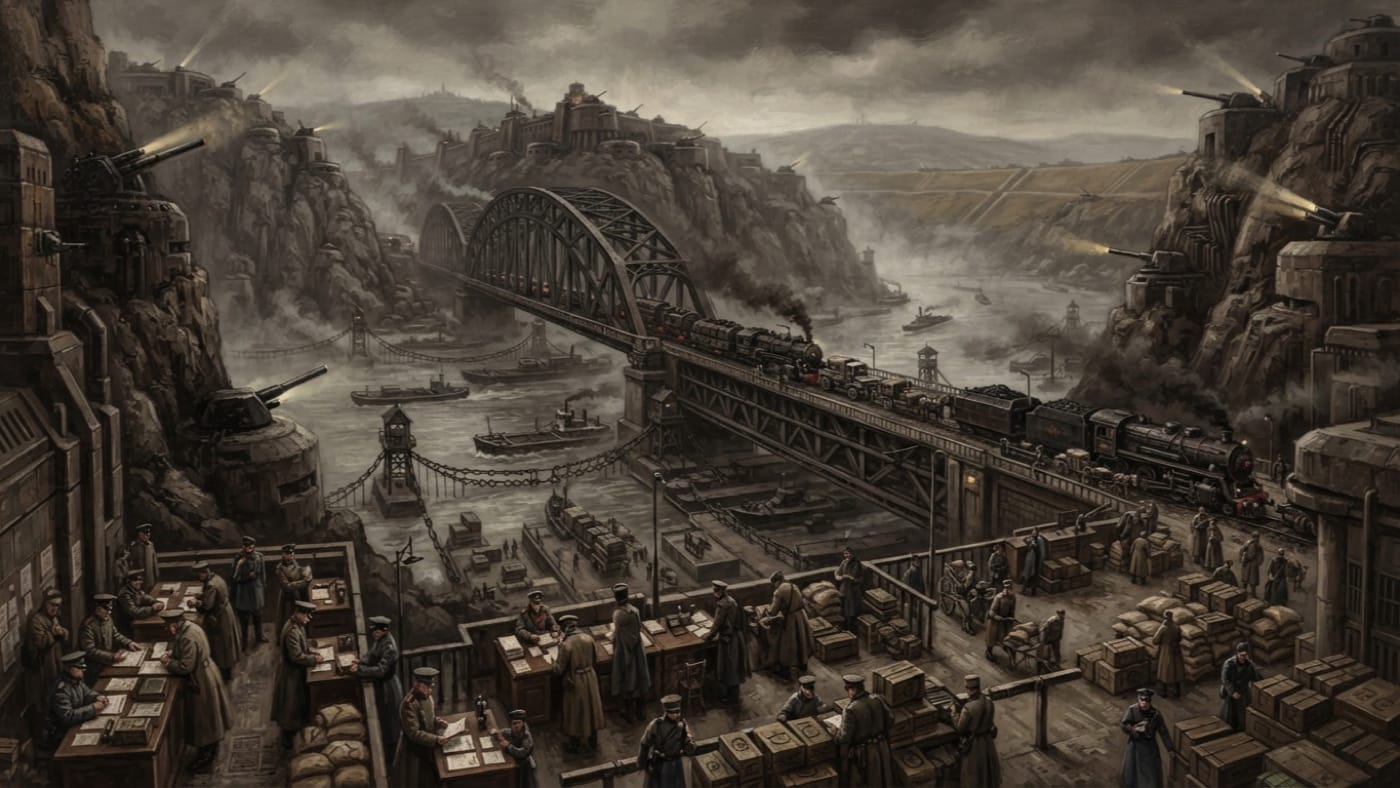
Every round the cliff batteries at Bastion-Irongate fire into the gorge got there by cart, barge or railcar, under a clerk's manifest, after crossing water. Bastion-Sibiu eats grain it did not grow. Two thousand miles of earthwork, masonry and consecrated iron make up the Sagittal Line, and every mile of it runs on deliveries.
The Codex uses the Danube crossings as a collective name for the places where the Synod's men, freight and paper cross the river on their way to the Line. This entry gives no roster, no charter and no founding year. The record supplies none, and I do not manufacture records. That is the Bureau of Records' prerogative, and they guard it jealously.
Three things must be kept apart, because the dispatches mix them up every quarter. The crossings are where things pass. The Danube approaches are the theatre around them, where the enemy presses. Irongate is the fortress in the gorge. A man who confuses the three will tell you the river is defended when he means one cliff is, and the Bureau of War will believe him.
#On the River and the Line
The Line runs north to south. The river does not respect it.
Upstream, between the ruins of Vienna and Budapest, Bratislava serves as a Danube crossing, a secondary rail junction and an overflow yard for supplies the larger depots cannot hold. The Bureau of Passage keeps a major checkpoint there. Downstream, Budapest stages the Sibiu–Irongate corridor from its west bank, which the Synod holds. The east-bank districts were abandoned after A.S. 120 and are still contested. Freight leaving the largest city in the forward heartlands therefore sets out within sight of streets the Church no longer governs.
Sibiu stands behind the Transylvanian Alps, which serve as its outer wall, and guards the passes through them. South of it the Danube cuts through the Carpathian foothills at the Iron Gates near Orsova, on what was once the Romanian–Serbian border. The gorge is barely wide enough for two ships abreast. Irongate holds both cliffs with cannon cut into the living rock, and chain-booms across the water control what may move on it. Synod engineers call it the most beautiful fortification on the Line. Engineers say this about whatever they built last, but on this occasion they are right.
The batteries close the gorge to hostile hulls. They do nothing about a barge that arrives with correct papers. Cannon cannot read, and the river they command carries the Synod's own traffic.
#On Provision and Its Purchase
Velmora, the Covetous Serpent, presses the Transylvanian wall opposite Sibiu. She works the gold-veins beneath the Alps in her held territory and spends the proceeds buying loyalty along three supply corridors. Sibiu's garrison intercepts more bribed convoys than it repels direct assaults. The figure is in the Bureau of War's returns, and the Bureau of War has not enjoyed reading it.
Her methods along these routes are documented in her own entry, and they do not depend on any particular ford. Bribed quartermasters water the grain. Bribed toll-collectors pass wagons whose manifests are written in ink that proves, under scrutiny, to be something else. Bribed chaplains bless relics that sour prayer instead of strengthening it. Agents of the Ten Thousand Keys pass as grain merchants, notaries of the minor courts, anyone whose trade runs on a signature and a seal.
A sack of flour that passes a checkpoint has been inspected. Nobody has inspected the man who loaded it, or the clerk who signed for it, or the debt that clerk took on three winters ago when his daughter was sick and a very reasonable lender happened to be in town. The fortifications can be perfect. The loyalty inside a shipment does not show on a manifest.
Velmora's threat to river freight lies in cursed coinage, which may be found and confiscated at inspection.
The Bureau of Doctrine has revised its classification of her sorcery from "cursed coinage" to Contract Theurgy. A coin can be taken out of a strongbox at a checkpoint. A binding, as Doctrine describes it, goes wherever the signatory goes. Inspectors are reminded that emptying a convoy's strongboxes does not cleanse the convoy.
The Bureau of Tithes has standing orders to audit every Crown of Grace that passes through the western provinces. The auditors find something wrong about once a month, and the Bureau considers that an acceptable ratio. I consider it a ratio.
#On the Four Thousand Pages
In A.S. 172 (1882 CE), an Assessor was captured near the Danube crossings.
To be precise, which I always am, the Assessor in question was a demon of Velmora's host, a physical creature that could be caught and burned. It should not be confused with the human Assessors who hold that rank in the Ten Thousand Keys and judge the worth of new recruits. Nor should it be confused with the Synod's own tithe assessors, honest servants of the Church whose name has caused them no end of awkward conversations in taverns. The demon-Assessors look at a man and work out what he is worth: his skill, his years left, the market value of his loyalty, the exact price at which he would sell a comrade.
Inside its body this one carried four thousand pages of finely written script. They held the financial and spiritual accounts of every soldier in Bastion-Sibiu's Third Company, the whole company and no one else.
The Bureau of Purity burned the Assessor. Purity then discovered that the information had already been filed.
The record does not say how Purity learned this, where the accounts were filed, or by whom. I will not supply what the record leaves out, and I advise the reader against supplying it in the privacy of his own imagination, which Purity also audits.
By the Bureau of War's arithmetic, the capture was a success. An enemy instrument was taken in Synod territory and destroyed under proper authority. By the arithmetic of a ledger, the transaction had closed before the arrest. Guns at a crossing can stop a demon. They cannot recall a copy. A company of soldiers went on standing to arms at Sibiu, fully assessed and itemised, with every man priced.
#On Scrutiny and Recognition
The Church has two established defences against this kind of commerce, and neither involves a cannon. The Bureau of Records keeps contract readers whose sole function is to search agreements for demonic influence, buried clauses and terms that mean something other than what they say. The Bureau of Tithes audits. Both functions are documented. Neither has been shown to have a dedicated procedure for the crossings, and I will not invent one so that the reader can sleep. Nobody has been granted that comfort, least of all the clerks.
A manifest can be checked against a ledger. A face can only be checked against the memory of the person checking it, and that is where the second danger on the river comes in.
Morwen, the Sin-General of Envy, presses the western Balkans and the Danube approaches opposite Irongate. That gorge is hers to besiege, whatever Velmora's agents get up to near the water. The Bureau of Doctrine holds that Morwen's work runs through identity, imitation and replacement, and that the faces she sends across a river can pass a clerk who has known the original for years. A checkpoint built to catch forged paper has no defence against a forged colleague.
The two Generals also fight each other along the approaches. The Bureau of Hearsay describes their skirmishes as "domestic." The Bureau of War, which has to fight in the same country, has filed no description at all.
#On the Present Condition
As of A.S. 201, the Bureau of Passage still operates its major checkpoint at Bratislava. Budapest's west bank is held and stages the corridor, and its east bank remains contested. Irongate holds the gorge with batteries on both cliffs and booms across the water. Morwen still presses the approaches opposite. Sibiu still intercepts more bought convoys than it fights armies, and Velmora's gold still pays for them.
The river is open to the Synod's traffic. That is its function, and it is also the vulnerability. Every wagon admitted is an act of trust, and every act of trust has a price that someone across the water has already calculated.
Somewhere there is a fair copy of four thousand pages. The Third Company has not been told what it costs.