
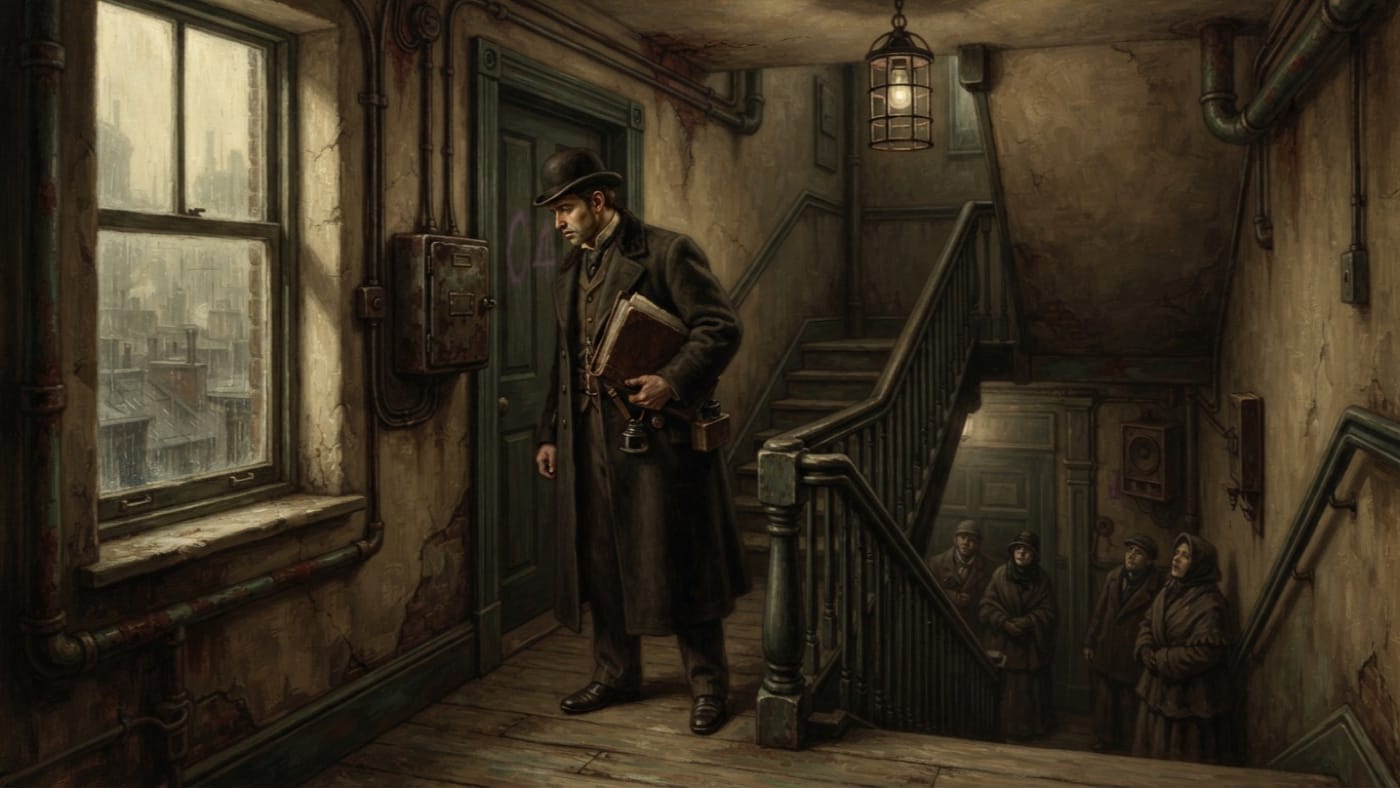
#On the Deadzone
"Silence eats." — Auditor training slate, origin unrecorded
A deadzone is any place the Sky-Sermon was sent and did not arrive. The Bureau of Orison and Song speaks through tower-horns, relay wagons, rooftop speaker shrines, household receivers and, where the Vigil Arks patrol, through brazen projectors hung beneath their hulls. Each of these instruments can fail, and when one fails the sector map acquires a hole. The hole may be a single cellar under an ossuary street, or a stairwell whose receivers have gone cold since the last thaw. It may be a tenement block. It may be a wharf district lying under wet air for a season.
The definition concerns delivery. Dogs bark in a deadzone, infants scream, landlords collect; the place is noisy enough. What it lacks is the authorized Word at the authorized hour. Its residents may open every window on the street and hear nothing but gutters.
The ledger's difficulty is simple. A household that could not hear and a household that would not listen produce the same zero in the same column, and the Synod has spent the better part of a century declining to tell them apart.
#On How the Word Fails
Most deadzones are made of ordinary things. Stone is the oldest offender. The ossuary districts and the thick-walled cellars dug before the Concordat will stop a sermon as calmly as they stop a cannonball. Water comes next. Horn bowls fill, shrine cabinets pool, and copper contacts go green-black overnight in a port fog. Storms topple rooftop shrines. Riots take hammers to them. Thieves strip relay cabinets because copper keeps its resale value long after theology has lost its own.
Neglect does the rest. I have seen a speaker shrine left dead for months because its maintenance allotment was redirected to the Bureau of Tithes three fiscal quarters earlier and has not come back. That is a single case. Every district can supply its own.
The labour is divided cleanly, as the Synod prefers. The Orison Signal Engineer climbs the mast, dries the coil, dusts the filters with saint-dust and harmonic salts, and certifies that the horn sounded. The Auditor stands in the stairwell and determines whether anyone heard it. An engineer's certificate says the Word left the horn. It says nothing about the widow on the fourth floor. The Auditor files a deadzone mitigation request, the Engineer files a repair estimate, and the estimate waits for funds.
The Engineers' own manuals list worse hazards: sabotage, imitation broadcasts, and the corruption they call soft inversion, in which a sermon arrives with its cadence intact and its meaning turned over. The Auditors' manuals add false deadzone reports, filed by rivals to cripple a district's rations. None of these accounts for most silent districts. Most silent districts are wet stone and an unpaid invoice.
There remains a smaller class of report that the manuals file separately. The horn works. The tester hums. The window opens and the household stands ready. No sermon arrives.
#On the Counting of Silent Houses
Every sector office keeps the map. Acceptable streets are chalked grey, wavering streets yellow, and branded streets bruised purple. Deadzones are inked in a red so dark it approaches black. The Auditors' specialists, the Deadzone Cartographers, redraw those borders by lamplight with damp sleeves and chalk dust under their nails. The map is a government document. Its copies are a black-market commodity, because a man who knows where the horns fall silent knows where he can hold a meeting.
The Choir Rate does not care why a horn failed. It counts tokens, open windows and receiver tones. Where no tone exists to confirm, the household is short a confirmation, and a sector below eighty-five percent enters the branded range. Three consecutive failed broadcast windows put the public mark on the district compliance board. After that, ration priority drops a tier, curfew lengthens by two hours, and the sector's name joins the Bureau of Purity's attention list. Below seventy percent comes forced assembly: the street is marched to the nearest working shrine and made to listen for three hours at a volume the Bureau of Engineering calls pastorally assertive.
The two schools of Auditor treat a silent street differently. The Mercy Counters round upward, accept an engineer's note in damp ink, and mark a cold receiver "Noted" so that the stairwell still eats. The Branders mark the absence, mark the closed window, and mark a broken receiver "Suspicious" until a repair proves it innocent. Their ledgers are cleaner and their districts are hungrier.
The household's formal remedy is the Environmental Adjustment Protocol, which permits a Choir Rate correction for certified interference, deadzone conditions included. It has been invoked four thousand times and approved seven.
#On the Quarter and the Fog
Deadzones are older than any decree that names them. The first one that mattered to the Synod lay in the lower wards of Kanzleiburg. Storm had wrecked its speaker shrines and the Bureau of Engineering blamed its budget. The district went quiet and then went its own way. When Purity cleared the Quiet Quarter, it found unlicensed prayer circles, hand-copied tracts, and a cellar where services had been held in a language the Bureau of Doctrine could not identify and the Bureau of Records refused to transcribe. The Hornline Reforms followed: rooftop shrines in every district, coverage standards, and a corps of Auditors to measure whether the standards held.
The Metric Sanctification Edict of A.S. 158 then declared compliance scores to be spiritual health indicators. From that day a gap in coverage was a gap in sanctity, and the ledger treated it accordingly.
The Fog Weeks of the A.S. 160s tested the doctrine across the western ports, the river districts and the low industrial basins. Horns drowned, Choir Rates collapsed, and the Inquisitors culled Engineers and Auditors without partiality. When the fog lifted it left new deadzones behind and made old ones permanent. Purity drafted its standing order in the aftermath.
At the Fourth Compliance Congress in A.S. 171, certain Auditors proposed reading the Choir Rate beside a measure of signal condition, so that a district whose sermon never arrived would not be judged as though it had spat into the horn. The proposal was defeated and its authors expunged. The Compliance Directorate maintains that the Signal Methodists do not exist. Their vocabulary survives in maintenance appendices, with the conclusions removed.
Deadzones are infrastructure failures, addressable by the Orison Signal Engineers through standard maintenance protocol.
The classification stands for deadzones that have a fault. It does not account for the filed reports of districts in which the horn, the relay and the household receiver were each certified functional and no authorized sermon was received. Those reports remain under Doctrine's review. The classification has not been amended. Its scope is hereby noted.
#On What Listens Instead
Silence fills quickly, and most of what fills it is human. Private prayers flourish in rooms where the Auditor's chalk has faded from the doorframe. Unlicensed preachers appear. Pamphlets circulate. The Silent Godless arrive with their compartmented cells and their patience. I am obliged to record that they worship nothing, demons included. Their offence is organized unbelief, which the Bureau finds harder to burn because it gives off no smoke.
Counterfeit compliance grows in the same soil. Token runners mark a shut-in "present" in exchange for soup. Forged excuse slips sell by the stair. The signal-lie, a palm-sized box that hisses like an active broadcast, lets a household offer the sound of attention without the attention itself. Its manufacture is punishable by erasure, and the Bureau's internal estimate calls its prevalence statistically inconvenient.
Then come the reports the Auditors do not joke about. They describe static with a cadence, a rhythm in the hiss that the tester's needle follows like a congregant keeping time. They describe names-in-static, in which a man hears his own name, or his mother's, inside the noise of a dead channel. And they describe still crowds: residents standing at their windows or in their rooms with their mouths moving and no sound leaving them. Questioned afterward, the residents say they were listening to the sermon. Their tokens are stamped and their attendance is perfect.
Fraud remains possible in any single case, and so does ordinary interference. The Auditor in the stairwell is not paid to decide which.
LOWER WARDS, BASTION-IRONGATE — DEADZONE BLOCK, RECONCILIATION SHEET Choir Rate at time of report: perfect Receiver status: ███ Reporting Auditor: reassigned Block status: levelled Population at subsequent count: ███ Discrepancy reconciled by Records: no
I have read the sheet. I have not read the report it summarizes. The Bureau of Doctrine has classified that report, then reclassified it, then reclassified it again, and I respect a document that keeps its handlers moving.
#On the Present Order
As of A.S. 201 the procedure has two branches, and the Auditor chooses between them at the threshold of a room.
Where a deadzone has a visible fault, such as a drowned horn, a stripped cabinet or a receiver gone to rust, the Auditor maps it, files the mitigation request, and counts the district as the ledger requires. The Engineer comes when funds and weather allow, and the brand stays until the Choir Rate recovers.
Where the apparatus works and the reception does not, the Auditor leaves.
Engineers resent the order, because it bars them from the one fault they most want to examine. Auditors obey it, because the Auditors who did not are no longer available to give an opinion. Purity regards it as the most merciful paragraph it has ever drafted. I take no position on whether Purity has correctly diagnosed every block it has entered. My office is to record that it entered them.
Each quarter the sector boards are repainted and the Choir Rates are published. In the margins of certain wards, the restored figures sit beside population columns that the Bureau of Records has not closed.