
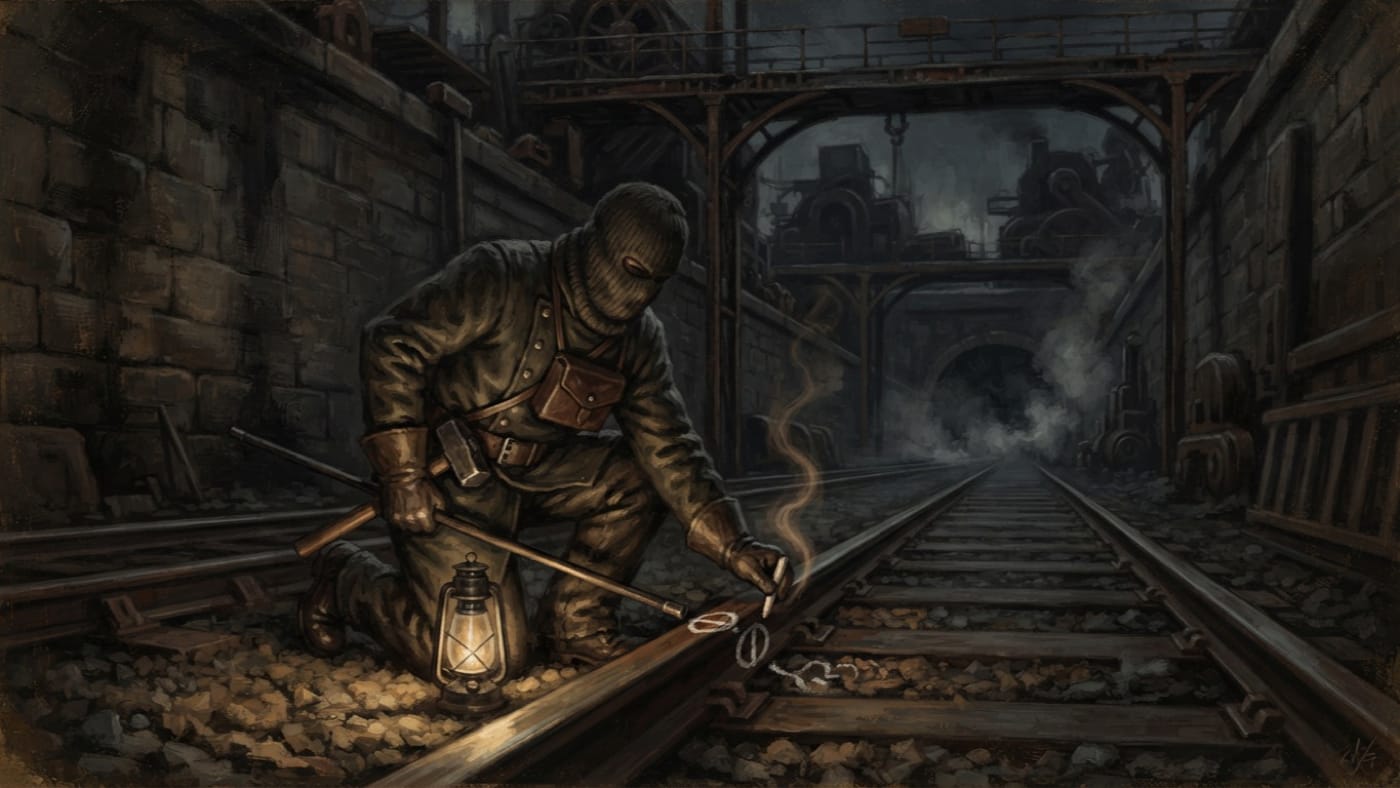
#On the Chalk in the Breast Pocket
Lantern low. Hammer quiet. Chalk warm. — Guild night instruction, transmitted orally
Demon-sign chalk is a white stick small enough to lose in a coat, and no Track Walker ever loses it. It sits on the issue list of the Railway Track Engineer after the gauge rod, the alignment glass, the hammers, the tie tongs, the ballast fork and the oilcan. The rod is a legal instrument. The ledger is a sworn record. The chalk is a consumable, and it rides in the breast pocket, over the heart, where consumables do not ordinarily live.
Every crew carries it. Day gangs use it to mark suspect ties and suspect lengths of rail for the next replacement. The Night Walkers carry it on dusk-to-dawn patrol with lantern, hammer and gauge rod. The Military Track Corps stows it in its tool carts among the spikes and mauls. It is the most ordinary object in the Guild's kit, and the only one the Bureau of Doctrine has thought it necessary to deny.
The denial says demon-sign chalk is a maintenance tool with no theological significance. No Bureau has ever pronounced on the theological significance of the oilcan.
#On the Circle and the Line
The warning is a circle drawn in white on the rail-head, with one vertical line through it. That is the whole of it. A child with a stub could draw those two strokes, and the Guild guards their meaning more closely than Records guards its pension rolls.
In my entry on the Track Engineer I likened it to a simplified eye. The likeness ends at two strokes, and anyone who adds a pupil, a lid or a third line has drawn something else and should explain himself to a Stationmaster. To a passing clerk the sign reads as defect notation: a frost-crack indicator, the sort of mark a gang leaves so the next gang knows where to bring the tongs. That resemblance is the mark's first virtue. A warning that looks like paperwork travels wherever paperwork goes, and it alarms nobody who holds a pen.
To the Guild it means one thing: do not walk this section alone after dark.
Careless readers fuse the chalk and the sign. A stroke across a rotted tie is maintenance. A circle and line on the rail-head is the warning. In Guild speech, "demon-sign" names what the Walker found in the steel. The chalk mark is what he drew once he had found it. The tool takes its name from the thing it records, much as the hangman's ladder takes its name from the hangman.
No one will say who designed the symbol. The mark is old enough that nobody admits inventing it, and the Bureau of Records holds no patent, minute or memorandum that contradicts the silence. Its earliest use is undated.
#On What the Walker Marks
The procedure begins with the ear. A Walker taps the rail and listens. A clear ring means live steel. A dead sound means fracture, a void, or patience under the sleeper. He checks gauge with the rod. He looks for hairline cracks that resemble frost but are arranged with intent. He notes rail that holds the wrong heat after sundown, signals that show an aspect no lever has set, and the smell the Guild calls honey-ozone. No public manual lists that smell, and every senior hand knows it at twenty paces.
Only then does the chalk come out.
The oral instruction for honey-ozone is three words: mark and withdraw. The mark comes first because the next man must know. The withdrawal comes second because the first man must live to sign the ledger. A Walker who reverses the order is remembered at supper.
The sign records a judgement. It does not replace one. A section can ring clear and still carry the circle; Section Foreman Grosz has said, with his customary ornament, that clear can lie. A section without a mark may simply have been walked by a man who never came back to draw one. The chalk cannot tell a crew where the line is safe. It tells them where somebody was frightened enough to stop and competent enough to write it down before leaving.
#On Metz and the Rule Thereafter
In A.S. 147 (1857 CE) a junction near Metz killed three hundred people in one night. The Codex files it as the Devil's Joint Incident. Guild crews from two section houses and a Metz yard gang worked until dawn among the steaming wreckage with silver spikes and salt-ballast. Somewhere in that labour they chalked the circle and the line on the rail-head. Then they scraped it off before the Records clerk arrived.
The foreman's report survives in its public form: Junction secured. Recommend no further inquiry.
The sign is older than that night. Its discipline is younger. After A.S. 147 the marks became consistent across section houses, the same two strokes in the same place from the northern frost routes to the southern spurs. Metz did not invent the warning. Metz made the Guild agree on it.
What sealed the junction is another question, and the published record does not answer it. Silver and salt appear in the accounts, and so does the chalk. No account claims the chalk did the sealing, and Doctrine has made sure no public account will describe what did.
BUREAU OF DOCTRINE STANDING ORDER 44/197 — PUBLISHED EXCERPT No published instruction shall describe the mechanism by which rail-bound entities are contained, diverted, named, spiked, salted, soothed, bargained with, or █████████.
#On Warmth and Official Explanation
Doctrine's position remains as filed: a maintenance marker without theological standing. The Bureau of Engineering adds that thermal contraction after sunset justifies inspecting at night. The Guild adds that fractures are easier to hear once traffic falls and the yards go quiet. Each explanation is true as far as it reaches. None of them reaches the pocket.
I have held a stick of it. It was warm. I set down that sentence in the Track Engineer entry, and I decline to improve it with a thermometer reading I did not take.
Others report more. Night Walkers speak of chalk warm in the pocket. By the Corps account, asking why it has begun to warm before sunrise can be enough to get a man sent south. On the dedicated spurs of the Sepulcher Locomotive, chalk marks have been seen darkening at the edges. Doctrine calls this soot contamination. Soot from a shrine-engine is a respectable explanation, and the Guild accepts it in the tone men reserve for a weather forecast delivered from indoors.
Some crews bless their chalk and some do not. The profession's own lore allows consecrated or mundane sticks according to crew theology, and Doctrine has not ruled between them, because a ruling would concede that the question exists. Chalk nubs collect among the offerings beneath the icon of Saint Vandrail, the tolerated and uncanonised patron of men who work on steel. The Codex Ferrum does not mention the chalk at all. Sensible documents leave room for survival.
No formula, quarry, maker or consecrating office is on record. Whether a blessed stick serves better than a plain one is left to crew opinion, and crew opinion has buried more theologians than I care to list.
An earlier entry in the wider Codex record stated that Night Walker disappearances averaged two per annum across the network.
Corrected by the Bureau of Records to fewer than one per annum, attributable to weather, terrain hazard and personal misadventure. The Guild keeps its own figure. Nobody has requested it.
#On Present Application
As of A.S. 201 the chalk is issued to every Guild breast pocket. Day crews still mark ties for the tongs. Night Walkers still carry it the full length of their patrol and bring back less than they took. Corps carts still take it south on War's spurs, where the rails hold heat too long and Engineering files the matter under metallurgy.
The Bureau of War lists it among the stores in Corps carts. The Bureau of Purity lists it among things it watches.
For the traveller, the clerk and the curious young priest, the rules are short. A white circle with a line through it on the rail-head is a Guild warning. Do not touch a fresh sign. Do not rub one out to see what is beneath it. Do not stop a Walker to ask what he marked. If he tells you to step away from the rail, step away. If he says nothing, step away faster.