
#On the Specialist's Station
A missing man is a question. The court prefers him as an answer. — saying of the forward tables, attributed to no one who wished to keep his post
The Desertion Hearing Specialist determines whether a soldier deserted. The office is senior within the Trench Courts, and disputed absence goes to it once ordinary clerks have run out of certainty or nerve. Every Trench-Court Clerk logs desertion hearings, most of them in absentia, since the subject of a desertion hearing is by definition elsewhere. The Specialist receives the files that refuse to close. One man is listed dead and has walked into a ration line. Another is listed fled and has been found in a fever tent under a cousin's name. A third has three rolls that disagree with one another in three different handwritings.
The office belongs to the profession's elite tier, above the Contradiction Custodians, from whose ranks it partly recruits. Its precedence against the Cadence Examiner is a matter on which both offices hold firm opinions and the Bureau holds none in writing. I decline to supply one. I have to eat at those tables.
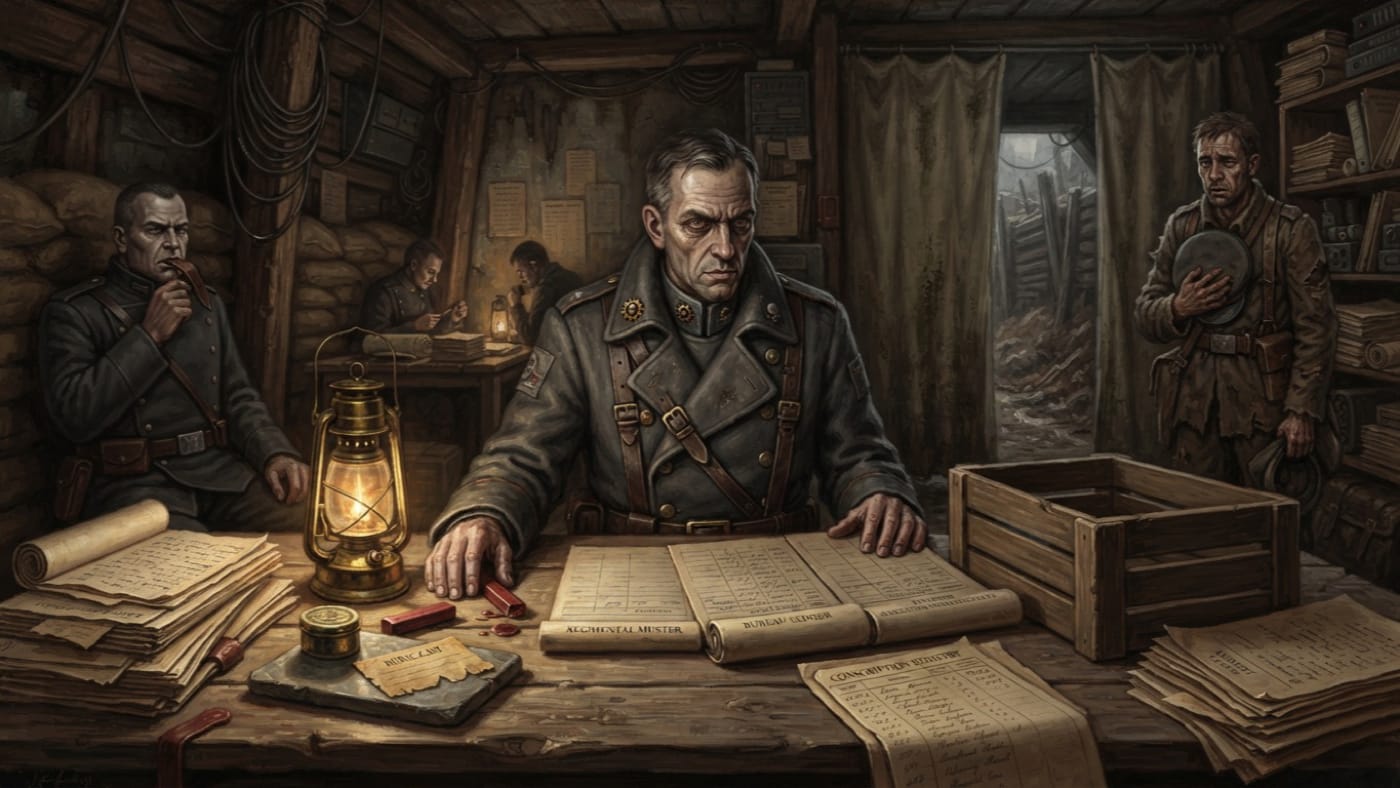
The table itself is ordinary: plank, lantern, seal tin, wax, a rubric card weighted under a stone. Two or three rolls lie spread side by side. A War representative sits at the left, chewing. A soldier witness stands at the right because nobody offered him the crate. Across from the Specialist there is very often an empty place, where the accused would sit if he were present, alive, and the man the papers say he is.
#On the Inheritance of the Purges
I hold no founding charter for the office. I know of no founder whose portrait hangs in a Records corridor and no year of creation I would swear to before Purity. Its trade, by contrast, it inherited entire.
The Uncounted Winter, which quarrelling authorities place somewhere between A.S. 87 and 91, left fifty thousand men dead without attestation. It also left an unknown number of living men attached to nothing. The Trench Courts were constituted in A.S. 91 under the joint mandate of the Bureau of Records and the Bureau of War, and they began fixing the dead to paper. Each death they fixed made every unfixed survival more conspicuous.
The Deserter Purges swept the northern sector in that year and its immediate aftermath. They left the court a working kit:
- the quick-hearing protocol of three identity questions, five absence questions and seven loyalty phrases;
- the corrective prompt;
- the three-roll cross-check of regimental muster, Records ledger and local conscription registry;
- the vile, efficient principle that the absent man must rebut the convenience of his own recorded absence.
They also left rope annexes, brands, and a generation of clerks who could hear a verdict in a man's first verb.
The Specialist is what an institution produces when it judges such tools too dangerous for juniors and too useful to abandon. Records wanted reconciliation and War wanted examples. Doctrine supplied the vocabulary. Purity watched for fraud and sat nearer the lantern than anyone liked.
#On Taking Account of Absence
Take a file of the kind that reaches a Specialist more often than Records admits.
A rifleman is entered dead on his company's casualty return after a bombardment. His tag is collected, a burial token issues, and his mother's pension claim begins its slow passage west. Four months later a man answering to his name draws rations at a depot two sectors south. The depot clerk has read the casualty return and sends the discrepancy inward.
An ordinary clerk sees two possibilities: a deserter wearing a dead man's name, or a dead man's name worn by a deserter. The Specialist sees at least six. The rifleman fled and kept his tag. He fled, and someone else's tag went into the grave in his place. He was carried unconscious to a rear hospital and entered under a misheard name. An officer transferred him by word of mouth and died before writing anything down. The roll burned and was rebuilt from memory by a sergeant who disliked him. Or the man at the depot is someone else entirely, who found the name lying about, as names lie about after a battle.
Each possibility leaves its own residue. Flight leaves gate transfers and ration draws in the wrong direction. Evacuation leaves a hospital entry, a chaplain's note, and a stretcher-bearer who remembers carrying the weight. Swapped tags leave a body measured wrong for its file. The Specialist lays muster against ledger against registry. Then come the casualty list, the ration record, the gate log, and whatever the witnesses can be made to recall before they are needed elsewhere.
Witnesses are the worst evidence and the only kind with a pulse. A corporal who hated the accused remembers him running. A medic remembers him bleeding, if the medic has not already been reassigned to a casualty pit. The War representative remembers nothing and offers this as testimony to the sector's discipline.
When the accused is present, he answers the protocol. When he is absent, the hearing proceeds without him, and the Specialist answers for him out of the documents. That is the office's quiet horror and also its real skill. A careful hearing in absentia has returned dead men to the pension rolls and living men to their names. A fast one hangs a stranger's paperwork.
The Desertion Hearing Specialist determines whether a soldier deserted.
Corrected. The Specialist determines what the record can bear. Whether the soldier deserted is a separate question, occasionally answered by the same process.
#On Loyalty Phrasing and Contradiction
Once identity is settled, or settled enough, the hearing turns to grammar. The rubric card lies under the Specialist's left hand. It has been revised since the Purges and is still field-issued, and its logic is unchanged. Some explanations of absence can be filed. Some must be corrected. Some must be taken out of the soldier's mouth before they reach the ledger.
"I lost contact under bombardment" is a sentence the court can live with. "They left me" draws the corrective prompt, which is offered once. The Specialist reads it in the flat voice of a man offering bread to a dog he intends to keep. If the soldier accepts the safer sentence, his file grows more survivable. If he refuses, the refusal is recorded, and refusals carry weight.
The hardest answers name command. One man says his captain ordered the withdrawal and then reported that the company fled. Another says the relief never came because it had been sold for lamp oil. Testimony of this kind splits in the Specialist's hands. Whatever concerns the soldier stays in his hearing record: his absence, his explanation, his category. Whatever concerns the captain is marked, sealed and routed under the Contradiction Doctrine into a pouch for Custodian disposition. The soldier may go back to the line under punishment while his accusation travels rearward, or toward the furnace, without him. Two papers come out of one mouth.
The Specialist does not burn anything. Burning is Custodian work, done under Burn Directive 7-C with its authorised countersignature. Nor does the Specialist judge borrowed speech. A soldier may answer the protocol in a cadence that is not his own, or in his dead sergeant's phrasing. That file goes to a Cadence Examiner under a cadence anomaly hold. The Specialist then washes his hands in cold water and does not mention it at supper.
#On Reclassification and Its Price
Every category in a desertion file has a price, because every category has a consequence. Desertion closes the pension, stains the family notice and can forfeit burial eligibility. Missing in action keeps the widow's claim alive. Killed in action produces bread. Return to the line under brand produces a man who is useful and visibly ashamed. The court's outcomes run from conditional restoration and penance through labour conversion, corpse detail, wire work and ossuary draft, all the way to execution. The Specialist commands none of these alone. He prepares the record that makes each one possible.
So the offers arrive. A supply sergeant brings ink and paper and asks whether a desertion hearing might be reclassified as missing in action. His interest is rarely charitable, since a missing man's rations keep drawing. A family sends coin by courier to keep "fled" off a son's file. An officer asks more gently, only that the hearing finish before his own name surfaces in the witness notes. Falsifying desertion outcomes is a named corruption of the profession, and it was named because it is common.
The Rubric Clerks supply the Specialist with clean categories and consciences to match. The Record-True Clerks supply duplicate transcripts, kept inside hymn covers. Such a copy can prove a man was carried out unconscious, or it can prove a captain lied. Either faction can save a household, and either can bury one.
This is where promotion from Custody shows. A Custodian learns to judge which truths have teeth. Brought to the hearing table, that habit turns into a talent for hearing absence as guilt, because guilt files cleanly and doubt costs another week. The best Specialists resist it. They are tiresome and slow, and they account for nearly every dead man restored to the rolls.
#On the Present Hearing
As of A.S. 201, Desertion Hearing Specialists are among the active personnel of the Trench Courts along the Sagittal Line. The courts cover the Line from Brest and Przemyśl south through Irongate and Shipka to Constantinople. Not every station keeps a Specialist. Records has published no count, and I would distrust one if it had. The hardest files travel to whichever Specialist the sector can reach.
The office depends on three things it cannot control. Men under shellfire must keep the rolls honestly. Witnesses must stay alive long enough to remember. Senior authority must tolerate a hearing that ends in "error" when it wanted "flight." All three are scarce. The Specialist sits down to the lantern, the seal and the empty place regardless.