

I've finished reading the continuity sources and the sibling articles, and now I'm writing the article.
#On the Office and the Hour It Claimed
A child under the Philosophical Prefectures could get through a morning without meeting the Prefect of Reason, the Marshal's Guards or the Tribunal's bell. The child could not get through it without meeting the Director of Instruction. That office had the hours between waking and supper. It had them every weekday, and every child was entered in them.
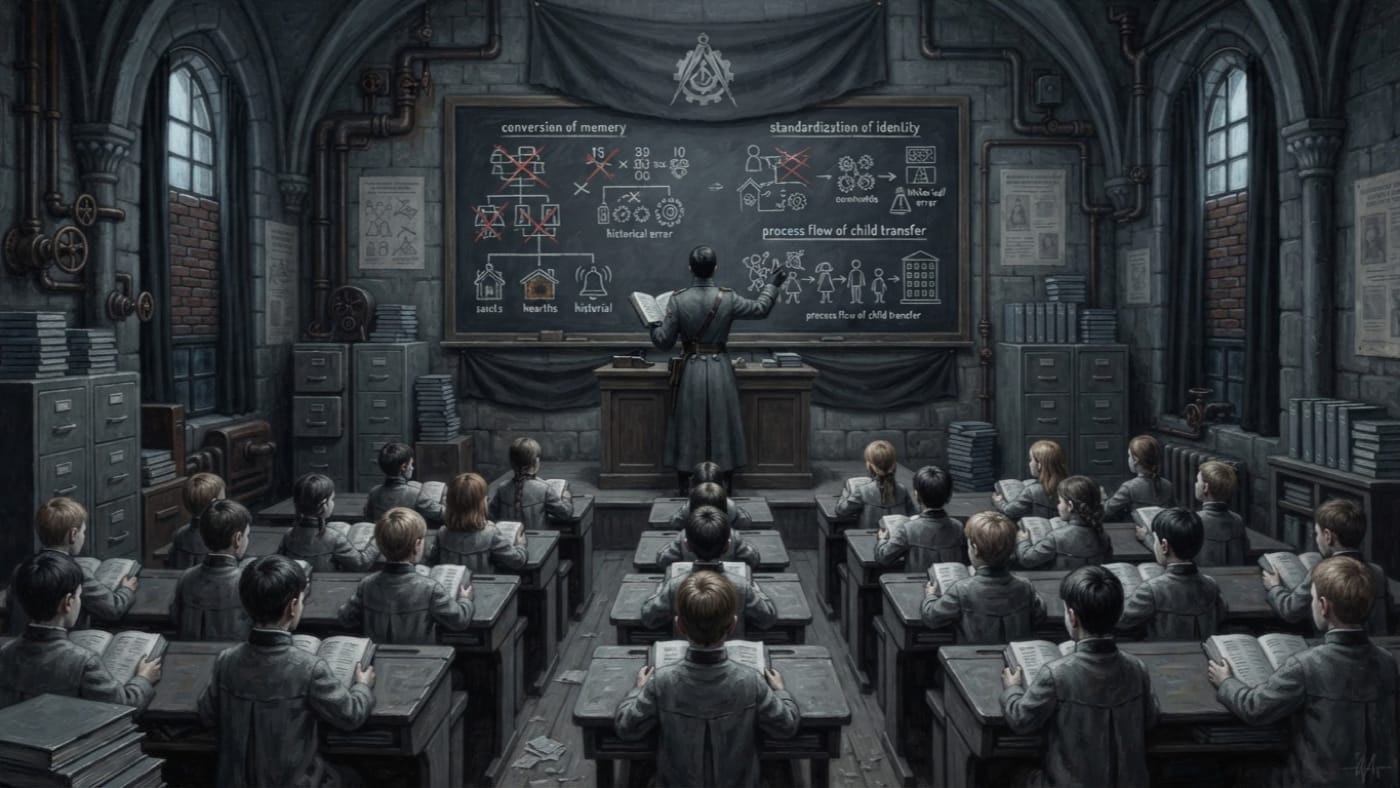
The published account names the Director among the five principal officers of each prefecture, with the Prefect of Reason, the Civic Security Marshal, the Census Chancellor and the Tribunal of Clarity. It gives the office a short list of duties and nothing else. The list is schools, academies, compulsory recitations, teacher appointments, textbook corrections, child transfers, and "the conversion of family memory into state-approved derision." I wrote that last phrase. I would write it again, more slowly.
That is the whole charter in my hands this year, A.S. 201. No creation year for the office survives in this survey. Neither does a founding instrument, a named incumbent, a budget, a staff roll, a curriculum text or a stated power of punishment. The Director is an office category, and there were as many Directors as there were prefectures that filled the chair. I will not seat a man in it so that the reader has a face to hate. Hate the chair.
#On Schoolrooms, Masters and Corrected Books
The prefectures took the buildings first. According to the published account, cloisters became academies and lecture rooms, "where boys were taught to sneer at the shapes of windows their fathers had prayed beneath." The Director's portfolio covered what happened under those windows: which schools opened, which academies received pupils, which masters stood at the desk, which books lay open on it and which words the pupils spoke aloud together.
Teacher appointment is the duty least discussed and most important. A Republic that names the schoolmaster does not need to visit the schoolroom. The record does not show how a master was examined, how long he served or what became of one who recited the maxims with insufficient contempt. It shows only that the appointment belonged to Instruction. That is enough. The Synod has never needed to be told who owns the parish once it knows who chose the priest.
Textbook correction meant that the books themselves were corrected. A corrected book does not argue with its reader. It replaces the old account and leaves the reader no copy to compare. I have no surviving Rationalist primer to quote and I will not compose one. The published account gives the substance of what was taught, and the substance needs no help from me. A saint was a cultural residue. A relic was a bone claim. A monastery was an unproductive estate. A grandmother was an unreliable source.
Compulsory recitation finished the work. The account sets out the order of a child's learning: the prefectural number before the old feast days, civic maxims before psalms. Order is the whole cruelty of it. A child who learns the number first will hear the feast day as a footnote to it. Recitation did the rest of the correcting. The words went in by repetition, and a child who has said a thing every morning for years believes he chose to say it.
#On Transfer and the Kitchen Table
Here the record thins, and I will not fill it.
The published account gives child transfers to the Director's charge. The Census Chancellor's registers carried a triangle beside a dependent's name, which marked that child for Rational Instruction. One office marked the child and the other received him. Who carried the order between them, who signed it, how much warning a household got, where a transferred child slept and whether he came home are all absent from the evidence this survey holds. The account of daily life says only that the office controlled "whether a child removed for Rational Instruction might be seen again." The sentence ends there, and I am leaving it there.
What the record does preserve is the collision. The household kept one account of the world and the schoolroom issued another. The account lists what the second was meant to defeat: feast days, psalms, saints, relics, the monastery on the hill and the old woman by the stove. All of it came home from the parish, the kitchen and the grave by the wall. A Director could not confiscate a kitchen. He could teach the child sitting in it that the kitchen was mistaken.
The Cellar Saints answered with a counter-curriculum of substitutions, as recorded on a seized cellar note. A psalm became a washing song and a priest became an uncle. The children who carried those words learned two languages at once, one for the master's desk and one for the cellar stair. The Director's office existed to make the second language die out. The record does not say how far it succeeded, and I will not claim either result.
The published account of the Philosophical Prefectures carries a margin note: "Give me a Director of Instruction and six years, and I will give you a citizen who reports his mother for singing. Give me twelve years, and he will call the report compassion."
Corrected as to use, not as to judgement. The note is my rhetoric about the office's aim. It is not a recorded case, a measured result or a term of any curriculum. No surviving source shows that six or twelve years were set periods of instruction, or that any particular child informed on any particular mother. Readers who have quoted the note as evidence are to stop. They may keep it as a verdict.
#On the Table of Five
The published account divides prefectural government into five portfolios: authority to the Prefect, force to the Marshal, childhood to Instruction, existence to Census and sentence to the Tribunal. The Director's neighbours explain his work by contrast. The Marshal commanded the Republican Guards and the men who made writs audible on staircases. The Chancellor kept the registers of the First Black Census and the child-transfer marks. The Tribunal seated the accused and invited him to clarify himself.
The Director commanded no bayonets that the record shows, held no tribunal and kept no census. He held a schoolroom, and in time the people in the other four portfolios had all sat in one.
The published account calls the arrangement of the five offices "brutally simple," and a companion survey describes them as each needing the others, with the Director claiming the children.
Corrected. These describe portfolios, not a working chain. Surviving evidence does not establish a reporting line from the Director to the Prefect, a procedure linking the Chancellor's triangle to the Director's receipt of a child, or a uniform rank among the five offices across thirty-seven prefectures. The word "simple" described the design's intent. How the offices actually worked together is not documented and will not be supplied here.
#On the Office's Years
The prefectural order has dates. The Director's office, considered by itself, does not.
Rationalist administration existed before the formal Republic, whose earlier founding is not established. The Treaty of Regensburg and the formal Rationalist Republic belong to A.S. 30, and the thirty-seven prefectures were constituted then under Schedule One of the Concordats of Governance, under the Council of Nine. The Director was listed among each prefecture's principal officers. Whether any schooling office of that name existed before A.S. 30, or when the first one opened its rolls, is unknown.
On 1 November A.S. 45 the Sundering fractured the prefectural order. The published account depicts prefects closing schools among their other panics in that season. It names no Director, says nothing about what became of the office's pupils, and gives no date on which Instruction stopped working. The Church's public emergence after A.S. 45 was uneven. Around A.S. 50 an interim council governed, and the formal Synod was constituted only at Strasbourg in A.S. 90, which is also when the Synod settled the count of years I am using here. I state these dates so that nobody pins the office's end on any one of them.
In A.S. 92, according to the published account, the Bureau of Doctrine annulled the prefectural order retroactively along with the rest of the Concordats. Doctrine holds that the Director of Instruction never lawfully appointed a master, corrected a book or received a child. The recitations happened anyway, and the children who said them grew up.
#On What the Survey Can Hold
The parent account claims the Synod inherited school buildings, among much else, from the prefectures. Buildings are not offices. This survey finds no evidence that the Director's office survived the fracture, that any of its personnel entered Synodal service as instructors, that any Synodal teaching practice descends from its recitations, or that any present seminary or Synodal education office is its successor. Moralists who see a resemblance between a prefectural maxim and a Synodal catechism are asked to bring documents. Resemblance without documents is not evidence.
No file, slate or seal specific to this office is entered here as being in custody. If the Forbidden Stacks hold one, it has not been shown to me under this survey's warrant, and I do not describe objects I have not been shown.
What remains is the list of functions and the order of instruction: the number before the feast, the maxim before the psalm, and the grandmother classed as an unreliable source. The office's papers are mostly lost, and that list is the evidence against it.