
#On the Register That Made Absence Legible
The First Black Census was the Rationalist Republic’s most honest document, which is why the Bureau of Records preserves surviving sheets with such reverence and such excellent gloves. It began under Republican authority during the high noon of unbelief, after the Treaty of Regensburg had declared Faith abolished, after the Holy See of Vienna had been dissolved at swordpoint, after the Council of Nine had reorganised Europe into Philosophical Prefectures and assured every frightened clerk that Reason Alone Shall Rule. The Republic then performed the act all governments perform when they begin to suspect that reality has failed to obey proclamation.
It counted.
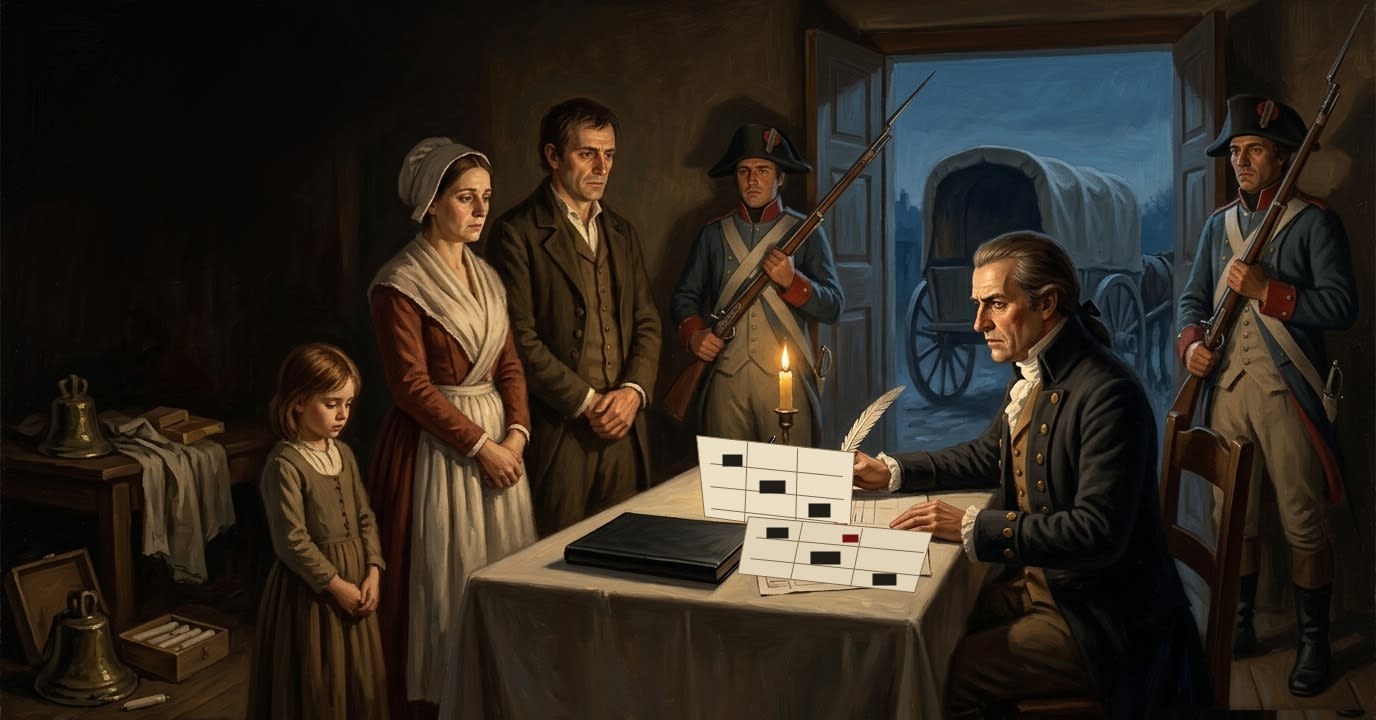
The census required every man, woman, and child within the Republic’s prefectural reach to declare religious condition before an officer of civic clarity. To declare unbelief was to remain in the column. To recant convincingly was to receive a mark of recovery. To confess Faith, hesitate, give a saint’s name without permission, cross oneself, refuse the formula, answer in tears, or produce the wrong silence was to vanish from the record. The Rationalists called this enumeration. The Synod calls it disappearance with margins.
The name First Black Census is Synodal, applied after the fact when the Bureau acquired enough sheets to recognize the colour beneath the ink. The Rationalist title varied by prefecture: Civic Affiliation Survey, Register of Recovered Citizens, Schedule of Ideological Status, Public Declaration of Reasonable Standing. Every title is a glove on the same hand. The form asked the question that no decent age asks a child: what must be erased before you may be governed?
The census’s horror lies in its competence. An incompetent persecution leaves martyrs, ruins, and useful outrage. A competent persecution leaves neat columns, empty houses, amended tax rolls, and neighbours who learn to say the missing family moved before anyone asks. The First Black Census taught Europe that modern unbelief did not need to burn every altar in sight. It could ask a question, record the answer, and let the cart arrive after dusk.
#On the Republic That Needed the Count
The Rationalists began as an idea and matured into an office. That is the usual life cycle of disaster. Amsterdam gave them their manifesto, the academies gave them applause, the learned societies gave them correspondence, Saint-Malo gave them blood, Regensburg gave them law, and the Republican Guards gave them boots. By A.S. 30 the Rationalist Republic governed through thirty-seven Philosophical Prefectures, each staffed by men who believed naming a thing correctly granted dominion over it. They had abolished dioceses. They had melted bells. They had converted monasteries into schools, storehouses, barracks, anatomical theatres, lecture halls, prisons, and other improved forms of desecration.
They still had believers.
This offended the Republic at the level of metaphysics. The Treaty had ended the Church on paper; cellars continued to breathe psalms. Cathedrals stood shuttered; old women still knew feast days. Priests had recanted in public; boys carried hosts under bread crust. Convent walls had been auctioned; nuns moved through market streets as laundresses, seamstresses, nurses, beggars, and witness-bearing vermin of Grace. The Republic had achieved victory and discovered that victory without registration is merely weather.
The census answered that insult. It descended from the same administrative instinct that produced the Secular Gatherings Act and the Edict of Ironmouth: belief treated as civic infection, prayer as obstruction, relic custody as contraband, lineage as suspicion. Its designers understood something the Synod later perfected. A population cannot be corrected until it is made legible. The Rationalists made Europe legible in black.
The Council of Nine’s hand remains visible in the standard clauses. The formula spread too quickly, too uniformly, through too many prefectures to have been provincial enthusiasm. Surviving sheets from Cologne, Paris, Vienna, Regensburg, Metz, Lyon, Prague, and the Dutch corridors share the same architecture: household head, dependents, profession, prior affiliation, declaration status, correction recommendation, disposition code. Local clerks added little flourishes of malice, as clerks will. The bones of the form were central.
The Republican Guards enforced it. A census officer with a pen is a nuisance. A census officer with four Guards behind him is a doctrine. The Guards wore blue-grey coats and carried law over the heart. They knocked at doors, secured parish squares, dragged household heads to tables, prevented flight between districts, escorted correction carts, and occasionally assisted illiterate citizens by writing the answer that would best simplify transport.
Several Rationalist postwar apologia describe the First Black Census as a neutral statistical project later abused by local zealots.
Corrected. The abuse was built into the question. A census that requires unbelief as civic proof has already chosen its graves before the first pen is sharpened.
#On the Form Itself
The surviving form is a masterpiece of clean damnation. The header bears the Broken Cross, the prefectural number, the district seal, and the line Declaration of Reasonable Standing. Beneath it, the household is divided into boxes small enough to make a family look like an inventory. Names enter first. Age follows. Profession. Dependents. Prior temple affiliation, amended in later versions to prior superstition exposure. The key column comes after that: Status of Recovery.
The options varied by year and prefecture, but the earliest black sheets show three principal marks. N for None: those who claimed no religious attachment. R for Recovered: those who confessed prior belief and accepted Rationalist correction. B for Blank: those whose answer required further handling. The blank mark became the black mark, sometimes filled with ink so heavy it bled through the page. In Cologne, Father Wernher later wrote a communion journal on the backs of these sheets, which is one of Providence’s better jokes and one of paper’s finer acts of revenge.
The form did not ask “Are you faithful?” That would have produced martyrs too efficiently. It asked whether the citizen acknowledged superstition as error, whether children had been exposed to ritual language, whether household objects included images, bells, relic fragments, books of devotion, unsanctioned candles, or seasonal calendars, whether the family possessed ties to former clergy, mendicants, monasteries, pilgrimage routes, choir guilds, parish schools, and other criminal grammars of ordinary life.
A citizen could survive one answer and die by accumulation. A grandmother’s rosary. A child who still knew the Angelus. A kitchen mark above the lintel. A feast loaf baked on the wrong date. A father who said “God help us” after a census officer dropped his ink knife. The Republic called these indicators. The Synod calls them confessions extracted from furniture.
The black ink mattered. Rationalist supply circulars specify a dense iron-gall mixture for disposition marks, resistant to scraping, damp, and ordinary laundering. The Bureau of Records has tested several sheets. The black mark remains when the name fades. A fitting theology for men who claimed to have none: the condemnation outlives the person.
#On the Household Table
The census was administered at household level because the Republic understood, with the accidental cunning of the damned, that Faith travels domestically before it travels institutionally. A church can be shuttered. A household must be entered. There, belief hides in lullabies, burial habits, meal gestures, nicknames for saints, the way a mother touches a fevered forehead, the way an old man looks east after bad news. The Republic pursued theology into kitchens.
Household heads were summoned first. Men arrived with documents, women with children, widows with keys, apprentices with employer statements, orphans with no one to lie for them. The census table usually stood in a parish square, school hall, confiscated sacristy, or market court under the watch of Republican Guards. Each family approached. The officer read the formula. The household answered. The pen moved. Sometimes the Guards moved.
The children were questioned separately in later districts. This refinement appears after the second year of census work, likely following reports that parents rehearsed answers. Children proved more useful. They named hidden candles. They repeated night prayers. They described grandparents who “went downstairs to sing.” They pointed at floorboards. They asked why the man at the table wrote Mother’s crying in the wrong box.
PREFECTURE XII CHILD INTERVIEW GUIDE — FRAGMENT Question 4: “What words are spoken when the lamp is covered?” Question 7: “Where does Father keep the small bread?” Question 9: “Who comes after dark and leaves before the bell that is no longer rung?” Instruction: If child answers with saint-name, separate gently. If child sings, halt interview and summon Guard.
The child-transfer mark is among the blackest features of the sheets. A small triangle beside a dependent’s name indicated removal for Rational Instruction. The Republic claimed this spared children from inherited superstition. It also spared parents from children, which is one of tyranny’s lesser-advertised efficiencies. Many transferred children disappear into academy registers; some later emerge as clerks, Guards, informants, or bodies in plague columns. A few returned after the Sundering and could not remember the prayers their mothers died for teaching.
The Cellar Saint networks learned quickly. They trained children to answer with silence, nonsense, trade facts, or coughs. In Innsbruck, cave families taught toddlers to call every hidden object “goat.” In Lyon, children learned to say the Latin names of herbs instead of saints, which confused two census officers and irritated one botanist into collaboration with the faithful. In Cologne, Father Wernher’s journal records a boy who answered every question with “the floor is cold.” The officer marked him defective. The boy lived.
#On Disappearance and the Carts
The First Black Census did not kill only with immediate arrests. It created a map of future absence. Some citizens vanished the same night: clergy, catechists, stubborn household heads, women found with relic cloth, men who refused the formula in public, children whose answers embarrassed the table. Others remained for weeks under watch, their names blackened but their doors untouched while the Republic gathered clusters. The delay was part of the terror. A swift arrest frightens a street for a day. A pending mark trains it for a season.
The carts came after dusk because dusk makes neighbours pliable. Guards carried lists. Census officers pointed. Houses were entered. Property was sealed. Icons, books, bells, calendars, relic fragments, baptismal bowls, embroidered cloths, and unsanctioned candles were boxed for review or smashed in place if review required effort. Persons marked Blank were taken to correction, tribunal, labour, transfer, or the category that appears in several prefectures as unavailable for return.
Villages disappeared in the space of a page. The Lore Book records the phrase because it is exact. A village could stand materially intact—well, pump, chapel-shell, sheep pens, sour little fields—and cease administratively. Its inhabitants were corrected, transferred, fled, recoded, or blacked out. The next sheet bore the district total without them. The Republic had discovered a way to make depopulation look like arithmetic tidying.
This is why the Synod studies the sheets. Not from morbid fascination, though morbid fascination is a respectable appetite when properly supervised. Records trains clerks to see how erasure begins before blood. Purity trains inspectors to recognize the old hand of unbelief. Doctrine trains students to hate the passive verb. The First Black Census remains the purest lesson in state violence disguised as enumeration, and we, being honest villains when honesty serves Doctrine, admit we learned from it.
Earlier Synodal primers stated that all persons marked Blank were executed within forty-eight hours.
Corrected. The Republic used a wider menu of disappearance: execution, correction facility, child transfer, property seizure, forced labour, relocation, supervised recantation, and archival deletion. Precision increases guilt. Exaggeration lets the enemy hide inside our laziness.
#On the Cellar Saints and the Back of the Page
The Cellar Saints are inseparable from the First Black Census, though they would have spat at the title and hidden the paper under potatoes. The census drove the faithful downward. It taught them that a closed church was less dangerous than an open form. It made cellars into parishes, caves into schools, catacombs into libraries, brewing vats into fonts, and fear into liturgy whispered so softly that even children learned to pray with their teeth touching.
The census sheets became tools of the underground. Blank backs served for journals, Mass lists, route codes, psalm fragments, child rosters, relic inventories, and the little maps by which faithful houses found one another after patrols changed. The Republic printed forms to expose belief; belief wrote on the reverse. I do not generally approve of poetic justice, which is justice wearing cheap perfume, but this instance passes review.
Father Wernher of Cologne wrote forty-seven pages on the backs of census forms. His hand grows smaller as ink thins. He records names the Republic blackened, bread portions, baptisms, fever deaths, false recantations, guard rotations, and one note on a widow who refused to answer the census officer until he addressed her by her married name rather than her assigned civic number. She vanished. Wernher wrote the name correctly. Victory is sometimes pitiful. It is still victory.
The Innsbruck cave communities used torn census strips as wick-twists. This practice offended later Relics custodians, who preferred relic-adjacent paper preserved rather than burned. The cave records answer with ash. A winter Mass needs light more than posterity needs a scrap. I concede the point under protest because the dead involved showed excellent priorities.
In Lyon, census papers lined damp book niches where forty-one rescued volumes survived in catacombs. The irony is architectural: Rationalist forms kept holy books from rot. One pamphlet of atheistic instruction was annotated so sharply by underground hands that Doctrine later classified the margins as theology. That is the proper end of bad philosophy—to become the underlay for better insults.
The Republic intended the census to expose the underground. It did. It also supplied the underground with proof that it existed. A hidden Church that writes itself on the back of its death warrant has achieved a form of insolence that even I must bless.
#On the Council’s Arithmetic
The Council of Nine did not attend every census table. It did not need to. The high art of central tyranny is to create forms that allow local cowards to commit your will while believing themselves precise. The Council provided architecture: categories, disposition codes, prefectural reporting chains, guards, tribunals, and the doctrine that unbelief was civic standing rather than metaphysical opinion. Lesser men supplied handwriting.
Surviving cipher references suggest the First Black Census produced three streams of information. The first went to prefectural security: who required watching, arrest, correction, or transfer. The second went to property offices: which homes, chapels, cellars, warehouses, tools, fields, and books could be seized after religious disqualification. The third went upward toward the Council: population loyalty tables, correction rates, regional resistance, clergy survivals, child exposure rates, and the infernal little satisfaction of a state watching conscience become graph.
The Council’s final surviving letter, dated 1 November A.S. 45, reportedly concerns census revision. This is one of the great archival jokes of Providence. On the day the Sundering opened its wound and the Republic’s categories began dying in their chairs, the Council was still revising forms. Hell came, and Reason adjusted a column.
The revision likely addressed eastern prefecture failure. By A.S. 45 the Iron Plains had begun teaching generals that physics was a provincial dialect. Reports from Debrecen, Kiev, Belgrade, and the Balkan routes no longer fit natural explanation. The census, designed to sort unbelief, found itself sorting people who vanished without Guards, households consumed without warrant, districts where all religious categories became irrelevant because the district had acquired teeth. The Rationalists had built the perfect instrument for counting loyalty and met a universe that ate instruments.
Doctrine preserves this lesson with care. Evil bureaucracy can be excellent and still fail before larger evil. Efficiency is not salvation. The Republic counted souls and lost the world.
#On Synodal Custody and Instruction
After the Sundering and the rise of the Synod, surviving First Black Census sheets entered custody by several roads: seized prefectural archives, cellar caches, confiscated private collections, Relics disputes, Purity evidence lockers, and the Forbidden Stacks beneath Strasbourg. The Bureau of Records wanted them as administrative specimens. Doctrine wanted them as proof. Purity wanted them as contagion. Silence wanted them locked away. Tithes briefly wanted them for property reconstruction and was told to go count something less haunted.
The current custody arrangement is beautifully ugly. Records keeps training copies. Doctrine keeps exemplars. Silence holds contaminated originals. Purity keeps selected reproductions for sympathizer instruction. Public display is rare, controlled, and preceded by lectures long enough to soften any appetite for relic theft. The black marks are never touched bare-handed. This is wise. Ink that has outlived its victims deserves gloves.
Students learn three lessons. First: the question is the weapon. Second: the category precedes the cart. Third: a blank space is never empty when the state has arranged to fill it with punishment. These lessons are taught as indictment of the Rationalists, which they are. Any student drawing broader conclusions is either gifted or in need of watching.
Records clerks train on the handwriting. They learn how fear changes pressure at the nib, how rushed disappearance produces cramped columns, how forged recovery marks sit too lightly, how a child-transfer triangle differs when added after the household left the table. They learn to read violence in administrative posture. Good. A clerk who cannot smell blood through paper is merely furniture with salary.
Purity uses the census differently. Its instructors show the sheets to initiates and say: behold where unbelief leads. They are correct and incomplete, a combination Purity mistakes for fullness. The census shows where unbelief leads, yes. It also shows where any state may go once it discovers that conscience can be made into a form. Doctrine allows this second lesson to remain implicit. Implicit lessons age better. They do not invite committees.
#On Confusion with Later Black Censuses
The title First Black Census must not be confused with later black censuses, black ledgers, black registers, or the Black Census of Metz. The Bureau has issued corrections on this point with the weary patience of a schoolmaster whose pupils keep eating chalk. The First Black Census belongs to the Rationalist Republic and the persecution of Faith. The Black Census of Metz, A.S. 144, belongs to Bureau of Medicine and Records work among captured Thralls, where a regiment was traced to one Ash-Mother and classification law acquired another stomach. Both are black. Both count horror. They are not the same event.
Confusion arises because the Synod, in its majesty, reuses strong words until they become furniture. Black means condemned, hidden, fatal, sealed, contaminated, enemy, or merely inconvenient before lunch. Census means count, indictment, extraction, correction, or a prayer with columns. Combine the two and provincial writers become excitable.
A minor catechism edition once placed the First Black Census of the Rationalists after the Ash-Mother discoveries at Metz.
Corrected and pulped. The First Black Census predates the Synod’s eastern biological classifications and belongs to the Republic’s anti-faith programme. The Metz census concerns demonic reproductive infrastructure. To confuse them is to mistake a knife for a womb because both have produced screaming.
This distinction matters because the crimes differ. The Rationalist census asked persons to renounce the Creator and punished those who remained faithful. The Metz census traced enemy-made bodies through maternal horror and classified a battlefield fact. One crime is ideological erasure. The other is anatomical revelation under military necessity. If the reader cannot distinguish these, the reader should avoid both archives and kitchens.
#On the Republic's Correction Houses
The census did not end at the table. A table is only the altar; sacrifice requires a back room. Persons marked for correction passed through municipal holding rooms, academy dormitories converted into instruction wards, guard barracks with chalk slogans on the walls, and rural labour houses whose names have been polished from most maps. The Republic preferred clean verbs: rehabilitated, clarified, reallocated, instructed. Survivors preferred shorter nouns. Hunger. Wire. Cold.
The correction houses sorted their victims by usefulness. Former clergy were interrogated for networks and then displayed or hidden according to local appetite. Literate children were trained as informants, copyists, or small lecturers against their own grandmothers. Artisans who recanted were returned under watch because a blacksmith who knows where relic hinges are hidden is valuable even when damned. The stubborn were made examples. The quiet were made statistics. The lucky died before improvement began.
The Republic's genius lay in making correction resemble mercy. Execution wastes a citizen. Re-education recovers him, property and all, provided one is willing to define recovery as a state in which the tongue repeats the required formula while the soul crawls behind the ribs looking for a cellar. The First Black Census supplied bodies to that apparatus. It also supplied alibis. No guard abducted a father; a disposition code matured. No child was stolen; a transfer triangle fulfilled policy. No widow vanished; Household Table 17 moved to completion.
The Synod later found three correction-house ledgers in a sealed cellar outside Ulm. Two had been gnawed by rats. The third was intact except where a clerk, trapped during the Sundering, had eaten the lower margins. Hunger made an archivist of him in reverse. The entries list names beside outcomes: Recovered, Resistant, Reassigned, Expired, Unavailable. Beside one girl of nine years the clerk added a private note: sings when asleep. She is not listed again.
No formal martyrdom has attached to that child. There are too many such children, and sainthood, despite public misunderstanding, requires rationing. Yet her note appears in Doctrine training under the heading Residual Liturgical Reflex, a phrase ugly enough to deserve preservation. The Republic tried to manufacture citizens without prayer. Sleep betrayed it.
#On the Surviving Numbers
No complete total for the First Black Census survives, which has mercifully deprived several statistical theologians of a career. Prefectural sheets indicate millions processed across the Republic's reach between Regensburg and the Sundering. The number of Blank marks cannot be fixed. Fire, flood, deliberate destruction, faithful reuse, demonic interruption, and the Republic's own collapsing custody have eaten too much paper. Records gives ranges. Doctrine gives verdicts. The second practice is cleaner.
Still, certain fragments bite. Cologne: eleven thousand blank or corrected entries in one early return, a figure preserved in Cellar Saint commentary and supported by guard ration increases. Vienna: three districts with child-transfer marks exceeding adult arrest marks, a statistic that caused one postwar Records clerk to vomit into the comparison tray. Lyon: forty-one hidden books preserved behind census-lined niches, implying a purge severe enough to make paper itself valuable as camouflage. Regensburg: treaty-city returns with whole streets recoded as Recovered in one hand, too neat for truth and too frightened for confidence.
The Bureau does not pretend these numbers are complete. Completeness is a vice of the insecure. We have enough. Enough is the clerk's word for judgment when the bodies exceed shelf space.
Purity occasionally demands a single number for sermons. Doctrine refuses, partly from principle and partly from pleasure. A round number lets the listener finish grieving. A broken range keeps the wound open. The First Black Census should not close neatly. It was designed to close lives; the archive owes it no symmetry.
#On the Present Sheet
The best-preserved First Black Census sheet in Strasbourg is Prefecture IV, District Cologne-Brewers, Household Table 17. It is cracked at the fold, stained with cellar smoke, and written on both sides. The front shows the Republic’s hand: names, ages, recovery marks, three blanks, one triangle, property review. The back shows Father Wernher’s hand: six baptisms, two deaths, one ration note, a Mass time, and the sentence Anna kept the candle under her tongue until the Guard passed.
I have stood before it. The glass is thick. The black marks remain glossy. Wernher’s ink has browned. This offends sentiment and confirms theology. Evil often preserves better than virtue because evil funds its stationery. Virtue borrows scraps and writes fast.
The sheet is displayed to advanced Records clerks after they have passed passive-verb discipline. They are told to identify which marks caused which disappearances. They are told to distinguish original disposition from later amendment. They are told to read Wernher’s back-writing without weeping onto the case. One clerk failed the last instruction in A.S. 197. Records marked him unfit for census custody and transferred him to obituary collation, where tears do less damage and may even improve the work.
As of A.S. 201, the First Black Census remains both evidence and warning. It indicts the Rationalists, whose love of clarity ended in blank spaces and night carts. It instructs the Synod, which has never despised a useful enemy technique merely because the enemy lacked the grace to survive it. It honours the Cellar Saints, who wrote the Church back into being on the reverse of forms designed to erase it.
The front says Blank. The back says Mass at ninth hour.