
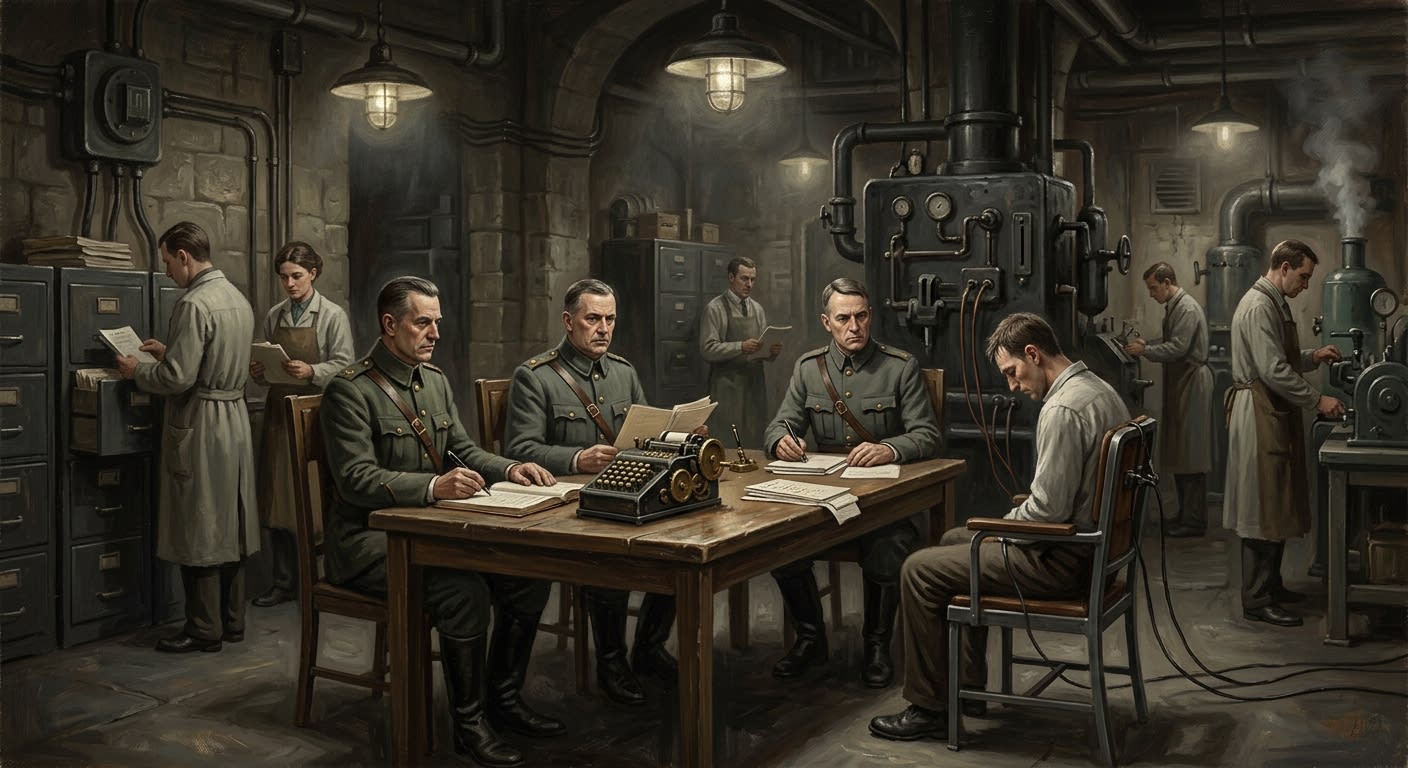
#On the Chamber That Called Torture a Definition
The Tribunal of Clarity was the Rationalist Republic's secret judiciary, a clean room for dirty verdicts, operating from A.S. 30 until the Sundering broke its clocks, its confidence, and several of its walls. It claimed jurisdiction over crimes against Reason: prayer, pilgrimage, relic custody, scripture recitation, refusal of Secular Gatherings, sheltering clergy, hiding bells, misnaming seized objects, teaching children old feast days, and possessing a face insufficiently persuaded by public lectures.
Its records are incomplete. This is fortunate for the dead and annoying for me.
The Tribunal had no published schedule, no ordinary defence counsel, no true appeal, and no patience for the old obstruction called innocence. It presented no public court with hidden abuses. It was hidden abuse with benches. The Rationalists, being men of polish, arranged it with sufficient furniture to flatter themselves into the language of justice: assessors, civic advocate, evidence reader, Guard witnesses, clapperless bell, table, slate, formula, water basin, physician, and a wall maxim declaring that error clarifies itself under pressure.
The word Clarity deserves handling with tongs. The Rationalists used it as sacrament, verdict, threat, and disinfectant. To clarify an accused person's relation to Reason meant to reduce him until the desired answer could be seen without human fog around it. The Republic loved words that made cruelty sound like cleaning. So do all clever regimes. The stupid ones merely beat a man and call it beating. The educated ones beat him, measure his pulse, and call the interval instructive.
#On the Legal Descent from the Concordats
The Tribunal was born in Schedule Seven of the Concordats of Governance, under the bloodless title Emergency Clarification. Every tyranny hides its appetite in clauses of emergency; the Rationalists merely provided better margins. Schedule Seven permitted Prefects of Reason to suspend local rights, seize speech-halls, close markets, detach children for instruction, and classify citizens as non-participating elements. Once a human being becomes an element, the scaffold begins clearing its throat.
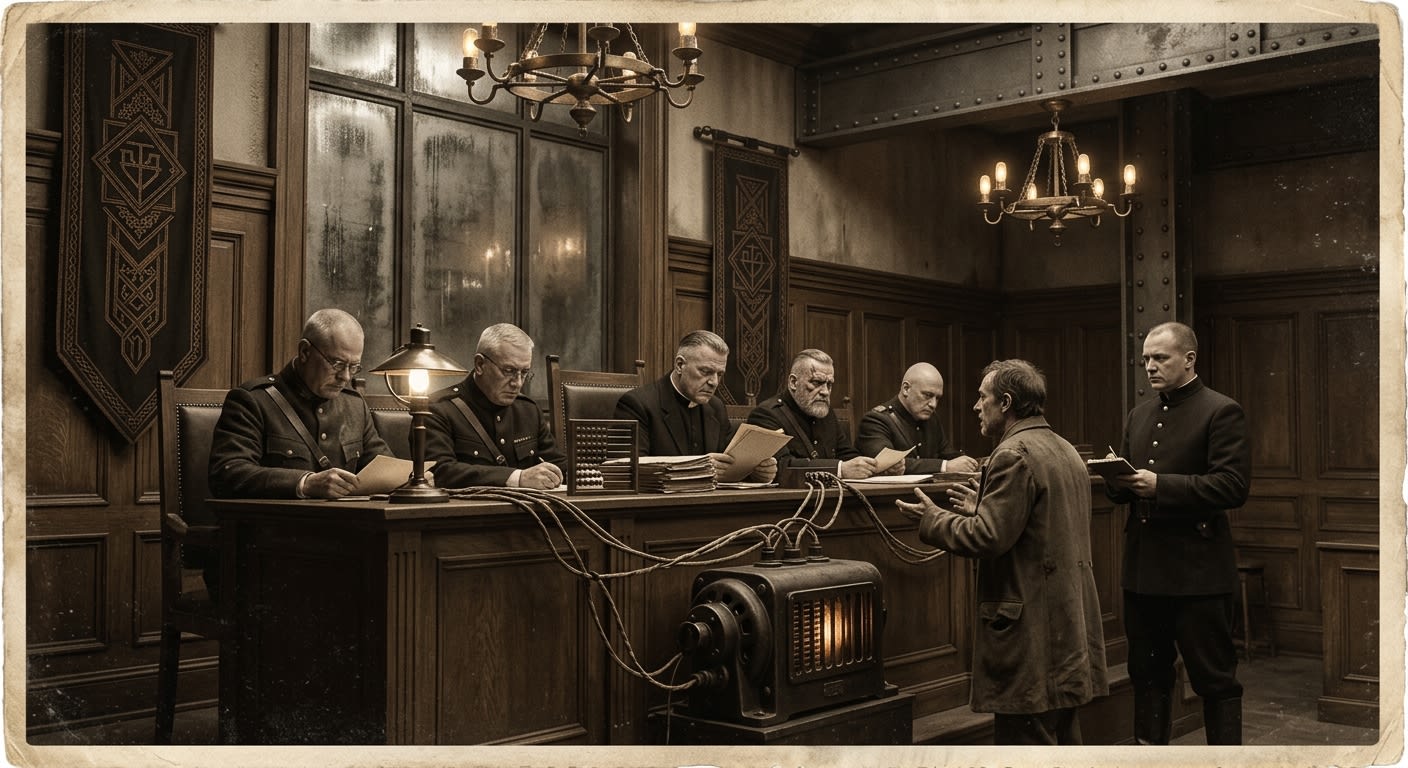
The thirty-seven Philosophical Prefectures supplied the Tribunal's local body. Each prefectural capital held, openly or by sealed annex, a clarity chamber attached to the Prefect's house, Civic Security office, Academy precinct, or converted ecclesiastical building. In Vienna, the chamber sat near the Desk of Civil Order where Koeler later performed his ballistics arithmetic with dry hands and fatal accuracy. In Paris, it sat behind the Edict offices that fed the Ironmouth machinery. In Kraków, tribunal vocabulary helped dress drownings as civic hygiene.
The Tribunal's place among prefectural officers was precise. The Prefect issued will. The Civic Security Marshal supplied force. The Director of Instruction manufactured future assent. The Census Chancellor decided who existed. The Tribunal supplied sentence. This was Republic governance at its most elegant: one office to name, one office to seize, one office to educate, one office to erase, one office to pronounce the erasure reasonable.
It is tempting, for weak minds, to treat the Tribunal as an aberration inside an otherwise rational court system. Nonsense. It was the court system's throat. Ordinary courts handled property, contract, theft, taxation, labour, and the pleasant fictions by which citizens pretend law exists for them. The Tribunal handled the question beneath all others: will the soul submit to being renamed as civic behaviour?
#On the Room and Its Appointed Cleanliness
Surviving descriptions agree on the room's arrangement because men who love control also love repeatable furniture. Three assessors sat behind a pale table, never a dark one; stains show more instructively on light wood. A civic advocate stood to the accused's left to clarify the Republic's interest in his improvement; defence did not enter the room under that costume. An evidence reader sat with the objects: rosary, host cloth, relic casing, prayer scrap, hidden bell clapper, devotional embroidery, saint bone, family register, school slate bearing forbidden names. Guard witnesses stood behind the right shoulder. A physician waited near the basin. The clapperless bell sat on a low stand where a chapel bell might once have been.
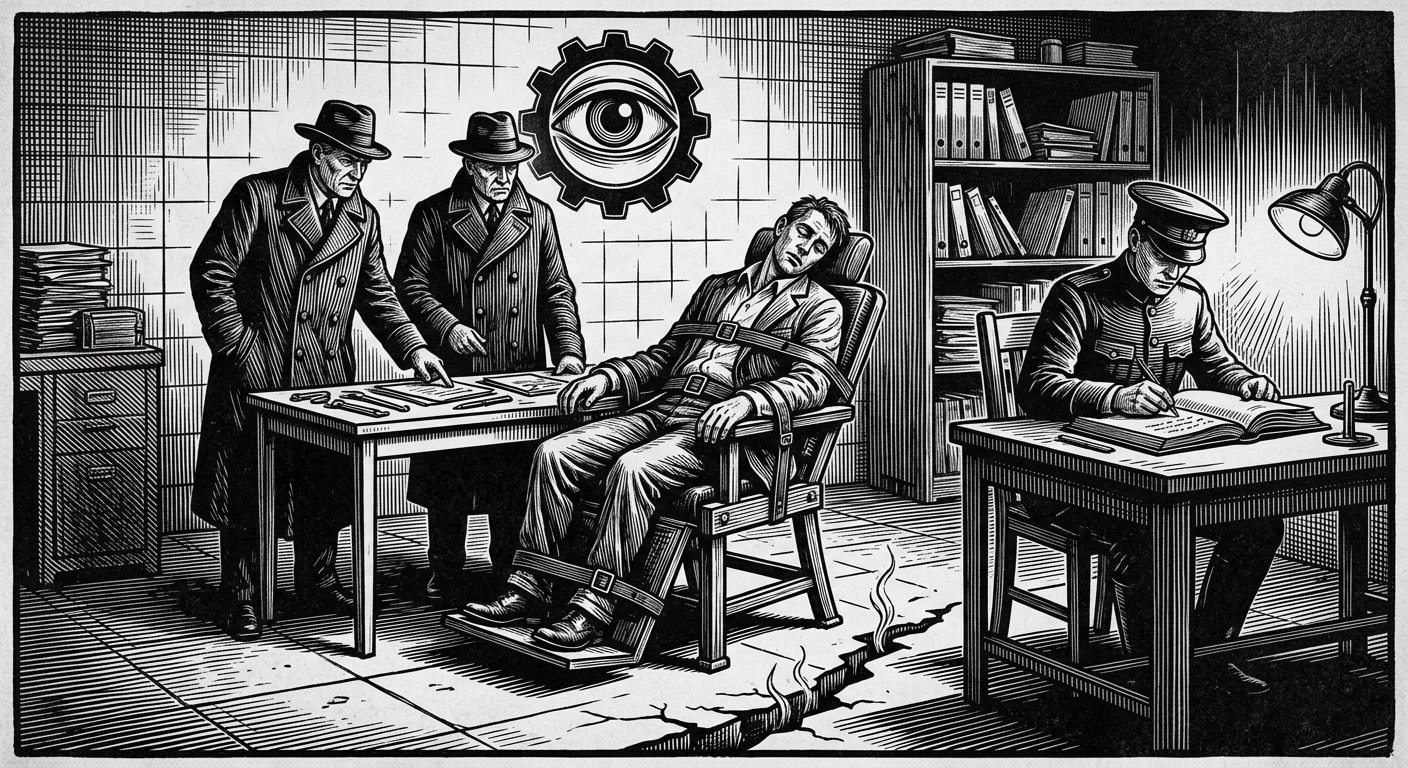
The bell matters. It had no clapper. It represented sound corrected by Reason, form emptied of superstition, religious architecture made mute before secular judgment. The accused saw it and understood the room's little joke: even metal may keep its shape after losing its voice.
The maxim varied by prefecture. Vienna used Error clarifies under method. Paris favoured Speech must answer to evidence. Prefecture Nineteen (Unregistered) used The clear citizen has nothing to conceal, a sentence so foul in its innocence that it should be made to scrub latrines in eternity. The Republic's room-designers understood that walls interrogate before men do. A prisoner made to stare at a civic maxim during waiting learns the first lesson: the room has already judged what vocabulary may survive.
CHAMBER INVENTORY — PREFECTURE ███, RECOVERED A.S. 92 Table, pale maple, scored underside. Bell, bronze, clapper removed, interior marked by fingernails. Basin, enamel, repeated heat cracking. Physician stool, blood under rear leg. Wall maxim painted over earlier fresco. Scrape test revealed █████████████████ beneath word CLARITY.
Cleanliness was doctrine. The floor was washed. The papers were squared. The instruments were named by function. Strap became alignment band. Hook became posture regulator. Tongue clamp became vocal stabiliser. A priest's stole became textile evidence. A child's catechism became pre-rational contamination object. The room's first violence was vocabulary, and its second violence was the confidence with which everyone present agreed to use it.
#On Clarification Procedure
The Tribunal began with substitution. Present object. Deny sacred term. Offer civic term. Require agreement. Mark hesitation. Repeat. This procedure survives in fragments of Philosophical Police training and in tribunal slips recovered after the collapse of Vienna offices. A rosary became bead chain. A reliquary became bone container. A chalice became silver vessel. A saint became historical morale figure. A prayer became unauthorised vocal formula.
The accused was invited to clarify. Invitation is doing comic work there. Refusal proved attachment to error. Agreement proved prior possession of error. Tears proved affective contamination. Silence proved concealed assent to superstition. Anger proved civic hostility. Calm proved trained deception. One admires the construction in the same way one admires a rat trap: briefly, professionally, from outside.
A confiscated Rationalist legal primer described Clarification as “a nonviolent means of removing conceptual confusion before civic sentencing.”
Corrected. Violence does not begin when skin opens. A man compelled under Guard witness to rename his Creator as a cultural residue has already been struck where the Republic most intended to strike him.
After substitution came alignment questioning. Did the accused attend Secular Gathering? Did he declare unbelief at census? Did he shelter an unregistered cleric? Did he use old feast names before children? Did he hear prayer and fail to report speech contamination? Did he possess objects not assigned a civic function? Did he refuse the Republic's mercy in permitting him correction? Such questions are not designed to gather facts. They are designed to arrange confession around the accused like boards around a coffin.
The evidence reader controlled the objects. He touched them with gloved detachment and spoke their corrected terms aloud. The civic advocate explained why the Republic desired clarity instead of punishment. The assessors recorded variance. The physician confirmed continuance. The Guard witnesses anchored force in the room, boots still, hands visible, faces empty by training or poverty of imagination.
When answers failed, Clarification acquired heat, pressure, hunger, sleep interruption, posture pain, forced repetition, object confrontation, or the little theatrical mercy of water offered after the accused used the civic term correctly. The Republic claimed these were methods of removing confusion. The body, being a more honest theologian than the Republic, called them torture.
#On Conviction, Acquittal, and the Ninety-Seven Per Cent
The recorded conviction rate was ninety-seven per cent. The Republic presented this as proof that tribunals selected cases carefully. The Bureau reads it as proof that selection had replaced judgment. Three per cent were acquitted, and the figure has inspired more foolish curiosity than it deserves. Several acquitted persons were dead by verdict. Others were released into guard corridors where fresh warrants awaited. A few were genuinely freed, usually because their evidence had become more useful against someone else.
Acquittal served the institution. It allowed the Tribunal to claim distinction between guilt and innocence while ensuring almost no innocent person survived long enough to become inconvenient. A tribunal with a hundred per cent conviction rate invites satire. Ninety-seven per cent invites statistics. This is why cruelty hires mathematicians.
Koeler's world and the Tribunal's world touched in the Vienna Prefectural Palace (Unregistered): desks of measurement, offices of civil order, tables that made violence legible before anyone bled on the floor. Koeler calculated how many rounds could halt ten thousand bodies. The Tribunal calculated how many answers could reduce one soul to civic matter. Both counted correctly. Both misunderstood what calculation had failed to include.
The Tribunal's daily returns passed upward: prefectural summaries to the Council's cipher offices, conviction tables to Vienna, object categories to Public Instruction, speech residues to Ironmouth enforcement, and property implications to Allocation desks. The sentence was only one product. The data was the feast.
#On Objects, Children, and Speech Contamination
The Tribunal loved objects because objects could not ask for counsel. A reliquary did not object to being called bone container. A bell clapper did not shout its saint's name. A school slate could be held up beneath a lamp while the teacher who wrote on it trembled into civic language. Objects permitted the Republic to accuse whole households through furniture, cloth, metal, wax, and crumbs.
Children appeared often. The Republic understood inheritance as infection and treated family memory as an illegal curriculum. A boy who knew three saints by name but could not recite the civic maxim became evidence against his house. A girl who crossed herself before sleep clarified her mother's failure of instruction. Tribunal slips mark such children as recoverable juvenile elements, eligible for reassignment to Rational Schools (Unregistered). The phrase is small, clean, and fit to be buried alive.
Prefectural apologists later claimed child-transfer orders were educational safeguards, not punishments.
Amended under Doctrine review. A child removed from a faithful household because he remembers a saint is a hostage with homework.
Speech contamination formed the broadest charge. Prayer overheard through a wall. A hymn hummed while washing. An old feast name used at market. A blessing muttered at a deathbed. Scripture recited from memory by someone who owned no book and carried no physical contraband. The Republic feared such speech because it could not confiscate it in advance. A relic may be seized. A bell may be melted. A spoken psalm vanishes into another mouth and returns behind the next door.
The Tribunal answered with repetition. Say the civic term. Say it again. Say Reason alone governs the mouth. Say the object has no sanctity. Say your mother erred. Say the child will improve. Say the dead are not listening. Say it until the room records compliance, or until the physician lowers his eyes, or until the Guard witness grows pale and is later corrected for softness.
#On the Sundering's Instructional Fog
The Tribunal of Clarity met its proper examiner in A.S. 45. Hell did not respect summons. It did not submit evidence. It did not accept civic terminology. It refused to clarify its relation to Reason, which was rude, effective, and in the end almost charitable.
During the first days of the Sundering, several prefectural tribunals continued operating. Paper moves after sanity fails. A Vienna annex scheduled hearings on eastern atmospheric exaggerations while Debrecen starved under Kargath's appetite. A Danube prefecture issued summonses to households whose names had begun appearing in ash on doors no Guard had touched. Near Vienna, one Prefect attempted to convene a Tribunal of Clarity for a fog bank that had used a village's voices to request admission. The fog did not attend. The village did.
The Tribunal's vocabulary failed first. Disturbance. Mass delusion. Atmospheric event. Acoustic contagion. Civic panic. Unlicensed dramatic congregation. Each label arrived with paperwork and died on contact. A thing that wears your grandmother's voice outside a shutter does not become clearer because a clerk has written phenomenon. It becomes hungry while the clerk sharpens his pen.
Some tribunal chambers became shelters. Some became slaughter rooms. Some were found locked from the inside with no bodies present and civic maxims written backward on the walls. The clapperless bells cracked in several sites without impact. In one chamber, the evidence table had folded into the shape of a kneeling man. Records classifies the report as architecturally suspect. Records has such delicate nerves.
#On Synodal Condemnation and Use
After the Republic's fall, the Synod condemned the Tribunal of Clarity under Rationalist judicial corruption, anti-clerical state violence, and procedural atheism made flesh. Correct. Necessary. Also incomplete. We studied the furniture.
Do not gasp. Gasping is for novices and widows at relic auctions. The Bureau does not burn a useful method merely because a damned hand held it first. We condemned Clarification as heretical violence. We retained object-chain custody, room geometry, evidence sequencing, transcript discipline, and the principle that a false word can corrupt a verdict before force enters. The heretical end was severed. The administrative muscle was cleaned, blessed, renamed, supervised, and denied excessive resemblance.
Modern Tribunals of Doctrine are not the Tribunal of Clarity. They proceed from revealed truth, sealed authority, proper counsel where applicable, liturgical witness, reviewable form, and the blessed humility of knowing that guilt is a spiritual matter before it is an administrative convenience. They also use pale tables in certain rooms. Do not simper. The table was never the heresy.
The Bureau of Purity's adoption of the word Clarification remains under controlled irritation. Purity claims the term was recovered, corrected, and fenced with doctrinal intent. Doctrine replies that words do not forget their first bite. This disagreement has produced nine memoranda, three revisions, and one lunch so cold that the fish seemed politically instructed.
#On Present Handling
As of A.S. 201, Tribunal records remain scattered between the Forbidden Stacks, Vienna restricted rooms, Bureau of Shadows fragments, Purity comparative files, and Records indexes whose headings have been made deliberately dull to repel young clerks. Advanced students read the material after the First Black Census, the Edict of Ironmouth, the Philosophical Prefectures, Koeler, and the Council of Nine. The order matters. One must understand the register before the chamber, the chamber before the basin, the basin before the borrowed word.
The lesson is not that Reason makes men cruel. Men accomplish cruelty without philosophical assistance and have done so with rocks, sticks, flags, and romantic songs. The lesson is that Reason without Doctrine makes cruelty tidy. It gives the executioner clean grammar, the judge clean hands, the clerk clean columns, and the victim a corrected noun before death.
One clapperless bell from a Prefecture Nineteen chamber sits in sealed storage beneath Strasbourg. I have seen it. Its bronze is smooth where fingers rubbed the rim during questioning. It makes no sound when struck. This is expected. Its silence is admissible.