

#On the Station and What Remains of It
The Civic Security Marshal was the officer through whom a Philosophical Prefecture turned paper into men. The published account of the Philosophical Prefectures lists five principal officers in each prefecture. The Marshal comes second, after the Prefect of Reason and before the Director of Instruction, the Census Chancellor and the Tribunal of Clarity. The account places the office in every prefecture's little crown of officers. That is close to everything the record gives freely, and I intend to spend it like a widow's last coin.
The office belonged to the order constituted in A.S. 30 under Schedule One of the Concordats of Governance, after the Treaty of Regensburg made the Rationalist Republic formal. Those instruments fix the prefectural system. They do not fix the Marshal. No founding warrant for the office, no oath of appointment and no roll of the men who held it has reached my desk. Thirty-seven chairs, and in Strasbourg's custody not one name set in any of them.
This survey bears A.S. 201 because it was made in A.S. 201. The year records no founding, no act of any Marshal and no claim that the office outlived the Republic that built it. Junior archivists confuse the year of the stamp with the year of the thing. I have stopped finding it endearing.
#On the Command of Force
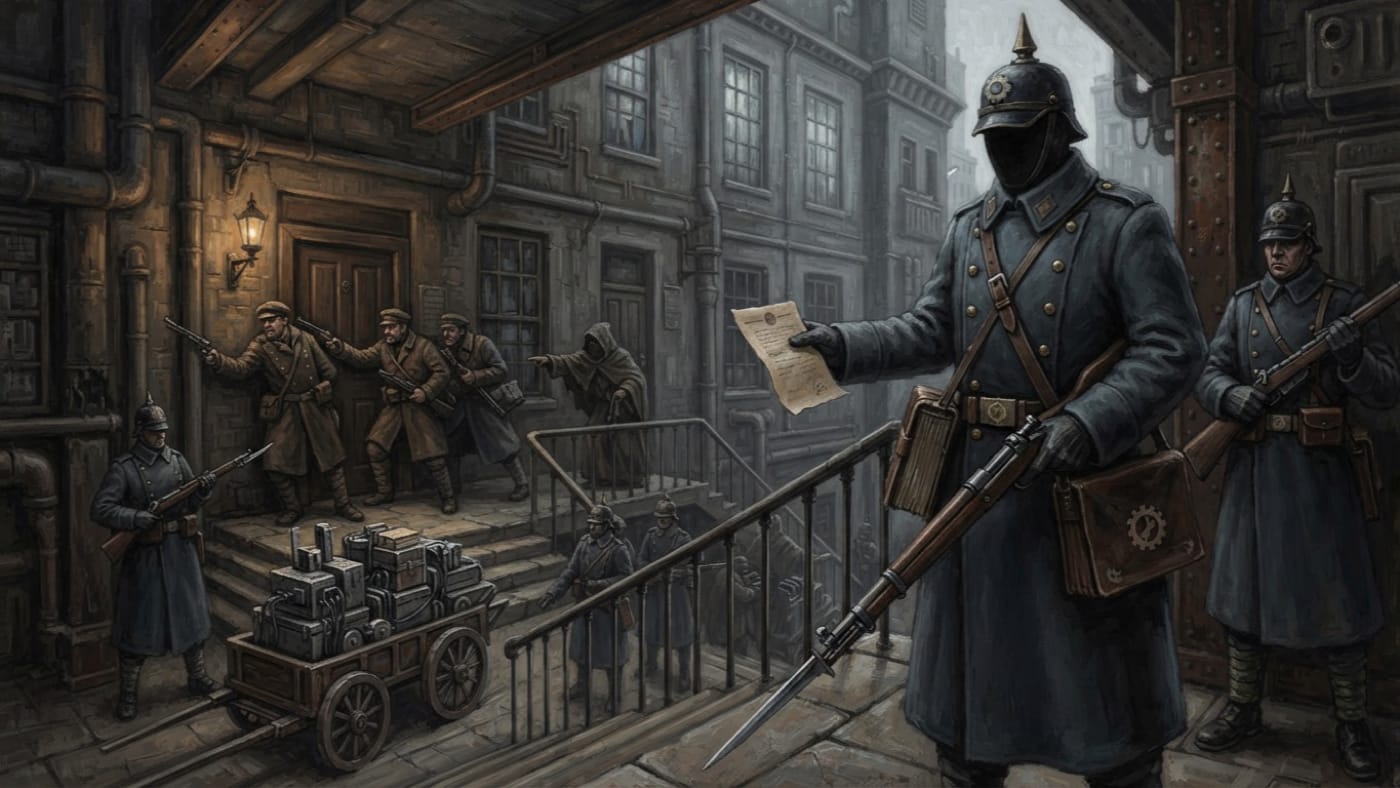
The prefectural account sets out the Marshal's command in one sentence, and the sentence rewards slow reading. He commanded "Republican Guards, municipal secular forces, informant chains, escort columns, and the men who made writs audible on staircases." That makes five holdings, and they were different beasts kept in a single stable.
The Republican Guards were soldiers. They wore blue-grey coats and triangular bayonets, drilled in volley and street clearance, and carried the Secular Gatherings Act in a leather case over the heart. According to the prefectural account, the Guards answered through the Marshal's structure after A.S. 30. The Guards' own entry adds that Regensburg placed them under the Council's Ministry of Civic Security. The two statements lie side by side in the Stacks. Whether a Marshal reported to that Ministry, to his Prefect, or to each on alternate weekdays, the papers in our custody do not say. I will not draw an organisational chart to comfort a seminarian.
The municipal secular forces were armed townsmen under prefectural orders, and they knew the streets the way a sexton knows his graves. The informant chains carried names instead of muskets, which made them more dangerous at a door than any musket. The escort columns moved whatever the prefecture needed moved. The Guards' entry records them escorting census tables. What else the columns carried, the surviving papers leave to imagination, and imagination is the wrong archive.
The fifth holding was the point of the other four. A writ is ink until somebody climbs the stairs with it. The Prefects entry traces one such paper. The Prefect set a confiscation schedule under the Edict of Rational Allocation, the schedule went to the Marshal, and the Marshal sent Guards to the parish and then to the houses around it. That is the whole liturgy of coercion in three movements, and nobody in it ever had to raise his voice.
The force came before the office. At Saint-Malo in A.S. 10, a Guard sergeant carried a lawful writ to a kneeling procession, and the detachment fixed bayonets and fired. At Kraków on 17 Martius A.S. 18, the Night of Knives joined secular militia and Philosophical Police to Guard detachments. No Civic Security Marshal is recorded ordering either, and both happened years before the prefectural office appears. A.S. 30 contributed a desk. The violence already had hands, and the Concordats gave it a correspondence address.
Under the prefectures, the parent account says, the Gatherings Act became local weather. A procession might be refused, dispersed, catalogued, struck or shot "depending on the magistrate, the Marshal, the street width, and the zeal tally due that month." The Edict of Ironmouth, issued from Paris in A.S. 30, ran on warrant, witness and return. The Republic's own records summed eleven thousand tongues in its first year. That is a figure for the whole Republic, and no Marshal's separate tally survives. I refuse to divide the total by thirty-seven and call the quotient scholarship.
The Civic Security Marshal was the Prefect's deputy and took up the prefecture's sword whenever the Prefect fell.
Corrected. The account says the Marshal served below the Prefect, and says nothing more. The emergency declaration belonged to the Prefect alone. No surviving instrument makes the Marshal a deputy, a successor or a regent. Force lived in his office. Authority stayed upstairs and signed things.
#On the Neighbouring Offices
The Doctrine gloss on the prefectures divides the labour in one breath: "Prefect for authority, Marshal for force, Instruction for childhood, Census for existence, Tribunal for sentence." The Bureau will not merge these offices for the convenience of lazy pamphleteers. A Marshal was no Prefect. Nor was he a Census Chancellor, and the Chancellor's entry already corrects a sermon that gave the register-keeper a power of arrest he never held. Carts, staircases and doors belonged to the Guards under the Civic Security chain.
Each office needed the others. The Chancellor's registers, from the First Black Census onward, supplied the names. The Director of Instruction claimed the children. The Tribunal of Clarity seated Guard witnesses in its chamber and passed sentence. The Marshal supplied the boots that brought the accused there. The Census entry puts it well: the Chancellor supplied the nouns and the other offices turned them into verbs. The Marshal conjugated most of them.
The division let every officer keep his own hands clean of the others' work. The Prefect never held the tongs, the Chancellor never lifted a cart, and the Tribunal never kicked a door. The Marshal did the lifting and the kicking, and he could point to a writ signed upstairs for every staircase. Guilt in a prefecture was a relay race in which each runner swore he had never carried the baton.
#On the Columns of A.S. 45
On 1 November A.S. 45, the Sundering opened the east. Paper went on moving after the world had stopped consenting to it. The parent account records that Civic Security Marshals sent Guard columns toward disturbances that fitted none of the categories Schedule Seven had thought to name. A riot calls for one response, brigands for another and plague for a third. The Marshal's office held a drawer for each, and the Great Deceiver arrived without a drawer.
The general ruin is on record elsewhere. The Iron Plains broke Guard confidence. At Debrecen, Kargath consumed stores the Guards had been posted to protect. The Eastern Silence, filed years earlier by prefectural bulletins as a failure of communication, turned out to have been a warning. Of particular Marshals in those months this survey has nothing to say: no named column, no surviving dispatch, no recorded outcome. I will not compose one. The dead of A.S. 45 do not need my improvements.
The prefectural order fractured. The parent account and the Collapse tell the rest at greater length than this office deserves.
#On Annulment, Inheritance and the Present Survey
In A.S. 92, the Bureau of Doctrine annulled the prefectural order retroactively, together with the rest of the Concordats. The Marshal's commission was therefore void at its birth, void at every staircase and void in every column sent east. The law was never valid. The doors it broke are still broken. Doctrine keeps both facts in the same drawer and asks no one's permission.
The published account claims a further inheritance: "The Civic Security chain became levy routing." The Synod's Continental Levy needs men moved, mustered and escorted, and someone had already worked out how to send an order from a desk to a doorway. I accept the claim as the account states it. It describes a chain, meaning a habit of who receives an order, who forwards it and who knocks. It does not describe an office that survived intact, a holder who carried on, or a reform with a date.
The Synod retained the Civic Security Marshal under a corrected name.
Corrected. The account says the chain became levy routing. It names no successor office and no continuous holder, and it gives no year for the change. Strasbourg kept the road and the timetable. The record does not show that it kept the man.
As of this survey in A.S. 201, the prefectural system is taught in advanced Doctrine and Records instruction, and copies of the Concordats lie in the Forbidden Stacks. There the Marshal survives as a line in an officer list and a clause in a chain of command. No register of Marshals has been brought to me from those shelves. If one exists, it is welcome to present itself through proper channels.