

#On the Term and Its Plural
The Rationalist Academies were never a single academy. The Bureau of Records uses the phrase for all the learned societies, faculties, lecture houses and printing assemblies that turned criticism of revealed religion into public doctrine across Europe in the century before the Sundering. No one charter binds them. No common seal, membership register or master roll of who taught what to whom has survived, if one ever existed. A reader who comes here expecting a corporation with a founding day and a date of execution will find what the archive actually holds: pamphlets, a manifesto, some plaster, and a great many ashes.
The Church counts its years from one of them. In A.S. 0 / 1710 CE the first formalized Rationalist Academy, at Amsterdam, published its founding manifesto, De Vera Luce, openly denouncing revealed religion in print. The Synod took that publication as the zero of its reckoning, retrospectively, at its constitutional settlement of A.S. 90. It calls the date the wound from which the Ledger counts. The wound is dated. The infection is older.
Readers sent here from Munich will have met the Academies in a subordinate clause, as the measure of the Bräuviertel's age, which predates them "by some accounts." Those accounts belong to the brewers. The Bureau of Records has not dated the brewery quarter, and this entry will not date it either. Munich held no academy of record. It only wishes to be older than one, which is the most Bavarian ambition the Bureau has yet catalogued.
#On the Antecedents
Rationalist learning had a long prehistory. The Church gains nothing by pretending that the Academies came fully gowned off a single Dutch press. In A.S. −55 / 1655 CE, the universities party to the original Concordats of Ulm signed a compact that subordinated theology to reason. The Ulm record gives its seal as a compass crushing a cross. That emblem belongs to Ulm. Later polemicists, some of them employed by this Bureau, have hung it over every Rationalist doorway in Europe. The evidence does not support them, and I do not intend to be caught supporting them.
Meanwhile, learned societies flourished in Paris and Vienna, trading papers and correspondents across the borders of kingdoms that still went to Mass. This was the Age of Reason in its courteous youth. Then came the Year of Letters, A.S. −32 / 1678 CE, when the scholars of Amsterdam publicly denounced the miracle of Saint Aldebrand as fraud. They put the charge into pamphlets, carried it into assemblies and let the marketplaces do the rest. Secular chroniclers still call the Aldebrand affair a "proven hoax." The proof was the scholars' own. They acted as plaintiff, examiner and printer at once, and the Church has never accepted their verdict.
Thirty-two years separate that pamphlet campaign from De Vera Luce. In those years the critics of the altar acquired statutes, members, rooms of their own and finally a manifesto. The Year of Letters gave the Rationalists a voice. A.S. 0 gave them a constitution and an address, and the Amsterdam Academy has been answering for both ever since.
The Concordats of Ulm were sealed in A.S. 0, in the same year and spirit as the Amsterdam manifesto.
The original Concordats of Ulm belong to A.S. −55 / 1655 CE, fifty-five years before De Vera Luce. Inherited summaries have run the two together because the Ledger's zero is a convenient hook for every Rationalist sin. The hook holds only one.
#On the Lecture Hall as Pulpit
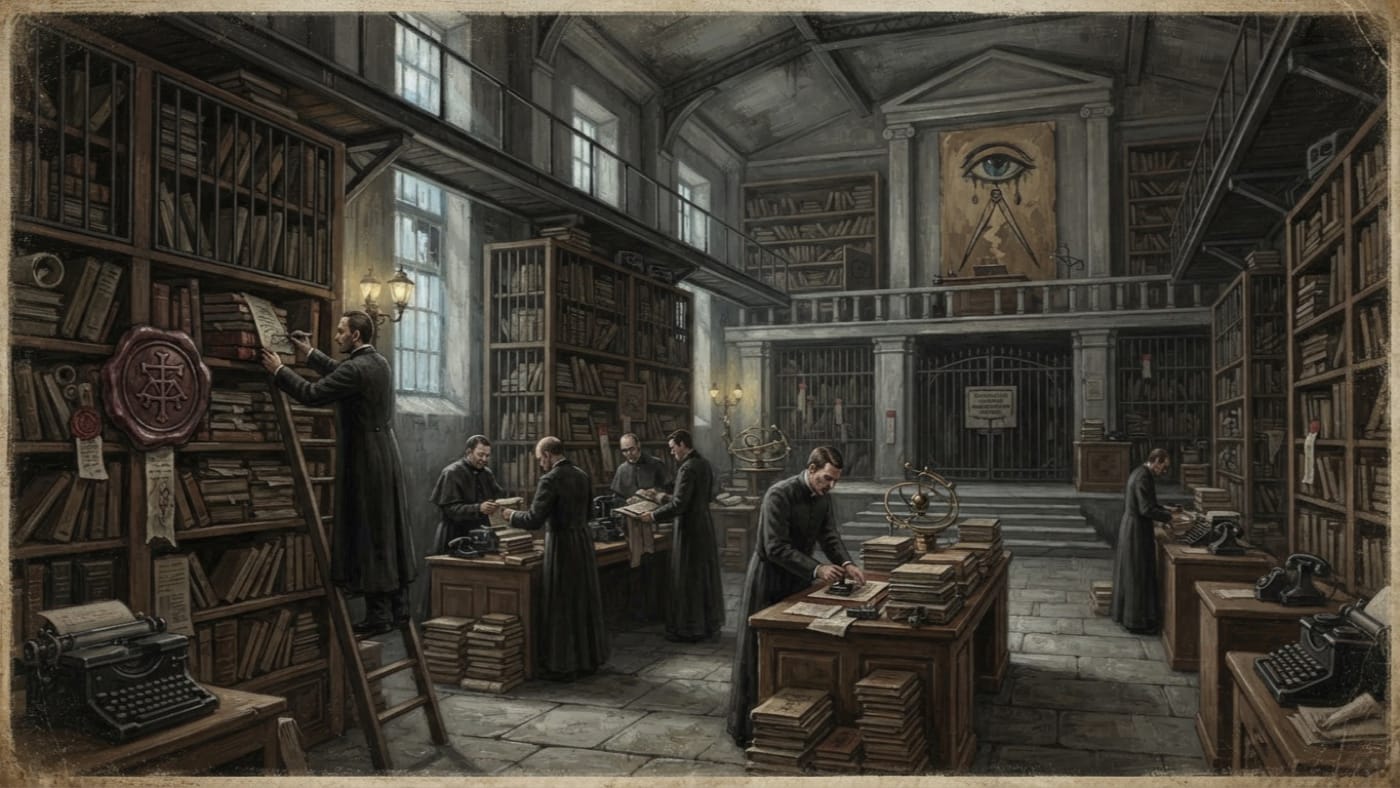
The Academies taught by means the Church had perfected and then neglected: the printed sheet, the public assembly, and the demonstration before witnesses. A pamphlet could reach Leiden by Thursday and Lyon by the end of the month. An assembly could be summoned in a guildhall and dispersed before a bishop's letter arrived. A lecture, given in a room with benches and a raised desk, borrowed every architectural courtesy of a sermon while preaching its opposite.
There was no common curriculum. The Bureau has looked for one with real diligence and found only a family resemblance, which the separate Academy System entry is welcome to dispute. Each house claimed the right to examine testimony, relics included, and to publish its findings without leave of any chapter. The Church had kept saints' bones behind glass and lock. The lecturers wanted them on the bench, measured, weighed and labelled.
They got them. During the Iberian Bonfires of Purification, relics were carried out of stripped convents into the plazas and burned while Rationalist lecturers delivered lessons on superstition. The ash was mixed with lime and used to plaster lecture halls. The record does not say which halls, or which lecturer first thought of it. I will not supply names for a crime the documents have left anonymous. Students scratched their equations onto walls made partly of martyrs. The Ledger requires nothing further.
#On the Republic's Schoolmasters
Scholarship and government grew together in the Rationalist decades, but they were never the same body. The Bureau's own polemicists blur the two at the cost of their credibility. The Academies gave the secular cause its arguments, its examiners and its printed proofs. Councils, magistrates and militias applied those arguments by other means. When Saint-Malo opened the Atheist Wars in A.S. 10 / 1720 CE, it was Republican Guards on the cobbles, not professors.
Rationalist administration governed much of Europe before any treaty called it a state. The Treaty of Regensburg in A.S. 30 / 1740 CE constituted the formal Rationalist Republic and dissolved the Holy See of Vienna at swordpoint. The treaty did not found the Academies, and no academy signed it. Over three decades, they had supplied the vocabulary in which the victors at Regensburg could toast the death of superstition without blushing.
Not every academy bears the guilt of every pyre. I record this because the Ledger requires it, and because a charge laid against everyone convicts no one. The lecturer who measured a reliquary and the guardsman who burned a procession are filed in different drawers. They are, I grant, in the same cabinet.
#On the Omens Explained
The Academies' most characteristic act came near the end, when the world began to behave in ways their instruments could not hold. In A.S. 32 / 1742 CE came the Year Without Dawn: forty days without a sunrise, which Rationalist astronomers declared a natural eclipse. In A.S. 34 / 1744 the Danube ran crimson for three weeks, and the authorities called the Red Flood volcanic runoff. In A.S. 38 / 1748 the east fell silent. Villages stopped writing, scouts did not return, and the councils proclaimed plague and quarantine.
These were three distinct events, and each received a natural explanation from people trained to supply one. The Bureau holds no single academy report covering all three and does not pretend otherwise.
On 1 November A.S. 45 / 1755 CE came the Sundering, and Rationalist supremacy broke. The Bureau of Doctrine teaches that the omens were refused warnings, and that a learned class which explained away every sign had taught a continent to stop reading them. That is Doctrine's finding, and I endorse it under my seal. The Ledger does not state what tore the veil, or how, and this entry will not improvise an answer.
#On Custody
The Academies did not all close on one day. The Sundering ended their supremacy without sending a bailiff to every lecture hall. Where the Church emerged after A.S. 45, it emerged unevenly. It worked first through hidden houses and refugee custody, then through an interim council and growing offices, and only at A.S. 90 through a formal Synod. Rationalist rooms were emptied, reconsecrated, requisitioned or simply abandoned, depending on which authority reached them first and what it needed.
What it needed, more often than Strasbourg cares to admit, was the learning. Rationalist pamphlets of the period survive under triple seal in the Forbidden Stacks, and access requires a Synodal licence. The Church burned less of its enemy's library than its enemy burned of the Church's. It locked the rest away for later use.
The later use is visible. In Lyon, the licensed Academy of Horological Sciences occupies a former Rationalist mechanics school and trains its instrument-keepers under a resident Doctrine observer. The Academy of Strasbourg trains theologians and lawyers and keeps its occasional independent scholar under a suspicion that has hardened into tradition. Neither descends from the old Academies by any charter the Bureau recognises. Both work in rooms the Rationalists would know at once.
Amsterdam lies outside the Synod's sovereignty and keeps its presses. The Bureau does not suppress what it does not govern. It reads everything that crosses the border.
Beyond licence, the quarrel continues in cellars. The Ashen Circle gathers banned histories and heretical sciences and calls the habit seeking truth. The Silent Godless meet underground to deny the Creator outright. The Bureau of Purity would very much like to prove that one or the other is the Academies' direct heir. The evidence shows a family likeness and no succession. Reading a forbidden treatise does not make a man a member of the society that printed it. It merely makes him a criminal.