
#The Entry as Filed
The Codex has quoted a suppressed text, and readers have noticed. Several wrote to the Bureau of Records to ask whether this was permitted. The Bureau replied, in a letter I countersigned, that quotation is a form of custody. A text held inside the Codex is a text under supervision. I supervise it here.
What is known fits in four lines, and I set them down as the Sacred Ledger would:
Title: Dispatches from the Southern Hinge. Attributed author: Warden-Adjutant Remy Sauvage. Year of citation: A.S. 197 (1907 CE). Status: suppressed pending theological review.
That is the whole record as it reaches this desk. The entry gives no count of dispatches and no page count. It names no binding, no commission and no list of readers, and it says nothing of what became of the Warden-Adjutant afterward. The plural in the title proves only that someone chose a plural. Clerks who ought to know better ask me how many dispatches there were. I do not know, and I do not guess in ink.
What survives in the Codex is one paragraph, quoted in the entry on Bastion-Constantinople. That one paragraph has produced more correspondence than most bastions.
#The Six Hours
Here is the passage in full, as the Codex holds it:
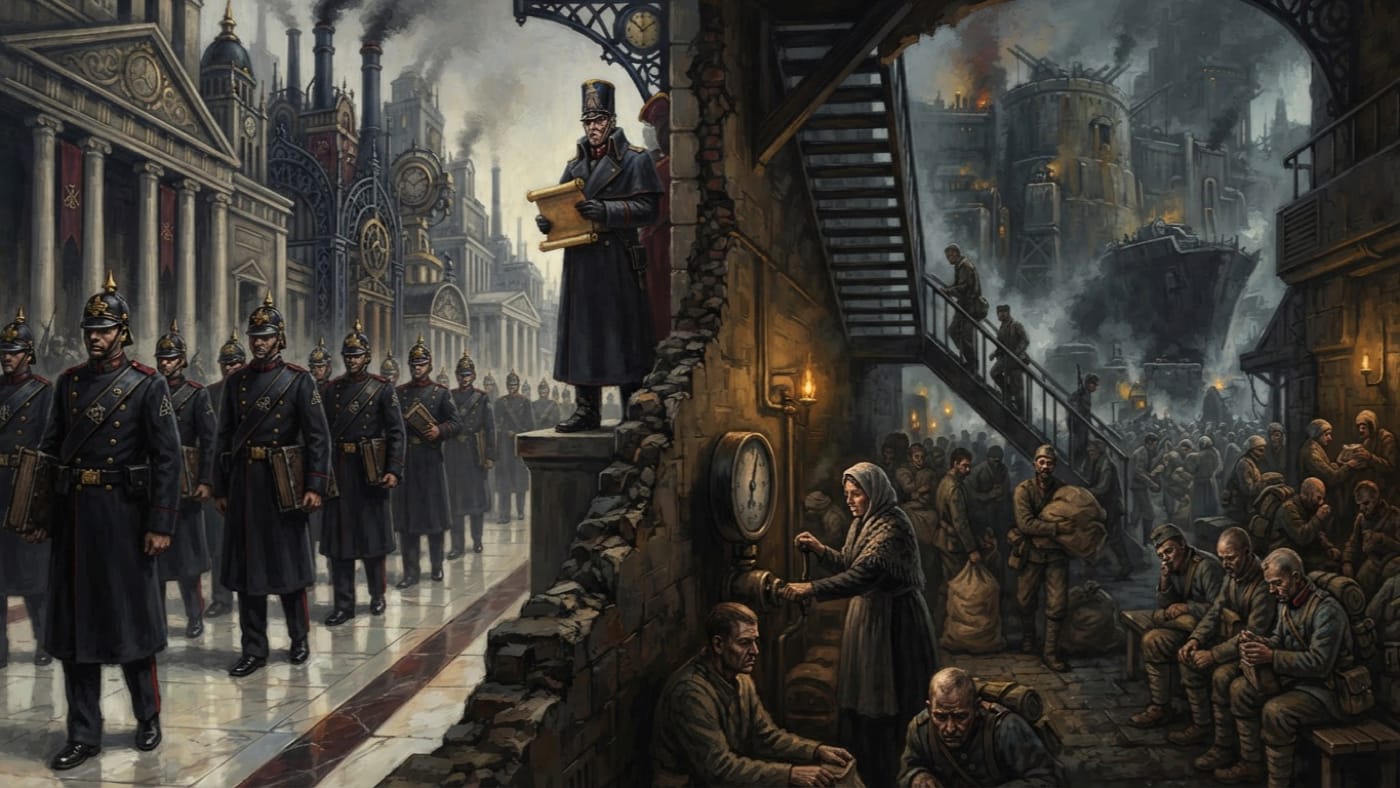
The traveler's first impression of Constantinople is that it is organized. The traveler's second impression, arriving approximately six hours later, is that this organization is performed rather than achieved — a theater of order sustained for the benefit of the inspectors, behind which everything proceeds by habit, exhaustion, and the quiet competence of people who have stopped waiting to be thanked. — Warden-Adjutant Remy Sauvage, Dispatches from the Southern Hinge, A.S. 197 (suppressed pending theological review)
Read it twice. The Warden-Adjutant would approve, since a second look is the whole method of the passage.
The first sentence is a compliment any Bureau would print on a placard. It is organized. Visitors say this of Constantinople the way they say it of a well-kept ossuary: the rows are straight, the labels are legible, and the dead lie where the plan puts them.
The second impression arrives about six hours later, and the cut comes in that interval. Sauvage claims no timed inspection, no audit and no afternoon spent with a watch in an anteroom. Six hours is roughly the length of a traveler's patience. In that time a meal can come late, a requisition can stall, and a bell can ring unheeded by someone with work in their hands. Somewhere inside it the visitor stops looking at the facades and starts looking at the people holding them up.
Then comes the verdict: performed rather than achieved, a theater of order kept up for the inspectors.
I have read that phrase forty times or so. Every time, I have wished I had written it. Every time, I have reached for the seal.
#What the Inspectors Are Shown
Constantinople displays its authority along its Sanctum Mile. This is the city's own Mile, no relation to the corridor of the same name in Strasbourg, and it resents the comparison. It runs from the old Hagia Sophia, now the Cathedral of the Perpetual Registry, west past the Records sub-vaults and the administrative houses to the Belfry of the Hinge. Marble facades carry the Triune Knot. Lictors and Ledger-Carriers cross between doorways at the pace of men who expect to be watched. It is the one district of the city that looks the way the reports say the whole city looks.
An inspector walks the Mile, which is what the Mile is for.
Behind its windows, the work moves at another speed. A clerk works through requisitions with one sleeve rolled and sealing wax cooling at the elbow. Across the street a regiment eats on the bell, because in Constantinople the kitchens lock when the noonday peal is missed, and the Bureau of Bells reopens them for no one. Every ration chit carries a charge that the Bureau of Tithes attached long before the soldier holding it was born. The chit is printed. The bread is baked by someone whose name appears on no chit at all.
Go downhill toward the water and the arrangement grows plainer. In the Foundry Quarter, powder is measured by hands that have measured powder for twenty years and do not consult the posted tables. At the Harbor of Chains, manifests are checked twice: once for the inspector and once for the cargo. The second check keeps the grain from rotting on the quay.
None of this comes from Sauvage. The surviving paragraph names no district, no clerk and no ship. I supply the streets myself, because I have walked them and because the passage needs no invented testimony to prop it up. Anyone who has stood in the Bureau of War's supply office at Sext knows what the Warden-Adjutant meant by habit.
Inherited Codex geography, compiled from refugee-community usage, describes Bastion-Constantinople variously as the "western anchor" and the "eastern anchor" of the Line.
The Sagittal Line runs north to south, from the Baltic to the Bosphorus, through seven bastions. Constantinople is its southern anchor and has been since the hinge was ratified in A.S. 68. This correction applies to the Codex's own inherited maps. It does not touch the text of the Dispatches, which the Codex has never held beyond the single paragraph above. The Warden-Adjutant's title had the direction right. The Codex took longer.
#The Unthanked
The last clause is the one the review cannot get past: the quiet competence of people who have stopped waiting to be thanked.
The soldiers who learned to eat between two peals fit that clause. So do their widows and children, and the veterans too broken for garrison duty, who live in the Warrens beneath and between the Ossuary Rings, where the Bureau's maps thin out and ledger-clerks do not go after dark. So do the craftspeople who came to supply an army and never earned the fare home. These people keep the drains open and the lamps trimmed, and they mend the ration sacks. When a requisition stalls, they find the clerk who can free it, and they do not ask for a receipt.
The Bureau of Records counts them, and the Bureau of Settlement has proposals concerning them. No one thanks them. Sauvage, in the sentence now under review, says they have stopped expecting it.
I do not thank them either. I am a Hieromnemon. Thanks are issued by liturgy, on feast days, in the plural, to the faithful at large. Yet the ink on my desk was ground and bottled by someone in the Warrens, and the lamp I read Sauvage's paragraph by was trimmed by a hand I have never seen. I mention this once, and I will not mention it again.
#The Doctrinal Difficulty
Why should one plain paragraph about how a fortress is staffed trouble the Church?
What follows is my own reading. The Codex's entry attributes it to no panel, no Bureau and no charge sheet. The entry says suppressed pending theological review and nothing more.
The Bureau of Doctrine holds that the Hinge stands by the Creator's sufferance, through the bells, the walls, the Ledger and the faith of the garrison, in an order Doctrine has ratified. Sauvage names a different support: habit, exhaustion and competence. None of the three is liturgical, and none needs a priest. If a fortress facing Kargath's famine and Maldrake's fire endures because tired people do their jobs, then the processions on the Sanctum Mile are decoration, and decoration can be struck from a budget.
Then there is the word inspectors. The passage says plainly that the order is staged for them. Every Bureau sends inspectors to Constantinople. Every Bureau, reading that sentence, sees its own envoy walking slowly down the Mile while a clerk somewhere squares a stack of files.
The Bureau of Purity enforces what may be printed. Doctrine decides what a printed thing means. The entry does not say which of them holds Sauvage's file, and I will not guess where a guess would be read as knowledge.
Understand the status exactly, because pending is a word with edges. A suppressed text is withheld from circulation while its meaning is weighed. Condemnation is a separate finding, and the entry records none. Destruction would require an order, and none is cited. The record says nothing whatever about the Warden-Adjutant's own orthodoxy, and silence in a Ledger is never an accusation. Silence in a Ledger is a blank line waiting for a hand.
#Disposition
Until the review returns, the Codex keeps what it already keeps: one paragraph, with its attribution, its year and its status. Rumor will not lengthen the paragraph, and I will not improve it. Anyone who claims to have read a second dispatch is invited to produce it at the Bureau of Records, where it will be received, examined and very probably placed under the same seal as the first.
I reread the passage while composing this entry. My first impression is still that it is organized.