

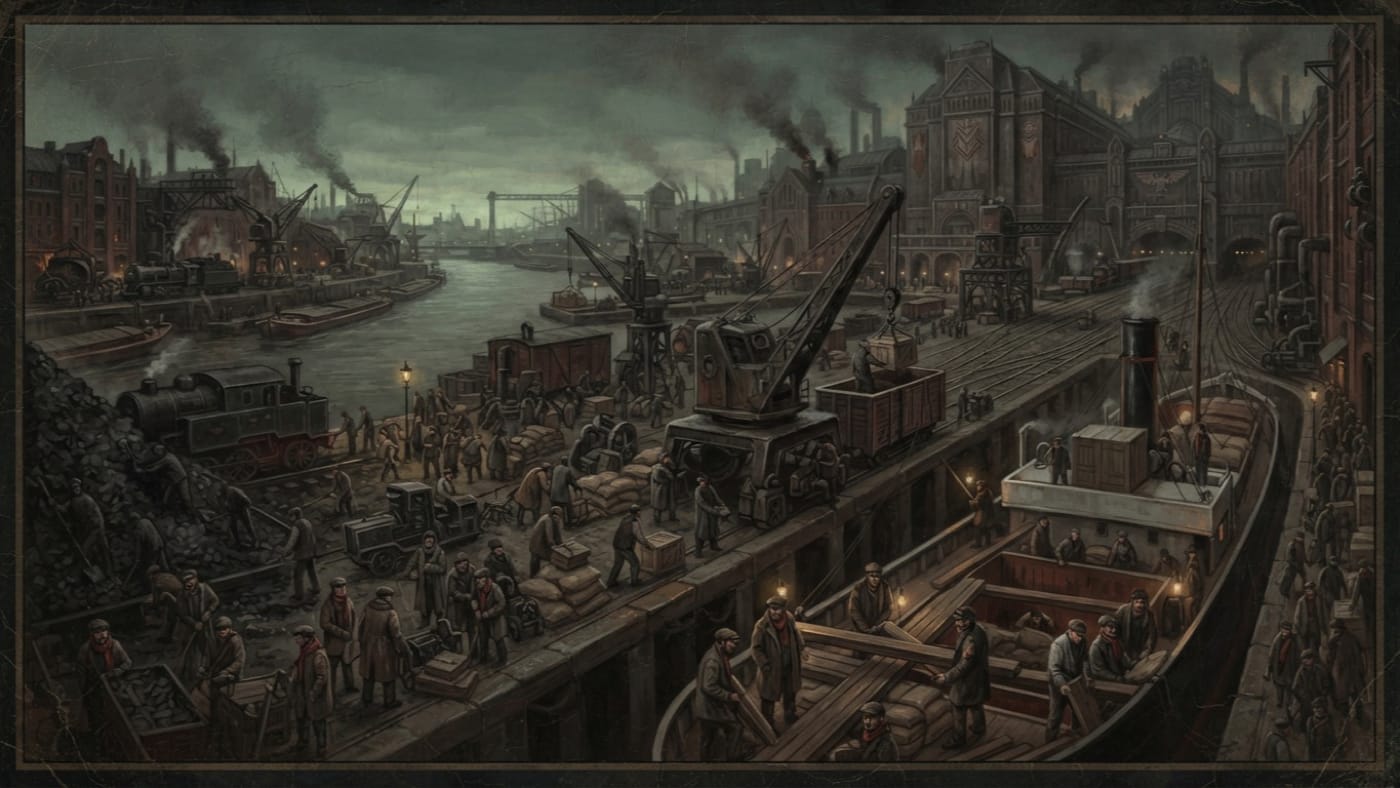
#On the Guilds and Their Work
The dock guilds of Hamburg are plural. Strasbourg keeps writing them in the singular, and Strasbourg is wrong. This survey was compiled for the Codex in A.S. 201 and is sealed under that year. It treats the guilds as the Hamburg account reports them: twelve bodies of waterfront labour, each with its own trade and its own jealousies. What joins them is that nothing reaching Node Seven from the North Sea moves east until one of them lifts it.
The same account puts the dock workforce at about forty thousand. That number counts the waterfront. It is not the roll of any one guild, and it is not the membership of some federation invented after supper. No document consulted for this compilation puts the twelve under a common charter, treasury, election or master. An official who asks to see "the head of the dock guilds" is asking for a man the archive has never produced. He is usually sent to the wrong hall, which is how the docks prefer to answer.
The guilds' work is to turn foreign cargo into domestic movement. British grain and Welsh coal come out of the holds, and so do Scandinavian timber and crates labelled by men who will never be asked to carry them. The guilds put all of it onto quays, into bonded warehouses, onto barges, and finally into the wagons of the eastbound line. Hamburg handled four point two million metric tons in A.S. 200. Every ton of it went through somebody's hands.
#On Quay, Hold, and Coal Yard
The Longshoremen's Brotherhood is the oldest and strongest of the twelve. It holds loading on the western and central quays. It keeps the call-books for crane crews, sling gangs and deep-draught grain berths, and it uses chalk marks to decide which crate reaches rail custody before dusk. Grain is where every other authority takes its hat off, so the loading schedule runs through the Brotherhood. Being prominent does not mean owning the port, and the Brotherhood's own dossier says so: the Brotherhood does not control every dock worker in Hamburg. I record that admission because rival guilds are seldom handed one so cleanly.
The Stevedores' Compact works below the waterline of everyone else's attention. It governs shipboard stowage: holds and hatches, the bracing of hazardous loads, the tally cords, and certification of hold order before a cargo is released. A longshoreman takes cargo ashore. A stevedore makes it behave before the shore has any claim on it. The two crafts meet at the sling, and that is where they quarrel. The Brotherhood says grain belongs to the quay once the sling takes its weight. The Compact says it stays with the hold until the hold-order token is released. That jurisdictional dispute has produced arbitration packets and at least one broken tooth, and it has not produced a merger.
The Coal-Heavers' Union keeps the black yards: the coal heaps, chutes, tender loading, barge transfer, night bunker crews, and the inspection of damp covers before a warm heap decides to burn on its own initiative. Coal comes in by British hull. It goes out to locomotive tenders and winter depots, and the northern bastions freeze before they starve. The Union pays for that in lungs. Its own injury tins record the cost, and Mercy files it under a phrase long enough to bury a man in.
The Hamburg account names a fourth body, the Chandlers' Corporation. The Brotherhood's dossier links the chandlers with rope and lamp oil, and the dock cannot work after dark or under strain without either. The Brotherhood account also mentions smaller fraternities that handle hides, livestock and quarantine freight. The rest of the twelve are not named in any source this survey may cite. Records filed them under a classification that needs three stamps to open, and the matter of my third stamp has already been entered elsewhere. I will not invent eight names to make the list look finished. A list completed by invention is called a forgery, and a forgery still needs a stamp.
#On the Eleven Days
In A.S. 189, chrismole meant for Bastion-Brest was stored at Storage Facility 17-E in wooden crates stacked six high against a wall that Engineering had already condemned. The published accounts agree that the dockmen had complained about that storage for years. They also agree that the Bureau of War declined to pay for a new wall. The ignition sequence is set out at length in the Dock Fire entry, and an occupational survey does not need to argue over it again. The result does need recording: three hundred and twelve dead and four city blocks burned. After that came eleven days in which Hamburg did not lift.
Each guild refused in its own trade. The Brotherhood closed the west quays. The Compact refused deep-draught grain. The Coal-Heavers refused night unloading first and then day unloading. Twelve guilds took part. They acted together as twelve, not as one body, and that tells you more about the docks than any charter would. Each body withdrew its own skill, at its own point in the chain. The port stopped because every link let go at the same moment.
War called it mutiny. The Bureau of Tithes called it a supply interruption. Those are the classifications each office found convenient. Neither is a finding of fact, and neither proves the guilds rebelled. War saw disobedience because War measures loyalty in tonnage. Tithes saw lost receipts because Tithes measures everything that way.
The Codex entry on Hamburg counts the Dock Fire among the city's riots: "Hamburg has rioted twice in living memory," the second occasion being the aftermath of A.S. 189.
Corrected. The dedicated Dock Fire entry has already ruled on this, and this survey follows it. The aftermath was a disciplined labour stoppage. Nobody broke windows. The guilds broke schedules, and schedules are much harder to glaze.
On the twelfth day, War offered a seven-per-cent hazard supplement, Tithes agreed not to tax it, and work resumed. Every account calls that the settlement. None of them calls it peace. Tithes still reviews the exemption every quarter and describes its status as provisional. In A.S. 201 the guilds still defend it, and they return the assessment forms marked with soot. The Compact's account adds a provision of its own: senior holdmen may refuse to certify certain unsafe loads without being arrested on the spot for obstruction. That is a Compact clause and is recorded here as such. It is not a constitution for all twelve guilds, and the Brotherhood would be the first to object if anyone tried to make it one.
#On Halske and the Loading End
Gerta Halske was already known inside the Northern Maritime Chapterhouse by the fire year. She became Admiral-Prefect in A.S. 194, five years later. Anyone who writes her into office in A.S. 189 will be corrected. Anyone who makes her the founder of a guild will be corrected more slowly and less politely. The dossiers link her rise to the guilds' trust in her arithmetic, which they trusted more than War's promises. They link her administration to defending the supplement against Tithes. Who drafted the original settlement sits in a field that Kanzleiburg has partly blacked out. This survey leaves it blacked out.
Her authority is the loading end. She sets harbour routing, berth windows, import schedules and the priority of war cargo. Her civil line runs to the Archon of Kanzleiburg and her military line to War. She does not command the whole railway, and she does not own the guilds. What exists between her and them is a negotiation. The guilds value that she remembers names from the casualty lists and defends their pay. Her own dossier says just as plainly that she would break a strike if the front were starving. That is a stated condition. It is not the record of any strike she has broken, and this survey does not supply one.
The Hamburg–Kanzleiburg Line is why any of this matters to the state. It is two hundred and eighty kilometres of double track, carrying forty trains a day in winter and sixty in summer. The guilds fill the wagons. Separate railway institutions maintain the track and route the trains. If a hold certification runs late, a sling gang misses its berth window. Then a coal tender sits half-fed and a departure slips. A slipped departure becomes a gap on the boards at Kanzleiburg. From there the cargo goes to Warsaw, Bastion-Königsberg and Bastion-Brest, where nobody asks which guild lifted their bread and every soldier notices when it fails to arrive.
#On Present Application
In A.S. 201, War depends on the guilds and resents depending on them, which is War's normal posture toward anything it cannot conscript. Tithes keeps circling the supplement. Purity's Hamburg sub-office is small, and War's loading priorities keep it out of the halls until a loading window closes. The guilds treat that as the correct order of business, and Purity treats it as an insult.
The Elbe gives some relief. Barges go upriver through Magdeburg and Dresden when depth, weather and pilots allow it. Its capacity is limited, and the Archon's own red pencil has struck out any claim that the river could replace the rail. The fourteen days of reserve that appear in Kanzleiburg's arithmetic apply only if rail and river fail at the same time. They do not forecast what happens in a guild dispute. The Elbe account also records the dock guilds insisting that no food convoy pass a civilian queue without witnesses. Hamburg remembers the famine of A.S. 65, when grain passed hungry people on its way to mouths the state valued more, and the guilds want to see where the grain goes.
The jurisdictional quarrels remain. So do the supplement and the tins, the chalk, the cords and the call-books. No accord has merged them, and this survey proposes none.