

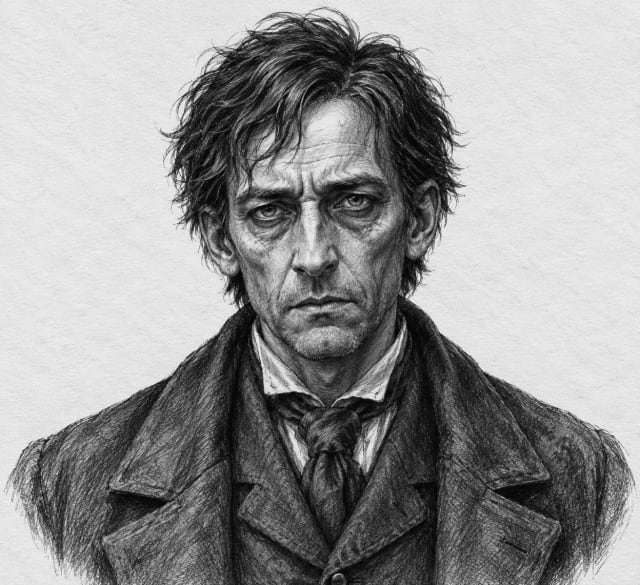
#On His Station
This dossier is compiled in A.S. 201, 1911 of the Common Era, and the year belongs to the compilation alone. It marks when the Bureau gathered what the records of the Breatheries of Bastion-Irongate say about Doctor Fen. The drawer does not say when he entered the mountain, where he learned medicine, whether Fen is the whole of his name, or which office first wrote Doctor in front of it. I have shaken the drawer.
What survives is about his work. Fen practises in the respiratory wards beyond the Choir Nave, where the air turns from brass-warm to bleach-sweet. The descriptive registers place him in the care network of the Shaft Priory, beside Sister Noll. The same registers give him one personal attribute. He sings like a saw.
I record the sound because the source records it. Irongate licenses throats by pitch, and a physician whose voice rips where it ought to ring is at least easy to pick out in a corridor. I draw nothing from it about his tier, his licence or his lungs. None of those papers have reached me.
He has no rank on file and no appointment. His arrival is undated. What the file holds is a man with a trade and a reputation, working inside a complex whose authority sits in other hands.
#On the Ear and the Flame
Fen's recorded skill is listening.
By ear he can tell ice-lung from chant strain. He can tell both from valve-fume scarring, which is what the Valve Quarter's hot cuts and gasket vapour leave in a chest. He can hear the cough of terror, the fright that shuts a throat at the wicket while the clerk watches. He can also hear a fifth sound, the one the Office cares about most: the stage rasp of a healthy man acting sick to get light duty.
That makes five sounds from one ear, and the record claims no more than that. It credits him with no instrument, no published method and no cure the Bureau can cite. Nobody has shown that he never errs, and I refuse that honour on his behalf. He listens and he tells sounds apart. The distinctions are attributed to him by people who watched him work.
The candle test cannot do what he does. A clerk holds the flame at arm's length, the patient breathes at it, and the clerk counts how long it stays bent. The candle measures sustained breath and nothing else. It names no illness and detects no contagion. Exhaustion, cold, fear, age and rot all bend wax the same way, which is to say not enough. The threshold exists but has never been published, and no table turns the clerk's seconds into a voice tier.
Tier is decided somewhere else, at the stanza audition before Cantor Ys Varr and the Choir Magistracy. Tier then decides heat, rations, bunk and residence.
So one chest faces three judgments. The doctor hears what is wrong with it. The Breath Office measures how much breath it has left. The Magistracy sets its worth. Only the first of these is medicine, and it is the only one that carries no seal.
#On the Releases
The Breatheries account credits Fen with falsifying at least seven releases. He did it by lowering the candle before the clerk began counting.
I give the count as the record gives it, as a floor. Seven is how many someone could attest to. It is not his lifetime total, and it is not a list of the saved. The record gives no names and no dates, and it does not say what became of the seven after they left the ward. Some may have gone back to their bunks and recovered. Some may have gone back to the pits with a better score on file and done worse. The Bureau keeps no ledger of either outcome, and I will not start one to flatter a doctor.
The record also leaves out the mechanics. It does not say what the lowered flame did to the clerk's count, and I will not invent the trick for it. What it does give is the act and when it happened: before the count, which means before any paper existed.
The paper is what matters. A recommendation in Fen's hand is medicine. A candle score in the clerk's hand is evidence. Leaving the Breatheries requires a Breath Office seal. Lysa Murne handles the permits and quarantine clearances, and a physician's recommendation, however well argued, is not enough. Physical passage belongs to Tunnel Command under Commandant Hadrik Sorn. Fen controlled neither. He changed the one figure that would travel up the stairs to the people who did. The record does not say how that changed figure got past the other desks.
#On the Lower Register
The same doctor has also sent men back.
The Breatheries account records that Fen returned patients to the Nave whom gentler doctors would have kept. Pressure was falling, and a chamber needed a lower register. The account says the chamber needed that register more than the ward needed a conscience. I keep the wording as I found it and will not try to improve it.
Since the Great Hush of A.S. 94 the Gasket Choir has held Irongate's seals in place with continuous calibrated chant. When a chamber loses pressure, it asks for particular voices. Fen had such voices in his beds, and he knew which throats could hold the low note because he had listened to them. The ear that caught the shirker's rasp also caught the bass under the cough.
The record names no chamber and gives no date. It does not say how many men he returned and lists no casualties. It does not show that his choice held a seal that would otherwise have failed, and it does not show that any of those men died because of it. A patient sent back to the Nave with a damaged chest sings in the dust and the cold. The fortress counts the gauge reading and not the patient. That cost is documented in every ward of the Breatheries. What it came to in Fen's cases is not documented.
My profession tempts me to reconcile the two Fens, the one who lowered the candle and the one who emptied the bed. I decline. Both acts are on file, and neither cancels the other. A man who falsified seven releases and sent an unrecorded number back to the Nave cannot have his conduct averaged.
This office has said before that his cruelty comes from exhaustion. I let that stand as a description of the man, not as proof of anything. A tired man can be cruel and a cruel man can be tired, and the record has not told me which came first.
#On the Hands Around Him
Fen does not work alone, and the people around him are not his accomplices just because they stand near him.
Sister Noll works across the Breatheries without any title that satisfies the Office. She is accused of giving broth to unlicensed patients, keeping names off quarantine lists, and warming wax tablets so records can be rewritten before they are seized. The accusations are credible, and they are made against her, not him. The Priory's known methods include shelter, false records and throat-wax. Fen's falsified releases fit well alongside that practice, but the record never puts the two in the same room. It documents no pact, no shared count of seven and no joint operation. The Synod tolerates the Priory and the provost hunts it. Whether the provost is also hunting Fen, I cannot say.
The Underchord Cartel sells quiet routes, oxygen bulbs and altered candle scores in the same corridors. The Counterkey Circle recruits failed singers from the same benches. A doctor who falsifies scores in a ward where scores are for sale will be suspected of selling them. I hold no evidence that Fen took a ring, carried a pass or learned a forbidden hum.
Father Lukasz objected to the labour assignments that are cutting Ward Eight. A Priory doctor complained that nobody was monitoring the cutting crews' breath. The record does not name that doctor, so neither do I. At Irongate, standing too close to the accused has already hanged enough men.
#On His Present Record
In A.S. 201 Ward Seven has more patients than beds. Its corridors have been wards since the lung-rot outbreaks of A.S. 199 widened quarantine into compulsory isolation. Ward Eight takes patients behind the sealed Third Lung while the picks are still working above them. Fen works across all of that crowding, but he does not direct it. The Breatheries records appoint neither him nor Noll to that post, and no appointment has turned up.
His ear has not settled what causes lung-rot. Nor has it settled how rot relates to ice-lung, which the registers still keep in separate columns.
Ward Eight was "newly carved" behind the Third Lung.
Inherited correction, carried forward from the Ward Eight plate. Ward Eight is still being carved. Its beds are occupied and no completion has been reported. Any account of Fen's work there uses the present tense.
This A.S. 201 compilation closes with the doctor still at work, as far as this office knows, and with his file as open as I found it. No report of retirement, death, punishment or absolution has reached me. The Creator may hold a fuller account. The Breath Office holds the seals.