

#On the Ward That Is Still a Wall
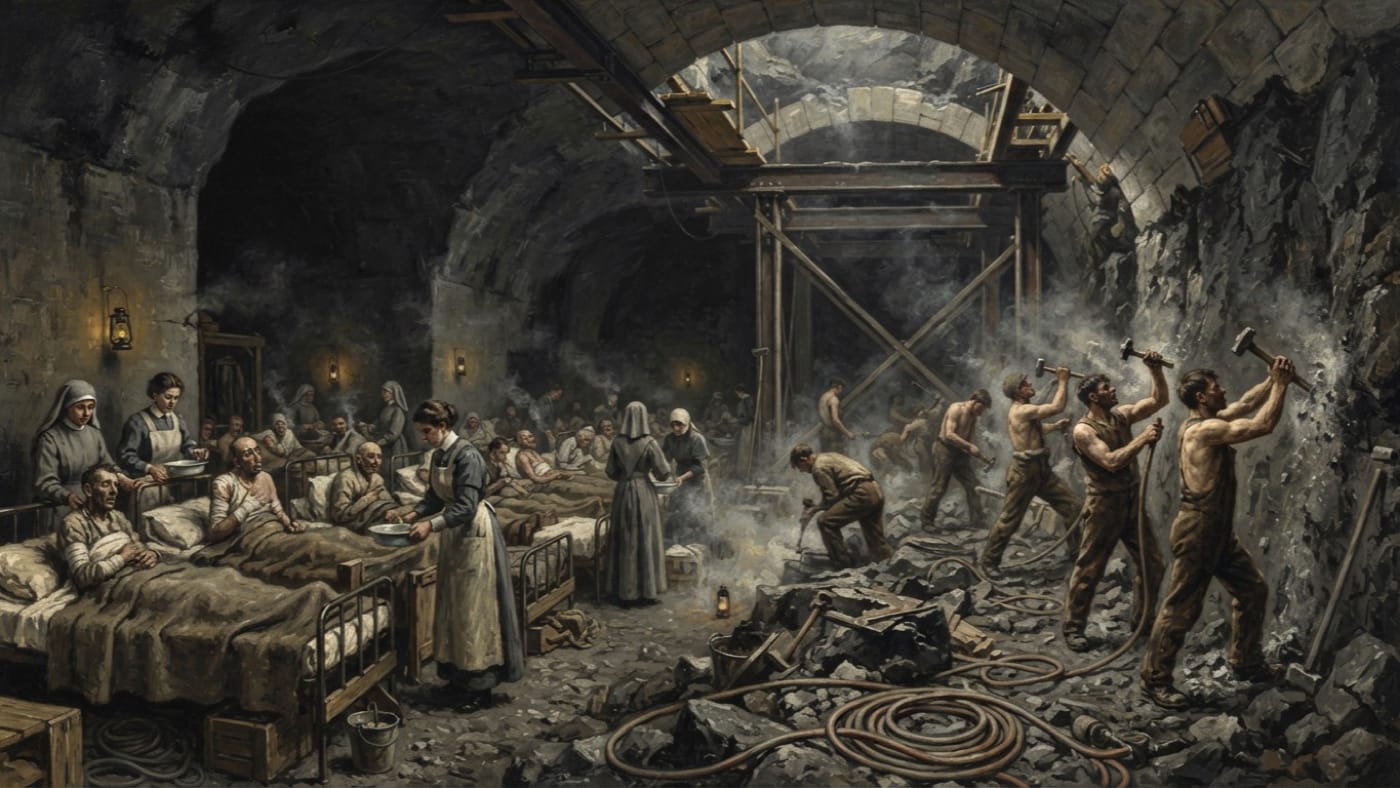
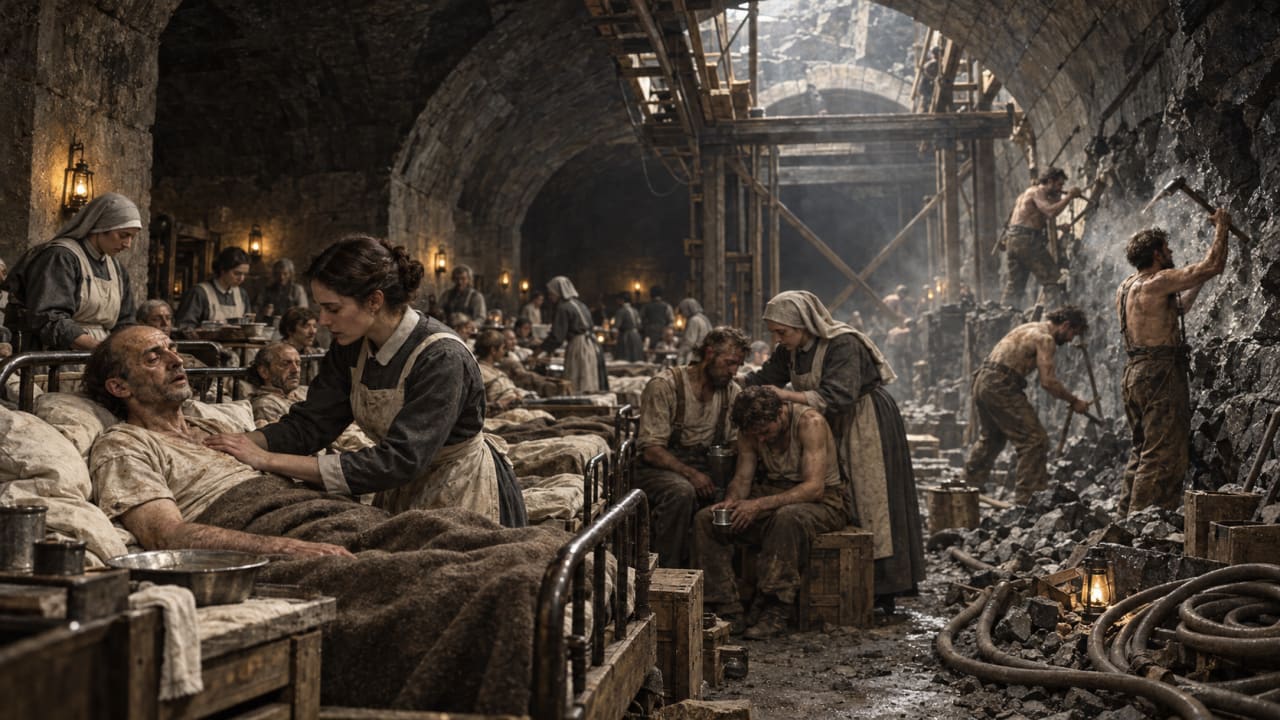
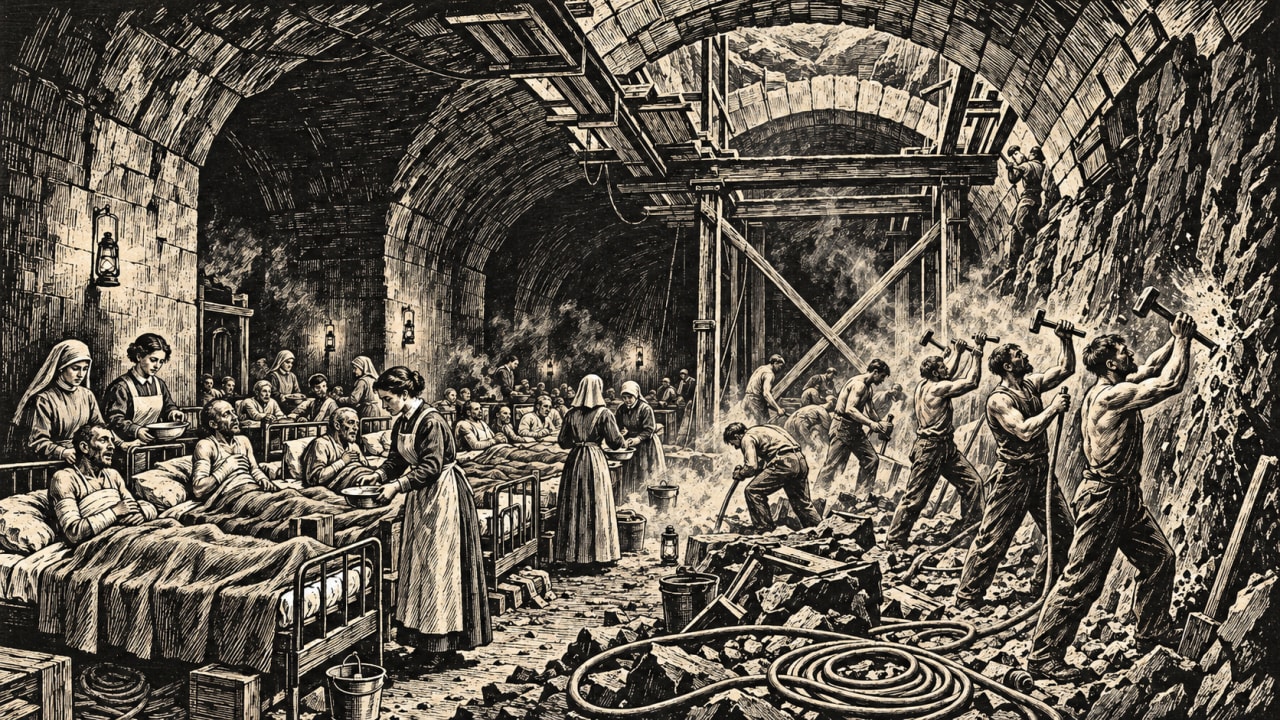
Ward Eight is the newest room in the Breatheries of Bastion-Irongate, and the only one whose patients can watch their own ceiling being finished. It lies behind the Third Lung, past the Choir Nave and the Valve Quarter, cut into the black basalt above the Danube where the Iron Gates gorge closes like a fist. No surveyed plan of it has reached this Bureau. I can give its neighbours, its smell and its purpose. Its dimensions still belong to the men cutting them.
The Breath Office lists purpose first, so I will too. Ward Eight holds workers whose breath has fallen below what the fortress requires, and it treats them where treatment can be had. Beds stand in it and patients lie in the beds. At the far end of the same room the picks are still working, and their dust settles wherever it likes, patient list or no patient list.
The Office's phrase for this condition is incomplete and receiving. I have tried to find a better one and failed.
#On the Shortage That Ordered It
The mountain needs voices. Everything else about Irongate follows from that.
Since the Great Hush of A.S. 94, when nine quiet hours loosened every seal in the mountain and buried the Third Lung, continuous calibrated chant has kept the gaskets seated and the bolts honest. The voice-license regime was ratified in A.S. 97. The Gasket Choir sings in three watches and doubles them in pressure weather. Each watch is paid for in lungs, and the Breatheries exist to repair the lungs that can still be used, sort the ones that cannot, and keep the second kind somewhere warm only for as long as the regulations allow.
The lung-rot outbreaks of A.S. 199 overturned that arrangement. Ward Seven filled. The Breath Office's quarantine powers were widened to compulsory isolation of any worker whose breathing test fell below threshold. An office can decline to use a power it merely holds. A compulsion leaves no room to decline, and so it fills rooms. By A.S. 201 Ward Seven's overflow has turned corridors into wards. Patients sleep sitting up, and nurses tie cords around their chests so they can feel a coughing fit begin.
Ward Eight is the fortress's answer to that crowding. It is an emergency measure taken under a shortage that has not ended.
The number suggests seven earlier foundations, each with its own charter. I have not found the founding papers for every ward before it, and I will not make them up to satisfy the arithmetic. Nor will I say what fills the beds. The Bureau has not ruled on the cause of lung-rot. The garrison's ice-lung, the thickening that stone dust works on tunnellers, is kept in a separate column of the registers, and nobody has explained to me the relationship between the two columns. Dust is documented in the cutting crews' work. It does not explain every chest admitted.
#On the Cutting Behind the Lung
The ward smells of raw stone, wet lime, sawdust, bleach and hot lamp oil, in roughly that order as one walks in from the corridor.
It is being cut by labourers, and labourers breathe what they cut. The Shaft Priory's doctor has stated, more frankly than the Priory's tolerated status really permits, that the excavation crews' own breath scores are insufficiently monitored. I record that opinion as his, word for word, because it needs no help from me. The fortress is digging a ward for failed lungs with men whose lungs no clerk is checking.
Father Lukasz objected to the labour assignments and called his objection pastoral concern. The Breath Office filed it as interference. The Choir Magistracy asked whether the Priory would like to supply licensed singers for the replacement shifts. The Priory sent lentils.
Building and admission were not kept apart. The first beds went in before the ceiling was fully sealed. Dust fell into the wash basins. Patients complained in writing, and the complaint forms were kept, because loose paper clogs the vents and every page in Irongate is worth something. The fittings arrive late, because the Valve Quarter cannot spare enough clean work for a room that will fill as soon as it has walls, with people the official system has already marked as marginal.
The circle can be traced without inventing a single diagnosis. A worker spends years keeping Irongate standing and the mountain gets into his chest. The candle catches him, quarantine takes him, and Ward Seven has no bed. So another worker is put to cutting Ward Eight, in the dust, with nobody holding a candle to him. Whether that cutter ends up in a bed he built, the registers have not yet said. The registers are not being asked.
The Third Lung itself stays sealed. Ward Eight is new work cut behind it, and none of this cutting reopens the old chamber or grants any access to the dead the Great Hush left there. The masonry of A.S. 94 is still beige, still painted over and still cited in court. The picks work beside it and not through it, and the Breath Office keeps its diagrams in a state that lets everyone involved say so.
The Breath Office expansion notice described Ward Eight as "a planned increase in compassionate capacity."
Amended. Ward Eight is an emergency excavation carried out under medical shortage, labour coercion and political embarrassment. Individual nurses may supply compassion. Nobody built it into the plan.
#On Candle, Stanza and the Seal on the Door
Two examinations govern a throat at Irongate, and Ward Eight receives the losers of the cheaper one.
The candle test belongs to the Breath Office and is given at the Intake Gateworks wicket. A clerk holds a flame at arm's length. The worker breathes against it and keeps it bent for as long as the chest allows. The clerk times this and writes it down. The threshold exists and has never been published, and I will not supply a figure the Office has kept from me through three polite channels. The candle measures capacity, and that is all it measures. It names no contagion, proves no rot and detects no sin. A low score shows only that, on one day and in one room with no draft, a body could not keep a flame bent for as long as the Office wanted. Exhaustion, cold, fright and age all look the same to the flame.
The stanza audition is a different rite and belongs to a different office. Before Cantor Ys Varr, a worker holds a prescribed harmonic at prescribed volume for a prescribed duration while a Choir Warden watches the gauge. The audition settles voice tier, and tier settles heat, rations, bunk and the right to stay inside the mountain. No published table turns seconds of candle into a tier. A man can pass the flame and crack the upper measure, or hold a true note and run out of breath before the clerk finishes counting.
Since A.S. 199, a failed candle can lead to custody. The available outcomes include rest, quarantine referral, licence review, transfer to non-choir labour, and the form the clerks call discharge preparation. Not every patient goes through all of them, and none goes through them automatically. Each one has its form, and each form has a line for appeal.
Leaving the ward is a matter of seal. Lysa Murne handles the permits and the quarantine clearances. A physician's recommendation can be written, read, admired and filed, and the patient still cannot leave until Murne's brass touches the page. Murne decides whether a person may leave on paper. Commandant Hadrik Sorn holds the corridors and the compartment doors, and so decides whether any passage will let them leave in fact.
The ward has made one contribution of its own to Irongate's classifications. A nurse painted small throat marks on the bedheads to show which patients could still make sound, which could only whisper, and which could answer only by tapping. The marks looked enough like Counterkey notation that the Bureau of Purity inspected the ward, confiscated three innocent charts, and frightened a feverish boy into confessing to an alphabet. The Codex notes, for any Purity desk that wants it, that a patient who taps because he cannot speak has joined no circle and learned no heresy. He has only run out of breath.
#On the Hands That Keep It
The Breatheries are run by people the hierarchy praises in its speeches and uses up in practice, and Ward Eight gets them at the same rate it gets everything else: late, short and already tired.
Infirmary bleachers wash linen until their knuckles split, and in Ward Eight they wash the basins twice, once for the patients and once for the ceiling. Lung nurses count breaths by touch because the coughing drowns the clocks. Throat orderlies grind mint, salt and wax into pastes that taste of apology. Patients are sat upright when lying down floods the chest. Ribs cracked by coughing are bound, fevers are cooled with wet cloth, and steam is drawn through herb. Patients are taught to pace their breathing so that a body short of air wastes less of it. Some go back to the line for another season. The fortress counts that as a success, and on the evidence of the gauges it is one.
Priory hands come and go on sufferance. Sister Noll works across the Breatheries without any title that satisfies the Office. Her hands are stained with grease from carrying supplies through maintenance runs. She is accused of giving broth to unlicensed patients, keeping names off quarantine lists, and warming wax tablets so records can be rewritten before they are seized. The accusations are credible, which is why I find them comforting. The Priory also hands out throat-wax, a local preparation the garrison swears by and the Bureau has never analysed. I report it and do not prescribe it.
Doctor Fen sings like a saw and diagnoses with a cruelty that comes from exhaustion. He can tell ice-lung, chant strain, valve-fume scarring, fright and the stage rasp of a man angling for light duty apart by ear. He has falsified at least seven releases by lowering the candle before the clerk began counting. He has also sent men back to the Choir Nave whom gentler doctors would have kept, because pressure was falling and a chamber needed a lower register more than a ward needed a conscience.
The Breatheries records tie Noll and Fen to this work. They name neither of them director of Ward Eight, and I have found no such appointment. In a ward that has no ceiling yet, the job of director is done by whoever happens to be holding the bucket.
#On Traffic Beneath the Register
Where the candle closes the stairs, the Underchord Cartel sells the crawlway.
It sells oxygen bulbs, taken from emergency reserves and filled through illegal valve taps. A bulb is air, sold by the breath, and it lasts exactly as many breaths as it holds. Nobody below has ever claimed it cures anything. The Cartel also sells counterfeit voice-licences in waxed cloth, forged quarantine clearances, altered candle scores, and its most expensive item, the quiet pass: a route, a timing and a stretch of silence, tapped out in pieces to runners who each carry only part of the way. Payment is in gasket-rings, the brass washers of the Valve Quarter, small enough to hide under the tongue. Prices move with pressure readings, ward rumours and executions. Any price printed here would be wrong before the wax set.
The published accounts record quiet routes from the Breatheries toward the Transit Spine that avoid the gate desks and the audition bench. They show no hatch belonging to Ward Eight, and I will not draw one. The nurses know the trade by what goes missing. A patient marked for discharge is gone before dawn. An oxygen bulb turns up under the bed of a man with no rings. A pass is found sewn into a throat wrap. Tap-code travels through the heating pipes in the gaps between coughs. The nurses report what cannot be ignored, and they ignore what they could not survive reporting.
Leaving the register costs more than rings. A route sold today can run past the Dead Gallery tomorrow. Somewhere among the fragments of every pass is the name of the passenger to drop if the pressure falls, and the passenger is never told which runner carries it. The Cartel does not rescue anyone. It processes them, and it processes them faster than the Breath Office does.
The Priory buys from the Cartel and confesses to neither side in any useful detail. The Counterkey Circle works the same stairwells and recruits among the failed singers, offering a doctrine in which the voice a man lost was taken from him before it failed. The Cartel and the Circle share corridors, suppliers and the fortress's discards. They do not share a creed. One sells routes, the other preaches a heresy, and a patient who buys a bulb has bought a bulb.
#On the Continuing Works
One piece of paper from the rear cut belongs on this plate. I reproduce it as filed, with its redaction intact. I have not seen what lies under the bar, and I will not guess.
BREATHERIES WORK CREW NOTE — WARD EIGHT REAR CUT, A.S. 201 At third bell the south wall answered the hammer before impact. Four workers heard a breath behind stone. One heard his own voice asking for discharge. Wall marked for preservation. Mark removed by morning. Replacement mark appeared inside wet lime: ███████. Breath Office response: continue excavation.
The note names no speaker and gives no cause. The war desks will reach for Morwen, who presses this fortress through imitation and grievance. The Priory will reach for the dead of A.S. 94. Engineering will reach for thermal settling, as it always does. None of them has shown me proof, and the Codex does not fill in the blank for them. What the record does establish is the Office's reply, which ran to three words and asked nobody's opinion.
An older entry in this Codex has to be corrected as well. Its offence was optimism, which my office dislikes even more than error.
Earlier Codex entries described Ward Eight as "newly carved" and as having "been carved" behind the Third Lung.
Corrected. Ward Eight is being carved. Its beds are occupied, its ceiling was finished after its patients arrived, and no completion has been reported. The past tense has been withdrawn as premature.
In A.S. 201 Ward Seven is still full and Ward Eight is still being cut. The candle is still held at arm's length at the Intake Gateworks, and the clerk still marks the time. The crews cut, the bleachers wipe the basins and the picks go on working above the beds. Somewhere in the lime there is a mark that someone saw fit to cover.