

#On the Command That Holds the Keys
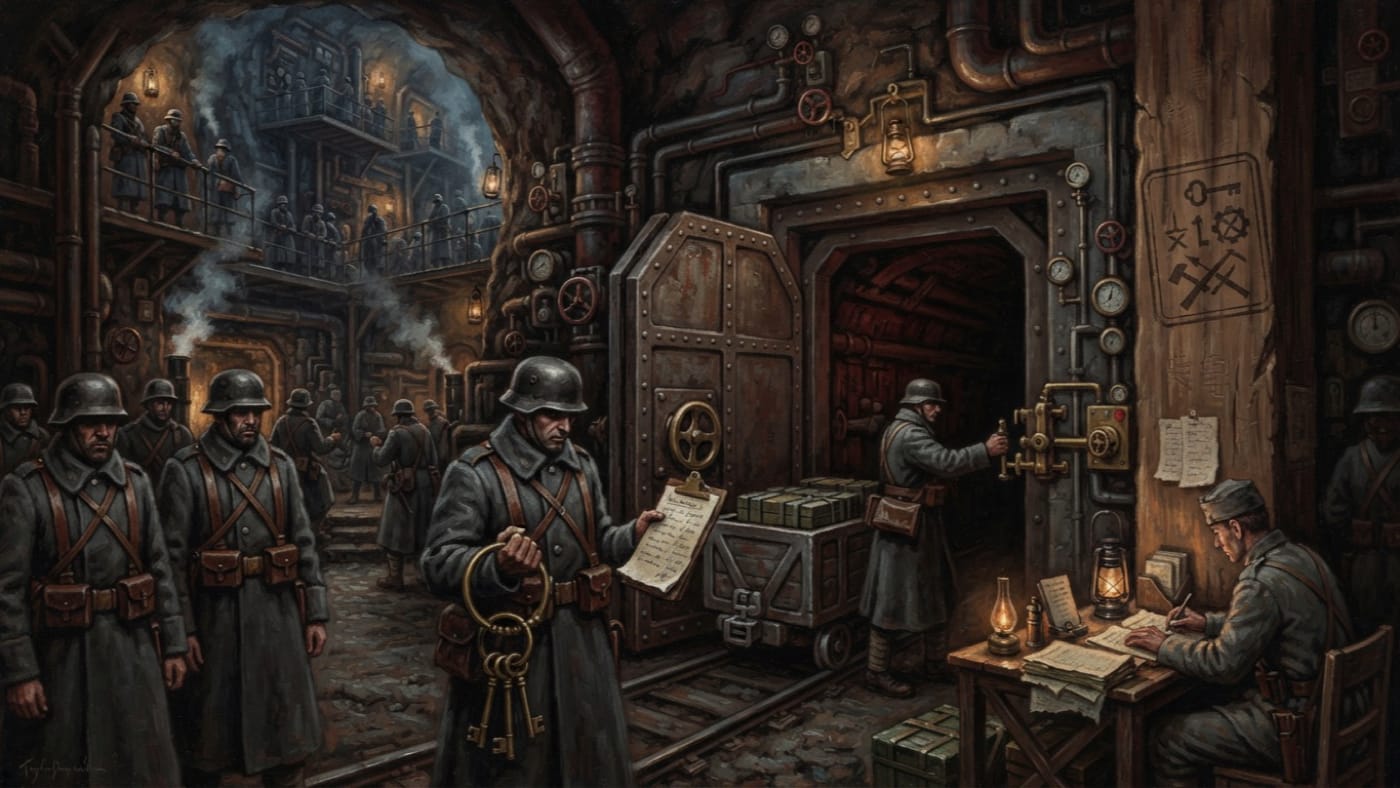
Tunnel Command is the military authority of Bastion-Irongate. Its theology fits on a key ring. It holds the gates and sets their hours. When the war surges up the Danube approaches and convoys back up along the Transit Spine like wet hymnals in an overfilled crate, it decides which doors open for powder, which open for grain, which open for men, and which stay shut while the people behind them work out how much air remains.
Its public face is the defence of the pass. Its practical aim, set down without blushing in the fortress's own survey of its factions, is to control the gates during war surges. Its methods are decrees, conscription, and compartment lockdowns. Its resources are soldiers, explosives, and gate keys. Its territory runs the length of the Transit Spine to Snowmouth Gate, the outbound throat where the air smells of pine pitch and gun oil, avalanches close the road without consulting anyone, and the tollers bury contraband in snow berms.
The cliff batteries and the river chain-booms are what the fortress shows the Danube. They command the gorge at the Iron Gates, where the river runs between Romanian and Serbian rock barely wide enough for two ships abreast. Tunnel Command lives in the gut behind that face, where the mountain is hollow, pressured, sung to, and resentful about all three.
Strangers mistake the Command for a man. Commandant Hadrik Sorn encourages the error by being hard to separate from his office. He has a cold humour, a talent for timetables, and a precise sense of what Irongate fears most, which is being sealed inside. Still, a commandant is the seal and the Command is the wax: soldiers, sapper stores, key-wardens, provost patrols, convoy clerks, and Lieutenant Vessa, whose one attested quality is that the lieutenant records everything. Remove Sorn and the keys would pass to another hand. Remove the keys and Sorn would be a cold man telling jokes in a corridor.
The Command is also distinct from the tunnels it guards. Engineering bored them, the Gasket Choir keeps them seated, and the Valve Quarter makes the fittings that let them hold pressure. It is distinct as well from the Breath Office, which owns the paperwork of lungs, and from the Choir Magistracy, which owns the paperwork of song. The Command owns movement and closure. In a fortress that depends on air, that is enough to frighten everyone who has ever stood on the wrong side of a pressure door.
#On the Pressures That Made It
No one has shown me the Command's charter. I have asked Records, War, and two archivists who smelled of lamp-black and resentment. None produced a founding instrument, a first commission, or a day on which someone first said "Tunnel Command" aloud with the capital letters attached. I will not invent one. Records has enough fiction to manage without mine.
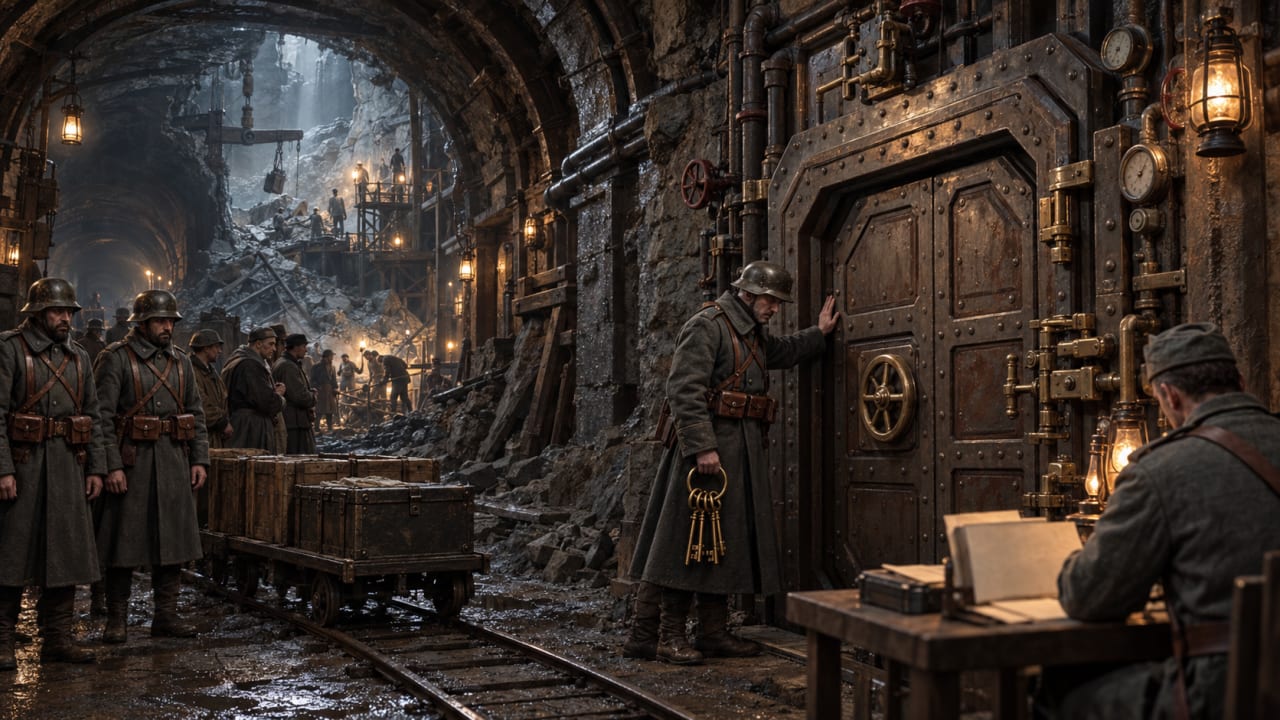
What can be dated is the pressure that built it. The fortress was designated a permanent garrison in A.S. 67, which made soldiers residents instead of visitors. Its permanent works were ratified in A.S. 72, which made the mountain a machine instead of a hole. Between those years and a later commandant with a printed schedule, a sentry holding a key turned into an institution holding all of them. Most military offices are born this way: as a habit that eventually receives a budget.
The Great Hush of A.S. 94 taught the habit what it was guarding. For nine hours the chant failed, the seals slackened, and the Third Lung came down. Three thousand dead were recorded. The recorded figure is the one I am permitted to repeat, and it should be read as a figure set down by men with reasons to stop counting. Knocking was heard through the masonry for sixteen days. The excavation took eleven months. After that winter no one in Irongate could pretend that a door was only a door. A door was the line between a chamber that could be saved and one that could not.
Voice licensing was ratified in A.S. 97, and the fortress's dependence on breath became law. Once survival is measured in seals, stanzas, and seated gaskets, whoever controls access to the chambers controls a good deal more than traffic. The Command did not have to seize that power. It came with the keys.
In A.S. 199 lung-rot widened the Breath Office's quarantine powers and filled the wards. Every widening of civil emergency authority has a military shadow, because someone must hold the cordon, someone must stand at the sealed chamber, and someone must decide whether a quarantine line counts as a medical boundary or a defensive one. The Command has never been shy about volunteering for that someone.
The Underchords survey, under this author's seal, described Irongate's tunnel complex as the product of "a hundred and fifty years of continuous boring."
Corrected. From the garrison designation of A.S. 67 to the present year is one hundred and thirty-four years; from the ratification of permanent works in A.S. 72, one hundred and twenty-nine. The earlier figure was rhetoric that had been allowed to round itself up. The mountain has not.
#On the Three Hands at the Gate
Formal authority in Irongate is divided among the Synod Chapterhouse, which works through the Transit and Breath Office, the Tunnel Commandant, and the Choir Magistrates. On paper this is a balance. In the corridors it is three hands on one latch.
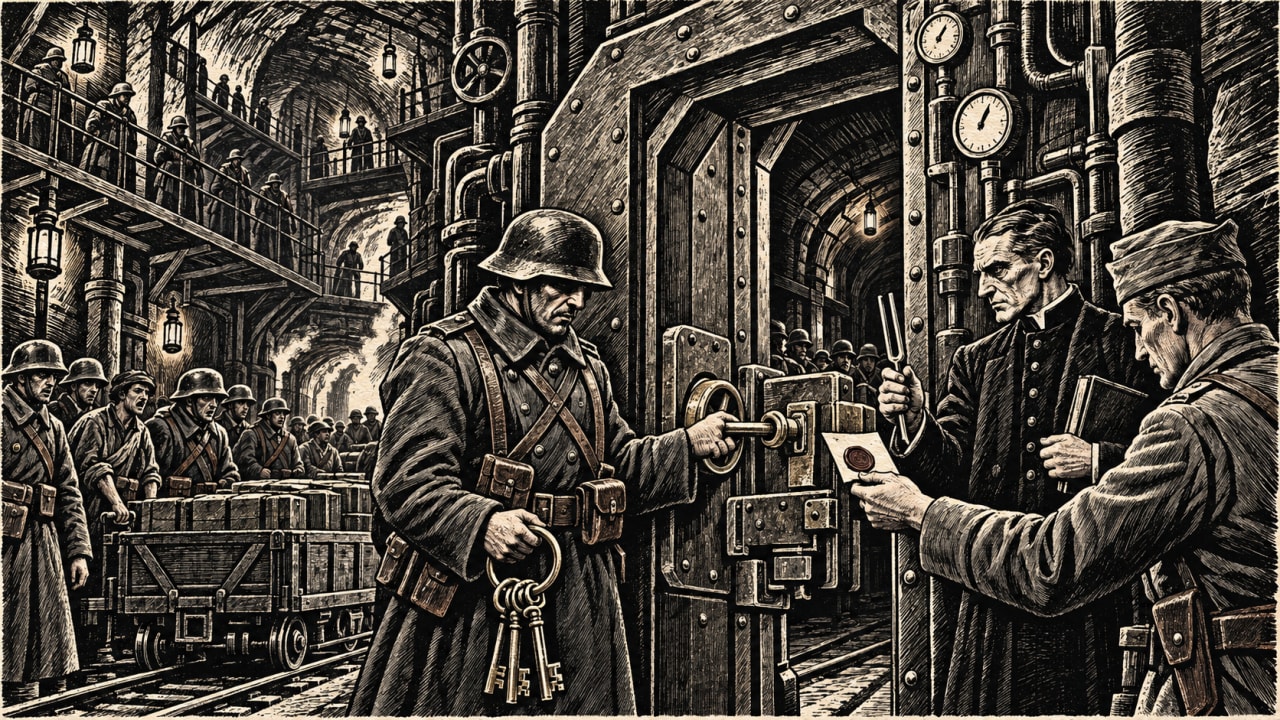
The Breath Office checks voice-license seals at the passage controls. It also keeps the permit desks, the candle-test records, heat allocations, quarantine clearances, and the access rosters that say who may be in which chamber when it closes. Tunnel Command tests what the gate clerks call stanza compliance, and it governs the movement of soldiers, convoys, and closures. The Choir Magistracy holds auditions, prescribes the stanzas, classifies voices, and runs the Hush Court, which turns silence into a crime and then sentences the silence.
None of the three is subordinate to another. Each has, at one time or another, behaved as though the other two were.
Follow a single convoy authorization to see the latch in use. Sorn's office posts a gate schedule: a window in the main bore, a hold at the freight descent, a release toward Snowmouth. The schedule cannot fill itself. The Breath Office must clear the crew's seals and confirm that nobody in the manifest is flagged for quarantine. The Magistracy must supply licensed voices for the breath lines the convoy will pass through, because heavy freight shakes the stone and the stone wants singing while it shakes. The Valve Quarter must confirm its hot shops are ready before any pressure door is cycled. Only then do the keys turn. If any one hand withholds, the schedule becomes an expensive document, and Lieutenant Vessa writes down which hand it was.
The Choir Wardens show the arrangement at its most uneasy. They serve the Magistracy. Their appointment abstract also makes them subject to Tunnel Command emergency order. In an emergency, then, the aisle officers who walk the Choir Nave with pitch forks and Beat Books can be directed by the men who hold the keys. The emergency ends, and so does the direction. The Warden still may not pronounce a final Hush Court sentence without Bench writ. Sorn cannot award a vocal tier, sign a medical release, or deliver the Court's judgment either. He can only decide where the accused are standing when those things are done to them.
The Command's surveyed temperament includes hatred of auditors. The Magistracy audits voices, the Breath Office audits lungs, and visiting inquisitors audit everybody. A soldier holding a gate during a surge experiences each audit as a delay with a seal on it. Cantor Ys Varr tightens her audits and the breath-line roster thins. The roster thins and the gate schedule slips. The schedule slips and the Commandant writes memoranda so composed that, as one ward clerk observed, they make the paper sweat. Each office blames the next for slowness, and each is correct.
Lieutenant Vessa's ledger is the quiet engine in all this. Records everything is a modest phrase for a dangerous trait. In a fortress run by three authorities, the officer who knows exactly when each one hesitated holds a kind of power no charter grants. I do not know what the ledger contains and have not been invited to read it. I do note that a lieutenant who records everything is seldom the one blamed for anything.
#On Gate Schedules and the Price of Passage
Irongate has several ways in, and the Command holds the hardest of them. There is the mountain gate, with its permit and breath test. There is the rail spur through the main bore. There is the convoy tunnel, which is military and which a civilian enters only as cargo, conscript, or prisoner. In season there is a rope road over the ridge, which the Command tolerates the way a magistrate tolerates weather.
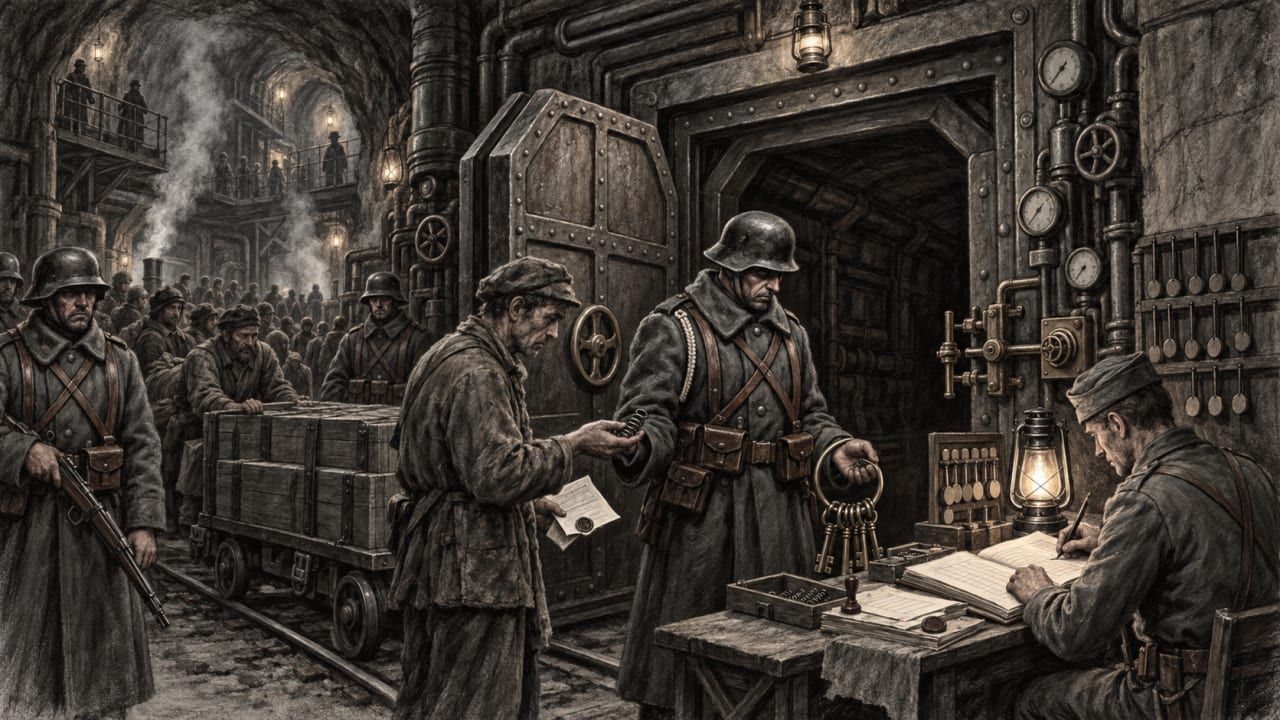
The Transit Spine is where these routes become one throat. It smells of diesel, coal, and wet stone. Rail carts stage there and convoys wait there. In a war surge it fills with the particular stillness of men who have been told to wait and have not been told for how long. Sorn's leverage is the schedule. A schedule seems a modest instrument until it decides whether a grain convoy reaches the lowland bastions before the rail freezes, or whether a company of tunnel infantry is in the right chamber when a door is ordered shut.
The control points carry the Command's sense of its own importance. Gate clerks check manifests against the list of things the mountain will not carry. Volatile powders without damp-seal are refused, as are unregistered bells, plague cargo, forbidden books whose paper dust clogs the vents, and anything that sheds: feathers, ash, flour. Soldiers test stanza compliance, requiring those who pass through the breath lines to show they can keep the line's prescribed sound and will not bring wrong silence or wrong noise into a chamber that depends on both being right. The Breath Office clerk at the next table examines the wax. Two inspections cover one body, and each is entitled to stop it.
Passage at Irongate is priced like everything else, in the fortress's survival currencies. Gasket grease buys a soldier's patience, valve-springs buy a clerk's eyesight, and a choir exemption, which is the most precious of the three, buys a man out of a breath line he would otherwise have to sing his way through. The Command condemns these exchanges in its orders and relies on them in its corridors. A gate that took no grease would run slower, and a slower gate during a surge is a tactical failure. Corruption at Irongate is part of how the place moves.
Conscription is the other price, and it falls when the gates are busiest. In a convoy surge the Command can sweep labour from the queue and put it on carts, chains, and shaft work, because a convoy has to be moved by bodies whether or not those bodies came to move it. The waiting worker learns to watch the schedule boards the way a farmer watches the sky. A long hold means conscription. A short hold means the soldiers are tired. An unposted hold means something has happened at Snowmouth, and nobody will say what until the snow has said it first.
At Snowmouth the Command shares the gate with the tollers, the avalanches, and the cold. Failed workers sent out with discharge certificates pass through there. So do convoys bound for Bastion-Sibiu and Bastion-Shipka. A soldier there keeps a key, a lamp, and in winter a white cord on the uniform. The cord is meant to mark command troops in snow-light. It has come to mark the men who decide who walks out into the snow.
#On Compartments, Kill Lanes, and Denial
The defensive doctrine of Bastion-Irongate fits in three phrases, and each one deserves to be read slowly: pressure-door compartmentalization, choke-chamber kill lanes, and shaft denial charges.
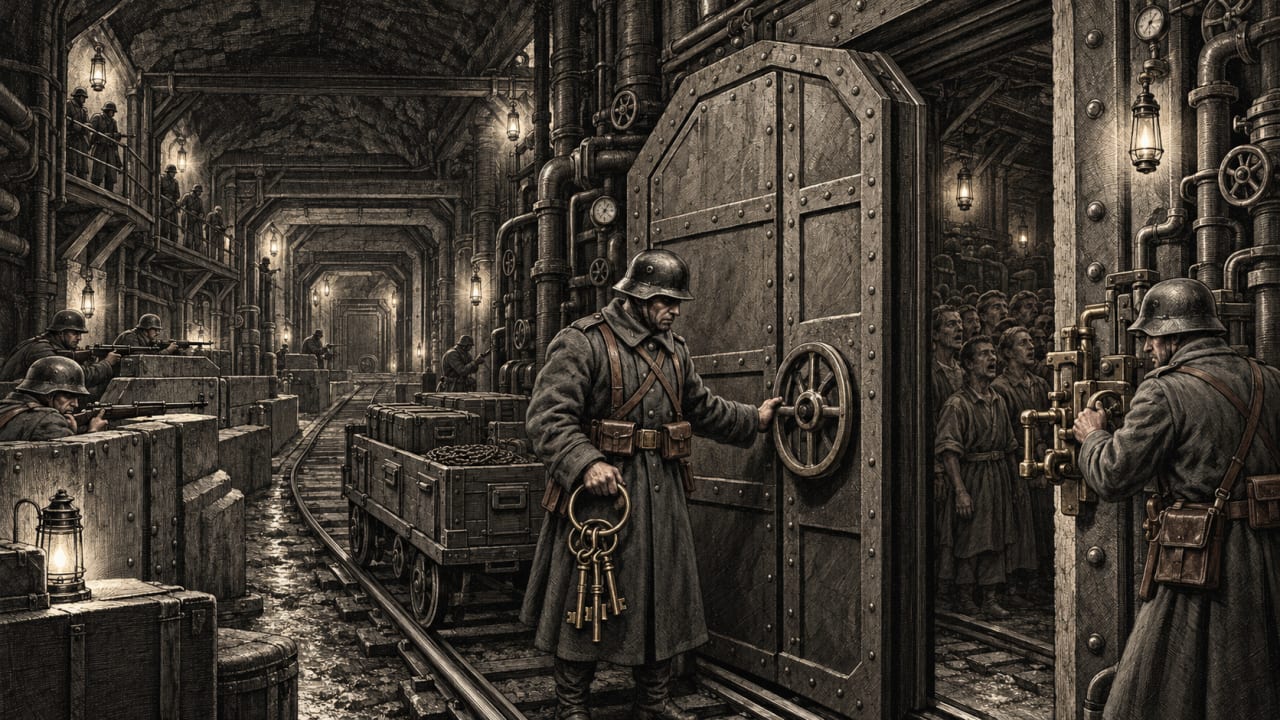
Compartmentalization is the old wisdom of ships applied to a mountain. A breach in one chamber must not become a breach in all of them. If stone slips, if pressure drops, if fire starts, if the enemy gets in, the doors close and the damage stays where it began. The fortress survives as a set of sealed rooms in place of one large wound. Every engineer who has buried a friend agrees with the principle. I agree with it too, and I have buried nobody, which makes my agreement cheaper.
The choke-chamber kill lanes are what the doctrine looks like with weapons in it. An enemy who comes into the tunnel works comes through narrow approaches built to be held by few men against many, along lanes where the stone does the confining and the soldiers do the rest. They are the military counterpart of the breath line: a marked corridor in which a particular kind of noise is required.
Shaft denial charges are the last instruction. A shaft that the enemy will take, or a passage that will carry collapse or contagion further, can be closed with explosives so it is useful to nobody. The Command keeps the charges among its resources. I will not describe their placement, mechanism, or quantity. I do not know them, and a codex that printed them would deserve to be read by the Great Deceiver's quartermasters. The point is that they exist and that the Command is trained to use them. Sorn has increased denial drills, which means live-pressure door cycling at hours when the rest of the fortress is trying to sleep.
Here is the doctrine's moral centre. People live in a compartment. When a door closes to save a route, it closes on everyone the roster puts on the wrong side. The fortress's own survey says plainly what a siege at Irongate looks like: suffocation rather than starvation, with civilians used as chorus labour to keep the supports seated. Under siege the Command needs those voices, so it keeps them inside, singing, in chambers whose air it is rationing by keeping them closed. Sorn's leverage and Sorn's fear are the same object seen from opposite sides of a door.
The Command's justification is easy to state and hard to dismiss. One compartment lost is a tragedy and the whole mountain lost is the end of the pass, of the lowland supply, of the mid-southern Line. Officers who have held a door while hearing knocking on the far side say the arithmetic is the only mercy available to them. The Third Lung, they will tell you, is what happens when nobody closes the right door in time. Survivors of the Third Lung's families point out that the knocking went on for sixteen days.
The doors do not close by order alone. A pressure door depends on its seals, and its seals depend on the Choir's calibrated sound and the Valve Quarter's hot shops. Engineering's posted notice is blunt: no pressure-door cycling without hot shop readiness. A commandant can order a door shut, and a gasket smith decides whether it will hold once shut. The Gasket-Hymn Mechanics know which stanzas a seating needs. The Diesel Resonance Plumbers know which pipes carry what and how they will answer a sudden change in pressure. Soldiers carry the keys, and the craftsmen carry the knowledge that makes the keys work.
#On Soldiers, Smiths, and the Threatened Silence
The garrison itself is of middling strength. The survey calls it medium and I will not inflate it, because inflated garrisons have a habit of becoming reasons not to send relief. It consists of tunnel infantry, made for narrow lanes, short weapons, and fighting in air thick enough to chew, and provost patrols that check licences in the corridors after the hush bell. Their morale is brittle, and the cause is a local one. Every soldier in Irongate is one cough from demotion like every other resident. Rank does not exempt anyone from the candle. A sergeant whose lungs are failing is subject to the same arithmetic as the chorus labourer he is guarding.
These are the Command's men: cold, competent, underslept, and always aware of the ceiling above them.
The Command's real constraint is labour. It can order soldiers, but it can only bargain with craftsmen. The Valve Quarter Guild runs the foundries and control rooms, and the survey calls it an uneasy ally of the Commandant, an ally when their interests coincide. They coincide often enough: both want the pass alive, both despise Synod auditors, and both have watched visiting inspectors count fittings without ever having seated one. They part when the Guild uses its leverage. Its stated aims are tolls and heat allocations, and its stated methods are strikes and threats of sabotage.
The current dispute is the one every officer in Irongate dreads. A guild strike threatens to stop the chant shifts. The Command wants forced conscription to fill them. The Synod fears how a mass collapse would look, which is a more honest fear than it sounds, since optics at Irongate are measured in bodies. None of the three has acted yet. No strike has stopped the chant and no general levy has been decreed. The threat alone has already made each side more expensive to the others.
Conscription seems the obvious answer to a soldier, and the mountain gives the soldier a lesson in reply. A conscript can haul a chain. A conscript cannot hear pressure, seat a gasket during the right stanza, or tell a dangerous knock in a pipe from a harmless one. The Command can fill the chant pits with pressed throats and still lose a chamber because the pressed throats were the wrong throats. Command officers know this and want the conscription anyway, because a bad answer that is yours to give is easier to live with than a good answer held by a foreman.
Scarcity sharpens all of it. The Valve Quarter is short of brass, short of purity wax, and short of hands. Ward Eight of the Breatheries, being carved behind the Third Lung, needs fittings the Quarter cannot spare. The surveys of the lower corridors need measuring chains from Quarter stores. Every fitting the Command takes for its doors and denial drills is one that a ward or a breath line goes without. The Command's priorities are defensible. They are also the reason a nurse somewhere is binding a coughing patient's chest with cord, because the proper fitting went to a door.
#On the Routes the Command Does Not Admit
Beneath the Command's gates runs the economy that exists to get around them.
The Underchords are the maintenance crawls, sealed galleries, and smugglers' hollows behind the brass baffles and below the pressure doors, the negative space of a fortress that has been bored, collapsed, sealed, and forgotten in layers. The Underchord Cartel trades there in quiet passes. These are routes that get past the gate checkpoints, the Breath Office permit desks, and the Magistracy's audition benches. A quiet pass is a schedule the Command did not write. A failed worker who buys one comes up somewhere along the Transit Spine where the manifests are audited less closely and a rail hookman looks the other way while someone climbs into a grain cart.
The Cartel's goods are well known: counterfeit licence seals, stolen hymn pages, oxygen bulbs, and grain bricks that have fallen off convoy stores, which the Command guards. Its currency is the gasket-ring. Its tap-code runs through the waste pipes under Tap-King Jaro, who does not speak. It is a business. It bribes, smuggles, and sells to the desperate on terms that are punctual and are not merciful.
The Counterkey Circle is something else, and the Command does it no favours by lumping the two together. The Circle teaches forbidden harmonics in silent sign and gasket grease. It claims the Magistracy's prescribed keys are wrong, and that the mountain could be held another way by a different set. That is a doctrinal and acoustic challenge, and its sharpest teachers, Reed among them, did not take it up for profit. The Circle uses Cartel routes. The Cartel sells to Circle members. Commerce and conviction share a corridor without sharing a purpose. Since it became visible late in the last decade, the crackdown on the Circle has belonged to the Magistracy and the Hush Court. The executions that followed were their sentences, not Tunnel Command's.
I put the question of these corridors to Commandant Sorn once, over tea. He told me, with the diction of a man addressing a magistrate while standing on a trapdoor, that there are no Underchords. I gave him locations. He gave me geology. That interview is on the record and I will not embroider it. I will only observe what the denial costs. A command whose maps show solid rock where men walk cannot defend those routes, cannot patrol them except under maintenance euphemisms, and cannot admit how much of its own fortress lies outside its schedule. The denial protects its authority and blinds its eyes.
COMMAND COPY — ENGINEERING FINDING, DEAD GALLERY, A.S. 200 (EXTRACT AS RECEIVED) Measured length: forty yards. Subsequent measurement: sixty. Sapper chains on return: eleven yards longer than issued. Links of correct stamp and alloy. Engineering classification: inventory discrepancy. Sappers' report of the deepest measured point: ████████████████████. Command annotation: ██████████. Initialled; initials obscured.
Below everything the Command denies is the one thing it cannot even deny competently, the Dead Gallery. It was measured at forty yards in A.S. 200 and later confirmed at sixty. The surveyors' chains came back longer than they went in. I report the measurements and say nothing about their author. The Command cannot schedule the Gallery, close it to any useful effect, or measure it twice with the same result. No faction in Irongate governs it, and Tunnel Command, whose whole authority rests on knowing where its doors are, has the most to lose by saying so.
#On Air, Rosters, and Tolerated Mercy
A closed compartment raises one practical question: who is inside. The Breath Office answers it with access rosters and quarantine flags, and the Command cannot run its doctrine without those papers. Soldiers in a sealed chamber need to know whose air they are sharing, which coughs are contagious, and which civilians have no right to be there. The Office supplies the list and the Command supplies the door. Between them the roster becomes a census of who the fortress has agreed to save.
The Command reads the Breatheries with a soldier's suspicion. Ward Seven has been full since the lung-rot of A.S. 199, and Ward Eight is still being cut out of the rock behind the Third Lung. The Command suspects deserters are hiding there among genuine patients, men who found a failed candle test easier than another posting at Snowmouth. The suspicion is reasonable and unproven. A fevered ward is a fine place to hide and a terrible place to search, and an officer who raids an infirmary in an epidemic is likely to spread the thing he was trying to contain.
Close to the Third Lung is the Shaft Priory, which has no charter and is tolerated without being admitted. Its kettle feeds failed singers, unlicensed children, widows, and anyone else who comes, without asking for a seal. Father Lukasz calls this comfort. The Magistracy calls it shelter. The Command's welfare appendix filed it as "a chaplaincy convenience serving minor morale needs." That phrase has been corrected elsewhere and I will not make a second relic of the correction. I will add the military point the appendix missed.
The Priory is part of the Command's defensive arithmetic, whether or not the Command signs for it. Several hundred unlicensed people live within reach of its broth. Fed, they stay quiet in the corridors. Unfed, they become pressure on the gates, the Cartel's customers, the Circle's recruits, and the crowd outside a door that has to close. The Priory does not serve the Command, is not a military chaplaincy, and is not a deserters' hostel just because some of the men it feeds have run from something. It is a kettle that does part of the Command's work for no pay. The Command watches the queue at the broth table, and its soldiers stand at the edge of it in winter cords. Their presence turns some people away and keeps others in line. Neither effect has been measured, which in Irongate means both are being paid for.
#On Recognition Under Envy
Morwen presses Irongate from the Danube approaches. She is the Sin-General of Envy, and she works through imitation, replacement, stolen voices, and the slow ruin of trust. A command structure is built on trust. An order is only as good as the certainty that it came from the officer whose name is on it.
Consider the order to close a door. It arrives by voice down a corridor, or on paper under a seal, or by runner. In a fortress where people report hearing their own voices answer late from behind them, a familiar voice is weaker evidence than it ought to be. A soldier holding a key cannot be fully sure the voice telling him to open was the Commandant's. He cannot be fully sure the runner was the runner. On a bad night he cannot be fully sure about himself.
The Command's countermeasures are the ones used across the Line. Brass is kept dull. Gauge glass is covered when nobody is reading it. Polished wheels are worked in pairs. Mirror Discipline teaches personnel to distrust their reflections and then, maddeningly, asks them to look. There are challenge-and-response phrases. There are identity ledgers that record appearance, habit, and history, so that anyone questioned can be checked against an entry. Vessa's habit of recording everything looks more useful from this angle, and more frightening.
These measures help without settling anything. A challenge phrase catches a careless copy, though a phrase can be learned. A dull fitting reflects less, which may matter. A ledger can be altered, and nobody is quite sure who decides what the true entry says. I make no finding that any officer of this Command has been replaced, that Sorn is anything but Sorn, or that every irregular order comes from Envy and not from fatigue, vanity, or a clerk's error. Those explanations belong to the people offering them. What can be stated is the cost. A command that cannot fully trust its own voices hesitates at its doors. In a fortress built on compartments, a hesitation can be fatal on either side of the door.
#On the Present Application
As of A.S. 201, Tunnel Command is strained and still operating. The gates open on schedule more often than not. The convoys move, slowly, and most of them arrive. The denial drills go on at hours that cost the Valve Quarter sleep it does not have. The guild strike remains a threat, conscription remains a demand, the Counterkey dispute remains open, and the Dead Gallery remains longer than it ought to be. None of these has been settled, and I have not been asked to settle any of them.
The Command depends on labour it presses, on craftsmen it cannot order, on rosters kept by an office it dislikes, on voices licensed by a tribunal it resents, and on a kettle it underestimated in an appendix. Its competence is real. It protects a route the whole mid-southern Line needs, and it would close a compartment on innocent people to do so without pretending otherwise. Its harshness is just as real, and it is mostly practised through schedules.
At Snowmouth the snow comes off the berms in the wind. In the Transit Spine a cart waits under a posted hold. A soldier in a white cord holds a key. Behind him, in a chamber the roster has counted, a chant line keeps its stanza and listens for the iron sound of the bolt.