

#On the Ward and Its Number
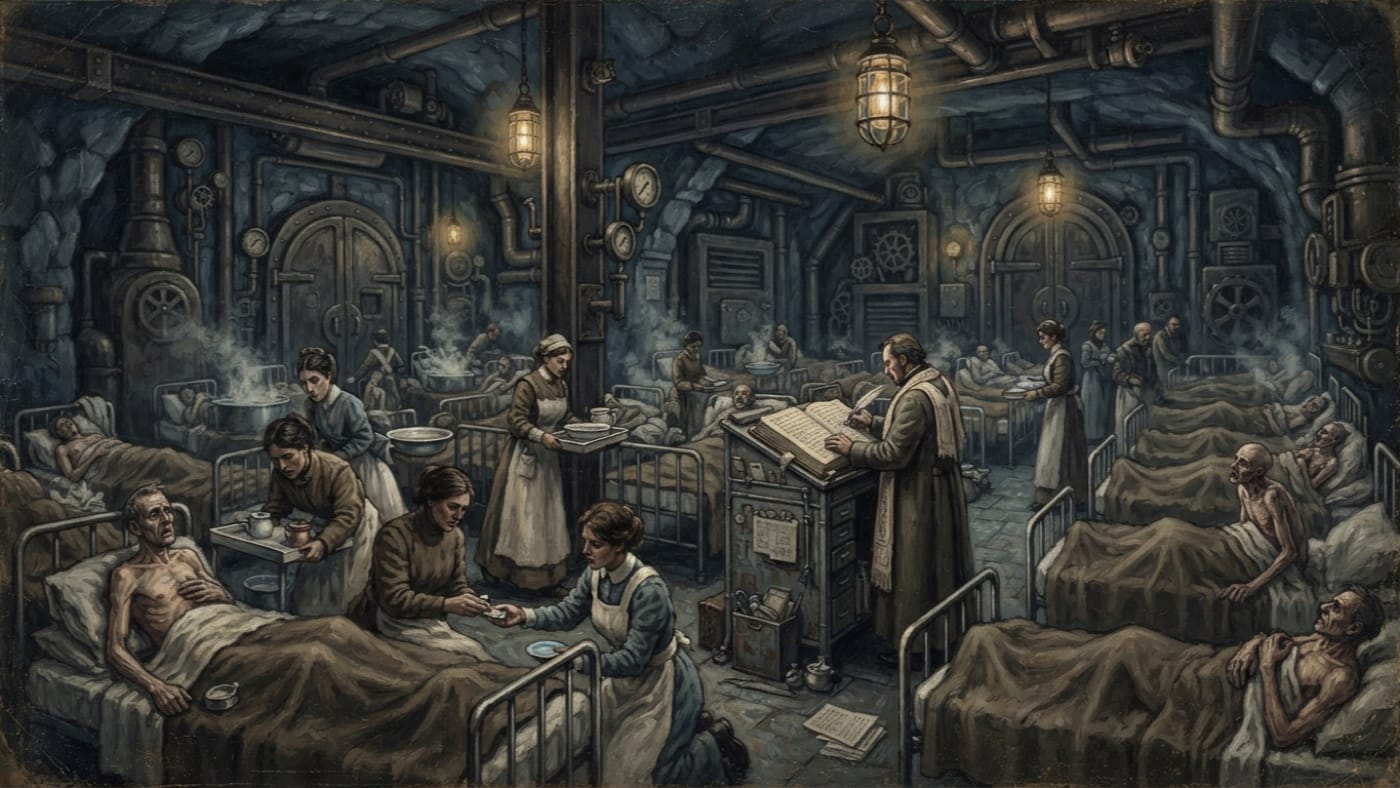
Ward Seven is a lung clinic in the Breatheries of Bastion-Irongate. It lies beyond the Choir Nave and the Valve Quarter, inside a fortress cut into the Iron Gates gorge that must be sung to every hour if it is to stay standing. The ward smells of bleach and mint. The bleach goes on the linen, the basins and the flags of the floor. The mint is ground into paste and smeared under the noses of the patients, so that a man drowning slowly in his own chest may at least do it in agreeable air. Visitors notice the mint first. Within a week the nurses no longer smell it. Patients say they can still taste it after discharge, in the cases where discharge comes.
The number distinguishes nothing. The Church keeps Ward Sevens the way it keeps ledgers, in quantity and under no supervision. The one at the Ember-Priory of San Vesta is experimental and answers to Sister-Physic Marra Vell. Its methods, its recoveries and its oddities belong to another file, and nothing in them should be carried a thousand miles east to explain this one. Irongate's Ward Seven runs no experiments. It receives the sick.
Records has not supplied its founding year, its commissioning office, its bed count or a plan of its walls. I will not invent them. A ward that cannot be measured has been spared at least one indignity.
#On the Breath Entered in the Register
To see why a cough in Irongate is an administrative event, the reader must know what the mountain demands. After the Great Hush of A.S. 94 the Gasket Choir stopped being a labour detail and became part of the structure. Calibrated chant holds gaskets in their seats and keeps pressure doors shut tight. The danger is real. If the singing stops, the stone moves. Three thousand dead in the Third Lung settled that matter, and I will hear no sophistry against it.
After A.S. 97 the danger was given a fee schedule. The Choir Magistracy grades throats under the voice-license regime. The tier decides warmth, ration, bunk hours and the right to remain inside at all. The Breath Office issues permits and quarantine clearances. At the Intake Gateworks it administers the candle test: a flame held at arm's length, the applicant exhaling against it, a clerk timing how long the flame stays bent. It is a breath assessment, and only that. It does not name a disease or find one. It records whether a chest can still do the work the mountain sets it.
So a worker whose lungs begin to fail loses two things in the same season. His body loses air. His file loses value. One costs him sleep and the other costs him his bunk.
Not every patient follows the same road through the ward. Some are treated and sent back to the pits with a lozenge ration and orders to rest. Some are held under quarantine. Some go before licence review while still too weak to sit up. The order varies with the season, the clerk and the pressure readings. All of them end in the same register.
#On the Outbreaks of A.S. 199
The lung-rot outbreaks of A.S. 199 (1909 CE) filled Ward Seven. That is the whole of the official record, and the official record is correct in the way a gravestone is correct.
What the ward experienced in that year can be reconstructed from its effects without inventing a single corpse. The candle test failed men by the dozen. Each failure sent a body somewhere, and the Breatheries were the nearest somewhere with a roof. Beds that had stood an arm's width apart closed up until a nurse had to turn sideways to pass between them. Linen went to the boiling tubs faster than the boiling tubs could return it. The bleachers worked through rest bells, through meal bells and through the bells that told them to stop. The mint was ground thinner, then cut with salt, then given out by the fingertip.
I make no claim about the cause of lung-rot. The Codex has seen enough confident theories of contagion written by men who never sat beside a basin. What the outbreaks established is narrower. Ward Seven's capacity was finite, and the fortress's supply of failing lungs was not.
The Breath Office responded as offices respond, with paper and then with stone. Discharge certificates were issued. Some workers took them and walked out toward the Carpathian winter with a stamped page in their pockets and no warm place left to them inside. More paid to go below. The answer in stone was Ward Eight, cut into the rock behind the Third Lung to take the overflow the Seventh could not hold.
This Codex's entry on the Underchord Cartel states that, following the outbreaks of A.S. 199, Ward Eight "was carved" behind the Third Lung.
Qualified. The past tense records the decision to dig and the start of the digging. It certifies no finished relief. The Codex's own survey of the Transit Spine reports Ward Eight still being cut in A.S. 201. The Seventh has not yet been relieved by anything.
#On the Names That Leave the Ward
The dedicated lore records a false patient registry at Ward Seven. I can confirm that it exists. I cannot confirm who made it.
Its effects are easier to describe than its author. A name in the register does not match the body in the bed. A bed in the ward has no name in the register. A patient marked as held is not in the room, and a patient marked as released never passed the desk. Each discrepancy has a beneficiary, since nobody forges a ledger for the pleasure of the penmanship. The Codex has not established who benefits.
There is a long list of candidates. The Shaft Priory works the Breatheries and the emergency galleries and is known to keep false records in order to shelter the unlicensed. A Breath Office clerk holds a seal and has a family. A family holds gasket-rings and a grievance. Some functionary prefers an orderly column to an accurate one. Each of these could have written into a register. None is proved to have written into this one. Purity would pick a suspect by the end of the week. I prefer to hold the question open.
The surer road out runs underground. The Underchord Cartel sells quiet passes through the upper and middle Underchords, including a published route from the Breatheries to the Transit Spine. Twelve rings will buy it in a decent week, if the route keeps away from the Dead Gallery. It sells oxygen bulbs by the breath-count, and their price climbs after every lung-rot notice. Nothing places a private hatch in Ward Seven's wall. The route starts in the Breatheries, and the patient must first get himself from his bed to wherever it begins. When the outbreaks struck the Cartel lowered no prices out of pity. It is a business, and it collects its fees from the dying as calmly as from the merely frightened.
A patient who buys a pass has bought a route. He has not taken up a creed. The Counterkey Circle recruits among discarded singers, and Purity would like the two transactions filed together because one file is cheaper than two. They are separate. A man paying for air has joined no heresy. He has made a purchase, and in Irongate a purchase is the most orthodox act left to him.
#On the Present Condition
In A.S. 201, Ward Seven is full.
The Transit Spine survey reports it in three words, and three words are all the report needs. Ward Eight is still being cut behind the Third Lung by crews whose own breath scores argue against the work. Healthy voices are scarce in the Gasket Choir. Every throat the ward fails to return is a throat the chant pits do without. Cantor Ys Varr is tightening the licence audits. Commandant Sorn keeps his denial authority and his uniform. The candle still bends at Intake, and the clerk still times it.
Below, the pipes still tap. Patients still pay in rings, and the bleachers still boil the linen. The mint is still rationed. Somewhere in the register a name still does not match the bed.
The fortress needs the ward to heal what it can, to hold what it must, and to keep its papers in order while the mountain goes on demanding breath that the ward's patients no longer have. Ward Seven does the first two badly and with great effort. It has never managed the third.