
#On the Chamber Beside the Wound
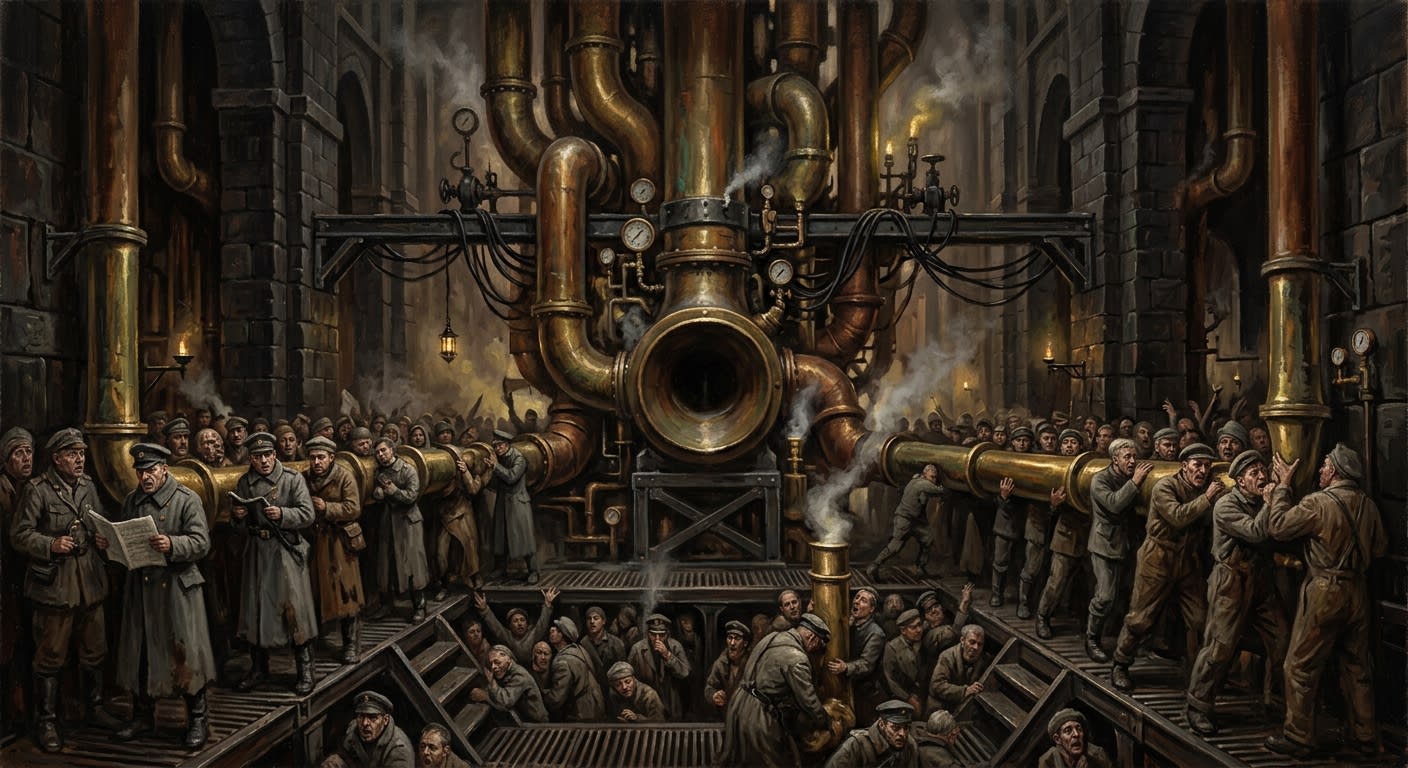
The Choir Nave of Bastion-Irongate is a cathedral with no altar, unless one counts the pressure gauge, which the practical faithful have counted for worse reasons.
It stands beside the sealed ruin of the Third Lung, close enough that dust from the old collapse still powders the rear baffle stairs whenever the mountain coughs. After the Great Hush of A.S. 94 killed three thousand and taught the Synod that silence could be load-bearing murder, the engineers wanted a reinforcement chamber. The Bureau of Bells wanted an acoustic testing hall. Doctrine wanted a visible answer to a buried scandal. The garrison wanted sleep. They received the Choir Nave, which satisfied none of these desires cleanly and became permanent for that very reason.
Black basalt forms its walls. Brass baffles climb them in stacked ribs, each plate angled by a degree the Bureau of Engineering can justify, the Bureau of Bells can hear, and the workers can suffer. Catwalks cross the upper reaches. Candle cages hang behind wire mesh so a falling flame cannot become a theological incident. Gauge boards face the central pits. Sound channels run out from the chamber like veins through rock, carrying human voice into gasket housings, pressure doors, valve seats, iron ribs, ventilation throats, and other places where matter must be persuaded to remain orderly.
The Nave is usually described as the acoustic heart of Irongate. Hearts are sentimental organs. The Nave is less tender: a throat, a courtroom, a foundry for obedience, a machine that uses breath as fuel and fear as lubricant. Its official designation places it under the Gasket Choir apparatus. Its practical authority belongs to the Choir Magistracy, which sits at the gaugeward end and turns vocal failure into civic arithmetic.
A stranger entering at Second Watch first feels damp heat, then brass smell, then the pressure of a thousand disciplined throats striking the same note under different instructions. The note is not beautiful in the sentimental sense. Beauty that has worked an eight-hour shift stops flattering the listener. The sound presses against the teeth. It makes loose buttons tremble. It sends old dust walking down seams in the wall. It passes through bone and, if the visitor has any administrative sensitivity, through conscience.
#On the Building of the Throat
The earliest plans called the chamber Reinforcement Hall Three. This name died in the usual way: soldiers mocked it, workers shortened it, chaplains blessed the shorter form, and Records arrived late with an obsolete stamp. By A.S. 96 the phrase Choir Nave appears in maintenance slips. By A.S. 97 the Magistracy used it in a licensing order. By A.S. 101 no clerk with survival instinct wrote Reinforcement Hall Three except in archival headings.
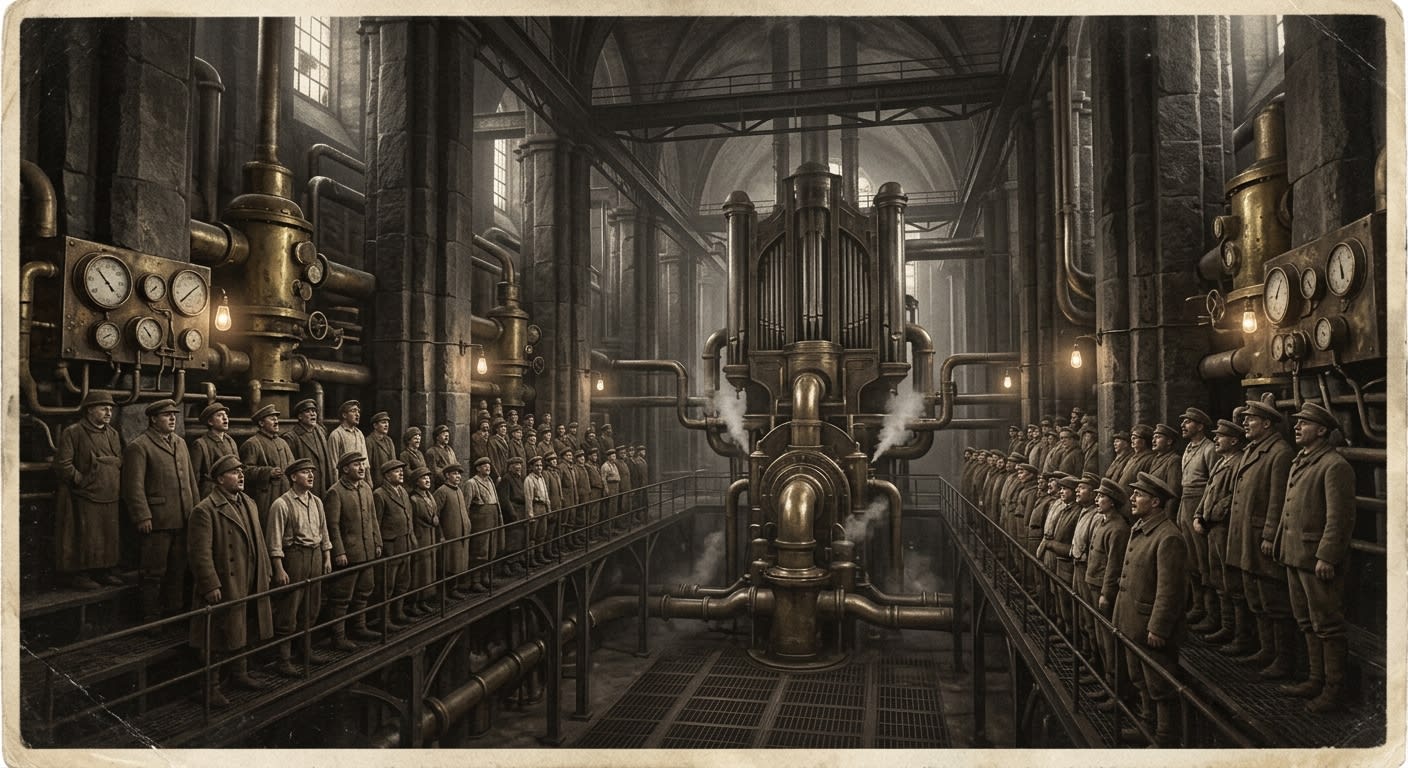
The first excavation crews cut into basalt still wet with rescue work. This was not symbolic. The mountain offered few safe volumes near the Transit Spine, and the wound of the Third Lung had already made space in the ledgers if not in the stone. Engineers bored outward from the collapse margin, careful to avoid pockets where buried air still thumped in measures no one wished to interpret. The work crews found bunks crushed into planks, helmet rims, a child's wooden prayer counter, nineteen bread carts flattened into a single devotional object, and a choir stool driven six inches into basalt by pressure. The stool was sent to Strasbourg. It has since been mislaid, which is the Bureau's gentlest form of denial.
The first baffles were bad. Of course they were bad. Every first instrument made after a catastrophe is part tool, part apology, part panic given screws. The A.S. 95 pattern threw too much sound into the upper channels and left the lower gasket runs hungry. Singers fainted from backwash. Candles bent inward. Gate Two seals complained in subsonic pulses that made teeth ache. The A.S. 96 revision added side fins, removed three upper plates, widened the central pits, and introduced the first marked voice stations. The A.S. 97 revision placed the magistrates' benches facing the gauges rather than the singers, an architectural confession so perfect I envy the anonymous coward who drew it.
The Bureau of Engineering's commemorative plate states that the Choir Nave was “raised in orderly confidence after the lessons of the Great Hush.”
Corrected. It was cut in haste, revised in fear, argued over by men with stone dust in their cuffs, and made orderly later by clerks who had not heard the knocking.
The chamber acquired its present form after the Cadence Revisions of A.S. 112 (Unregistered), when Bell analysts proved that the original central pit pattern forced altos into destructive interference during damp east wind. Eighty-three workers had already lost tier status for failures produced by the room rather than the throat. The Magistracy restored twelve licenses posthumously, which is an economical mercy: the dead cannot claim heat.
By A.S. 134 the Nave had five principal chant pits, three Warden aisles, two gauge galleries, a sealed hymn page vault, an upper listening walk for Bells, a lower service crawl for baffle mechanics, and the alcoves that everyone knew existed before the records admitted them. By A.S. 164 the Seal Standardisation Edict required hymn-gasket compatibility markings at each sound throat. By A.S. 200 one eastern wall alcove was found to contain counterkey notation older than the official notation that allegedly made counterkey heresy possible. The alcove, naturally, contained nothing. I have read the report. Nothing is rarely so well described.
#On the Pits, Baffles, and Gauges
The Nave's five chant pits correspond to the five great Lung functions of the Irongate complex: dormitory pressure, infirmary draw, foundry exhaust, transit surge, and the Third Lung mourning tone, which feeds the sealed ruin and keeps old masonry from joining the living fortress at speed. Each pit is sunk knee-deep below the walking floor, not for acoustics alone, though the acoustics benefit. A worker below floor level can be watched from every direction. Humility, like resonance, improves under containment.
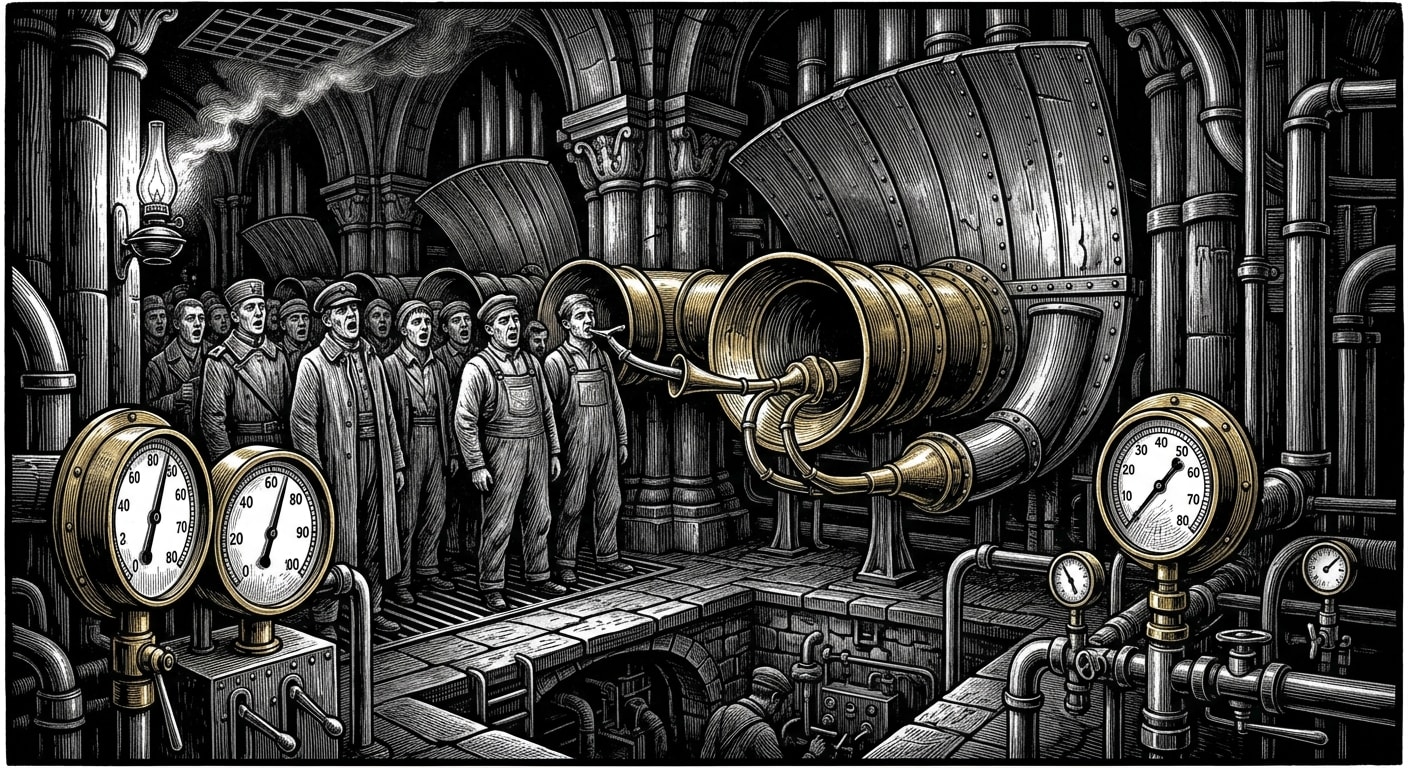
The First Pit handles baseline chamber hum. Its singers are second-tier and third-tier workers, mostly young, mostly frightened, still capable of mistaking endurance for career. The Second Pit carries higher corrective lines during weather shifts. The Third Pit belongs to heavy voices, basso men and contralto women whose notes sit in the ribs like hammered nails. The Fourth Pit is reserved for emergency overpressure, convoy surge, and valve replacement support. The Fifth, closest to the sealed wall, sings to the dead.
No one likes the Fifth Pit. The air there tastes of mineral damp and old bread. Its gauges lag by a fraction of a breath. Its notes must be held lower than comfort and longer than dignity. Workers assigned there report hearing response-tones after shift: taps from behind masonry, a distant chair scrape, a child's cough, measures of seven, eleven, thirteen. Bells calls these sympathetic artefacts. Doctrine calls them temptation. The workers call them the other choir and do not say the phrase when Wardens are near.
FIFTH PIT INCIDENT NOTE — A.S. 199 Third Watch, mourning tone. All assigned singers present. Gauge stable. Unauthorized lower harmony entered at measure thirteen. No visible source. Two workers wept without breaking note. One Warden ordered cessation and was countermanded by Cantor Varr. After shift, thirteen names appeared in condensation on the sealed wall. Records confirms nine were among the Great Hush dead. Four are not yet born.
Above the pits hang the baffles: brass plates, ribbed horns, angled resonators, pressure vanes, and listening fins polished by condensation and the hands of Gasket-Hymn Mechanics. The plates are tuned by hammer, heat, and curse. A quarter-inch drift in a baffle angle can shift sound from a useful seal to a sleeping dormitory, producing headaches, cracked plaster, or mass confession depending on frequency. The workers know which baffles are kind. Baffle Twelve gives back warmth. Baffle Nineteen strips saliva from the mouth. Baffle Four on the east wall has acquired an unofficial saint, no doubt because men prefer blaming saints to blaming maintenance.
The gauge boards are less dramatic and more tyrannical. Each needle corresponds to a chamber, a seal cluster, a pressure door, a gasket run, or a resonance channel. The board does not show men. This is its power. A failing voice becomes a falling number. A cracked throat becomes drift. A collapse becomes variance until the dust arrives. The magistrates read these boards with the reverence provincial priests reserve for relic bones. Unlike relic bones, the boards answer.
#On the Human Arrangement
The Nave eats people in schedules.
A full ordinary watch places between eight hundred and twelve hundred voices in rotation through the chamber, depending on pressure weather, convoy movement, illness, punishment, and whether the Underchords have stolen enough hymn pages to frighten the Warm Bench into extra bodies. Three watches turn daily. Emergency doubles are common. Punitive extensions are less common than rumour claims and more common than compassion permits. The public number is always lower. Public numbers are moral cosmetics applied to arithmetic.
Workers enter by voice tier. Second-tier singers take baseline lines under Warden supervision. Third-tier singers carry corrective sequences. Fourth-tier voices are chamber assets and treated with the jealous care one gives expensive livestock. Fifth-tier supervisors stand on raised stones at the pit corners, conducting with rods of dark ash tipped in brass. Master Cantors rarely sing. They listen, correct, and preserve their throats for the blessed labour of judging other throats defective.
The Nave's day begins before dawn with wet cloths over the baffles and candle tests at the side doors. Singers pass through the Breath Office wicket. A clerk watches flame bend, counts seconds, marks the card, and pretends the flame has not become a small portable tribunal. Those whose candles fail are diverted: Breatheries, retest, heat review, or Hush inquiry. Those who pass take salt, water, a lozenge if their tier earns one, and the page assigned to their pit. The page is not owned. The page is borrowed under threat.
Inside the pit, rank becomes geometry. Chalk marks designate stance. Heel to crescent. Left shoulder toward gauge. Mouth open on signal. No private ornaments above the collar. No throat wraps except licensed cloth. No whispering between measures. No crossing pit lines without Warden permission. No looking up toward the Bell gallery during classified tests. No answering if a voice from the sealed wall calls a childhood name. That rule came late, which means it came from an incident.
Singers learn each other's failures with obscene intimacy. Who coughs at measure eight. Who sags after convoy surge. Who drinks too little to avoid latrine breaks and then faints in Fifth. Who hides blood in the sleeve. Who covers a wife's cracked note by widening his own. Who reports the cover. Who is rewarded for reporting. The Nave breeds loyalty and betrayal from the same breath. A man cannot hold a line alone. A man also cannot survive if the weak voice beside him drags the gauge down and the Warden sees kinship where he should see deviation.
Marriages form by overlap. Friendships form by shared lozenges. Hatreds form by pitch correction. Children of Nave families play at audit with candle stubs and cruel accuracy. Old singers, when their voices go, sit outside the side doors and mouth measures from memory until a Warden moves them along. The Nave has no patience for ghosts unless the ghosts are load-bearing.
#On the Magistrates' End of the Room
The magistrates sit at the gaugeward end beneath a shallow arch called the Warm Brow, because pipes run through the wall behind it and no acoustic principle has yet required their removal. Their benches are raised three steps above the floor. Three steps are enough. Tyranny need not climb a tower when damp workers are already in pits.
Cantor Ys Varr's chair stands slightly behind the central board, angled so she can watch both gauges and mouths by turning only her eyes. She is not theatrical. This is why she frightens better than theatrical women. A theatrical judge spends force on display. Varr saves hers for the verdict. She hears late entries, false vibrato, fear breath, pity cover, Underchord tap habits disguised as cough, and that smallest slippage by which a worker begins singing for another worker rather than for the gauge.
The magistrates' table holds pitch forks, page seals, heat slips, throat inspection hooks, a small iron sandglass for sustained notes, three ledgers, and a covered brass bell no one rings without authority. The bell is not for summoning. It is for stopping. One strike ends all sanctioned sound in the Nave for the length of one breath. Used during audit, it exposes unauthorised resonance: hidden humming, wall responses, sympathetic vibration, forbidden intervals riding under the official line. The first time a novice hears the Stop Bell (Unregistered) he often smiles at the relief. By the second time he understands that relief is evidence.
A visitors' guide prepared for rear-zone donors states that the Choir Magistrates “conduct the faithful in holy song.”
Corrected. They do not conduct the faithful. They audit pressure by means of frightened labour. The holy song is a useful costume worn by the apparatus when donors are present.
Behind the benches lies the hymn page vault, a dry chamber with double seals and a guard who is chosen for poor musical memory. Pages enter and leave under count. Revisions are read aloud to Wardens only, never to full crews, lest workers learn how often the official note changes. Recalled pages are burned, pulped, or sent to Bells for comparison. A few vanish. They always vanish before scandals. The Underchords pays well for a page whose ink is still wet with authority.
The Magistracy's discipline is more tonal than physical inside the Nave. A bad beating can damage a useful voice, and useful voices are property wearing skin. Shame does less immediate harm. A worker who fails publicly is made to repeat the cracked measure alone while the pit stands silent. A worker who hides blood is moved to a colder line. A worker suspected of pity cover is separated from kin. A worker caught listening to the wall is reassigned to Fifth, which is either punishment or an invitation, depending on which theology currently has the better whisper.
#On Hidden Sound and Counterkey Contagion
The Choir Nave is the most watched chamber in Irongate, which makes it the chamber most attractive to heresy. The amateur imagines secrecy requires darkness. The professional knows that a secret placed under too much supervision can hide in the supervisors' fatigue.
The Counterkey Circle covets the Nave because its official notes are strongest there and because the old stone behind the baffles remembers earlier instructions. The Circle's claim that the Magistracy's harmonics are suboptimal would remain cellar theology if no one could hear the difference at the source. In the Nave, difference has teeth. A non-standard interval can make Gauge Six steady when the official page says it should flutter. A forbidden lower line can seat a gasket faster during damp wind. A worker can learn, in one dangerous second, that the page may be wrong.
The Hidden Alcove behind east baffle bank four proved this. The maintenance crew found fresh gasket-grease notation over older scored marks, both pointing toward frequencies the Circle calls original keys and the Magistracy calls actionable contamination. The alcove's existence implied a pre-Magistracy acoustic practice inside the Nave wall. The old marks implied the first builders knew more than the present page admits. The fresh grease implied someone from below had reached the chamber's sanctum. The official report implied nothing, at admirable length.
Since A.S. 200 the Nave has operated under Counterkey precautions. Wardens inspect baffle seams with mirrored rods, though Mirror Discipline requires the mirrors be warped and small. Page Custodians test ink under heat for hidden grease notation. Singers assigned to east-wall pits rotate faster than before. No worker may clean behind baffle four twice in a month. Bells analysts are permitted to observe but not touch. Engineering may touch but not interpret. Doctrine may interpret without touching, which is the closest my Bureau comes to exercise.
The precautions have not stopped contamination. They have made it clever. Counterkey marks appear as cleaning scratches, throat-remedy smears, boot scuffs, condensation trails, children's chalk games copied from memory and misunderstood until a gauge twitches. One Warden found a forbidden interval encoded in the spacing of candle cages. Another found it in a laundry tally. A third claimed to hear it in the way Third Pit coughed between measures and was mocked until the cough pattern reseated a fluttering seal.
COUNTERKEY PRECAUTION FILE — NAVE / EAST WALL A.S. 201 inspection. Baffle Four removed under guard. Old alcove seal intact. Interior empty. Fresh notation found on reverse side of replacement plate. Material: gasket grease and human saliva. Phrase decoded by Bells: “You moved the wall. You did not move the note.” Disposition: plate melted; crew separated; Varr retained copy.
The Circle does not need to seize the Nave. It needs the Nave to doubt itself. A choir that wonders whether the page is wrong is still capable of singing, but every note becomes an argument conducted through flesh.
#On My Inspection of the Nave
I inspected the Choir Nave during a river-fog morning, which is the correct time to see any institution that claims certainty. Fog presses questions against stone.
The entry wicket displeased me immediately. Too narrow, too damp, and too honest about hierarchy. Workers entered through the low arch after candle test. Wardens entered through the side door. Magistrates entered dry. A building reveals its doctrine through thresholds, and this one spoke with admirable vulgarity: bend if you labour, stride if you judge.
Inside, the sound took my hat. Not physically. I am not a provincial. It pressed the brim against my skull with such force that I removed the thing voluntarily, which is worse. The First Pit held a baseline hum. The Third Pit came in under it like a verdict. The Fifth Pit made the sealed wall answer in dust. On the gauge board, seven needles trembled. Varr watched the fourth.
A girl in Second Pit faltered at measure nine. Not much. Half a breath. Her neighbour widened to cover. A Warden heard. Varr raised two fingers. The Warden did not interrupt until the line completed. This impressed me. Bad tyrants waste structure to display authority. Good ones let the pressure hold before ruining lives. After the measure, the girl was marked for retest, the neighbour for pity cover, and the pit for correction drill. The gauge did not move. The paperwork did.
I walked the lower service crawl with a baffle mechanic named Odrin Pell (Unregistered), who had three fingers on his left hand, no eyebrows, and the resigned contempt of a man whose work preserves the authority that underpays him. He tapped plates with a felt hammer and named their temper: sour, fat, hungry, lying, proud. Baffle Seventeen, he said, had developed a saint's ear. Baffle Twenty-One wanted heat. Baffle Four he refused to discuss until I mentioned that refusal before a Hieromnemon is also discussion. Then he said: “Baffle Four remembers.” A useful sentence. I stole it.
At the Warm Brow, Varr offered tea and no apology for the temperature. Her office pipe clicked behind the bench. I asked whether the Nave could function with fewer voices under corrected harmonics. She looked at the gauge board for just long enough to commit treason privately. Then she answered that the authorised harmonics function. This is a bureaucrat's reply: confession with armour on.
Before I left, the Stop Bell rang for a classified test. One breath of silence crossed the chamber. I heard water. I heard my own pulse. I heard, from the sealed wall, three taps, then five, then a pause that shaped itself like expectation. The singers heard it too. No one moved. Varr smiled without pleasure and ordered Third Watch to resume.
The official note returned. The hidden one did not depart.
#On the Present Condition
As of A.S. 201, the Choir Nave remains operational, crowded, damp, overburdened, surveilled, and indispensable. The three-watch structure holds. Emergency doubles rise during pressure weather. Ice-lung (Unregistered) has thinned the pool of reliable fourth-tier voices. The Breatheries receive more names than they release. Page custody has tightened since the Hidden Alcove. Counterkey suspicion has made every cough a possible sentence. The sealed wall has not opened. The Third Lung remains sealed. The mountain continues to accept song in lieu of apology.
The Bureau of Bells wants longer access for Commission work and fewer Warm Bench interruptions. Engineering wants permission to replace east-wall baffles without doctrinal witnesses, which is a charming request from men who once called the Great Hush adverse weather. The Bureau of Purity wants expanded authority to question whole pits after drift events. The Magistracy wants more Wardens, more lozenges for useful voices, fewer auditors from Strasbourg, and absolute control of all cleaning crews. The workers want dry socks, warm broth, truthful pages, and a world in which breathing badly is not construed as treason.
Recent donor correspondence from the Western Heartlands praised the Choir Nave as “the Synod's great musical answer to despair.”
Corrected. Despair asked no question. The mountain did. The answer is labour, brass, fear, and a note held until the throat tears.
Still, the Nave does its work. Gate One compression holds. Transit surge can be ridden through most convoy passages. Fifth Pit mourning tone keeps the sealed ruin from becoming a fresh collapse. The garrison sleeps in hour-rented bunks because other people stand in pits and lend their throats to stone. This is the Nave's defence. It is also the indictment. The finest machinery of Order always arranges matters so that condemning it sounds like wishing everyone dead.
At Third Watch the baffles sweat. A Warden chalks stance marks that will be scuffed away by boots before dawn. A singer hides blood under her tongue until the measure ends. Gauge Four trembles and steadies. Behind east baffle four, where nothing was found, no mark remains. The absence has edges.
The next note is struck.
A visitor may leave the chamber and imagine the sound ends behind him. It does not. The Nave exports itself through the whole fortress. In the Intake Gateworks the note trembles in permit glass. In the Breatheries it sits under coughs like a second pulse. In the Valve Quarter it mingles with hammer fall until the mechanics strike in time without meaning to. Even the Underchord Cartel times certain tap-codes against the official watches, because rebellion, too, appreciates a reliable clock.
This is the chamber's quiet triumph. It sustains the mountain, then teaches everyone inside the mountain to measure life by its intervals. Work begins at pitch. Meals arrive between measures. Punishment waits for cadence. Sleep fits wherever the note leaves a crack. The Choir Nave is a room; the Choir Nave is also the hour by which Irongate knows it has not yet been buried.