
#On the Crime of Having No Error to Correct
I have nothing to confess. — Arno Kett, Quai des Bateliers, A.S. 138
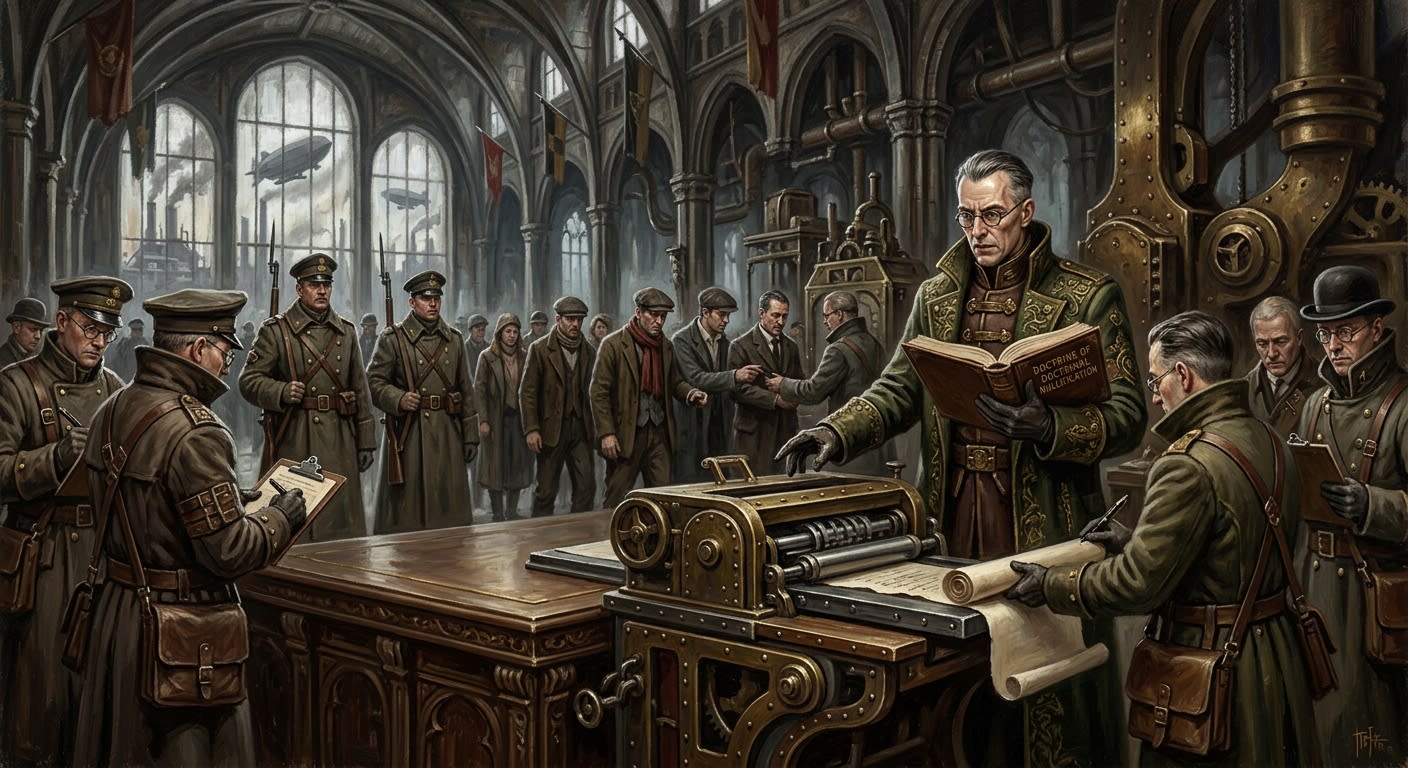
Doctrinal Nullification is the legal doctrine by which the Bureau of Purity learned to convict absence of belief as active injury. It was drafted in A.S. 138 for the prosecution of Arno Kett, the seminary dropout, print-shop apprentice, left-handed nuisance, and founder of the first verifiable Silent Godless cells. Existing heresy law had a problem with him. Heresy wanted a false article, rival creed, illicit saint, bad hymn, demon-compact, disputed sacrament, or some other object upon which the law could place its boot. Kett offered vacancy.
Vacancy, properly charged, can hang.
The charge required four months to draft because the older instruments of correction were too honest for the task. Apostasy implied a prior faith abandoned. Blasphemy implied a sacred object insulted. Heresy implied doctrine mischosen. Treason implied allegiance transferred. Kett’s position was fouler. Doctrine itself, he taught, was the disease. The law had to find a way to accuse a man of killing a body he refused to acknowledge existed.
#On the Four-Month Drafting
The drafting committee met in a sealed room above the Strasbourg Purity court, with two Doctrine consultants, one Records examiner, three canon lawyers, a clerk from Masks and Seals to authenticate every scratch of panic, and a Mercy observer who was dismissed after asking whether a man could be punished for lacking what the Synod had failed to preserve in him. Her name does not appear in the final minutes. This is how one knows she existed.
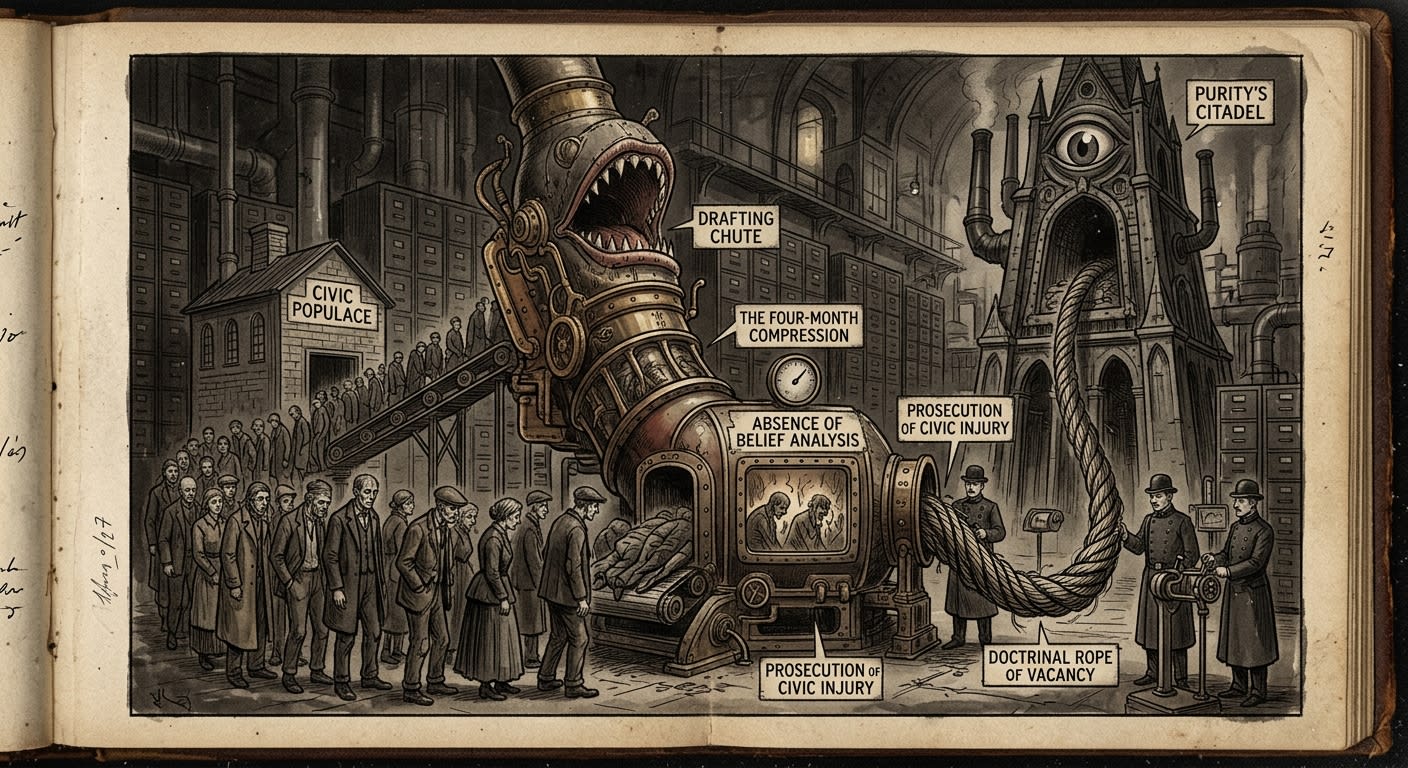
They began by trying to stretch apostasy. It tore. They tried contumacy. Too narrow. Sedition. Too political. Spiritual sabotage. Too pretty and insufficiently fatal. They tried “atheistic contagion,” an ugly phrase with good shoulders, but it required proof that unbelief moved like illness and no Bureau wished to let doctors near metaphysics. Doctors measure. Measurement is a swamp where theology has drowned better boots.
Doctrinal Nullification arrived on the forty-ninth draft.
The winning formulation was elegant in the way a trap is elegant: belief, within Synod law, belongs to civic infrastructure. The citizen’s faith supports oaths, tithes, levies, testimony, marriage, burial, confession, ration discipline, bell compliance, and the thousand small obediences by which civilisation keeps its hat on. To teach that doctrine itself is void is to damage the instrument that makes public order possible. Absence becomes action. Silence becomes assault. Refusal becomes demolition.
DRAFT 49 — EXCERPT, SEALED CANONICAL MEMORANDUM Where an accused does not hold, preach, imply, circulate, honour, imitate, counterfeit, or confess a contrary doctrine, yet by instruction, question, arithmetic, example, or organised absence renders doctrine inoperative in another subject, such accused shall be deemed to have committed ████████████████ against the doctrinal capacity of the Faithful. Margin hand, unattributed: “At last, a hook.”
#On Kett as the Necessary Body
Law prefers a body. The idea may be everywhere; the defendant must sit somewhere. Lutz Brennan supplied that mercy to the Bureau in spring A.S. 138 when he confessed to a parish priest, returned to Kett’s cell smiling too brightly, and asked to hear everything again. Kett recognised the smile. He burned papers, dismissed the cell, and walked to the Purity district office on the Quai des Bateliers.
This remains the most irritating act of procedural cooperation in heretical history. He deprived Purity of a chase, deprived Doctrine of a dramatic capture, deprived Records of a decent arrest map, and made the Bureau keep an appointment. He sat forty minutes. He announced himself. He said he wanted to confess that he had nothing to confess. The sentence entered the room like a rat in vestments.
His interrogation lasted nine days. The surviving log is sealed, damaged, recovered in A.S. 194, re-sealed, excerpted, disputed, and scented with the mildew of embarrassed importance. It records tears in the final hour, three requests for water, and a recitation identified by the attending priest as “a prayer, or a habit shaped like one.” The charge did not require Kett to die in rhetorical perfection. It required him to make absence prosecutable. He obliged.
#On the Juridical Trick
The trick is simple enough for a magistrate and cruel enough for a theologian. Doctrinal Nullification treats the destruction of receptivity as an offence distinct from the teaching of error. The heretic who says worship this can be tried for misdirected worship. The Nullifier says stop needing worship, and the law must punish the emptied hand rather than the forbidden idol.
That is why Kett frightened the legal offices. A rival creed can be indexed. A demon cult can be infiltrated. A false relic can be seized, tested, denounced, melted, and put in a box labelled instructive. The Silent Godless left no idol on the table. They removed the table and asked who had been charging rent.
An A.S. 139 public circular described Doctrinal Nullification as “standard heresy law applied to a novel faction.”
Withdrawn. Standard heresy law failed. The Kett proceeding required a new charge because the defendant’s crime was the refusal of the category by which crimes of belief had previously been counted.
The charge defines doctrine as civic organ. Injure that organ and the body politic bleeds. Convince a tithe clerk that no divine witness watches his arithmetic, and you have injured tithes. Teach a bell attendant to hear only bronze, and you have injured bells. Persuade a levy mother that no altar receives her son’s death, and you have injured war. The injury need not produce riot. The law prefers earlier meat.
This is the part citizens should admire. The Synod no longer waits for disbelief to become disobedience. It convicts the amputation of reverence before the limb is missed.
#On the Problem of Evidence
Evidence in a Nullification case is a pig with ink on it: hard to hold, noisy when cornered, and likely to disgrace everyone’s boots. The accused may possess no pamphlets, no forbidden icons, no demon marks, no Rationalist tract, no alternative liturgy. He may possess questions. He may possess corrected figures. He may possess a habit of silence in rooms where hymns are compulsory. He may possess, worst of all, pupils who now answer sermons with arithmetic.
Purity developed evidentiary clusters: repeated questions without declared doctrine; recruitment by doubt rather than assertion; correction of Bureau figures in private circles; refusal to supply replacement consolation; patterns of bell absence among associates; testimony that the accused “made faith feel like a procedure”; and the famous Kett phrase, copied badly by amateurs, When the bell rings, does anything answer?
The Bureau of Records supplies absence maps. The Bureau of Masks and Seals supplies handwriting drift, paper fibres, false rosaries, and ash-ink evidence. The Bureau of Orison and Song supplies hymn compliance collapse. The Bureau of Tithes supplies corrected arithmetic with visible disgust. Doctrine supplies the pronouncement that the cluster is no cluster but a wound.
The last line is the hinge. Absence of idol is not exculpatory. I would have carved it over the courtroom door if Engineering had not objected to load-bearing prophecy.
#On Bureau Debate and Private Disgust
The Bureau of Doctrine approved the charge because Doctrine enjoys victory over categories. Purity approved it because Purity enjoys rope. Records approved it because a new charge creates new forms, and Records is never happier than when sin arrives requiring stationery. Mercy objected in private and was thanked in public for its humane vigilance. Tithes asked whether convictions under the charge interrupted arrears collection. They did, briefly. Tithes recommended posthumous assessment.
There were objections from canonists who still possessed enough intellectual hygiene to be troublesome. If disbelief without rival doctrine could be charged as injury, where did examination end? Could grief be Nullification if it refused prayer? Could fatigue? Could a soldier’s silence after bombardment? Could a widow who stopped kneeling because her knees had swollen beyond charity?
The answer, sealed and never preached, was yes if useful.
Doctrinal Nullification did not make every despairing citizen guilty. That would be administratively vulgar. It made every despairing citizen legible as a potential instrument of guilt. There is a distinction. The distinction has fed several archives.
A pastoral guidance sheet of A.S. 140 assured parish priests that ordinary doubt “falls outside the Nullification framework.”
Clarified. Ordinary doubt falls outside prosecution until it acquires method, witness, repetition, instructional value, or inconvenience to a Bureau with jurisdiction. Parish priests are advised to report patterns rather than souls. Souls are Mercy’s problem. Patterns belong to Purity.
#On Later Use
After Kett’s execution, the Silent Godless were formally catalogued as the Fourth Proscribed Heresy. The charge remained. It proved useful because it moved faster than older heresy categories and dirtier than sedition. A cell need not call for rebellion. It need only train citizens to experience obedience without reverence. The law calls this nullifying the doctrinal capacity of the Faithful. I call it teaching the animal to notice the leash.
The Great Inquest of Names in A.S. 173 relied on the Kett precedent whenever Purity lacked a rival creed to display. Three hundred and twelve organisers were erased, immured, or forced to confess. Forty per cent of the Rhine corridor structure broke. The surviving cells reconstituted within eighteen months, of course, because enemies persist in being educational after one has spent good money destroying them.
By A.S. 180, Nullification had migrated into counter-cell manuals. By A.S. 197, it was paired with consolation-denial indicators tied to Null Catechists. By A.S. 201, it had become ordinary enough for junior prosecutors to mishandle, which is the fate of every elegant cruelty once bureaucracy adopts it. The first blade is honed. The tenth is issued to a nephew.
#On Its Theological Consequence
The doctrine’s true achievement reaches past law into metaphysical theft. By criminalising the absence of belief, the Synod affirmed that belief is public property. Your faith is not yours. It is a load-bearing civic asset, inspected by priests, taxed by offices, protected by Purity, measured by Bells, sung over by Orison, and corrected by Doctrine whenever private thought develops mould.
This is splendid government and alarming theology. Naturally, we filed it under government.
The Silent Godless understand the charge perfectly. Their Burnwrights forge around it. Their Skein-Organisers train recruits to avoid its evidentiary mouth. Their Null Catechists teach pupils to survive the terror of having no sanctioned consolation while refusing the vanity of becoming martyrs to a legal phrase. They do not say Doctrinal Nullification proves them right. They say it proves the Synod knows what they remove.
This is intolerable. It may also be accurate. Accuracy, when found in enemy hands, should be confiscated and reissued with better seals.
The charge endures because it solved the Bureau’s oldest legal embarrassment: how to punish a man who brings no false deity to court.
We bring the Creator for him.