
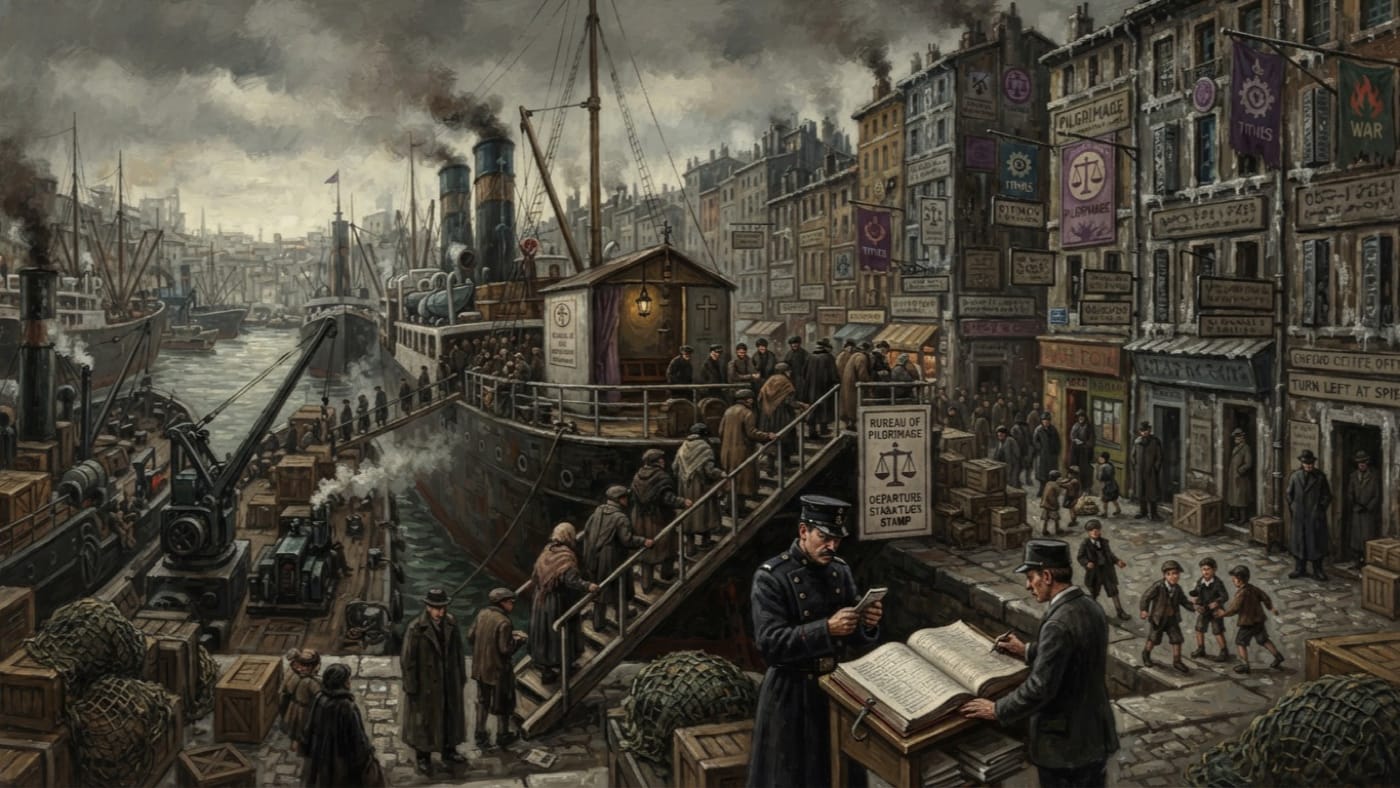
#On the Basin
In Marseille the name "Eastern Basin" means two things at once, as most things there do. First it means the water: the enlarged harbour joined to the Vieux-Port, dredged and walled under a Bureau of Engineering project begun in A.S. 130 and declared complete in A.S. 158. Second, it means the quarter that grew up along those quays. It is one of the four quarters of Marseille, with the Vieux-Port, the Cathedral Quarter and the Canebière. The Bureau of Records has never fixed where the water's jurisdiction ends and the street's begins. I have walked the quays at low tide and at high, and the boundary moves with the sea.
The quarter's work fits in one sentence. It puts pilgrims aboard ships for Thessaloniki and the Aegean shrine circuit, and it takes in goods that need more paper than the pilgrims do. The offices that license both stand between the two traffics, their limestone fronts crusted white with salt to shoulder height. The quays smell of tar, wax and fish, and no quantity of censer smoke has yet removed the fish.
Nobody has counted the basin's residents. Each Bureau assumes the quarter's share of the city's six hundred and fifty thousand is whatever number best supports its next budget request.
#On Boarding
The pilgrim fleet sails from here. Its ships are converted merchantmen, hulls that once carried grain or sulphur and now carry berthing decks and a shipboard chapel. The chapel is usually a partitioned cabin with an unoccupied cross, a hanging lamp and a kneeler worn smooth by people who are mostly seasick. Every ship carries an inspector of the Bureau of Pilgrimage, whose authority aboard is spiritual in theory and total in practice. The Bureau has held the licensed southern routes since the Harmonized Routes Edict of A.S. 123, and the basin is where that monopoly takes its fees.
The permissions must be obtained in order. A document obtained out of sequence is void and must be bought again.
First, pilgrims present their tokens at the foot of the gangway. Each token is checked for its serial number, its wear and the small faults that betray a counterfeit die, and the bearer's name is read against the passenger manifest. Second, the manifest is checked against the Great Ledger of Souls before the anchor is weighed. Every soul aboard is accounted for, which means every soul aboard can be taxed on return. Third, the vessel needs the Bureau's departure stamp for Thessaloniki. That stamp is issued to the captain, not the passengers, and it does not care how many tokens are in order. Fourth, any cargo below decks needs an absolution slip valid for the estimated length of the voyage, and not one hour longer.
The absolution slip is where the sums turn cruel. Clerks who do not sail make the estimates in port, in fair weather. When the mistral blows and a crossing runs long, the slip expires at sea. The cargo spoils, by the slip's reckoning at once and by the nose soon after, and on arrival the captain pays a sanctified delay surcharge. Bad weather becomes the captain's fault and the Bureau's income. I have heard captains in the basin taverns pray for following winds with a fervour I would welcome in any seminary.
#On the Jurisdictions
Three Bureaus share the water, and they divide it by what floats on it. Pilgrimage holds the passenger manifests. The Bureau of Tithes assesses cargo. The Bureau of War claims military shipments. Tithes may not open a crate marked for the War without a letter of authority, and in my reading of the files it has never once been granted one. A Tithes assessment and an absolution slip are separate documents, issued at separate desks under separate seals. A merchant who mistakes one for the other pays twice and is lectured once.
The Salt Dues lie over all of this. The Bureau of Tithes imposed them on coastal trade in A.S. 92 as a temporary measure, and they have remained temporary ever since. They fall on the whole harbour, but the basin feels them hardest. Each point of salt duty raises the price of a berth, and the owner passes that price on to the pilgrim along with the cost of the token. Pilgrimage has filed its opposition every year since A.S. 94, and every year Tithes has noted it.
The Harbour-Master sits between the three Bureaus. No filing I am permitted to cite gives a name. All three send instructions, and the Harbour-Master settles them the way a confessional settles sins: by hearing everything, repeating nothing and charging penance at a fixed rate.
The harbour's published figures for A.S. 200 give three hundred and forty deep-draught berths across the Vieux-Port and the Eastern Basin together, more than eight hundred smaller berths, and an estimated 2.8 million metric tons of cargo a year. None of these figures applies to the basin alone. A clerk who quotes them as if they did is preparing a budget request.
The Bureau of Pilgrimage has given the pilgrim fleet's annual departures from this basin as "two hundred and six vessels." That count treated return voyages as departures. The revised figure is approximately one hundred and forty departures a year. It counts sailings, not ships, and says nothing of how many hulls the fleet owns. The Bureau of Tithes argues that if returns are not departures, it must refund the dues it collected on them as departures. The Bureau of Pilgrimage has refused to refund.
UNRESOLVED — Inter-Bureau Arbitration Panel, convened A.S. 199. Ruling: pending.
#On the Trade Behind the Quays
Relic dealers keep stalls and narrow shops in the streets behind the quays, close to the pilgrims who buy on the way out and the sailors who sell on the way in. The main dealers' quarter lies between Saint-Victor and the harbour. The basin's trade is its seaward edge: cheaper, quicker and much less careful about receipts.
Every imported relic is supposed to pass through the southern authentication office of the Bureau of Relics at Quai Saint-Lazare before it is sold or sent on. A Relic Authenticator works like an inquisitor, examining the documents first and the object second. The provenance book is opened and its chain of custody traced back to the shrine of origin. Then the object is handled in white gloves under a hooded lamp, weighed, measured, quarantined and tested for whatever response its category requires. The verdict is graded, the seal applied and the custody book signed, and a porter nails the crate shut for transport.
The seal certifies only that the procedure was followed. Pilgrims in the basin take it to certify a good deal more, and the dealers do not correct them. Some sealed relics do exactly what is claimed for them. Others sit in their glass cases and do nothing at all, which the Bureau records as reverent stillness. Both kinds sell at the same price.
The Demon-Glass Polishers keep their workshops in the eastern harbour district, in and around the basin. Nobody has recorded the exact bounds. Officially the craft does not exist, and demon-glass is condemned material. Even so, lenses ground from it turn up in the rangefinders and scopes the Bureau of War carries to the Line, and the War does not ask where its optics are finished.
The polishers set salvaged fragments in lead and grind and lap them by hand in shuttered rooms. They work inside quiet boxes lined to deaden sound, by lamplight kept as low as the work allows. Lead greys their fingertips, and their eyes object to daylight. After dark a faint violet glow escapes their shutters. The Bureau of Purity does not patrol those streets between vespers and matins. I once asked a Purity sergeant why. The sergeant said the hours were reserved for prayer. I asked whose prayer, and received no answer.
#On the Offices and the Present Condition
The Bureau of Shadows keeps an office in the Eastern Basin that does not officially exist, and every child in the quarter can point to it. "Turn left at the spies" is a standard direction on the quays. The Bureau has filed a complaint. The children have filed nothing, being children. The staff who go in wear the plain coats the Bureau issues to people who must look like nobody in particular, and so they all look like one another.
Beyond the building itself, nothing is known. I cannot give its personnel, its remit or the office it reports to, and I am assured the Bureau of Records cannot either. People ask whether a second, better-hidden office stands behind the first. I raise the question only to decline it. A conspicuous office makes excellent cover for an inconspicuous one. It also makes excellent evidence of incompetence. The Bureau of Shadows would prefer the first explanation, and has supplied nothing to rule out the second.
The Black Ledger keeps two confirmed cells in the dock quarter. The record does not say where they are, or whether either lies inside the basin. Their methods suit the place. A stolen token puts a pilgrim aboard as surely as a purchased one. An altered manifest passes an inspector who reads quickly. A forged absolution slip keeps a cargo holy until somebody checks the seal. The Ledger hands tokens to the poor, which looks like charity until the debt is collected. It deals with defaulters quietly enough that the Bureaus can go on arguing over whose jurisdiction the matter falls under.
The basin goes on working. Ships leave on the tide with their chapels lit and their manifests checked. Cargo comes in under three seals and pays for each one. The departures case has sat before the arbitration panel since A.S. 199. The Harbour-Master keeps the peace by charging all three Bureaus at once, and the children keep giving directions by the spies.