
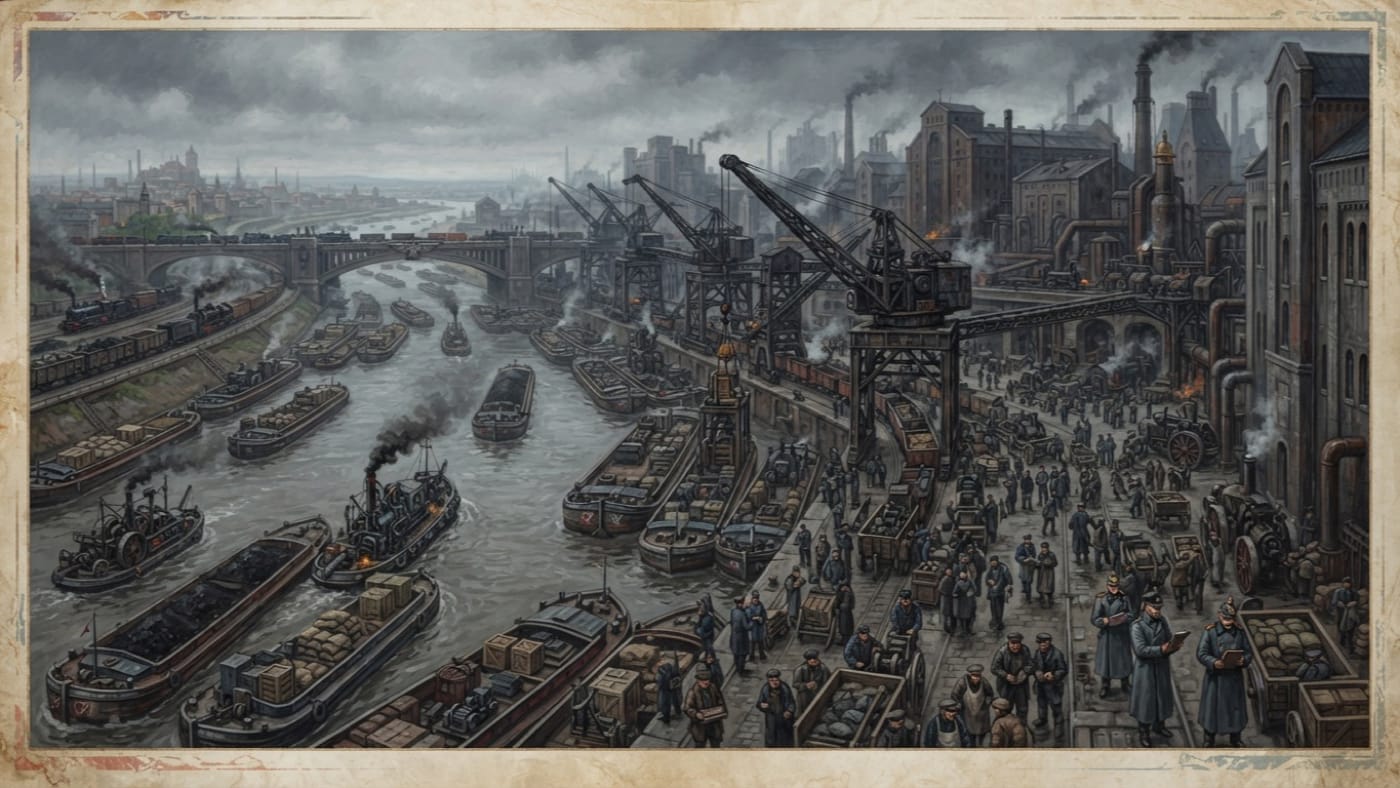
#On the Waterborne Supply
The northern front feeds through its mouth at Hamburg and swallows through the Hamburg–Kanzleiburg Line. Every quartermaster between the Baltic and the Bug has at some point been asked by a superior what happens if the throat closes. The Elbe Barge Network is the answer nobody enjoys giving. It is slower than a railway, wetter and more quarrelsome, and it works.
It is a supply system laid on a river. The Elbe runs inland from the Hamburg approaches past Magdeburg and on toward Dresden. Barges carry freight up it from the port and unload at transfer basins. There the cargo goes to the railway, which carries it to Kanzleiburg and the allocation boards of the Archonate Isle. Kanzleiburg itself stands on the Spree. No barge has ever tied up beneath the Archon's windows, and the Archon has never wished that one would. The river delivers to the rail, the rail delivers to the city, and the city decides.
In ordinary seasons the network moves ordinary freight: grain, coal, timber, everything bulky and in no hurry. In bad seasons it relieves the Line. In the worst seasons it becomes the second leg on which the Northern Corridor stands while the first is in splints. The Bureau of War plans for those seasons every year and prays against them every week.
#On the Transfer Basins
Magdeburg is where the river becomes paperwork. It is a Zone 2 transfer city on the middle Elbe. After Kanzleiburg's absorption in A.S. 95 the Synod converted it into a contingency organ, and its apparatus is entirely practical. Basin locks hold vessels at a workable level, and crane towers lift cargo from hold to quay. The Middle Rooms are a range of wet warehouses where freight waits between one mode of carriage and the next. The name is accurate. Everything in the Middle Rooms is in the middle of something.
A consignment from Hamburg passes the locks into the basin, comes under the cranes and lands on the quay in lots. From there it goes into the Middle Rooms or, if the railway is ready, directly to wagons on the southwest branch toward Kanzleiburg. Between the hook and the wagon sits the Corridor Desk, constituted in A.S. 96. Its single task is to reconcile what came off the river with what Kanzleiburg's routing tables say ought to go onto the rail. The Desk commands no barges. Its property is the discrepancy, which in the Synod is the senior form of title.
Magdeburg also holds bridge toll custody over its crossings and keeps a reserve wet-store in the basin district. That reserve belongs to the river until the Archonate Isle calls for it. Then it belongs to the front.
Dresden lies farther upriver and serves another purpose. It is the southern diversion from Kanzleiburg, a second rail–river transfer city that takes northern overflow and relieves the central line. Its Elbe Rooms keep their own warehouse discipline, and its White Yards sort what the Rooms release. A Hamburg consignment can reach the front without passing through Dresden. The network sends freight there when Magdeburg is full or the southwest branch is choked. It also goes there when the central corridor wants a cargo more urgently than the north does, which happens more often than the north is told.
#On Cargo and Clearance
The registry's cargo list for the Elbe reads like an inventory drawn up by a man who has given up: grain, coal, timber, machinery, paper bales, hospital furniture, sacred freight and winter contingency stores. Each behaves differently under a crane, and each fails in its own way.
Grain fears water and travels on it. A sack weighed at Hamburg and weighed again at Magdeburg will disagree with itself, because river air gets into grain the way doubt gets into a novice, and the scale records the difference as a crime. The tariff-chapel weighers set zero on a reliquary fragment before witnesses. They hold that drift is an offence whichever party it favours, and the Elbe drifts in every direction.
Coal cares nothing for damp and everything for weight, and it teaches crane crews what their tackle will bear. Machinery arrives crated and sealed and must be lifted whole, because a lathe in two pieces becomes a requisition for a new lathe. The Bureau of Records ships its own appetite upriver as paper bales, and those must be kept dry. The Middle Rooms are wet warehouses, so they manage it by heroic effort and occasional prayer.
Sacred freight receives the gentlest handling and the longest delay.
Clearance follows the common practice of weigh-houses throughout the Church. The weigher calibrates, weighs, compares the weight with the manifest, inspects the seals, issues the ticket, reconciles the ledger and files a copy for the auditors. When a manifest names one cargo and the hold contains another, the matter goes to dispute. There the manifest litigants argue identity, provenance and seal as fiercely as they do on every other quay. The registry counts false manifests among the network's afflictions. An honest manifest attached to a dishonest weight is another, and the Bureau of Tithes wants its assessment out of both.
#On Water and Winter
A routing table is drawn up at a desk in Kanzleiburg. Rain draws up the Elbe.
Low water closes stretches of river to laden barges while the tables go on showing them open. Then the pilots, who carry the shoals in their heads, refuse loads that the clerks have already dispatched. Pilotage is knowledge held by the people who use it, which makes it unsuitable for filing. Mud-law governs what the river does to its own bed, and the dredgers contest it every season and lose by small margins. Frost stops the water well before it stops the paperwork. A bridge collects its toll and has its limit, and a crossing bears only so much, whatever the manifest says about how urgent its contents are. The registry lists devotional obstruction without elaboration. Any river clerk can supply examples, but none of them are fit for the Codex.
The people who fund the network think winter contingency is its reason for existing, and the phrase misleads them. It does not mean barges moving through ice. It means the network spends the open season filling stores at Magdeburg's wet-store, the Rooms at Dresden and the boards of the Archonate Isle. When the river closes, the allocation draws down by rail what was laid in by water. A winter contingency is a calculation made in autumn and paid for in March.
Magdeburg keeps Winter Tables, introduced after the Coal-Frost Week of A.S. 165. Dresden's route-lamp custom dates from the same year. The registry records the association and nothing more, and the Codex adds nothing to it. Two cities remember the same cold and keep different ceremonies for it.
#On the Present Condition
The registry describes Magdeburg in A.S. 201 as operational, damp, watched, overused and under-praised, and the description fits the whole network. Everything the network carries ends at the allocation boards of the Archonate Isle, seat of the Northern Hierarchate and of the Bureau of War's northern command. The Archon's logistics directorate routes civil resources and supply allocations through those boards. The military command shares the corridor with him and keeps a separate desk. Ownership along the Elbe is spread with an untidiness that offends the Bureau. Boatmen work hulls that someone somewhere holds a deed for, the cities hold their tolls and the Desk holds its discrepancies. The Archonate Isle holds only the decision about where the cargo goes next.
Next means the Northern Corridor: from Kanzleiburg to Warsaw, from Warsaw to the forward spurs, and from there to Bastion-Königsberg and Bastion-Brest. The river's part in the war ends at a crane in Magdeburg or Dresden, and the railway carries the rest into the front's arithmetic.
The Codex entry on Kanzleiburg stated that "everything that enters Hamburg by sea leaves Hamburg by rail."
Hamburg's sea cargo leaves Hamburg by rail and by river. The Elbe route carries freight inland to Magdeburg and Dresden, and there it joins the railway. The Kanzleiburg entry names the barge network in its very next paragraph. Its earlier sentence was right about the railway and wrong about the river.
Planners who treat the two routes as independent alternatives are careless. Both begin at Hamburg's intake. Both depend on transfer labour: dockers in the port, crane crews in the basins, yardmen in the Rail Quarter. Both end at the same boards on the Archonate Isle. The river gives the corridor another path but no second mouth.
The Archon has estimated, in remarks recorded in this Codex's entry on Kanzleiburg, that if the Hamburg railway and the Elbe barge route were cut at the same time, the northern front would have fourteen days of reserves. The figure covers the front as a whole. It says nothing about any single garrison's larder or the river's capacity. Nor does it cover the loss of the river alone, which the Archon was not asked about. The registry places the concurrent-failure reserve calculations in A.S. 200. The Archon's fourteen days carries no date of its own, and I supply none.
At Magdeburg the cranes are working, the clerks are counting, and the routing tables in Kanzleiburg show the river open. They always do.