
#On the City That Receives the Overflow
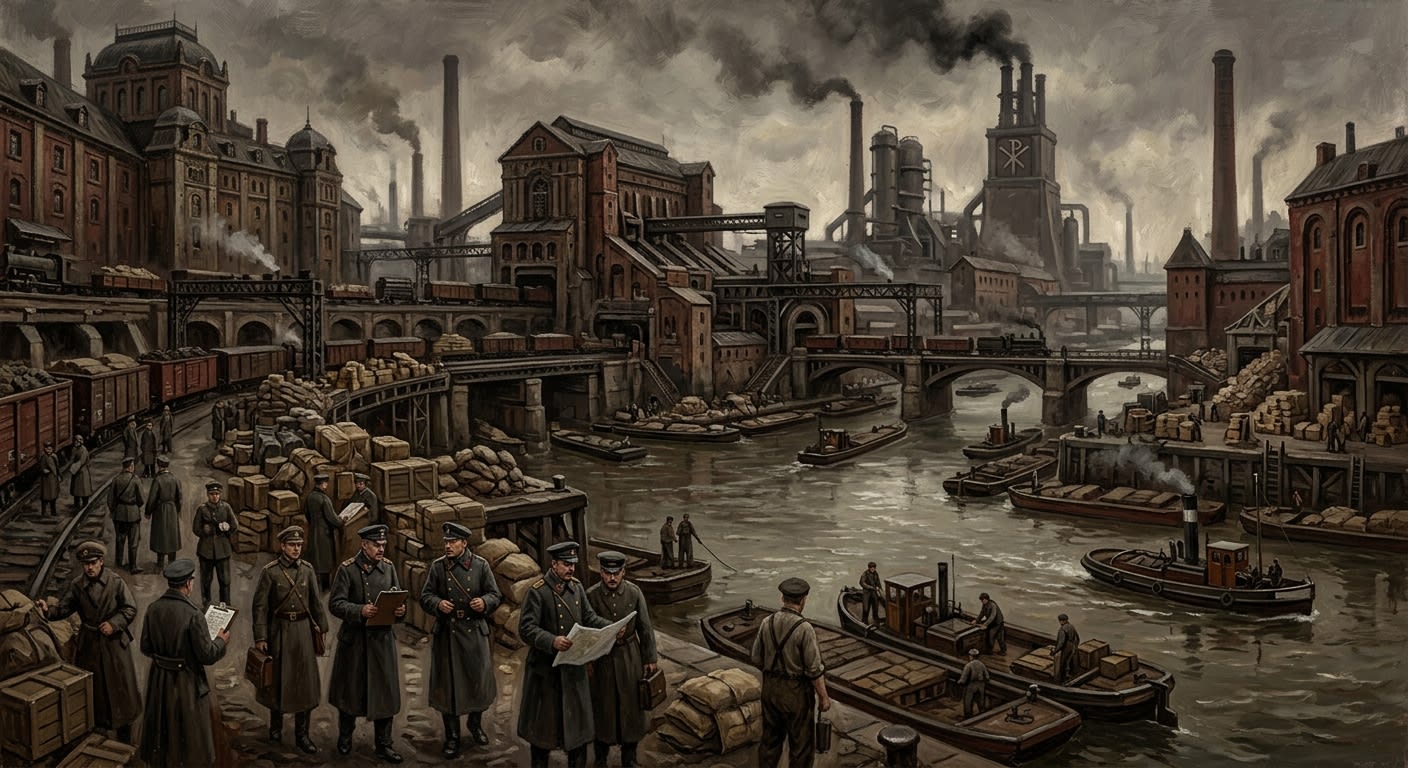
Dresden is the Synod's side-throat on the Elbe: too southern to swagger with Hamburg, too northern to plead kinship with Munich, too beautiful to be trusted with hardship, and too useful to be permitted beauty without supervision. It sits where river freight, rail diversion, Saxon (Unregistered) habit, porcelain vanity, chapel discipline, and northern contingency meet in a basin of pale stone and blackened timetables.
The city is not the primary artery. That honour, with all its soot and ulcers, belongs to the Hamburg-Kanzleiburg Line. Dresden is the alternative route everyone praises in peace, overburdens in winter, forgets in accounting, and curses when snow converts respectable theory into a queue of stalled wagons under frozen bells.
The Archonate Isle keeps a Dresden room among its Corridor Rooms. That tells the reader more than a civic hymn. Hamburg has a room because cargo enters there. Warsaw has a room because the front begins to bite there. Danzig has a room because the Baltic is a liar with fish scales. Dresden has a room because every system needs a place where excess is sent and responsibility thins.
#On Its Situation and Its Manners
Dresden lies on the Elbe, downstream of hill-country and upstream of the harsher northern arithmetic. Its old Saxon core was already a city of stone, galleries, court habits, river commerce, and cultivated self-admiration before the Synod learned to rename conquest as correction. The Synod did not need to break Dresden. It needed to route through it. This spared the façades and doomed the cellars.
Kanzleiburg sends overflow south when the western throat tightens: delayed Hamburg grain, coal lots that missed primary slots, timber too long for urgent manifests, devotional freight that can endure insult, wounded moved away from forward priority, civilian petitions travelling with crates because paper has always possessed superior mobility to flesh. From Dresden, freight may continue along Elbe-linked depots, bend toward Magdeburg, enter central relief channels, or wait until some clerk in Kanzleiburg discovers that waiting has become a political condition.
The city smells cleaner than Hamburg and lies less convincingly. Its riverfront warehouses wear pale plaster. Its station glass is washed more often than necessity requires. Its yard clerks keep their cuffs tidy, which has misled visitors into thinking the cargo is better behaved. Cargo does not improve under architecture. It merely ruins nicer rooms.
#On the Elbe Rooms
The Elbe is Dresden's oldest accomplice. Barges bring what rails cannot immediately digest: coal, timber, grain in wet seasons, stone, gun-carriage parts, hospital furniture, paper bales from western copyhouses, and those awkward sacred consignments whose handlers insist vibration disturbs relic temper. The river accepts them all with the flat expression of water that has carried kings, corpses, and municipal sewage without developing preference.
The Elbe Rooms are the long riverside warehouses where cargo ceases being shipment and becomes argument. Each house holds two ledgers: the public receiving book and the working slate. The receiving book records manifest, seal, weight, origin, destination, and blessing status. The working slate records rot, broken crate, missing guard, bribe suspicion, rat damage, frost risk, chapel interference, and the private opinion of the foreman, usually expressed in marks not suitable for catechism.
Dresden's first civic genius is transference. A barge becomes rail. A rail delay becomes warehousing. Warehousing becomes fee. Fee becomes petition. Petition becomes doctrine if enough widows sign it. This is the Synod in miniature: movement slowed until it becomes authority.
Earlier corridor summaries described Dresden as “a reserve convenience along the Elbe.”
Corrected. Dresden is not convenient. It is necessary in all the ways governments resent: expensive before crisis, insufficient during crisis, and politically loud immediately afterward.
#On the White Yards
The White Yards take their name from old porcelain works, limewashed loading walls, and the Saxon civic fantasy that pale surfaces cleanse dark labour. In practice the yards are black by noon. Coal dust enters the cracks. Brake grease stains the stones. Horses steam in winter. Men curse in dialects Purity has not catalogued because Purity prefers heresy to grammar and has never respected the difference.
The yards sort southern overflow from the Northern Corridor. Primary tracks run north toward Kanzleiburg and westward Elbe nets. Relief tracks bend toward central stores, municipal coal, and transfer sheds feeding the Munich roads. Two hospital spurs stand behind a curtain wall painted with saints whose faces have been repeatedly blackened by locomotive breath. The wall is repainted every spring. By Ashmonth the saints look like miners.
The White Yards also possess the politest strike tradition in the Synod. Dresden workers do not riot first. They submit a weather correction, a wage petition, a safety memorandum, a clergy obstruction complaint, a frostbite tally, and a request for arbitration under six obsolete Saxon clauses the Bureau of Records has failed to repeal because repeal would require admitting the clauses exist. On the seventh day they stop moving cargo. This is called the Dresden Courtesy (Unregistered). It has ended three directors and no grievances.
#On the Porcelain Chapels
Dresden's chapels are too pretty. This is not an aesthetic objection. It is a security assessment.
Porcelain saints line certain station shrines: white hands, blue eyes, gold-edged halos, smooth faces unstained by the freight they bless from a polished niche. The Bureau of Doctrine tolerates them because Saxon devotion has always required glaze, music, and the impression that salvation has been fired at the correct temperature. The Bureau of War tolerates them because yard workers pass them before night shift and break fewer windows afterward. The Bureau of Tithes tolerates them because donor plaques are taxable.
The Porcelain Chapels (Unregistered) became operational during the A.S. 165 Coal-Frost Week (Unregistered), when the northern line froze hard enough to send three days of missed coal south through Dresden. Workers slept in shifts beside stoves fed with broken crate wood. Priests placed porcelain lamps along the yard path so crews could walk without stepping between wagons. The lamps worked. By morning, thirty-seven unofficial route-lamps had acquired offerings, names, and a queue. Doctrine arrived late, as usual, and licensed the practice before anyone could call it a cult.
Purity's first Coal-Frost report classified the route-lamps as “spontaneous lay superstition requiring removal.”
Amended after War demonstrated that removal reduced night throughput by eleven per cent and increased crush injuries by twenty-two. Superstition that moves coal becomes custom. Custom with numbers becomes policy.
#On the Dresden Room in Kanzleiburg
The Dresden Room on Archonate Isle is smaller than the Hamburg room and meaner than the Magdeburg table. Its maps are full of conditional arrows. Its cabinets contain snow charts, bridge strain tables, labour temper reports, river-depth slips, chapel obstruction notices, porcelain-lamp inventories, and sealed correspondence about what to say publicly when the alternative route proves alternative only in the theological sense.
A red pencil note from A.S. 198 remains copied in the room's working folio: Dresden accepts transfers until it begins manufacturing delay. That is the city's perfect indictment. It can receive overflow, sort it, shelter it, bless it, fee it, and send it onward. It can also cradle cargo so tenderly in procedure that the cargo begins to age in place.
DRESDEN ROOM — FAILURE NOTE, A.S. ███ If Hamburg-Kanzleiburg main line severed and Elbe route degraded by frost: transfer Dresden surge classification from supplementary to ████████. If White Yards labour stoppage occurs during surge: authorise █████████████████ under civil calm language. Public phrase: “temporary redistribution.”
Kanzleiburg distrusts Dresden because Prussian order dislikes Saxon tact. Dresden distrusts Kanzleiburg because Saxon tact recognises Prussian order as vanity with sharper corners. The quarrel is useful. Kanzleiburg cuts. Dresden cushions. Between knife and cushion, crates survive.
#On Art, Freight, and Civic Self-Deception
Dresden believes it remains a city of art. This belief is false enough to be useful. Galleries still open on feast afternoons. Choirs still perform in old halls when Orison permits the programme. Porcelain workshops still produce devotional lamps, seal bowls, saint faces, signal cups, votive plaques, and the blue-white corridor tiles used in transfer offices across the north. Citizens still speak of refinement while walking past warehouses where grain sacks sweat under guard.
The Synod permits this theatre because a city that thinks itself refined will often police its own brutality to keep blood off the visible stair. Dresden hides its machinery behind music, glaze, river mist, and municipal manners. Hamburg shows its teeth. Kanzleiburg shows its tables. Dresden smiles, bows, and charges storage.
Its contracts touch more neighbours than its vanity admits. Danzig sends salt-edge cargo through northern rooms when ice closes pilotage. Warsaw requests spare wagon strings after forward dispatch surges. Magdeburg appears whenever Elbe depth becomes political. Records copies the delays, Tithes prices them, and War pretends none of this constitutes dependence until the next frost bulletin arrives with teeth in it. Dresden calls these relationships civic service. The Corridor calls them ligaments. I call them evidence.
This has produced a class of civic mediator peculiar to the city: men and women who can quote a chapel aria, read a freight delay slate, calm a donor, bribe a yard foreman, and inform a bishop that his reliquary crate has lost precedence to turnips without receiving a curse. Strasbourg calls them municipal harmonisers. The yards call them white-glove muleteers. Both names are accurate enough to be insulting.
#On the Present Condition
As of A.S. 201, Dresden functions. This is not praise; it is a verdict. The Elbe Rooms receive. The White Yards sort. The Porcelain Chapels glow through coal smoke. The Dresden Room in Kanzleiburg keeps its conditional arrows sharpened. Snowfall drills have improved after the A.S. 198 embarrassment, though the improvement depends on six temporary sheds, two disputed coal contracts, and one bridge the Bureau of Engineering has certified by avoiding eye contact with it.
The city is safe in the western sense, which means the enemy is distant and the accounting is intimate. No demon stands at its gates. No Sin-General names it. Its danger is subtler and more likely to survive inspection: a northern front that needs alternatives, a central corridor that resents sharing, a river that freezes when doctrine would prefer symbolism, workers who stop only after being perfectly reasonable, chapels that become routes before they become approved, and a civic pride polished so smooth that warnings slide off it.
Dresden is the place freight goes when the main throat coughs. Remember that. A cough is small until the body cannot breathe.