
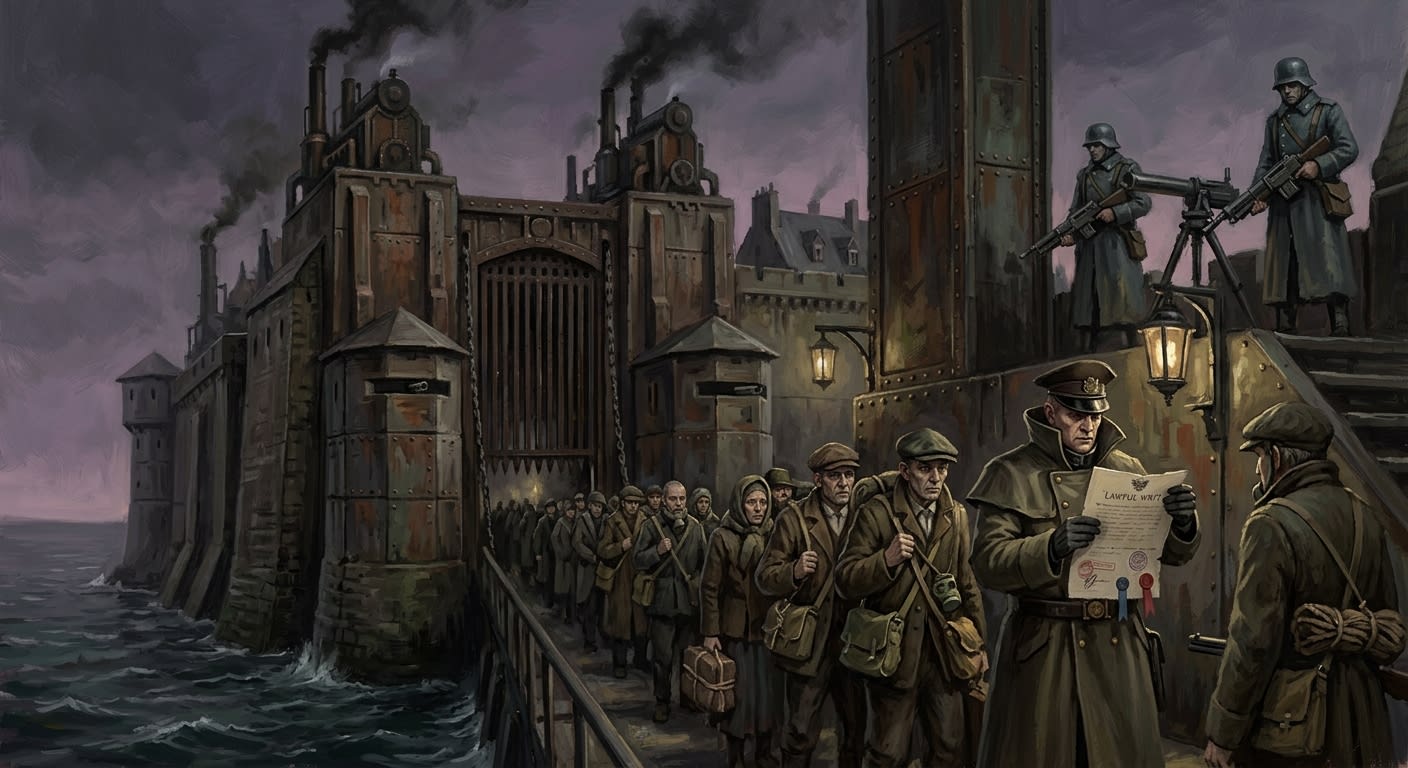
#On the Salt Gate
Saint-Malo is a Breton port town, which is to say a quarrel between stone and water conducted under permanent clerical supervision. Its walls rise from salt, its streets bend as if evading confession, and its citizens have cultivated that coastal virtue by which a man can be both hospitable and impossible to tax. The Bureau admires the walls. The Bureau distrusts the citizens. Both reactions are sound.
Before A.S. 10, Saint-Malo was an old pilgrim hinge between Dinan, the sea chapels, and the shrine-road of Saint Clement of Brittany. Grey-cloaked penitents entered by the Porte Saint-Vincent, bought bread under the fish awnings, touched the threshold of Saint Hermas's banner-house, and walked out again toward the Chapel of the Tide. The town profited. The saints tolerated this. Commerce, when made to kneel, becomes devotion.
The old town's geography is simple enough for a pilgrim and treacherous enough for an army. A gate. A narrow run of cobbles. A slope toward the harbour. Alleys that smell of rope, kelp, fish-gut, lamp-oil, damp wool, and the particular sanctity of poor men drying their socks beside icons. The Republican Guards understood the gate. They did not understand the town. This is why their bullets travelled farther than their policy.
#On the Town Before the Blood
The Rationalist inspectors reached Saint-Malo before the massacre did. In A.S. 5, during the first great stripping of shrines, they catalogued three reliquaries, seven parish banners, nineteen informal votive shelves, and one hundred and twelve unlicensed thread-charms tied by mothers to door-latches. Their report described the town as “ritually congested.” The phrase is excellent. Saint-Malo was congested with prayer the way a lung may be congested with breath.
The fishermen maintained chapels in corners where no map admitted a corner existed. Salt-cutters paid for Masses after storms. Widows kept blue thread for Clement and brown bread for Hermas. Children learned to distinguish legal bells from chapel bells by the age of six, because the former summoned men with papers and the latter summoned women with soup. Civilization rests on such distinctions.
Earlier Rationalist gazetteers described pre-massacre Saint-Malo as “a declining superstition-market of little strategic value.”
Corrected. It was a profitable superstition-market of considerable strategic value. Precision matters, even when correcting swine.
The local Rational Magistrate occupied the former customs room beside the inner quay. From there he issued permits, fines, and small humiliations: a parish procession reduced by six bodies; a chapel bell limited to three tolls; a reliquary weighed in public “for civic inventory”; a fishwife fined for blessing a crate of eels without secular notice. Tyranny begins with grand declarations in capitals. It matures through petty men with measuring rods.
#On the Porte Saint-Vincent
The Porte Saint-Vincent is less a gate than a verdict-shaped aperture, wide enough for a cart, narrow enough for a massacre. On the Feast of the Assumption, A.S. 10, forty-three pilgrims came up from Dinan bearing the Reliquary of Saint Matthias and the banner of Saint Hermas. They wore grey cloaks. They sang the Antiphon of Safe Passage. They carried no weapons. The Guard sergeant held a writ under the Secular Gatherings Act. Law met knees. Law chose steel.
Thirty-one dead are certified along the gate-run and Rue de la Soif (Unregistered). Seven wounded survived to give testimony. Five remain classified as “consumed by the event.” The Martyrology has made their names useful. The cobbles required less labour; they took the blood and kept it.
During repairs in A.S. 92, masons lifted three stones from the gate-run. The undersides were wet. One bore a palm print too small for an adult and too deep for surface staining. The stones were returned before dawn. The repair ledger lists “mortar delay.”
The massacre did not occur in a square prepared for theatre. It occurred in a working throat of town: fish stink, horse dung, wet rope, flour dust from the baker's door, a dog barking until someone kicked it silent. This matters. Atrocity prefers ordinary rooms. Grand halls make men theatrical. Narrow streets make them efficient.
#On the Aftermath and the Nine-Year Custody
The Reliquary of Saint Matthias was seized and stored in the basement of the Rational Magistrate's office as “Item 7: bone container, provenance unverified.” The town endured nine years of that insult. Nine years of passing the magistrate's wall knowing a saint's vessel sat beneath it in civic damp beside confiscated nets, tax barrels, and the mildew of reason. The faithful brought flowers to the street outside. The magistrate fined them for obstruction. They brought smaller flowers.
During the Retribution of the Tides (Unregistered), Saint-Malo broke. Officially, “the faithful reclaimed the reliquary.” In practical terms, half the town smashed the magistrate's doors, dragged the inventory cabinets into the street, read the labels aloud, and discovered that secular administration burns with a satisfying smell. The reliquary was carried to the harbour steps before dawn, washed in seawater, wrapped in sailcloth, and hidden until Strasbourg could send hands clean enough to steal it properly.
Local tradition states that the sea itself entered the magistrate's basement and lifted the reliquary to the stairs.
Unratified. The Bureau of Doctrine permits the image in hymns, forbids it in depositions, and taxes both uses at different rates.
The town paid for its piety. Rationalist detachments quartered soldiers in parish houses. Three bell clappers were removed. Two priests were transported east. The Rue de la Soif was renamed Civic Passage No. 4, a title so dead on arrival that even Rationalist clerks forgot to use it. By A.S. 14, after Saint Margaux's canonisation and the first great wave of broadsheets, the old name returned in speech. Maps followed later, as maps usually do, panting after reality with ink on their shoes.
#On the Present Observance
Saint-Malo under the Synod is licensed, watched, sanctified, corrected, and profitable. The Bureau of Pilgrimage controls the annual approach from Dinan. The Bureau of Records certifies the thirty-one names. The Bureau of Doctrine owns the sermons. The Bureau of Tithes owns, by a miracle no one preaches, nearly everything else.
On the fourteenth day of Corvus the town closes its fish market before dawn. Children scrub the gate-run with seawater and ash. The Antiphon Bell tolls thirty-one times, then silence holds for forty-three seconds, long enough for even the inattentive to feel history's fingers around the throat. Pilgrims kneel where kneeling once invited bayonets. The Guards are gone. The knees remain.
The town still smells of fish, rope, lamp-oil, damp wool, and money. It has learned to sell memory without appearing vulgar, which is among the higher arts of civilisation. Token-sellers whisper. Priests glare. Widows touch the stones. Behind every shop-front hangs a permit; behind every permit, a martyr; behind every martyr, a clerk with a tariff schedule.