

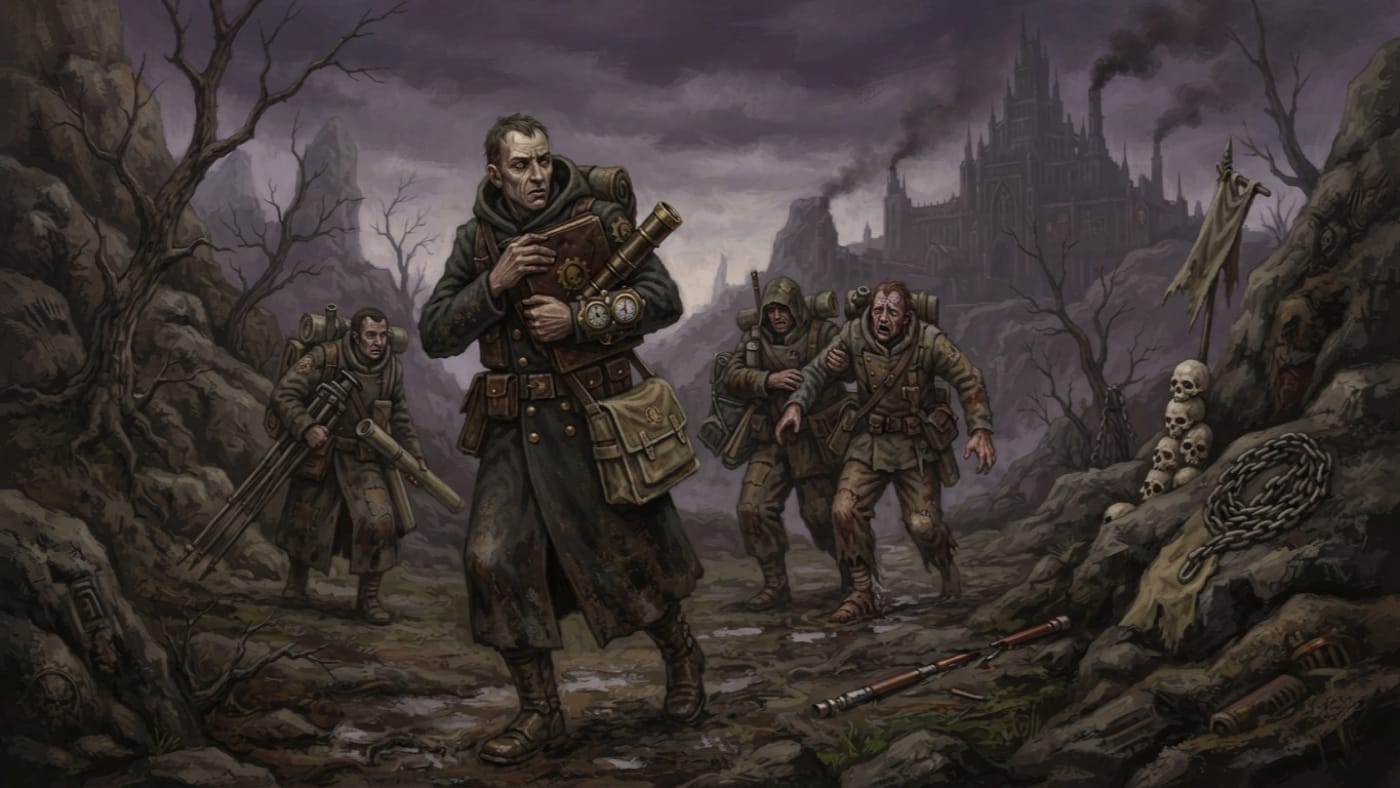
#On the Commission of This Survey
This survey of the Field Adepts of the Bureau of Cartography was made in A.S. 201. That is the year of the survey. The caste is older than my ink, and the Bureau has not given me its founding year, its founder or the order in which its first members learned to run. I will not supply them. A codex that invents a founding to tidy a page commits the very sin Cartography is paid to commit, and I prefer to be paid for my sins.
The Field Adept's task fits in one sentence, which is more than most Bureaus can say of theirs. Go where the map has stopped being true, take an observation someone can use, and bring it home with the notes, whatever instruments can be spared and every person who cannot.
Each clause after the first is harder than the one before it.
#On the Place of the Caste
Cartography recognises three castes in A.S. 201. Bench Cartographers compile and revise plates in the warm galleries at Strasbourg. Mortuary Cartographers, whose office learned its trade in the mud of the Ash-Glyph Marshworks, mark the dead. Field Adepts go out.
The castes divide the labour. They are not rungs. A reader who pictures a ladder with the Bench at the top and the field at the bottom has been listening to Bench Cartographers. No rank list for the caste has reached my desk, and I will not draft one. The three castes work together whenever the job requires it, which is always, and resent each other as regularly as the Hours are rung.
The order of business is plain. The Adept observes and the Bench draws. War, Records, Doctrine and Tithes receive the plate, curse it and send it back for correction. Between the observation and the plate lie a waxed notebook, a long road, and whatever the Adept could carry while leaving.
In the Bureau of Cartography entry, this author described Field Adepts as those "who carry instruments into weather with opinions."
Corrected. The Adept carries the transit. The sighting rod is often in an assistant's hands, as the Bureau's own curriculum admits. The weather's opinions stand unamended.
#On the Two Curricula
Every Cartography apprentice starts the same way, whichever caste later takes them. The first year goes on copying old parish plates until the fingers cramp in the approved posture. The apprentice learns bell-radius calculation, tithe-border convention, road grades, marsh hatching, contour discipline and grave-grid alignment. Then comes the oath, sworn over a sealed atlas: to mark faithfully, revise obediently, conceal lawfully, and burn inaccuracies before they become casualties.
A Bench Cartographer keeps that oath at a desk. A Field Adept has to keep it walking backward.
The second curriculum belongs to the Adepts alone. I give its articles as the Bureau states them, because nothing I could write would improve them.
They learn how to retreat while preserving notes. This article is the first and it governs the rest. An Adept who comes back without notes has been for a walk. An Adept who comes back with notes made illegible by rain, blood or haste has been for a longer one. Waxed notebooks exist for this reason, and the folio is closed and stowed before the legs are told anything.
They learn how to abandon a sighting rod without abandoning the assistant carrying it. I consider this the finest clause in all of the Bureau's training literature. In one breath it admits that in the field an instrument will sometimes be weighed against the person holding it, and it rules for the person. A rod is brass and timber and can be issued again. The Bureau's list of priorities for this year asks that losses be accounted for "with names legible where possible." An assistant has a name. A rod has a stock number.
They learn how to mark a route as forbidden when forbidden is insufficiently emphatic. The Bureau does not publish the method, and I will not invent one. A reader who wants to know what lies past "forbidden" in Cartography's vocabulary may look up the Vermilion Teeth, which the Bureau's legend gives to no-recovery perimeters. A mark warns the next party. It does not wall anything in, and no Adept who has passed the second curriculum believes that ink keeps anything out.
They learn how to identify bread-smell as contact. Out there the field sometimes smells of bread where no oven burns, and the Adept is taught to treat the smell as a report that something is near. The curriculum does not say what, how near or in which direction. An honest Adept writes down the smell and the time and adds nothing. Kargath's Abundance Fields stand behind the lesson, and the lesson is still only a smell in a notebook.
They learn how to recognise when one's shadow has begun disagreeing with bearing north. The transit says one thing and the shadow says another. The Adept is not asked to settle the dispute. The Adept is asked to notice it, record both and begin the retreat set out in the first article.
They learn how to report a moving hill without being diagnosed as humorous. This is a lesson in prose and the hardest of the six. The Bench wants a bearing, a time and a hand it trusts. The physicians want a reason to keep the Adept. A moving hill has to be written so flatly that a clerk in a warm gallery files it instead of laughing, and so exactly that the next party knows where to look.
#On the Case and the Clock
The standard Adept's case holds a brass transit, two sighting rods, waxed notebooks, black and vermilion ink cakes, salt chalk, exposure wafers, diocesan string, bell-audibility cones, a collapsible prayer staff, three scale rules, a sealed blank for emergency renaming, and a pistol whose official purpose is wolf deterrence. Wolves seldom appear in eastern survey reports.
The exposure clock is issued separately, during training. The Bureau has not told me how it works, what it measures or how long it runs, and I will not pretend that the wafers in the case are the same instrument. It has told its Adepts what the clock is for. When the clock expires, the work is finished. Courage after the clock expires, say the instructors, is usually vanity wearing boots.
I have heard many definitions of courage from the pulpit. This is the only one I have met that came with a time limit, and the only one written by people who count who comes back.
The clock promises nothing. It guarantees no return and gives no protection. It tells the Adept the moment the Bureau has stopped expecting anything more of them. The Bureau grants that mercy to very few of its other servants.
#On the Present Work
At the time of this survey the Bureau lists five labours, and the Adepts stand at the front of most of them. The Blightmarsh edge is being revised for the third time this year. Patrol sketches from the Charnel Lands have drawn the same church in two valleys, and the Bench is reconciling them. The Abundance Field plates are being revised after AB-17 appeared within smelling distance of the observation line, which puts the fourth article to work in the field rather than the classroom. The interdiction boundaries around the Vault of Ten Thousand Keys are being maintained over the formal objection of Tithes, which wants the wealth catalogued and has never offered to carry a rod.
The fifth labour is the training of a new class of Field Adepts. Their examination now includes a practical exercise called "Retreat Without Looking Back." The pass rate is poor. The survivors learn quickly.
Beyond its name and those few sentences, I have been told nothing about the exercise. I have not tried to improve on them.
#On Those Who Return
Returning Adepts are handled in Cartography's own Quiet Annex. It is a different house from any ward of a similar name elsewhere, and the reader should not confuse them. In the Bureau's account, coming back wrong has grades. At the mild end are repeated bearings, night sweats and murmuring at the edge of a map. Further on is the Adept who cannot draw a known room the same way twice, and further still the one who insists that east has become personal. Nothing in the account explains the cause, so I record these as the Annex does, by symptom. Some Adepts move to Bench work after one bad outing and flinch when rain strikes the gallery windows. Others ask to go back out. The Bureau watches those ones carefully.
Households receive a stipend and a phrase: occupational distortion, route fever, eastern fatigue, sacrificial service. The vocabulary is kind, and that is the most anyone can say for it.
The Bureau keeps one Adept on file who has refused every grade. In its account, Adept Harlen was lost on a Drava survey in A.S. 174 and declared dead. In A.S. 200 a figure was sighted from Kestrel-11, apparently unchanged. The three maps from his original survey do not agree. Records confirmed within the hour that there was no pension liability. Medicine was refused access. I will not explain him, and neither will the Bureau.