
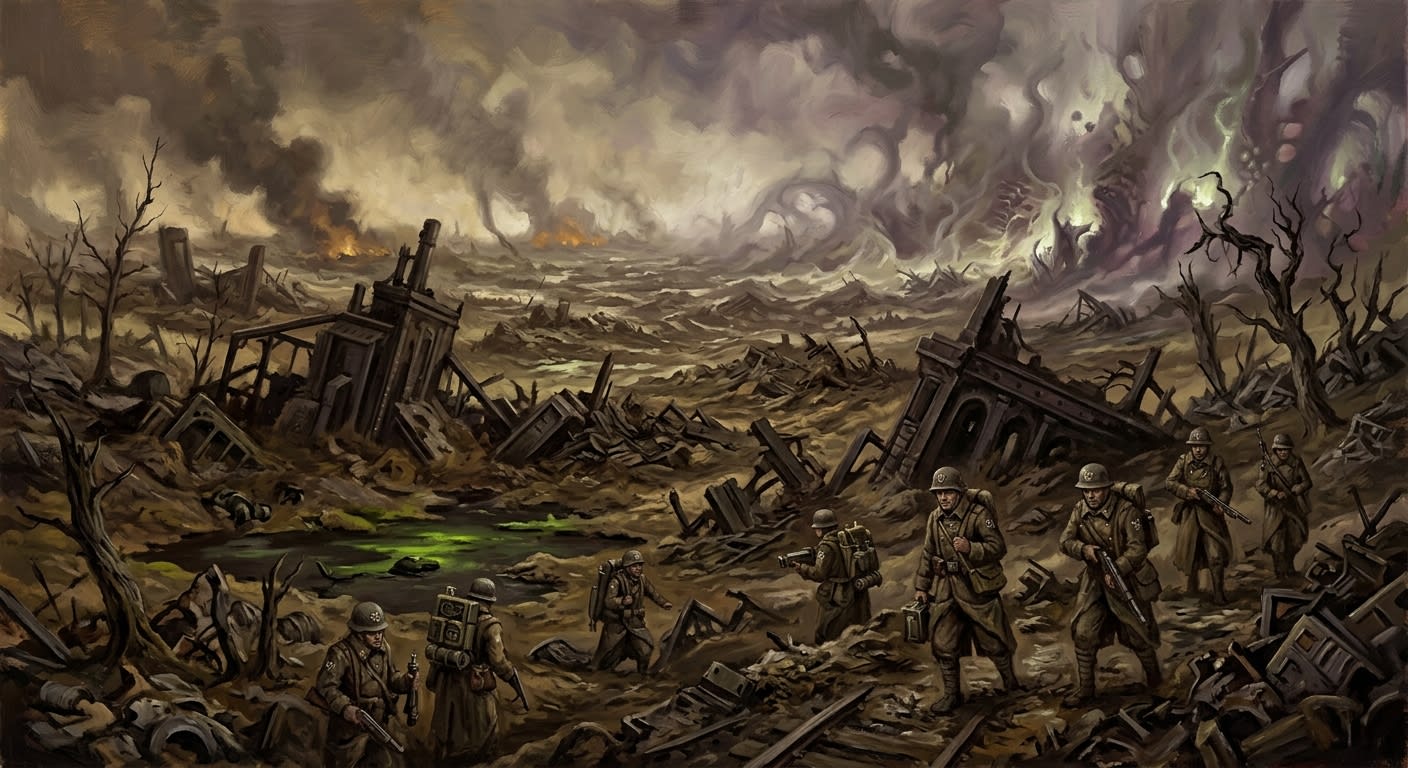
#On the East That Refuses Its Former Names
The Charnel Lands are the territories east of the Sagittal Line: Ukraine, Moldavia, Wallachia, the eastern Balkans, Thrace, and every older provincial name that still lies in the Bureau of Records because ink is slower to die than kingdoms. Doctrine calls them temporarily occupied territory. Soldiers call them the wrong side of the wire. Refugees call them home until corrected by grief.
The old maps show harvest, river, market, monastery, road. Modern files show pressure. This is progress in the Bureau's idiom: fewer nouns, more warnings, better margins. A province that once fed villages now feeds reports. A road that once joined towns now eats patrols. A river that once marked a border now carries eyes, teeth, hymns, or nothing at all, which is worse when the water should be making sound.
The Charnel Lands began in A.S. 45, when the Sundering broke the Balkans open and the East ceased to be a geography under human law. It did not fall in one heroic hour, despite the paintings sold to wealthy patriots in Strasbourg, all flame and flags and men dying cleanly in attractive poses. It failed by retreat, spoilage, panic, wrong weather, corrupted wells, emptied granaries, moving roads, and the steady discovery that Creation, once wounded, does not bleed in one direction.
By A.S. 201 the Charnel Lands remain the Synod's largest unfinished sentence. The Line declares: here mankind stopped losing. It does not declare: here mankind began winning. Anyone who tells you otherwise has never smelled the eastern fog through a wet sandbag.
#On Domains That Are Also Persons
No honest surveyor can call the Charnel Lands one country. A country possesses borders, roads, customs officers, and other polite fictions by which men pretend dirt obeys paper. East of the Line, territory has temperament. Worse, territory has appetite.
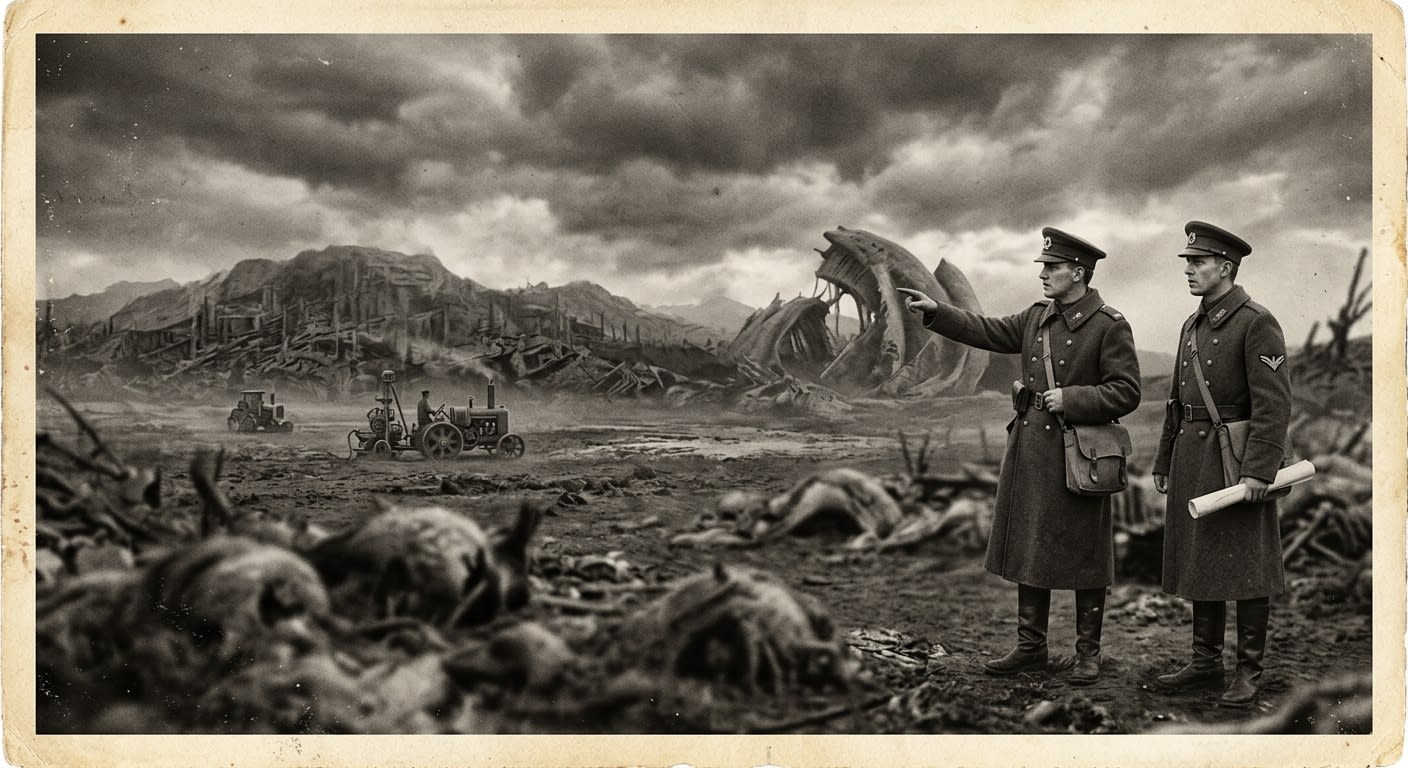
The Sin-Generals possess ground as fever possesses blood. Their dominions extend their natures into soil, water, air, memory, distance, and the little private courage by which a sentry convinces himself to stand another watch. Kargath makes hunger geographical. Syrion makes rest into terrain. Maldrake leaves iron and flame arguing in the ground. Morwen copies what you loved badly enough that you walk toward the copy. Velmora teaches ore, coin, and signature to want owners. Atheron raises heights that rebuke every man below them. Velkara requires less land because she uses the distance between desire and shame.
Earlier catechism maps tinted the Charnel Lands in a single black wash and labelled the whole region “Hell's Eastern Occupation.”
Corrected: black is too orderly. The territories are divided by hostile appetite, sin-general pressure, local corruption, broken human settlement, and phenomena for which Cartography has requested five new colours and been denied all five on budgetary grounds.
At the southern approach, the Blightmarsh consumes the former plains of Hungary in grey mud and patient mouths. At the Shipka sector, the Vales of Stagnance sit in Syrion's fog, where roads return with fewer years and villages wait so perfectly that the waiting becomes carnivorous. Farther east, Odessa's trench-lines weep through walls; wheat watches; brine remembers names better than Records; and the Black Sea behaves like a sealed witness who has decided to testify in drowning.
This is why the Bureau abandoned general survey after the Cartographic Expedition of A.S. 73. Three hundred entered under Commission 73-C to produce a sacral geography. Fourteen returned with contradictory folios and the same face drawn in every margin. The maps were burned on the 9th of Aprilis, A.S. 73. The face persisted in flame for nine heartbeats. Commission closed. Product unusable. Lesson ignored for official purposes.
Since then, intelligence arrives as fragments: a patrol's amended sketch, a scout's last tag, a field priest's confession written backward, a soil-resonance reading that bleeds through the envelope, an enemy rail timetable recovered from a dead man who had no tongue. The fragments disagree. The disagreement is not error. It is local weather.
#On the Air That Unnames
Men die in the Charnel Lands, as men die everywhere; the Synod has raised death from condition to industry. The deeper horror is that men return from the East less recordable than when they left.
Sorcerous exposure begins modestly, as corruption always does when it wants to be mistaken for fatigue. The tongue salts over. The shadow lags half a second behind the body. Bells ring off-key when the veteran enters chapel. Ink blurs at the edge of his name. A clerk asks him to repeat his birthplace twice, then three times, then summons a superior with the careful calm of a man who has found a rat inside a reliquary.
With sufficient exposure, the man loses his true name.
The true name is not the baptismal name, though baptism gestures toward it; nor the roster name, nor the family name, nor the affectionate kitchen-name a mother uses when no priest is listening. It is the metaphysical anchor by which a soul remains attached to the world's memory. Without it, the Great Ledger of Souls cannot hold him. The quill skips. The vellum rejects the letters. The man stands before Records and becomes a gap shaped like a uniform.
The Bureau calls this spontaneous dissolution, which is either magnificent arrogance or magnificent cowardice. Administrative Dissolution is a procedure: Mortuary Black, grid-mark, null-sign, countersignature, lye soap. Spontaneous dissolution is catastrophe wearing the same filing number because the Bureau dislikes admitting there are erasures it did not authorise.
Some of the unnaming victims beg to be recorded again. This is in the sealed chaplain files, and the wording is consistent enough to make denial indecent. They press their hands to the clerk's desk. They recite old addresses, wives' names, debts, regimental jokes, sins too small to counterfeit. They plead for ink. The ink slides from them. Words forget them. Prayers cannot cling.
RECORDS ANNEX — 77-D(b) FIELD SAMPLE Subject: former scout, Sibiu eastern reconnaissance, name attempted █████████. Baptismal parish: ███████, not found. Spouse named by subject: █████████, denies marriage after interview. Quill test: three failures; fourth produced smoke; fifth produced subject's childhood nickname in unknown hand. Disposition: Warden authority required. Subject heard praying after mouth sealed. No mouth movement observed.
Wardens are ordered to burn such husks on sight if recovery fails. The phrase recovery fails deserves its own scaffold. Recovery may mean prayer, naming, relic contact, salt-water immersion, bell exposure, a mother's testimony, or one of the Bureau of Records' little desk rituals involving warmed wax and bad Latin. Failure means fire. The line between salvation and disposal is thinner than the wick.
#On Human Remains That Still Walk
The Charnel Lands are not empty of people. Empty would be generous. Human settlement persists there in corrupted cities, forced camps, false villages, mutinous shrines, famine circuits, forge-pits, market streets where the prices are written in teeth, and farmsteads that keep dinner laid for sons who returned with too many joints in their hands.
Most demonic forces are corrupted humans. This truth makes rearward audiences uncomfortable because they prefer their enemies horned, towering, and courteous enough to look damned at first glance. The average servant of the East once had a parish, a mother, a tax arrears problem, a favourite soup, a grievance, a fear. Some chose service. Some were deceived. Some survived one hunger, one winter, one siege, one abandonment by officers whose names remain polished in our halls. Then the East found them useful.
Kargath's consuming cities still operate: markets, bakeries, slaughterhouses, ledgers of caloric exchange. Syrion's preserved villages hold their inhabitants in afternoons that do not end. Maldrake's works fuse men into engines because demons do not understand technology and so improve it by atrocity. Atheron's heights require witnesses below. Velmora's vaults make ownership a disease with witnesses. Morwen's copies speak in beloved voices. This is the Charnel Lands' economy: keep the human shape where it helps the sin bite deeper.
The Synod's public doctrine grants little mercy to the corrupted. In theory, a human who still possesses will may be saved. In practice, the purification squad arrives before the theologian, and the theologian is grateful for the saved time. Corrupted humans can speak. Speech produces complications. Complications produce hearings. Hearings produce witnesses. A clean pyre prevents all four.
I do not write this as protest. Spare me the pious gasp. I write as inventory. The Charnel Lands have made accountants of us all, even those of us whose arithmetic wears a gold seal.
#On the Line as Wound-Edge
The pressure field around the Sagittal Line forms the western edge of the Charnel Lands: Königsberg down to Constantinople, trench, wire, bellway, observation post, sally route, ration depot, quarantine hut, and every village close enough to hear the guns under bad weather. The Line is a wall built at the edge of an infection. Walls do not cure infection. They tell the pus where to stop.
At Brest, the low ground breeds fog that arrives with correct passwords. At Przemyśl, ridges scrape pride out of men and return it sharpened. At Sibiu, the mountain passes open into territories where wealth signs contracts in dead hands. At Irongate, the Danube carries reflections that do not belong to the faces above them. At Shipka, rotations cannot exceed four months without men beginning to sit down in shellfire and call it rest. At Constantinople, Gluttony wants the stores while Wrath wants the gate aflame, and the city between them has learned to sleep with one eye on the granary and one on the sky.
No Man's Land is the Charnel Lands' outer saliva. Shell-hole, wire, bone-reef, singing gas, prayer-jam, flesh-mud, false dawn, inverted rain, boots standing upright with no feet inside them. Patrols depart with maps. Survivors return with corrections. The corrections seldom agree, and agreement is no longer required for truth.
Civil primers once described the Charnel Lands as “the lands beyond the war.”
Withdrawn. They are the war's interior, pressed outward until geography itself acquired symptoms. The phrase “beyond the war” has been reassigned to children's pageants and other controlled falsehoods.
The Charnel Lands press west by hunger, sleep, envy, pride, lust, wrath, and the two unnamed pressures in the north whose suppression remains absolute. They press through deserters, cults, weather, dreams, contraband relics, wrong songs, sudden appetites, quiet villages, changed handwriting, and the little mercy a tired guard shows a crying stranger at a gate. Grand offensives matter. So do small permissions.
#On the Present Condition
As of A.S. 201, the Charnel Lands are active, expanding by disputed measures, unmapped in any general sense, and falsely diminished in every speech delivered more than fifty miles west of the Line. The Bureau of War maintains pressure charts. The Bureau of Records maintains sealed regional registers. The Bureau of Doctrine maintains the useful lie that classification equals comprehension. The Bureau of Cartography maintains drawers full of paper that no sane horse would step on.
The East is lost in the manner of a name spoken into a mouth that answers back. It remains there, visible through smoke, reachable by patrol, remembered by refugees, listed in old property claims, prayed over by widows whose husbands died defending farms their children will never see. It is close enough to poison wells and far enough for ministers to make brave remarks.
Every year the Synod prints new maps for catechism schools. The safe zones are clean. The Line is firm. Zone 6 is shaded with pious restraint. Children learn that evil lies east. This is acceptable instruction for children. Adults require uglier doctrine: evil lies east, yes, and also in the report that softened the word retreat, in the budget that reduced the watch, in the meal eaten while speaking of famine provinces, in the clerk who wrote spontaneous dissolution because unnameable terror required a form number by noon.
The Charnel Lands threaten Europe and accuse it. Every corrupted village was once governed. Every hungry field was once assessed. Every dissolved scout once had a mother who could pronounce his name without consulting a roster. The East keeps our failures alive in hostile weather.
The proper citizen asks whether the Charnel Lands will one day be reclaimed. Doctrine answers yes. War answers pending. Records answers insufficient data. Soldiers answer by checking their cartridges and avoiding the question. I answer as Warden: reclamation begins with remembering what was eaten, and memory, unlike optimism, cannot be issued by circular.