
#On the Recorded Prohibition
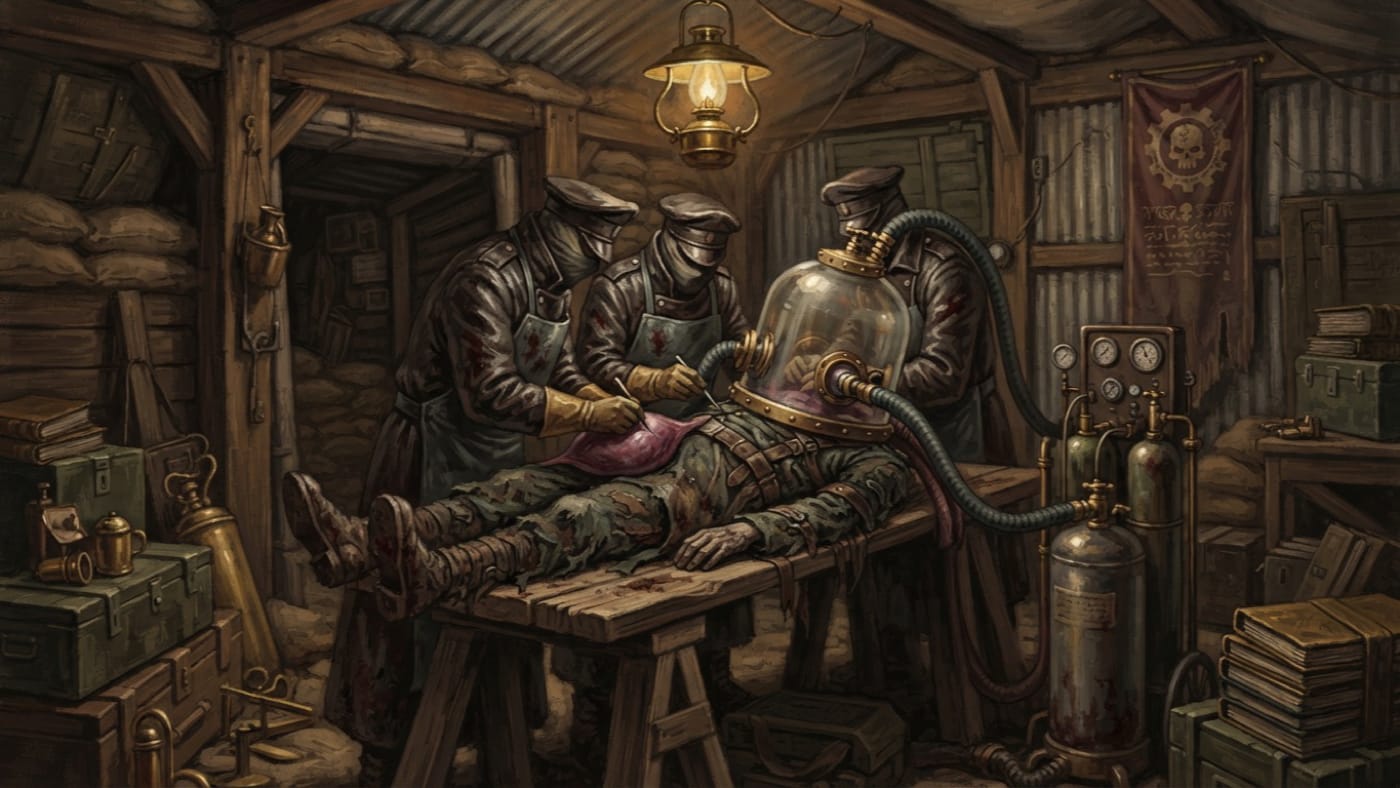
Field Autopsy Protocol 14-D has no address. It keeps no gate and flies no pennant, and I have never seen it on any map of the Line. It is a paragraph. It travels in the satchels of the Bureau of Medicine to whatever trestle table a field surgeon can find behind the trenches. Wherever it is unfolded, that table becomes the one place in the sector where a dead enemy is more dangerous than a living one.
The text survives in a form dated A.S. 193, which the secular almanacs call 1903. That is the year of the passage I hold. Whether an earlier draft preceded it, who composed it, and in what room it was first read aloud, the files do not say. I decline to supply a founding legend. The Bureau has enough of those already, most of them mine.
The problem the protocol addresses is simple. The Bureau wished to know what a Gore-Slinger is. The only reliable way to learn what a body contains is to open it, and the Gore-Slinger's body contains the weapon.
Read the first sentence twice. The protocol does not forbid the knife. It forbids the knife without the apparatus. Examination is permitted, and so are incisions elsewhere in the body. The sacs alone are walled off by a condition, and the condition is the whole of the law.
#On the Contents of the Sacs
The protocol was in force a year before the Bureau of War settled on the present designation in A.S. 194. Whatever the thing on the table was called on the day the passage was written, the surgeon bending over it was looking at a person who had been remade.
The subjects are captured civilians, prisoners of war, and now and then a volunteer from one of the more deranged cults of the Shadow Court. They are exposed to sustained demonic saturation until the blood thickens and the veins distend into ridges across the arms and torso. Burst capillaries do not drain. The blood pools beneath the skin in membranous sacs, which swell, are thrown, and grow again. The body keeps enough coordination to march and enough volition to aim. Its ammunition is its own blood.
Medicine refuses to call the contents blood. Its term is haemotoxic sorcerous condensate, a phrase that took somebody an afternoon and a committee a month. Inside the sac the condensate is inert. Once air reaches it, it becomes an aerosol within four seconds.
Four seconds is the time the process takes. No one should treat it as a margin for working without the apparatus. A surgeon who reads it as a grace period has misread the protocol, and the protocol records what such misreadings cost.
Category Three Biological Hazard, Morale-Adjacent. I admire that last word the way one admires a well-forged seal. In the field the aerosol blinds, sickens, and brings on a despair that Doctrine has never managed to classify as a mere mood. The soldiers call the cloud the red curtain and the despair the drop. Medicine looked at both and chose adjacent, as though despair were a parish bordering the lungs.
Three field surgeons were lost to premature incision. A fourth survived and has not spoken since. That is the full casualty roll as the protocol gives it. It records no names, no sectors, no days, and no account of the fourth surgeon's condition beyond that silence.
#On the Body After Death
A Gore-Slinger that stops walking has not stopped working. The Bureau of War learned this separately from Medicine and wrote it down in its own register, under its own number.
Standing Order 71-G is not part of 14-D. The two documents belong to different Bureaus, carry different seals, and govern different hands. The ward in the fifth clause is a condition for approaching a corpse. The containment apparatus in 14-D is a condition for cutting one. Neither text says one protection replaces the other, and only a clerk in a hurry would merge them.
The numbers need the same care. Four seconds belongs to the sac. Four hours belongs to the corpse. Seventy-two hours belongs to the soldier. None of them belongs to the surgeon. War's order says the sacs go on producing for up to four hours. It does not say that the fifth hour brings safe ground, and I will not say it on War's behalf.
Medicine estimates that the brine masks cut inhalation exposure by sixty per cent. That is a measurement of breath, taken at the parapet. It certifies nothing at the table, and the protocol mentions no mask.
#On the Variants Entered in the Record
The surgeon's difficulty grows with every Sin-General. On the table one Gore-Slinger looks much like another: the same distended arms, the same ridged veins, the same sacs. What the sacs carry depends on which of the Seven made the body.
According to the published variant record, Maldrake's payload burns. Kargath's brings starvation and spoils rations. Velmora's breeds paranoia and covetous distrust. Morwen's repeats soldiers' voices back at them until identity becomes negotiable. Syrion's brings sleep. Velkara's brings a wanting that cannot be satisfied. Atheron's brings a certainty of invulnerability that ends in death. The last two are thinly documented, and I will not thicken them with guesses.
The protocol makes no distinction among them. It sets no seven grades of containment, prescribes no seven tests, and lays out no seven procedures. It prohibits one thing, under one condition, for every sac.
STAMPED ERRATUM — Bureau of War, 3rd Revision, A.S. 199 (variant record; not a revision of Protocol 14-D)
Previous editions listed only three Sin-General variants of Gore-Slinger.
The current edition acknowledges seven.
The classifications are kept apart too. Category Epsilon is War's register for the enemy auxiliary. Category Three is Medicine's register for what leaks from it. A single corpse sits in both ledgers and is filed in neither as a person.
#On the Person Found Within
That last point is where the protocol stops being a matter of hygiene.
The field autopsies, three decades of them by Medicine's own count, written under fire in handwriting that worsens page by page, reached a finding that no Bureau wanted. Medicine reports brain tissue that is damaged but functional, and neural activity it describes as consistent with consciousness. The person who went into the pits is still present in the thing that comes out of them. They aim, they march, and they throw their own blood, and somewhere behind the eyes they remain someone.
I report Medicine's finding in Medicine's words. The files I have been shown do not say how the examination was conducted or in what order. They do not say that consciousness outlasts death, and they offer no method of recovery. Readers who want those things will have to find another archivist, and they will.
Consider what the protocol required of the surgeons who produced the finding. To learn that a person was still inside, they had to open the body. To open the body, they had to work around sacs that could kill them in four seconds. Three of them died establishing what the Bureau of Doctrine would later file as irrelevant.
Those are Doctrine's words, not mine. Doctrine holds that the retained person is irrelevant to tactical considerations. The Bureau of Mercy holds that the person is relevant to pastoral ones. Both positions are on record. Neither Bureau has yielded. No synod has ruled between them, and I am not a synod.
The soldiers settle the matter in their own way. They shoot at range, they burn the sacs before they detach, and they stay away from the corpses until a reliquary ward arrives. The surgeons settle it at the table, behind the apparatus. The protocol counts the cost in the only units it knows: three lost and one silent.
#On Present Application
As of the A.S. 201 survey, all seven variants were confirmed active in the field. The prohibition still reads as it read in 193, capital letters included. The passage I hold does not specify what full containment apparatus means: no materials, no dimensions, no inspection. Whatever Medicine issues under that phrase, it does not issue to me.
The casualty roll has not been amended. No fifth surgeon has been added and no names have been restored. The fourth survivor's silence remains on the record exactly as entered: a single clause, with no diagnosis and no end date.
The protocol remains in force. The sacs remain intact until the apparatus is in place. The person inside remains, in Medicine's word, consistent.