
#On the Classification
"Category Epsilon: Combat-Modified Auxiliaries, Ranged-Assault Subtype. Armed with biological ordnance of endogenous origin."
The Bureau of War has a gift for making the unbearable sound administrative. Gore-Slingers — the name is a soldier's coinage, blunt and accurate, and like most soldier coinages it has outlasted every official designation the Bureau has attempted to impose upon it. The current formal classification, listed above, replaced "Corrupted Ranged Auxiliary, Type Seven" in A.S. 194, which replaced "Modified Thrall, Projectile Variant" in A.S. 187, which replaced a designation from A.S. 168 that the Bureau of Records has misplaced and the Bureau of War has declined to reconstruct. The soldiers never stopped saying Gore-Slinger. The Bureau has, with the weary pragmatism of an institution that has lost four naming conventions in a row, started saying it too.
What distinguishes the Gore-Slinger from the lower tiers of the Shadow Court's mortal apparatus is the corruption itself. A Thrall is branded into vacancy. A Hollowed is carved into ordnance. The Gore-Slinger is shaped — flesh remade by sustained exposure to demonic influence until the body becomes a weapon that the mind, what remains of it, can barely steer. They retain enough volition to aim. They retain enough coordination to march in something resembling formation. They retain enough of themselves to scream when the sacs rupture. Beyond that, the person who entered the process and the thing that walks out of it share a skeleton and little else.
#On the Mechanism
The official description is clinically precise and therefore useless for conveying the reality: "Human-mutant husks with distended arms, hurling sacs of their own drained lifeblood, which burst into disease-clouds upon impact."
Let me improve upon the official description. The Bureau of Medicine has, over the course of three decades of field autopsies conducted under fire and submitted in handwriting that deteriorates page by page, assembled the following understanding.
The transformation begins with blood. The subject — a captured civilian, a prisoner of war, occasionally a volunteer from one of the more deranged cults — is exposed to sustained sorcerous saturation, typically in pits or holding-pens behind the enemy's front. The blood thickens. The veins distend, pressing against the skin until the subject's arms and torso are mapped in ridges of purple and black. The capillaries in the extremities burst, but the blood refuses dispersal — it pools, gathering beneath the skin in membranous sacs that swell over days. The arms elongate. The shoulders widen. The hands — the hands are the worst — splay into paddles of stretched tendon and cartilage, each finger a spoke in a frame designed for one purpose: to hurl the payload that the body has manufactured from its own substance.
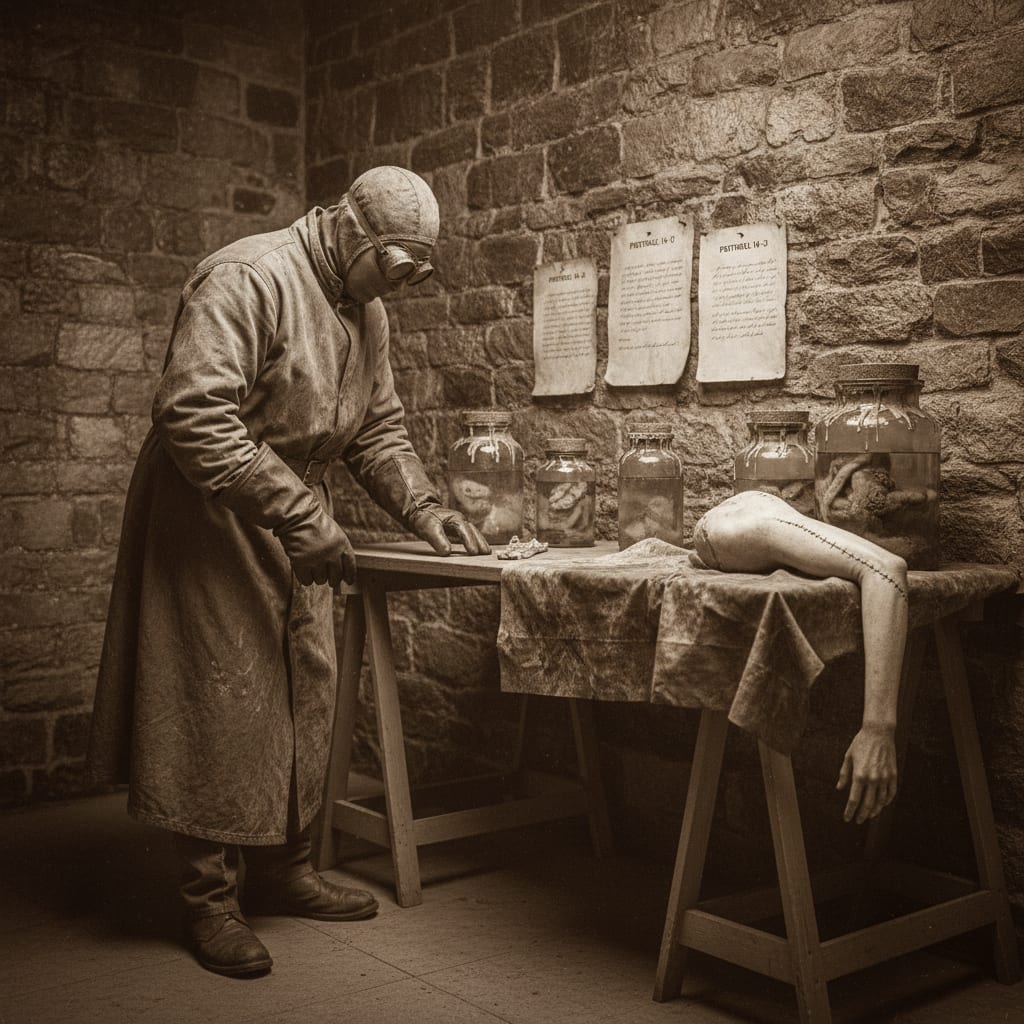
The sacs grow, burst, regrow. The Gore-Slinger's body is a factory in permanent production. It hurls the swollen pouches of its own corrupted blood with a range the Bureau of Engineering has measured at ninety to one hundred and forty metres — farther than a man can throw a grenade, close enough that the trench is already in range before the sentries identify the silhouette. Upon impact, the sac ruptures. The blood — if it can still be called blood; the Bureau of Medicine prefers "haemotoxic sorcerous condensate" — disperses into a cloud that clings to fabric, to skin, to the lining of the lungs.
The cloud does three things. It blinds — a thick, iron-stinking fog that reduces visibility to arm's length. It sickens — within minutes, exposed soldiers report nausea, vertigo, a loosening of the bowels that no catechism can dignify. And it corrodes morale in a fashion the Bureau of Doctrine has struggled to classify, because the sickness carries with it a despair that is sorcerous rather than psychological, a conviction that the war is lost, the Line (Unregistered) is fallen, and the effort of lifting one's rifle is simply beyond what can be asked of a body that has already given everything.
#On the Variants
Each Sin-General produces its own corruption, and the Gore-Slingers that emerge from their respective processes differ in ways the Bureau of War has spent decades attempting to tabulate. The tabulation has produced eleven memoranda, four contradictory field guides, and a request from the Bureau of Bells to stop filing documents about things that make the ink smell wrong.
Maldrake's variant — the most commonly encountered — burns. The sacs are blood laced with the thermal residue of the Eternal Forges. They ignite on impact. The cloud is toxic and incendiary, a mist of vaporised iron and cremation-heat that chars exposed skin and sets oiled equipment ablaze. Maldrake's Gore-Slingers are deployed ahead of the Hellbow Legion as softening agents: they lob fire into the trench, the defenders scatter or burn, and the Ember-Soldiers advance into the gap. The Bureau of War calls this "sequential thermal attrition." The soldiers at Constantinople call it Tuesday.
Kargath's variant hungers. The sacs burst into clouds that carry the Gluttony-aura in concentrated form — exposure induces immediate, overwhelming starvation. Men who have eaten within the hour double over with cramps. Ration stores exposed to the mist spoil within minutes, grain rotting to grey powder, water turning brackish and foul. The Bureau of Medicine's field notes from the Blightmarsh perimeter describe a company of Fusiliers who, after a Gore-Slinger barrage, consumed their leather cartridge-cases, their boot-straps, and three pages of the field chaplain's breviary before the medics could restrain them. Kargath's Gore-Slingers are thinner than the others — emaciated, ribs visible through skin stretched to translucence, mouths frozen in permanent gape. They throw their blood and immediately begin starving for more. Some have been observed eating their own expelled sacs when they miss.
Velmora's variant corrodes loyalty rather than flesh. The cloud that disperses from a Velmora-touched Gore-Slinger carries a particular corruption the Bureau of Purity has classified as "Fiduciary Contamination, Airborne" — exposure induces paranoia, covetousness, and a sudden consuming certainty that one's comrades are stealing from one. At Bastion-Sibiu, three incidents in A.S. 197 alone were traced to Velmora-variant barrages: a supply sergeant who barricaded himself in the ration stores and shot two quartermasters, a gun crew that refused to share ammunition because "each shell is worth more than your life," and an officer who deserted with the company's payroll and was found four miles behind the Line, weeping, clutching the coins and unable to explain why he could not stop counting them. The sacs themselves have a faint golden sheen. The Bureau of Tithes has requested samples for analysis. The Bureau of War has refused. The Bureau of Tithes has requested again.
STAMPED ERRATUM — Bureau of War, 3rd Revision, A.S. 199
Previous editions listed only three Sin-General variants of Gore-Slinger. The current edition acknowledges seven. The previous omission was no clerical error; it was a "phased disclosure strategy," as the Bureau preferred to introduce the variants gradually rather than all at once, lest the reader — or the soldier — conclude that the situation was worse than advertised.
The situation is worse than advertised.
Morwen's variant steals. The cloud from an Envy-corrupted Gore-Slinger sickens by duplication. Soldiers caught in the mist report hearing their own voices speaking from within the cloud, their own commands repeated back with subtle alterations. Squads have opened fire on each other after the mist cleared, each convinced the other was a Shade-Doppelganger (Unregistered). The Irongate garrison, already under standing Mirror Discipline, has added a supplementary protocol for Gore-Slinger barrages: upon exposure, soldiers must recite their service number, their mother's name, and the third verse of the Ninefold Matins. Anyone who hesitates is restrained until a Purity officer can verify identity. The protocol catches, by the garrison's own admission, roughly half the impostors. The other half pass the test. This has not improved morale.
Syrion's variant is the quietest and, by the assessment of the Bureau of Doctrine, the most insidious. The cloud induces sleep. A Syrion-touched Gore-Slinger's payload disperses into a mist that smells of nothing at all — no iron, no rot, just a faint sweetness, like lavender left too long in a drawer — and the soldiers who breathe it sit down. They sit down and they close their eyes and they do not open them again for hours, sometimes days, sometimes at all. The Shipka garrison loses more men to Syrion-variant Gore-Slinger barrages than to any other single cause of incapacitation. The Bureau of Bells rings its counter-measures. The bells wake some. The rest dream on, smiling faintly, while the Slumber-Hulks drift past them like icebergs through a harbour of sleeping ships.
Velkara's and Atheron's variants are rarer, confined to the periphery of their respective fronts, and the Bureau of War's data is insufficient for a full accounting. What is known: Velkara's cloud induces a fever that soldiers describe as "wanting" — a desperate, consuming desire for something they cannot name and cannot satisfy, so distracting that weapons are lowered and discipline collapses into confusion. Atheron's cloud is stranger still: exposure produces a conviction of absolute invulnerability, a certainty that one is the greatest warrior alive, that the trench needs no reinforcement, that the enemy cannot possibly prevail against such magnificence. The afflicted soldier charges alone. The afflicted soldier dies alone, magnificently, pointlessly.
#On the Countermeasures
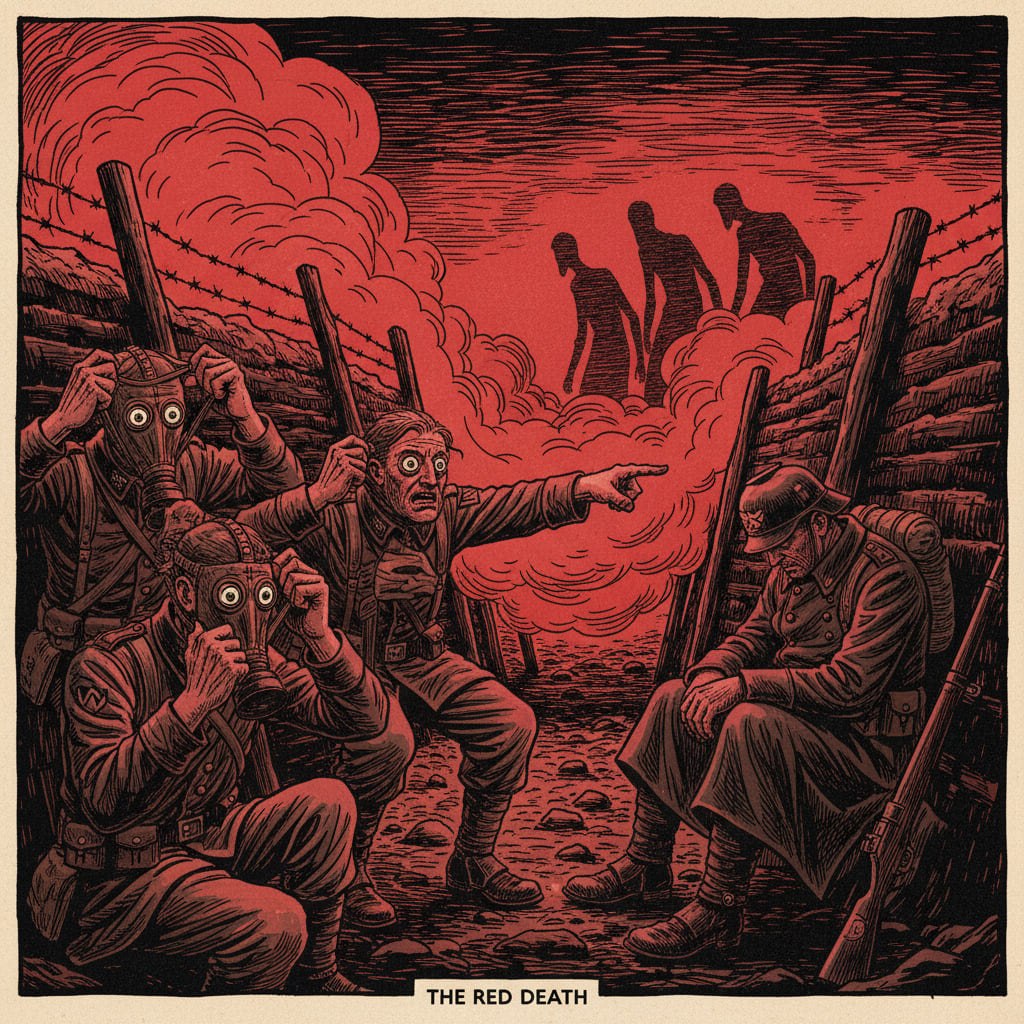
The countermeasures work. Partially. The sacramental brine masks reduce inhalation exposure by what the Bureau of Medicine estimates at sixty per cent, which means forty per cent of the cloud still enters the lungs, which means forty per cent of the sickness, the blindness, and the drop. Incendiary rounds at range are effective against the sacs but also ignite the Gore-Slinger itself, which continues its advance while burning and occasionally manages to reach the trench, where it collapses in a pyre of ruptured ordnance and flaming blood. The Bureau of Engineering has proposed a ventilation system for forward trenches. The Bureau of War has approved the proposal. The Bureau of Tithes has declined to fund it. The soldiers have improvised with wet rags and profanity.
The Gore-Slinger is a middling thing by the Shadow Court's inventory: less clever than some, less terrifying than others, and theologically less troublesome than several entries I could name. It is, by the Bureau of Doctrine's own classification, a "mid-tier combat auxiliary of limited strategic significance." The classification is accurate in the way that calling a plague "a medical event of distributed incidence" is accurate — technically correct, spiritually bankrupt, and of no comfort whatsoever to the man standing in the trench when the red curtain falls.
The person inside the Gore-Slinger — the captured farmer, the prisoner of war, the cult volunteer — is still in there. The Bureau of Medicine has confirmed this. Autopsies reveal brain tissue that is damaged but functional, neural pathways that still fire in patterns consistent with consciousness. They feel what is happening to them. They feel the sacs swell and burst and regrow. They feel their arms stretch beyond the limits of what bone should accommodate. They feel themselves hurl their own blood at men who were, in some cases, their countrymen.
The Bureau of Doctrine says this is irrelevant to tactical considerations. The Bureau of Mercy says it is relevant to pastoral ones. The soldiers say nothing. They shoot the Gore-Slingers at range, soak their masks in brine, and try not to look at the faces.
The faces are the worst part. The faces still look like people.