
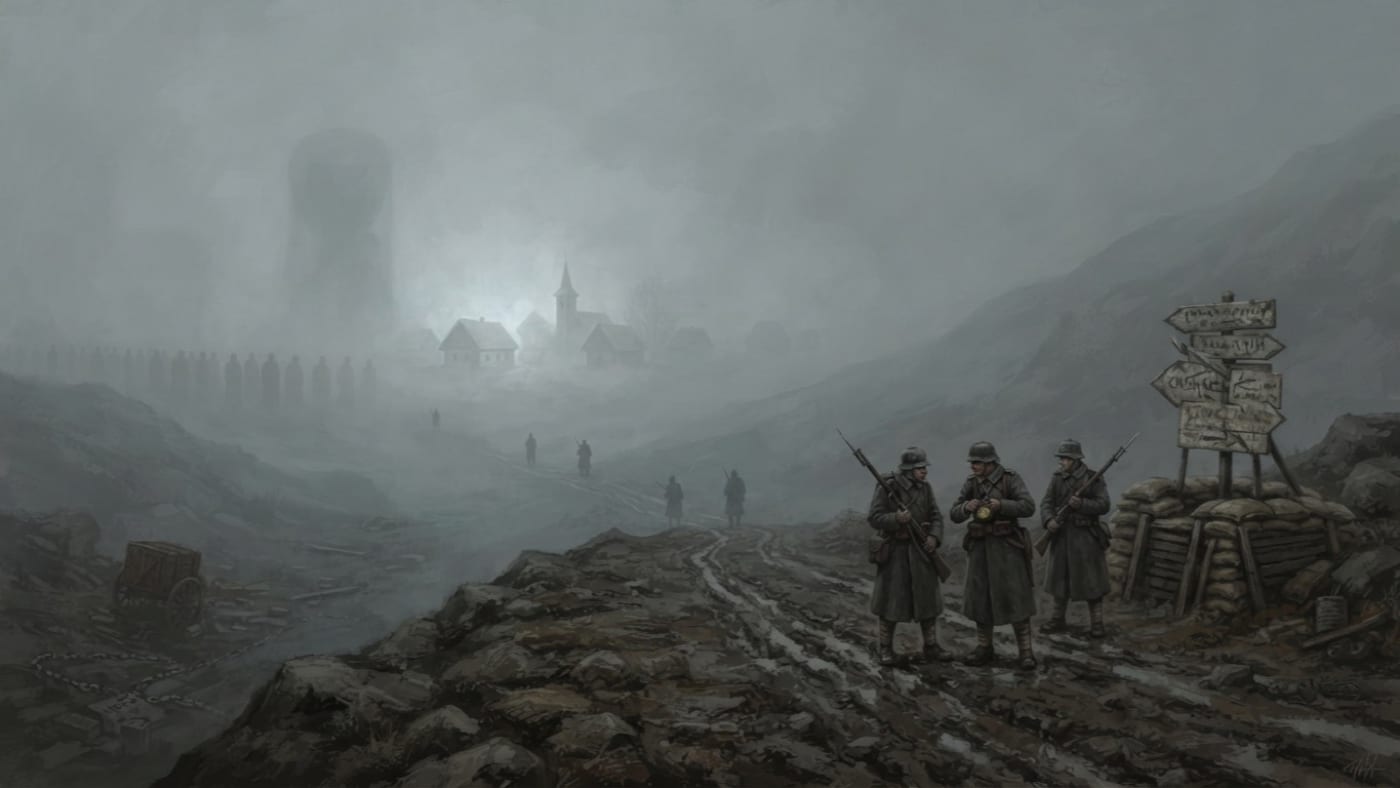
#On the Name
A soldiers' word, kept out of the registry until someone brings back a boundary for it.
"Fog Kingdoms" is barrack language. It came up the Shipka road in letters home and in songs the chaplains would rather not hear. The Bureau of War does not use it in orders. The Bureau of Records does not index it. I have been asked more than once to formalise it, and each time I have asked for a boundary in return. No one has sent me one.
The Bureau's objection is clerical, and therefore sound. A name in the registry needs a perimeter. A perimeter needs a survey, and a survey needs men who come back carrying the same map. The soldiers need none of this. They say "the Fog Kingdoms," and everyone who has stood the eastern watch knows what they mean.
The plural is the interesting part. The old provincial names survive in the ledgers: Serbian districts, Hungarian marches, the border country under the Carpathians, the highland counties of old Bulgaria, and Phocis. Only Phocis has a story attached. Its court fell asleep at its own feast during the Sundering, on what tradition calls the Night of a Thousand Lamps. The others went quietly, valley by valley, and left no date. No court beyond Shipka has sent an envoy, levied a tax or answered a letter since the fog took it. The Kingdoms are the entries the clerks could not bring themselves to strike out.
#On the Country Beyond Shipka
Which ground the name covers depends on who is speaking and how long he has been back. The registry is narrower and firmer. It assigns Syrion's principal theatre to the Bulgarian highlands, the Balkan Mountains and the Aegean approaches, and it sets Bastion-Shipka on that theatre's northern edge. The older dossier on the Languid Dreamer reaches further. It lists Serbia, parts of Hungary and the Carpathian borderlands as lands that once answered to their own names and now lie under his fog. I record both. I do not draw a line between them, because nobody has walked that line and come back to sign for it.
The soldiers' usage overlaps the Vales of Stagnance so completely that I will not pretend to separate the two. A clerk who claims to know where the Vales stop and the Kingdoms begin has been reading his own marginalia.
Three jurisdictions can be stated. Shipka, and the ground its bells reach, is Zone 4: held. The approaches beyond, where patrols go out and usually return, are Zone 5: contested. Behind them lies Zone 6, occupied in depth. East of the bastion, the marsh corridor is a different kind of country, reed and embankment rather than ridge.
Past the contested belt, the Church knows the country by its post. A village stays on the rolls for as long as it answers. It answers late, then under the wrong date, then not at all. The Bureau of Records keeps posting tithe-letters to it, because closing the account would need a witness. A frontier drawn from evidence of that kind is a list of silences in the order they began.
#On Roads and Duration
Stillness Fields lie scattered across the occupied country, and they move. A party may cross one in what its sergeant counts as an hour and come out to find the outpost has logged a week. Another may struggle through what feels like days and rejoin before the kettle it left has boiled dry. The fields keep no schedule and no address. Stakes set to mark last season's field stand where they were planted, marking nothing.
The Drag Corridors are worse, because they are sensible. They run long and narrow along old roads and riverbeds, which in mountain country are the only routes a column with wagons can use. A march that keeps to the road, as every manual instructs, keeps to the danger. Columns go in. The parties sent after them find fog.
The case the Shipka garrison tells recruits concerns a sergeant who entered a corridor on the Shipka approach in A.S. 181 and came out in A.S. 196, saying he had left that morning. His kit was clean, his rations were fresh, and his water-bottle was still cool. In his absence the world had spent fifteen years on his family, and the paperwork for that is filed elsewhere. Others have come out decades older, or no older at all.
No instrument has given the Bureau of Engineering a rate. Its chronometers come back from the fields showing different centuries, or the same second over and over, or they do not come back. I am regularly asked for a conversion: so many hours inside, so many weeks outside. There is none. An officer who promises one is selling something, and the fog will collect the price.
#On the Villages and the Waiting Hosts
The Kingdoms are not empty, and that is the worst thing about them.
Survey reports from inside the fog describe Preserved Villages: tables laid, bread on boards, hearths burning with no one to tend them. Some are empty. In others the inhabitants stand in lanes and doorways with their eyes open and their chests rising, and neither voice nor hand nor lantern reaches them. Some have stood that way for decades without decay. Carry one indoors and he will be found the next morning back where he stood.
Whether they know they are being watched is a question the Bureau of Doctrine has argued for generations. These were farmers, millers, wives and children who were tired, in a country at war, when someone offered them rest. Exhaustion is no crime, and needing sleep is no heresy. Any pamphlet that treats the standing people as idlers who had it coming will go back to its author with my seal across the title. What remains of their will is unknown, and the Church does not file an unknown as a verdict.
Along the fog margins stands the Patient Army: corrupted men and lesser demons in ranks that do not move until the fog does, and are then found to have moved with it. Still Ones hold the nearer ground and close the distance only while no one is looking. Grey Heralds come to the wire before an advance and tell tired men they have done enough. Time-Eaters keep to the corridors and lift hours out of a man's memory the way a thief lifts coins from a poor-box. Reports from deeper in mention Slumber-Hulks and the Hourglass Monolith. The Monolith has been sighted twice and measured never.
Somewhere behind all of it, the reports place the Throne of Mists: clouded glass, and by repute Syrion's seat. No two accounts give it the same height or the same distance. None gives it a position I could mark on a map without being laughed out of the Bureau of War.
#On the Survey That Returned Fourteen
The name has outrun the survey because a proper survey was tried once, and the account of it has discouraged everyone since.
In A.S. 73 the Cartographic Expedition went into the Vales: three hundred men, with instrument wagons, chains, bells and orders to draw the country and bring the drawing back. It was the work of a young administration, seventeen years before the formal Synod, and it was as confident as young administrations are.
Fourteen returned. Each carried a survey, and the fourteen surveys disagreed about every ridge, river and road. In the margins of every one was the same face. None of the fourteen remembered drawing it. The Bureau burned the maps and reassigned the men to the Bureau of Bells, which at least kept its witnesses in a building full of noise.
The other two hundred and eighty-six are carried as unreturned.
An inherited chronology summary lists the two hundred and eighty-six members of the A.S. 73 expedition who did not return as killed.
Corrected. No witness certifies their deaths. The rolls carry them as unreturned, and the Codex follows the rolls. A Drag Corridor has already given back one sergeant fifteen years late. The Ledger will not close an account the fog may yet reopen.
#On the Held Edge
The Kingdoms have no border, so the Church keeps an edge instead, and keeps it by labour.
Bastion-Shipka holds the pass. It is the sixth bastion, counting south, on the Sagittal Line, and the last mountain gate on the military road from the Danube lowlands toward Thrace and Constantinople. If it fell, the fog's margin would become a supply problem for the whole southern Line. By doctrine the garrison rotates every four months, and a commander who extends the posting answers to three Bureaus at once.
The bells are kept irregular on purpose. The ringers change the sequences often, and they are themselves relieved before the sequences start to please them. A wake-bell that begins to sound regular, or soothing, or like something remembered from a nursery, is reported at once. Men move in pairs and are never posted alone; if one must rest, the other walks. Soldiers count primes and recite the anchor litany, touching boots, belt, watch and tongue as each is named.
These measures help, and none of them is enough. Stimulants keep men upright for a span the Bureau of Medicine will not promise. Arithmetic holds for a while. Returning columns must state the date aloud at every station on the way down, and some of them get it wrong.
Where the foothills fall toward Thrace, the fog meets Maldrake's furnace country in the Contact Zone. The Bureau of Inter-Infernal Analysis reports a mutual accommodation along that line. The phrase describes two hosts that have stopped advancing on each other. It promises nothing to a patrol caught between them in upward-falling rain.
This assessment was compiled in A.S. 201 from current registry returns and the Codex's standing entries; no expedition was sent to produce it. The pass is held, the approaches are contested, and the depth is occupied. The villages beyond the bells remain on the rolls, and the name remains out of the registry.